|
Myths & Facts OnlineThe Peace ProcessBy Mitchell G. Bard“Anwar
Sadat deserves all of the credit for the Egyptian-Israeli peace treaty.” "Anwar Sadat deserves all of the credit for the Egyptian-Israeli peace treaty." FACT The peace drive did not begin with President Anwar Sadat's November 1977 visit to Jerusalem. Sadat's visit was unquestionably a courageous act of statesmanship. But it came only after more than a half-century of efforts by early Zionist and Israeli leaders to negotiate peace with the Arabs. "For Israel to equal the drama," said former Israeli Ambassador to the U.S. Simcha Dinitz, "we would have had to declare war on Egypt, maintain belligerent relations for years, refuse to talk to them, call for their annihilation, suggest throwing them into the sea, conduct military operations and terrorism against them, declare economic boycotts, close the Strait of Tiran to their ships, close the Suez Canal to their traffic, and say they are outcasts of humanity. Then Mr. Begin would go to Cairo, and his trip would be equally dramatic. Obviously, we could not do this, because it has been our policy to negotiate all along."1 Nonetheless, Israeli Prime Minister Menachem Begin proved that, like Sadat, he was willing to go the extra mile to achieve peace. Although he faced intense opposition from within his Likud Party, Begin froze Israeli settlements in the West Bank to facilitate the progress of negotiations. Despite the Carter Administration's tilt toward Egypt during the talks, Begin remained determined to continue the peace process. In the end, he agreed to give the strategically critical Sinai � 91 percent of the territory won by Israel during the Six-Day War � back to Egypt in exchange for Sadat's promise to make peace. In recognition of his willingness to join Sadat in making compromises for peace, Begin shared the 1978 Nobel Peace Prize with the Egyptian leader. "Egypt made all the concessions for peace." FACT Israel made tangible concessions to Egypt in exchange only for promises. Israel � which had repeatedly been the target of shipping blockades, military assaults and terrorist attacks staged from the area � made far greater economic and strategic sacrifices in giving up the Sinai than Egypt did in normalizing relations with Israel. While it received additional U.S. aid for withdrawing, Israel gave up much of its strategic depth in the Sinai, returning the area to a neighbor that had repeatedly used it as a launching point for attacks. Israel also relinquished direct control of its shipping lanes to and from Eilat, 1,000 miles of roadways, homes, factories, hotels, health facilities and agricultural villages. Because Egypt insisted that Jewish civilians leave the Sinai, 7,000 Israelis were uprooted from their homes and businesses, which they had spent years building in the desert. This was a physically and emotionally wrenching experience, particularly for the residents of Yamit, who had to be forcibly removed from their homes by soldiers. Israel also lost electronic early-warning stations situated on Sinai mountaintops that provided data on military movement on the western side of the Suez Canal, as well as the areas near the Gulf of Suez and the Gulf of Eilat, which were vital to defending against an attack from the east. Israel was forced to relocate more than 170 military installations, airfields and army bases after it withdrew. By turning over the Sinai to Egypt, Israel may have given up its only chance to become energy-independent. The Alma oil field in the southern Sinai, discovered and developed by Israel, was transferred to Egypt in November 1979. When Israel gave up this field, it had become the country's largest single source of energy, supplying half the country's energy needs. Israel, which estimated the value of untapped reserves in the Alma field at $100 billion, had projected that continued development there would make the country self-sufficient in energy by 1990. Israel also agreed to end military rule in the West Bank and Gaza, withdraw its troops from certain parts of the territories and work toward Palestinian autonomy. The Begin government did this though no Palestinian Arab willing to recognize Israel came forward to speak on behalf of residents of the territories. In 1988, the Jewish State relinquished Taba � a resort built by Israel in what had been a barren desert area near Eilat � to Egypt. Taba's status had not been resolved by the Camp David Accords. When an international arbitration panel ruled in Cairo's favor on September 29, 1988, Israel turned the town over to Egypt. "At Camp David, during the Carter Administration, Israel agreed to halt the construction of settlements for five years. Within months, Israel had violated the accords by establishing new settlements on the West Bank." FACT The five-year period agreed to at Camp David was the time allotted to Palestinian self-government in the territories. The Israeli moratorium on West Bank settlements agreed to by Prime Minister Menachem Begin was only for three months. Begin kept this agreement. Israel's position on the matter received support from an unexpected source: Egyptian President Anwar Sadat, who said: "We agreed to put a freeze on the establishment of settlements for the coming three months, the time necessary in our estimation for signing the peace treaty."2 "The Palestinian question is the core of the Arab-Israeli conflict." FACT In reality, the Palestinian Arab question is the result of the conflict, which stems from Arab unwillingness to accept a Jewish State in the Middle East. Had Arab governments not gone to war in 1948 to block the UN partition plan, a Palestinian state in the West Bank, Galilee and the Negev would be celebrating the 54th anniversary of its independence. Had the Arab states not supported terrorism directed at Israeli civilians and provoked six subsequent Arab-Israeli wars, the conflict could have been settled long ago, and the Palestinian problem resolved. From 1948-67, the West Bank and Gaza were under Arab rule, and no Jewish settlements existed there, but the Arabs never set up a Palestinian state. Instead, Gaza was occupied by Egypt, and the West Bank by Jordan. No demands for a West Bank/Gaza independent state were heard until Israel took control of these areas in the Six-Day War. The Arab states have always held the key to solving the Palestinian problem. The Palestinian refugees could long ago have been resettled among their people in Arab lands, which extend over five million square miles. These nations have the land and money to rehabilitate the Palestinian refugees; Israel, with a fraction of Arab land and wealth, absorbed 820,000 Jews driven from Arab countries in the 1950's. The Arabs' refusal to do the same with the Palestinians shows they are more interested in using the refugees as a political weapon against Israel than they are in truly solving the problem.
"If the Palestinian problem was solved, the Middle East would be at peace." FACT The Palestinian problem is but one of many simmering ethnic, religious and nationalistic feuds plaguing the region. Here is but a partial list of other conflicts from the end of the 20th century: the 1991 Gulf War; the Iran-Iraq War; the Lebanese Civil War; Libya's interference in Chad; the Sudanese Civil War; the Syria-Iraq conflict and the war between the Polisario Front and Morocco. "Almost every border in that part of the world, from Libya to Pakistan, from Turkey to Yemen, is either ill-defined or in dispute," scholar Daniel Pipes noted. "But Americans tend to know only about Israel's border problems, and do not realize that these fit into a pattern that recurs across the Middle East."3 If the Palestinian problem was solved, it would have negligible impact on the many inter-Arab rivalries that have spawned numerous wars in the region. Nor would it eliminate Arab opposition to Israel. Syria, for example, has a territorial dispute with Israel unrelated to the Palestinians. Other countries, such as Iran and Iraq, maintain a state of war with Israel despite having no territorial disputes. "A secular, democratic Palestinian state in the West Bank and Gaza Strip is the solution to the conflict." FACT There is no such thing as a secular or democratic state in the Arab world. Islam is the official state religion in nearly every Arab country. The only place where mention is made of a "secular, democratic Palestinian state" is in the West, where the slogan is used to generate sympathy. The PLO has never been democratic. Leadership in the PLO is determined by bullets — not ballots. Representation is determined by the size of each faction's militia. Opponents are not voted out of power; they are murdered. Moreover, if anything, the PLO has become less secular in recent years, in part to counter the growing influence of Islamic groups such as Hamas, which would never countenance mention of such a state. In 1947, the Arabs rejected the UN partition plan, which would have created a Palestinian state. From 1948-67, when the West Bank and Gaza were ruled by Arabs, no thought was given to forming such a state. It is therefore ironic that the Arabs demand that Israel do for the West Bank and Gaza what they were unwilling to do when they occupied the area. While Israel long opposed the creation of a Palestinian state, today Israelis recognize this will be the outcome of negotiations and that the Palestinian Authority is already a state in all but name. Israel would feel more comfortable with a democratic neighbor, but it has not imposed any conditions on the type of government the Palestinians adopt in the territories they control. If the Palestinians were content to have a state in the West Bank and Gaza, the prospects for a final settlement would be very good; however, they have consistently held out for much more. Prior to the Oslo agreements, the Palestinians laid claim to all of Israel, but they have subsequently recognized Israel's right to exist (though their rhetoric often suggests the dream of returning to their homes in Jaffa, Haifa and elsewhere has not died). Still, today they want not only the entire West Bank and Gaza but Jerusalem, which they demand as their capital.
"A Palestinian state will pose no danger to Israel." FACT Though reconciled to the creation of a Palestinian state, and hopeful that it will coexist peacefully, Israelis still see such an entity as a threat to their security. Even after returning much of the West Bank and Gaza and allowing the Palestinians to govern themselves, terrorism against Israelis has continued. So far, no amount of concessions by Israel has been sufficient to prompt Arafat to end the violence. This has not reassured Israelis; on the contrary, it has made them more reluctant to give up additional territory for a Palestinian state. Israelis also fear that a Palestinian state will become dominated by Islamic extremists and serve as a staging area for terrorists. The greatest danger, however, would be that a Palestinian state could serve as a forward base in a future war for Arab nations that have refused to make peace with Israel. "In Israeli hands, the West Bank represents a tremendous defensive asset whose possession by Israel deters Arab foes from even considering attack along an 'eastern front,'" a report by the Institute for Advanced Strategic and Political Studies notes. Today, an Arab coalition attacking from east of the Jordan "would face very difficult fighting conditions" because "it would be fighting uphill from the lowest point on the face of the earth: the Dead Sea and the Rift Valley that runs below it." The mountain ranges in the West Bank constitute "Israel's main line of defense against Arab armies from the east."5 "Israel has no right to be in the West Bank. Israeli settlements are illegal, and an obstacle to peace." FACT Numerous legal authorities dispute the charge that settlements are "illegal." International legal scholar Stephen Schwebel notes that a country acting in self-defense may seize and occupy territory when necessary to protect itself. Schwebel also observes that a state may require, as a condition for its withdrawal, security measures designed to ensure its citizens are not menaced again from that territory.6 According to Eugene Rostow, a former Undersecretary of State for Political Affairs in the Johnson Administration, Resolution 242 gives Israel a legal right to be in the West Bank. The resolution "allows Israel to administer the territories" it won in 1967 "until 'a just and lasting peace in the Middle East' is achieved," Rostow wrote. During the debate on the resolution, he added, "speaker after speaker made it clear that Israel was not to be forced back to the 'fragile' and 'vulnerable' [1949] Armistice Demarcation Lines."7 Settlements have never been an obstacle to peace. From 1949-67, when Jews were forbidden to live on the West Bank, the Arabs refused to make peace with Israel. From 1967-77, the Labor Party established only a few strategic settlements in the territories, yet the Arabs showed no interest in making peace with Israel. In 1977, months after a Likud government committed to greater settlement activity took power, Egyptian President Sadat went to Jerusalem. One year later, Israel froze settlements, hoping the gesture would entice other Arabs to join the Camp David peace process. But none would. In 1994, Jordan signed a peace agreement with Israel and settlements were not an issue. If anything, the number of Jews living in the territories was growing. Settlement activity may be a stimulus to peace because it forced the Palestinians and other Arabs to reconsider the view that time is on their side. References are frequently made in Arabic writings to how long it took to expel the Crusaders and how it might take a similar length of time to do the same to the Zionists. The growth in the Jewish population in the territories forced the Arabs to question this tenet. "The Palestinians now realize," said Bethlehem Mayor Elias Freij, "that time is now on the side of Israel, which can build settlements and create facts, and that the only way out of this dilemma is face-to-face negotiations."8 Consequently, the Arabs went to Madrid and Washington for peace talks despite continued settlement activity. And all of the agreements signed with the Palestinians as part of the "Oslo process" have been negotiated without any change in Israel's settlement policy. "Israel is provocatively settling Jews in predominantly Arab towns, and has established so many facts on the ground that territorial compromise is no longer possible." FACT Close to 90 percent of the settlers live in what are in effect suburbs of major Israeli cities such as Jerusalem and Tel Aviv. These are areas that virtually the entire Jewish population believe Israel must retain to ensure its security. Strategic concerns have led both Labor and Likud governments to establish settlements. The objective is to secure a Jewish majority in key strategic regions of the West Bank, such as the Tel Aviv-Jerusalem corridor, the scene of heavy fighting in several Arab-Israeli wars. Still, when Arab-Israeli peace talks began in late 1991, more than 80 percent of the West Bank contained no settlements or only sparsely populated ones.9 Today, approximately 175,000 Jews live in roughly 150 communities in the West Bank. The overwhelming majority of these settlements have fewer than 1,000 citizens. Analysts have noted that 70-80 percent of the Jews could be brought within Israel's borders with minor modifications of the "Green Line" (the unofficial boundary after 1967). "Israel must evacuate all Jewish settlements before a final peace agreement can be achieved with the Palestinians." FACT The implication of many settlement critics is that it would be better for peace if the West Bank were Judenrein. This idea would be called anti-Semitic if Jews were barred from living in New York, Paris or London; barring them from living in the West Bank, the cradle of Jewish civilization, would be no less objectionable. Any peace settlement would inevitably permit Jews to live in the West Bank � just as Arabs today live in Israel. No Israeli government would be expected to enforce the kind of policies instituted by the British by which large areas of Palestine were declared off-limits to Jews. "Israel has not acknowledged Palestinian claims to Jerusalem." FACT Jerusalem was never the capital of any Arab entity. Palestinians have no special claim to the city, they simply demand it as their capital. Israel has recognized that the city has a large Palestinian population, that the city is important to Muslims and that making concessions on the sovereignty of the city might help resolve the conflict with the Palestinians. The problem has been that Palestinians have shown no reciprocal appreciation for the Jewish majority in the city, the significance of Jerusalem to the Jewish people or the fact that it is already the nation's capital. The Israeli-Palestinian Declaration of Principles (DoP) signed in 1993 leaves open the status of Jerusalem. Article V says only that Jerusalem is one of the issues to be discussed in the permanent status negotiations. The agreed minutes also mention Jerusalem, stipulating that the Palestinian Council's jurisdiction does not extend to the city. Prime Minister Yitzhak Rabin said that Jerusalem will "not be included in any sphere of the prerogatives of whatever body will conduct Palestinian affairs in the territories. Jerusalem will remain under Israeli sovereignty." The agreement also says that the final status will be based on UN Security Council Resolutions 242 and 338, neither of which mentions Jerusalem. Other than agreeing to discuss Jerusalem during the final negotiating period, Israel conceded nothing else regarding the status of the city during the interim period. Israel retains the right to build anywhere it chooses in Jerusalem and continues to exercise sovereignty over the undivided city. Nothing in the agreements that Israel and the Palestinian Authority (PA) have concluded so far changes those conditions. The two sides agreed on interim autonomy for the Palestinians, the creation of a Palestinian Authority, the election of a Palestinian Council and the redeployment of Israeli military forces in the West Bank and Gaza. Jerusalem, however, was specifically excluded from all these arrangements. It was also decided that during the interim period, the Palestinian Council would have no jurisdiction over issues to be determined in the final status negotiations, including Jerusalem. It was explicitly agreed that the authority of the Palestinian Authority would extend only over those parts of the West Bank and Gaza that were transferred to its jurisdiction, to the exclusion of those areas to be discussed in the permanent status negotiations, including Jerusalem and Israeli settlements.
The overwhelming majority of Israelis oppose any division of Jerusalem. Still, efforts have been made to find some compromise that could satisfy Palestinian interests. For example, while the Labor Party was in power under Yitzhak Rabin and Shimon Peres, Knesset Member Yossi Beilin reportedly reached a tentative agreement that would allow the Palestinians to claim the city as their capital without Israel sacrificing sovereignty over its capital. Beilin's idea was to allow the Palestinians to set up their capital in a West Bank suburb of Jerusalem � Abu Dis. Prime Minister Ehud Barak offered dramatic concessions that would have allowed the Arab neighborhoods of East Jerusalem to become the capital of a Palestinian state, and given the Palestinians control over the Muslim holy places on the Temple Mount. These ideas were discussed at the White House Summit in December 2000, but rejected by Yasser Arafat. Barak's proposals were controversial. Giving up sovereignty over the Temple Mount would place potentially hostile Arabs literally over the heads of Jews praying at their holiest site. Other suggested of compromises involving a division of sovereignty over the Old City run into practical complications created by the labyrinthine nature of the city, and the intertwining of the Muslim, Christian, Jewish and Armenian quarters. In February 2001, Ariel Sharon ran for Prime Minister against Barak — and was overwhelming elected — on a platform specifically repudiating the concessions Barak offered on Jerusalem. The prospect for a compromise now depends in large measure on whether the Palestinians will recognize Jewish claims to Jerusalem and offer their own concessions
"Any agreement on Jerusalem would require Israel to give up sovereignty over the Temple Mount." FACT The Jewish connection to the Temple Mount dates back more than 3,000 years and is rooted in tradition and history. When Abraham bound his son Isaac upon an altar as a sacrifice to God, he did so atop Mount Moriah, today’s Temple Mount. It also is the site of both the First and Second Temples. The First Temple’s Holy of Holies contained the original Ark of the Covenant, and both the First and Second Temples were the centers of Jewish religious and social life until the Second Temple’s destruction by the Romans. After the destruction of the Second Temple, control of the Temple Mount passed through several conquering powers. It was during the early period of Muslim control that the gold-topped Dome of the Rock was built on the site of the ancient Temples. Israel has shared the Temple Mount since 1967, when Defense Minister Moshe Dayan, upon reuniting Jerusalem, permitted the Islamic authority, the Waqf, to continue its civil authority on the Temple Mount. The Waqf oversees all day-to-day activity there. An Israeli presence is in place at the entrance to the Temple Mount to ensure access for people of all religions. Prime Minister Ehud Barak raised the possibility of some concessions regarding control of the Temple Mount, but these were rejected by the Palestinians and subsequently repudiated by the Israeli electorate when Ariel Sharon was elected to succeed Barak. Giving up sovereignty over the Temple Mount would literally place potentially hostile Arabs over the heads of Jews praying at their holiest site. Other suggestions of compromises involving division of sovereignty over the Old City also run into practical complications created by the labyrinthine nature of the city and the intertwining of the Muslim, Christian, Jewish and Armenian quarters. "All the Palestinian refugees have the right to return to their homes; this is a prerequisite for a final settlement." FACT After the 1948 war, no more than 650,000 Palestinians (and probably considerably fewer) were refugees. Today, the number has swelled to 3.9 million. Does Israel have any obligation to accept all of those? Where would they live? The current Israeli population is 6 million. If every Palestinian was allowed to move to Israel, the population would be nearly 10 million and more than 40 percent Arab. Given the Arabs' significantly higher birth rate, the Jews would soon be a minority in their own country, the very situation they fought to avoid in 1948, and which the UN expressly ruled out in deciding on a partition of Palestine. Israel has consistently sought a solution to the refugee problem. David Ben-Gurion said as early as August 1, 1948, that the refugee issue would be part of the general settlement "when the Arab states are ready to conclude a peace treaty."12 The implied danger of repatriating Arabs opposed to its existence did not prevent Israel from allowing some refugees to return and offering to take back a substantial number as a condition for signing a peace treaty. In 1949, Israel offered to allow families that had been separated during the war to return and agreed to repatriate 100,000 refugees.13 The Arabs rejected all the Israeli compromises. They were unwilling to take any action that might be construed as recognition of Israel. They made repatriation a precondition for negotiations, something Israel rejected. The result was the confinement of the refugees in camps. The United Nations took up the refugee issue and adopted Resolution 194 on December 11, 1948, which states that "refugees wishing to return to their homes and live at peace with their neighbors should be permitted to do so at the earliest practicable date, and that compensation should be paid for property of those choosing not to return and for loss of or damage to property which under principles of international law or in equity should be made good by Governments or authorities responsible. Instructs the Conciliation Commission to facilitate the repatriation, resettlement and economic and social rehabilitation of refugees and payment of compensation..." (emphasis added). The emphasized words demonstrate that the UN recognized that Israel could not be expected to repatriate a hostile population that might endanger its security. The solution to the problem, like all previous refugee problems, would require at least some Palestinians to be resettled in Arab lands. The Arabs demanded that the United Nations assert the "right" of the Palestinians to return to their homes, and were unwilling to accept anything less until after their defeat had become obvious. The Arabs then reinterpreted Resolution 194 as granting the refugees the absolute right of repatriation and have demanded that Israel accept this interpretation ever since. Current peace talks are based on UN Resolution 242. The Palestinians are not mentioned anywhere in Resolution 242. They are only alluded to in the second clause of the second article of 242, which calls for "a just settlement of the refugee problem." The use of the generic term "refugee" was a deliberate acknowledgment that two refugee problems were products of the conflict — one Arab and another Jewish. Furthermore, most Palestinians now live in historic Palestine, which is an area including the Palestinian Authority and Jordan. When Palestinians speak of the right to return, however, they don't mean just to Palestine, but to the exact houses they lived in prior to 1948. These homes are either gone or inhabited now. Even respected Palestinian leaders have begun to acknowledge that it is a mistake to insist that millions of refugees return to Israel. The Palestinian representative in Jerusalem, Sari Nusseibeh, for example, said the refugees should be resettled in a future Palestinian state, "not in a way that would undermine the existence of the State of Israel as a predominantly Jewish state. Otherwise, what does a two-state solution mean?"14 In the context of a peace settlement, Israel could be expected to accept some refugees, as Ben-Gurion said he would do more than 50 years ago. If and when a Palestinian state is created, many of the refugees should be allowed to move there, though it is hard to imagine how the territory envisioned for that state could accommodate so many people, and the Palestinian leadership has expressed no great interest in absorbing these people.
Paradoxically, just as PA negotiators are demanding the right of refugees to return, tens of thousands of Palestinians are bolting the West Bank and Gaza Strip. In the fi rst part of 2002, an estimated 80,000 Palestinians left and another 50,000 were trying to enter Jordan. This time the Palestinians cannot repeat their old charges that they are being expelled. These Palestinians are fl eeing, much as the majority did in 1947-1948, because they do not want to be in the middle of a confl ict, and because their ties to the land are tenuous. The Jordanians are only reluctantly accepting a handful of these new "refugees," and only after they deposit 1,000 dinars ($1,400) to ensure they will not stay in the kingdom. "We have a national duty to Jordan, fi rst, and to Palestine, second, to block gradual transfer and prevent the Palestinian state from being relocated outside Palestine, specifi cally to Jordan," wrote Jordanian columnist Fahed Fanek.15a "Peace with Syria has been prevented only by Israel's obstinate refusal to withdraw from the Golan Heights." FACT For Israel, relinquishing the Golan to a hostile Syria could jeopardize its early-warning system against surprise attack. Israel has built radar systems on Mt. Hermon, the highest point in the region. If Israel withdrew from the Golan and had to relocate these facilities to the lowlands of the Galilee, they would lose much of their strategic effectiveness. One possible compromise might be a partial Israeli withdrawal, along the lines of its 1974 disengagement agreement with Syria. Another would be a complete withdrawal, with the Golan becoming a demilitarized zone. After losing the 1999 election, Benjamin Netanyahu confirmed reports that he had engaged in secret talks with Syrian President Hafez Assad to withdraw from the Golan and maintain a strategic early-warning station on Mount Hermon. Publicly, Assad continued to insist on a total withdrawal with no compromises and indicated no willingness to go beyond agreeing to a far more limited "non-belligerency" deal with Israel than the full peace treaty Israel has demanded.
The election of Ehud Barak stimulated new movement in the peace process, with intensive negotiations held in the United States in January 2000 between Barak and Syrian Foreign Minister Farouk al-Sharaa. These talks raised new hope for the conclusion of a peace treaty, but the discussions did not bear fruit. Hafez Assad died in June 2000 and no further talks have been held as Assad's son and successor, Bashar has moved to consolidate his power. Rhetorically, Bashar has not indicated any shift in Syria's position on the Golan. Israel has made clear it is prepared to compromise on the Golan and make significant territorial concessions. The only obstacle is Assad's unwillingness to say yes to peace with Israel.
"Israel's continued occupation of Lebanese territory is the only impediment to the conclusion of a peace treaty." FACT Israel has never had any hostile intentions toward Lebanon, but has been forced to fight as a result of the chaotic conditions in southern Lebanon that have allowed terrorists, first the PLO, and now Hizballah, to menace citizens living in northern Israel. In 1983, Israel did sign a peace treaty with Lebanon, but Syria forced President Amin Gemayel to renege on the agreement. Israel pulled all its troops out of southern Lebanon on May 24, 2000. The Israeli withdrawal was conducted in coordination with the UN, and, according to the UN, constituted an Israeli fulfillment of its obligations under Security Council Resolution 425. Still, Hizballah and the Lebanese government insist that Israel holds Lebanese territory in a largely uninhabited patch called Shebaa Farms. This claim provides Hizballah with a pretext to continue its attacks against Israel. The Israelis maintain, however, that the land was captured from Syria. Given Syria's de facto control over Lebanon, Syria will not allow the Lebanese government to negotiate peace with Israel until its claims on the Golan Heights are resolved. Once Israel and Syria reach an agreement, the expectation is that Lebanon would quickly do so afterward.
“Following the Oslo accords, the Palestinians have been educating their children about Israel and a future of coexistence with Israeli Jews.” FACT Rather than use education to promote peace with their Jewish neighbors, the Palestinians have persistently indoctrinated their children with anti-Semitic stereotypes, anti-Israel propaganda and other materials designed more to promote hostility and intolerance than coexistence. For example, a Palestinian children's television show called the "Children's Club" uses a "Sesame Street" formula involving interaction between children, puppets and fictional characters to encourage a hatred for Jews and the perpetration of violence against them in a jihad (holy war). In one song, young children are shown singing about wanting to become "suicide warriors" and taking up machine guns against Israelis. Another song features young children singing a refrain,"When I wander into Jerusalem, I will become a suicide bomber." Children on the show also say, "We will settle our claims with stones and bullets," and call for a "jihad against Israel."
Palestinians are also calling on their youth to join the battle against Israel in commercials on Palestinian TV that tell children to drop their toys, pick up rocks, and do battle with Israel. In one commercial, actors recreate the incident where a child was killed in the crossfire of a confrontation between Israelis and Palestinians. The commercial shows the child in paradise urging other children to “follow him.”17 Similar messages are conveyed in Palestinian textbooks, many of which were prepared by the Palestinian Ministry of Education. The 5th grade textbook Muqarar al-Tilawa Wa'ahkam Al-Tajwid describes Jews as cowards for whom Allah has prepared fires of hell. In a text for 8th graders, Al-Mutala'ah Wa'alnussus al-Adabia, Israelis are referred to as the butchers in Jerusalem. Stories glorifying those who throw stones at soldiers are found in various texts. A 9th grade text, Al-Mutala'ah Wa'alnussus al-Adabia, refers to the bacteria of Zionism that has to be uprooted out of the Arab nation.
Newer textbooks are less strident, but still problematic. For example, they describe the Palestinian nation as one comprised of Muslims and Christians. No mention is made of Jews or the centuries-old Jewish communities of Palestine that predated Zionism. The State of Israel also is not mentioned, though many problems of Palestinian society are attributed to the Arab-Israeli conflict. References to Jews are usually stereotypical and are often related in a negative way to their opposition to Muhammad and refusal to convert to Islam. A lesson on architecture describes prominent mosques and churches, but makes no mention of Jewish holy places.18a A recent study concludes:
The lessons don't end in school. Summer camp teaches Palestinian children how to resist the Israelis and that the greatest glory is to be a martyr. Campers stage mock kidnappings and learning how to slit the throats of Israelis. Four "Paradise Camps" run by Islamic Jihad in the Gaza Strip offer 8-12 year-olds military training and encourage them to become suicide bombers. The BBC filmed children marching in formation and practicing martial arts.19 The Palestinian authorities also try to convince children that Israel is out to kill them by all sort of devious methods. For example, the Palestinian daily newspaper, Al Hayat Jadida, reported that Israeli aircraft were dropping poisonous candy over elementary and junior high schools in the Gaza Strip.20 These teachings violate the letter and spirit of the peace agreements.
“Israeli textbooks are no better than those of the Palestinians. Jewish children are not taught tolerance toward Arabs and Muslims and they are told Palestinians do not exist.” FACT The best hope for the future is that Israeli and Arab children will grow up with a greater understanding and tolerance of one another. Unfortunately, the textbooks in Arab countries, and the Palestinian Authority, in particular, do not promote coexistence. By contrast, Israeli textbooks are oriented toward peace and tolerance. The Palestinians are accepted as Palestinians. Islam and Arab culture are referred to with respect. Islamic holy places are discussed along with Jewish ones. Stereotypes are avoided to educate against prejudice. In addition, the Arab-Israeli conflict is factually described as an ongoing conflict between two national entities over the same territory. Both the Arab and Israeli sides are presented. The content of the peace treaties between Israel and Egypt and Jordan is detailed, along with the implications of those agreements. Agreements with the Palestinians are discussed as well, and the atlas used in Israeli schools shows the Palestinian Authority.21a “The Interim Agreement called for the creation of a Palestinian police force and that is precisely what the Palestinian Authority created.” FACT Israel was wary of allowing the Palestinian Authority to create a police force because of the threat to Israeli security armed Palestinians might create. Israel understood, however, that the Palestinians required a means of keeping order and the Interim Agreement therefore allowed for up to 12,000 police officers to be deployed in the West Bank and up to 18,000 in the Gaza Strip. Contrary to the agreement, however, the Palestinians have not only created a much larger police force (the Palestinian Authority submitted a list of 39,899 names), but also a variety of other security organizations, most of which are designed less for maintenance of public order than the guarantee of Yasser Arafat's political control. Israel would probably overlook the violation of the agreed limit on the number of police officers if they were carrying out their responsibility to maintain order. It is clear from the violence that has persisted in 2000-2002, however, that the police are not doing their jobs. Worse, in many instances the police have participated in attacks against Israelis. President Bush observed that the "Palestinian authorities are encouraging, not opposing terrorism" and made clear "the United States will not support the establishment of a Palestinian state until its leaders engage in a sustained fight against the terrorists and dismantle their infrastructure." He added that this necessitated "an externally supervised effort to rebuild and reform the Palestinian security services. The security system must have clear lines of authority and accountability, and a unified chain of command."21b “The Palestinians have fulfilled their commitment to arrest and prosecute terrorists.” FACT Israel viewed the Palestinian obligation to prevent terror as crucial to providing the security its citizens needed to make territorial concessions. The Palestinians have arrested suspected terrorists from time to time; however, they have had a revolving door whereby most of them are subsequently released. In the period following the breakdown of the Camp David negotiations on July 25, 2000, and the start of the violence in late September 2000, more than 50 members of Hamas, Islamic Jihad and the Popular Front for the Liberation of Palestine were released from prison. To give one example of the failure to act against the terrorists, the head of Hamas, Sheikh Ahmed Yassin, was not arrested until the end of June 2002, and then he was only placed under house arrest. Shortly thereafter he attended a rally in the Gaza Strip.21c Despite leading the organization most responsible for the suicide bombing campaign against Israeli civilians, Yassin is still not in jail. The Palestinian Authority's treatment of Palestinians suspected of terrorism against Israel is in stark contrast to how it handles Palestinians accused of collaborating with Israel or threatening the political domination of Yasser Arafat. Palestinians who commit "crimes" against the Palestinian people are usually arrested and, in several instances, quickly executed.22The unwarranted release of those accused of violence against Israel sends the message to the Palestinian public that terrorism is acceptable. It also allows the terrorists themselves to continue their campaign of violence against Israel.
“Palestinians are justified in using violence because the peace process has not allowed them to achieve their national aspirations.” FACT The premise from the beginning of the Oslo peace process was that disputes would be resolved by talking, not shooting. The Palestinians have never accepted this most basic of principles for coexistence. The answer to complaints that Israel is not withdrawing far enough or fast enough should be more negotiations, more confidence-building measures and more demonstrations of a desire to live together without using violence. To understand why the Oslo process has not succeeded, and why Palestinians and Israelis are not living peacefully beside each other, it is useful to look at the first Arab-Israeli peace process that did work, the Egyptian-Israeli negotiations. Though the peace agreement was hammered out in intensive negotiations at Camp David, the route to peace was a long, tortuous one that took years to navigate. What made it possible, however, was the commitment both nations made to peace and the actions they took to insure it. Egypt maintained a state of war with Israel for more than 25 years before Anwar Sadat seriously talked about peace. Bloody conflicts were fought in 1948, 1956, 1967, 1968-70 and 1973. The anger, heartache and distrust of a quarter century did not dissipate overnight. The process began after the 1973 war when Henry Kissinger facilitated the negotiation of a disengagement agreement in which both sides made significant concessions. Egypt had demanded that Israel make a substantial withdrawal from Sinai and commit to abandon all its territorial gains from 1967, but Israel gave up only a tiny area of the Sinai. Rather than resort to violence, the Egyptians engaged in more negotiations. The first agreement was signed in January 1974. It took about a year and a half before a second agreement was reached. It wasn't easy. Israel was criticized for "inflexibility," and the Egyptians were no less difficult. Anwar Sadat agreed to limit anti-Israel propaganda in the Egyptian press and to end his country's participation in the Arab boycott. Yitzhak Rabin also made difficult territorial concessions, giving up oil fields and two critical Sinai passes. After "Sinai II," Egypt still had not recovered all of its territory. Sadat was dissatisfied and was pilloried by the other Arabs for going as far as he did toward peace with Israel. Nevertheless, he did not resort to violence. There was no unleashing of fedayeen, as Nasser had done in the 1950s. Instead, he continued talking. It took three more years before the Camp David Accords were signed and another six months after that before the final peace treaty was negotiated. It took five years to work out issues that were as complex as those in the current impasse. In return for its tangible concessions, Israel received a promise of a new future of peaceful relations. Israel could take this risk because Egypt had demonstrated over the previous five years that it would resolve disputes with Israel peacefully, and that it no longer wished to destroy its neighbor. Egypt still wasn't completely satisfied. Sadat demanded a small sliver of land that Israel retained in the Sinai. It took another nine years before international arbitration led Israel to give up Taba. Rather than using this dispute as a pretext for violating the peace treaty, Egypt negotiated.
“Israel has a surplus of water and its refusal to share with its neighbors could provoke the next war.” FACT The supply of water is a matter of life and death, war and peace for the peoples of the Middle East. A Jerusalem Post headline concisely stated the security threat for Israel, "The hand that controls the faucet rules the country."25 King Hussein said in 1990 the one issue that could bring Jordan to war again is water, so it is not surprising that an agreement on water supplies was critical to the negotiation of the peace treaty with Israel. Jordan now receives an annual allotment of water from Israel.26 Israel has had an ongoing water deficit for a number of years. Simply put, the amount of water consumed is greater than the amount of water collected from rainfall. In a drought year, the situation worsens, because the amount of water in reservoirs and the amount of water flowing in rivers and streams is significantly decreased.
The situation is growing more dangerous each year as the population of the region continues to grow exponentially, tens of thousands of immigrants arrive in Israel, political disputes over existing water supplies become more pronounced and Israel and the Palestinians negotiate rights to the water in the West Bank and Gaza Strip. Israel has three main water sources: the coastal and mountain aquifers and Lake Kinneret (Sea of Galilee). Each supply approximately 25 percent of the total consumed. Roughly 20 percent is derived from smaller aquifers. The remaining 5 percent comes from the Shafdan project that recycles sewage in metropolitan Tel Aviv. The coastal aquifer's water quality is deteriorating because of over-pumping and contamination from sewage. Lake Kinneret requires a delicate water level balance. If the level is too low, salty water from neighboring springs seeps in. If the level rises too high, it can flood. The mountain aquifer is in the best condition. The mountain aquifer is also the most politically contentious. Prior to 1967, Israel used 95 percent of this water, the Arabs only 5 percent. Since then, the Arab share has more than tripled, but the Palestinians are still demanding that these proportions be reversed. They argue that since the aquifer lies under the West Bank, it should come under the control of the Palestinian Authority (PA). The Palestinians maintain that Israel is "stealing" their water, but Israel wants to retain control over the lion's share of the water.
The water issue clearly affects Israel's economy and security. One danger, for example, is that pumping of water in Judea and Samaria by Palestinians could increase to a degree that would completely eliminate pumping in Israel. The Palestinians have also demanded the right to expand their agricultural sector, using the same limited water resources that Israel's State Comptroller said were inadequate to expand Israel's agricultural production. Meanwhile, Palestinian water authorities have said as much as 50 percent of domestic water is lost because of old, inefficient supply systems. The PA's dilemma is even worse in Gaza, where the sole aquifer is already virtually unusable because of contamination and salinity. The amount of water to be supplied to the territories by Israel was determined in negotiations between the two sides, and Israel has fulfilled all of its obligations under the Interim Agreement. In response to the threat to water supplies posed by the "al-Aksa Intifada," Palestinian and Israeli water officials issued a joint statement in January 2001 opposing any damage to water and wastewater infrastructure and expressing the intent to ensure the water supply to the Palestinian and Israeli cities, towns and villages in the West Bank and Gaza Strip.27 Israel could secure its water future by maintaining control over three West Bank regions comprising 20 percent of the land; however, pressure from the international community and the momentum of the peace process may force Israel to give up some or all of these territories.
Water is also an issue in negotiations with the Syrians. Syria demands the full return of the Golan Heights in return for peace with Israel. According to water expert Joyce Starr, an Israeli government that concedes territory on the Golan without a guaranteed supply of Yarmuk waters, or some alternative source of water, would be putting the nation in "grave jeopardy."29 Israel is taking steps to ameliorate the water issue by beginning construction of major desalination plants that are scheduled to provide, by 2006, nearly one-fourth of Israel's needs. An agreement has also been reached that will allow Israel to import water from Turkey. Israel has offered to build a desalination plant in Hadera for the Palestinians in the West Bank, but they have rejected the idea. “The Islamic Resistance Movement (Hamas) is a force for moderation in the territories. It advocates Muslim-Jewish harmony and reconciliation.” FACT Hamas is opposed to Israel's existence in any form. Its platform states that "there is no solution for the Palestinian question except through jihad (holy war)." The group warns that any Muslim who leaves "the circle of struggle with Zionism" is guilty of "high treason." Hamas' platform calls for the creation of an Islamic republic in Palestine that would replace Israel. Muslims should "raise the banner of Allah over every inch of Palestine," it says.30 “Israel withdrew from all of the Sinai to achieve peace with Egypt, withdrew to the international border with Lebanon and has offered to withdraw from the entire Golan Heights in a peace agreement with Syria; therefore, Israel should withdraw from 100 percent of the West Bank and Gaza Strip to make peace with the Palestinians.” FACT Israel has no obligation, legal or otherwise, to withdraw from the entire West Bank and Gaza Strip. Moreover, those territories are very different than the others that were the subject of negotiations. Israel did not have a claim to either the Sinai or the security zone in Lebanon. Those territories were held as defensive measures to protect Israel after hostile forces had used them to stage attacks. In the case of Sinai, even after the withdrawal, a series of security measures were put into place, including the introduction of U.S. observers to monitor compliance with the peace treaty terms. Israel has not formally offered to withdraw from the entire Golan though it has hinted at a willingness to give up much or all of that territory in exchange for peace with Syria. Such an agreement would also include terms for monitoring compliance and maintaining Israeli security. The situation in the West Bank and Gaza Strip is very different. Unlike the Sinai, for example, no buffer zone would exist to separate hostile Palestinian forces from Israel if it were to withdraw completely from the territories. Every Israeli government, and most nonpartisan observers, agree that Israel's security requires a presence in the Jordan Valley. Furthermore, Israel has a historic connection to Judea and Samaria, which have been home to Jews for centuries and have imporant religious significance to the Jewish people. Finally, Egypt, Lebanon and Syria could legitimately argue the territories in dispute belonged to them; this is not true of the Palestinians. The West Bank was never part of any country and the Palestinian claim to the territory is no better than that of Israel. Israel has acknowledged that it will be necessary to withdraw from parts of the West Bank and Gaza Strip to reach a peace agreement with the Palestinians, and has already withdrawn from large swaths of both, but its security needs are such that it cannot withdraw from 100 percent of those lands. “The Palestinians have never been offered a state of their own.” FACT The Palestinians have actually had numerous opportunities to create an independent state, but have repeatedly rejected the offers:
A variety of reasons have been given for why the Palestinians have in Abba Eban's words, "never missed an opportunity to miss an opportunity." Historian Benny Morris has suggested that the Palestinians have religious, historical, and practical reasons for opposing an agreement with Israel. He says that "Arafat and his generation cannot give up the vision of the greater land of Israel for the Arabs. [This is true because] this is a holy land, Dar al-Islam [the world of Islam]. It was once in the hands of the Muslims, and it is inconceivable [to them] that infidels like us [the Israelis] would receive it." The Palestinians also believe that time is on their side. "They feel that demographics will defeat the Jews in one hundred or two hundred years, just like the Crusaders." The Palestinians also hope the Arabs will acquire nuclear weapons in the future that will allow them to defeat Israel. "Why should they accept a compromise that is perceived by them as unjust today?"30a
“Yasser Arafat rejected Ehud Barak's proposals at Camp David and the White House in 2000 because they did not offer the Palestinians a viable state. Palestine would have been denied water, control of its holy places, and would have been divided into cantons surrounded by Israelis. Israel would have also retained control of Jerusalem and denied refugees the right to return.” FACT Israeli Prime Minister Ehud Barak offered to withdraw from 97 percent of the West Bank and 100 percent of the Gaza Strip. In addition, he agreed to dismantle 63 isolated settlements. In exchange for the 5 percent annexation of the West Bank, Israel would increase the size of the Gaza territory by roughly a third. Barak also made previously unthinkable concessions on Jerusalem, agreeing that Arab neighborhoods of East Jerusalem would become the capital of the new state. The Palestinians would maintain control over their holy places and have "religious sovereignty" over the Temple Mount. According to U.S. peace negotiator Dennis Ross, Israel offered to create a Palestinian state that was contiguous, and not a series of cantons. Even in the case of the Gaza Strip, which must be physically separate from the West Bank unless Israel were to be cut into non-contiguous pieces, a solution was devised whereby an overland highway would connect the two parts of the Palestinian state without any Israeli checkpoints or interference.
The proposal also addressed the refugee issue, guaranteeing them the right of return to the Palestinian state and reparations from a $30 billion international fund that would be collected to compensate them. Israel also agreed to give the Palestinians access to water desalinated in its territory. Arafat was asked to agree to Israeli sovereignty over the parts of the Western Wall religiously significant to Jews (i.e., not the entire Temple Mount), and three early warning stations in the Jordan valley, which Israel would withdraw from after six years. Most important, however, Arafat was expected to agree that the conflict was over at the end of the negotiations. This was the true deal breaker. Arafat was not willing to end the conflict. "For him to end the conflict is to end himself," said Ross.30c The prevailing view of the Camp David/White House negotiations – that Israel offered generous concessions, and that Yasser Arafat rejected them to pursue the intifada that began in September 2000 – prevailed for more than a year. To counter the perception that Arafat was the obstacle to peace, the Palestinians and their supporters then began to suggest a variety of excuses for why Arafat failed to say "yes" to a proposal that would have established a Palestinian state. The truth is that if the Palestinians were dissatisfied with any part of the Israeli proposal, all they had to do was offer a counterproposal. They never did.
“The members of the Arab League signed an antiterrorism pact and oppose any form of terrorism.” FACT The Arab League, a moribund institution that usually convenes only when it feels the need to publicly flay Israel, made headlines on April 22, 1998, for adopting the first Arab antiterrorism agreement. The agreement calls on Arab countries to deny refuge, training and financial or military support to groups that launch attacks on other Arab nations. It says attacks on ruling Arab regimes or the families of rulers should be considered terrorism and that Islam rejects "all forms of violence and terror." The signatories also promised to exchange information on terrorist groups. Arab countries and organizations have typically defined terrorism in such a way that groups attacking Israel are excluded. The new agreement does the same thing by exempting "resistance movements" because efforts to secure "liberation and self-determination" are not considered terrorism by the League (unless it is a liberation effort directed at an Arab government). Not surprisingly, Syria and Lebanon were the countries maintaining that individuals "resisting occupation" in Southern Lebanon, the Golan Heights and the West Bank should not be labeled as terrorists. For the members of the Arab League, the objective of "national liberation" justifies attacks against civilians, including women and children. The agreement did not signal a change in Arab morality or a newfound concern over terrorism. It was merely an act of self-preservation taken by autocrats who recognized that Israel was not as great a threat to them as their own disaffected citizens. Meanwhile, the Palestinian Authority, Lebanon, Syria, Libya, Iraq and Iran all have continued to fund, organize and harbor terrorist organizations, and heinous acts have been perpetrated by Arab terrorists against innocent men, women and children in Israel and elsewhere around the world. “Israel illegally took over the District Governor's Compound and the Palestinians' offices in Orient House, and has reoccupied territory in Jerusalem that was given to the Palestinians.” FACT Following a series of terrorist attacks, including the bombing of a Jerusalem pizza restaurant that killed 15 and injured more than 130, children, men, and women, Israel took a series of defensive measures in the Jerusalem area.One of these steps was to take over the District Governor's Compound and several adjacent buildings that were being used by Palestinian security forces to organize and instigate terrorist activities. A second measure was to close Palestinian Authority offices in the Orient House in Jerusalem. This latter move was especially controversial because Orient House had become a popular place for foreign journalists to meet Palestinians, and was viewed by Palestinians as their unofficial capital, where they frequently scheduled meetings with foreign dignitaries. Under the Israel-Palestinian agreements, security responsibilities in Jerusalem are the exclusive province of Israel (Interim Agreement). In addition to acting according to the well established principal of self-defense under international law, Israel's actions have been consistent with the terms of the Israel-Palestinian agreements. By using these areas as bases to instigate terror, the Palestinians violated their commitment to combat terrorism and violence (Interim Agreement Annex I, Article IV.1.f) and to implement a policy of zero tolerance for terror and violence (Wye River Memorandum II.A.1). Moreover, they have violated the promise to "renounce the use of terrorism and other acts of violence" (letter from Yasser Arafat to Yitzhak Rabin) that was the basis for the entire Oslo process. Finally, the decision of the Palestinian leadership to reject negotiations and to adopt a strategy of terrorism, flouts the first recommendation of the Mitchell Commission Report, calling on the parties to "immediately implement an unconditional cessation of violence." The Palestinians may be angry that they can no longer carry out their political activities at Orient House, but the truth is the agreements with Israel barred them from doing so in the first place. The Interim Agreement states that all PA offices can only be located in areas under Palestinian territorial jurisdiction in the West Bank and Gaza Strip (Interim Agreement Article I.7). Furthermore, the frequent meetings held at the Orient House between Palestinian officials and foreign diplomats violated the general prohibition on the exercise of foreign relations contained in Article IX of the Interim Agreement. Israel has agreed to allow the Palestinians to set up economic, social, educational, and cultural institutions to serve the needs of the population in Jerusalem; however, no political activity is permitted under any of the agreements signed by the two sides. And, of course, Israel cannot be expected to permit terrorist operations in its capital. “The Palestinians joined the rest of the world in condemning the September 11 terrorist attacks on the United States.” FACT Having learned his lesson from allying himself and the Palestinian people with Saddam Hussein during the Gulf War, Yasser Arafat did condemn the attack against the United States. Palestinians throughout the West Bank, Gaza Strip and refugee camps in Lebanon, however, celebrated the attacks. In one rally in Gaza, for example, demonstrators carried posters supporting Saudi terrorist Osama bin Laden. After the U.S. coalition attacked Afghanistan, Hamas organized another rally in the Gaza Strip in which thousands of Palestinians marched in support of bin Laden. Among those celebrating at these events were members of the Palestinian Authority police force, who fired their guns in the air. Others chanted, "God is Great," and handed out sweets.
“The Palestinian Authority has seized illegal weapons and fulfilled its other obligations under the Oslo agreements to restrict the possession of arms to the authorized police force.” FACT According to the Interim Agreement signed by Israel and the Palestinians, "no organization, group or individual in the West Bank and the Gaza Strip shall manufacture, sell, acquire, possess, import or otherwise introduce into the West Bank or the Gaza Strip any firearms, ammunition, weapons, explosives, gunpowder or any related equipment" except the Palestinian police. The agreement's annex further specifies that the police are only permitted a limited number of pistols, rifles and machine guns and that all weapons must be registered.
In June, when they agreed to the Tenet Cease-Fire Plan, the Palestinians committed themselves, again, to "make a concerted effort to locate and confiscate illegal weapons, including mortars, rockets, and explosives" and "to prevent smuggling and illegal production of weapons." They have failed to do either. This is a serious violation of the agreement signed by the Palestinians, one that provokes mistrust and threatens Israeli security. “Palestinian terrorists only attack Israelis; they never assault Americans.” FACT The PLO has a long history of brutal violence against innocent civilians of many nations, including the United States. Palestinian Muslim terrorist groups are a more recent phenomenon, but they have not spared Americans either. Here are a few examples of Palestinian terrorist incidents involving American citizens (click here for the complete list)::
“Israel's opposition to the creation of a Palestinian state is the cause of the present conflict.” FACT For many years, the consensus in Israel was that the creation of a Palestinian state would present a grave risk to Israeli security. These fears were well founded given the longstanding Palestinian commitment to the destruction of Israel and the later adoption of the phased plan whereby the Palestinians expressed a reluctant willingness to start with a small state in the short-term and use it as a base from which to pursue the longer-term goal of replacing Israel (see, for example, Faisal Husseini's remark in June 2001). Israelis still believe a Palestinian state will present a threat, especially given the Palestinians' illegal smuggling of weapons into the Palestinian Authority; nevertheless, a radical shift in opinion has occurred and even most "right-wing" Israelis are now reconciled to the likelihood that the Palestinians will establish a state and are prepared to accept the risks involved in exchange for peace..
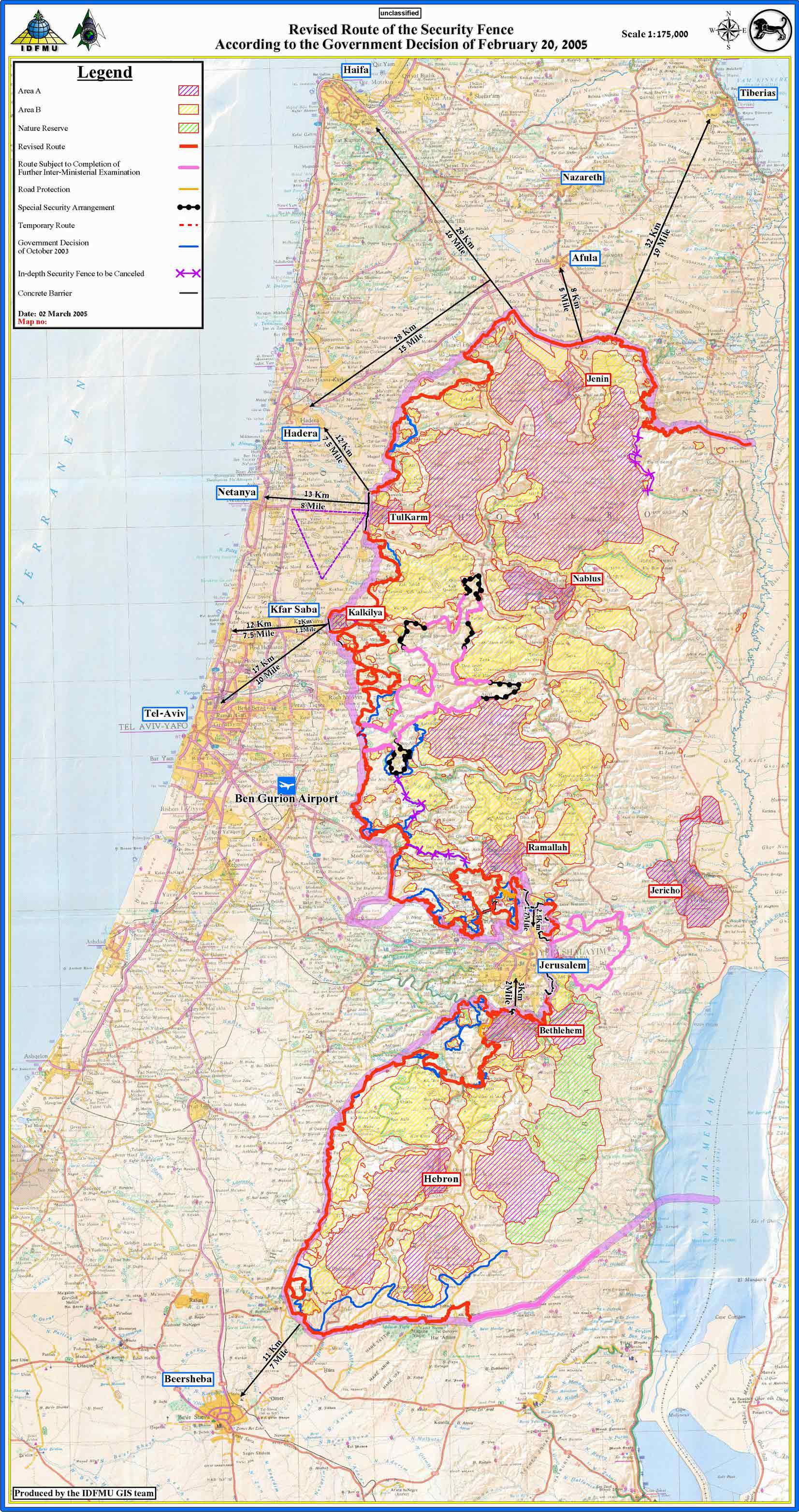
“The Palestinian Authority is abiding by its commitments and preventing illegal arms from being smuggled into areas under its control.” FACT Despite denials by Yasser Arafat, Omar Akawi, a Palestinian Authority naval officer who captained the Palestinian-owned and operated ship, admitted the smuggling operation was ordered by the PA: "I am an officer in the navy. I am an employee of the Palestinian Authority. I take my salary from them. I have to obey orders."39 The Bush Administration also found Arafat's denials unconvincing. "The information we are receiving and developing on our own," said " Secretary of State Colin Powell, "makes it clear that there are linkages to the Palestinian Authority."40 Akawi said the weapons were intended for Palestinians in the Gaza Strip. The plan had been to take the boat through the Suez Canal and then transfer the arms to three smaller boats near the Egyptian port of Alexandria. The small boats would then carry the weapons to a spot off the Gaza coast, where they would be dropped into the sea packed in special waterproof containers enabling the arsenal to float undamaged until it could be picked up by Palestinian navy officers disguised as fisherman.41 The smuggling operation violated the terms of the Oslo agreements signed by the Palestinians and represented a serious escalation of the already tense situation. The quantity and quality of the arms in the shipment, which exceeded what the Palestinians had already smuggled in through tunnels in the Gaza Strip and elsewhere, also reinforced Israeli concerns about Palestinian intentions and the threat that a future Palestinian state might pose. “Hundreds of Israeli soldiers are refusing to serve in the territories. This proves that Israel's policies are unjust.” FACT About 400 Israelis serving in the reserves (out of 445,000 - 0.08 percent) signed a petition in 2002 saying they would no longer serve in the territories. They received a lot of publicity because it is so unusual for Israeli soldiers to refuse to serve their country. What attracted no media attention was the reaction of most Israelis to the call to serve in Operation Defensive Shield. The response was more than 100 percent. Israelis who were not obligated to report because they were too old, had disabilities, or were otherwise excused from service volunteered to go to the territories. In a democracy, such as Israel, people may protest their government's policies, but the voices of a minority do not carry more weight than the majority. In fact, a poll from Tel Aviv University showed that 61.5 percent of Israelis were very much opposed to the activists' refusal to serve and another 17.6 percent considerably opposed it. That's nearly 80 percent of the public that rejected the refuseniks' argument. Total support for their point of view was 15 percent. In addition, a counter-petition was published in Israeli newspapers in February signed by more than 1,000 other reservists who said they were "amazed and ashamed" by the original letter written by a group of what they called "draft dodgers." Also, more than 4,500 reservists volunteered for additional duty.42 The soldiers raised important issues about the treatment of Palestinians by the military that are being taken seriously by the Israeli public and government, but their actions were also politically motivated and not mere acts of conscience. Shlomo Gazit, a former head of Israeli military intelligence, and someone who sympathizes with the political goals of the refusenik soldiers, wrote an impassioned plea for them to give up their protest. He pointed out that Israeli security depends on soldiers' absolute loyalty to the elected officials of the nation and the apolitical nature of the security system. Gazit points out that soldiers can't decide which orders they wish to carry out and said that if the refuseniks' principles were adopted they could find that many other soldiers would take the exact opposite views and, say, refuse to carry out orders to evacuate settlements or withdraw from the territories. As he points out, the soldiers can carry out their missions without losing their humanity and can refuse illegal orders.43 In addition, Israel's democractic society gives the soldiers other outlets to pursue their political agenda, such as creating a new political movement or using an existing one to change Israeli policy. Another option is to take their grievances before the judiciary. Eight of the Israeli reservists did just that, and their case was heard by Israel's Supreme Court. In December 2002, the court ruled that reservists cannot choose their assignments. The court said allowing them to do so could lead to a situation in which each army unit operates according to its own moral code.43a While the small minority of “refuseniks” created a sensation in 2002, the number of Israelis who have resisted service in the territories has declined ever since. In 2002, 129 reservists were jailed; in 2003, the figure fell to 26.43b In November 2004, an all-time high of motivation to serve in IDF combat units was recorded when 92% of fresh conscripts asked to be deployed in these units.43b1 “A fence is being constructed to separate Israel from the Palestinian Authority. This will not solve any problems and will lead to the racist creation of a Palestinian ghetto.” FACT Along much of the frontier separating Israel from the West Bank, there are either no barriers of any kind, or easily avoidable ones. In response to dozens of suicide bombings, and daily terrorist attacks against its civilians, Israel decided to construct a security fence near the “Green Line” to prevent Palestinian terrorists from infiltrating into Israel. A large majority of Israelis support the construction of the security fence. Israelis living along the Green Line, both Jews and Arabs, favor the fence to prevent penetration by thieves and vandals as well as terrorists. In fact, the fence has caused a revolution in the daily life of some Israeli Arab towns because it has brought quiet, which has allowed a significant upsurge in economic activity.43c It is not unreasonable or unusual to build a fence for security purposes. Israel already has fences along the frontiers with Lebanon, Syria, and Jordan, so building a barrier to separate Israel from the Palestinian Authority is not revolutionary. Most nations have fences to protect their borders (the United States is building one now to keep out illegal Mexican immigrants), and, ironically, after condemning Israel's barrier, the UN announced plans to build its own fence to improve security around its New York headquarters.43d Even Israelis who are not enthusiastic about the establishment of a Palestinian state argue the fence is needed to reduce the number of terror attacks. The head of the Shin Bet, Avi Dichter, for example, has said that a physical barrier can be a deterrent and cites the example of the fence that was built to separate Israel from the Gaza Strip.44 Since its construction not a single suicide bomber has penetrated the barrier while approximately 250 came from the West Bank during the second Palestinian uprising.
Critics have complained that the fence is being built beyond Israel's pre-1967 border, but the so-called “Green Line” was not an internationally recognized border, it was an armistice line between Israel and Jordan pending the negotiation of a final border. As Israel's Supreme Court noted in its ruling on the route of the barrier, building the fence along that line would have been a political statement and would not accomplish the principal goal of the barrier, namely, the prevention of terror. The route of the fence must take into account topography, population density, and threat assessment of each area. To be effective in protecting the maximum number of Israelis, it also must incorporate some of the settlements in the West Bank. Most of the fence runs roughly along the Green Line. The fence is about a mile to the east in three places that allows the incorporation of the settlements of Henanit, Shaked, Rehan, Salit, and Zofim. The most significant deviation from the pre-1967 line is a bulge of less than four miles around the towns of Alfei Menashe and Elkanah where about 8,000 Jews live. In some places, the fence is actually inside the “Green Line.” Palestinians complain that the fence creates “facts on the ground,” but most of the area incorporated within the fence is expected to be part of Israel in any peace agreement with the Palestinians. Israeli negotiators have always envisioned the future border to be the 1967 frontier with modifications to minimize the security risk to Israel and maximize the number of Jews living within the State, and a growing number of Israelis have come to the conclusion that the best solution to the conflict with the Palestinians is separation. Palestinian charges that a fence would have the effect of creating a ghetto are nonsense. Prime Minister Sharon has accepted the establishment of a contiguous Palestinian state on their side of the barrier. When the Palestinians stop the violence, as required by the road map for peace, and negotiate in good faith, it may be possible to remove the fence, move it, or open it in a way that offers freedom of movement. Israel, for example, moved a similar fence when it withdrew from southern Lebanon. Until the terror stops, however, Israel must take precautions to protect its citizens, and finishing the fence is one of the most vital safeguards. The fence may help stimulate the Palestinians to take positive steps because it has shown them there is a price to pay for sponsoring terrorism. In the short-run, Palestinians benefit from the fence because it reduces the need for Israeli military operations in the territories, and the deployment of troops in Palestinian towns. Onerous security measures, such as curfews and checkpoints, have in many areas become unnecessary or dramatically scaled back. Every effort is being made to exclude Palestinian villages from the area within the fence and no territories are being annexed. The land used in building the security fence is seized for military purposes, not confiscated, and it remains the property of the owner. Legal procedures are already in place to allow every owner to file an objection to the seizure of their land. In addition, Israel has budgeted $22 million to compensate Palestinians for the use of their land. Israel is doing its best to minimize the negative impact on Palestinians in the area of construction and is providing agricultural passageways to allow farmers to continue to cultivate their lands, and crossing points to allow the movement of people and the transfer of goods. Moreover, property owners are offered compensation for the use of their land and for any damage to their trees. Contractors are responsible for carefully uprooting and replanting the trees. So far, more than 60,000 olive trees have been relocated in accordance with this procedure.
The original route was approximately 458 miles; however, the plan has been repeatedly modified and, in February 2004, the government announced its intention to shorten the route by about 60 miles. As a result of the June 2004 Supreme Court decision, the route is being altered further to move the barrier closer to the 1967 cease-fire line and to make it less burdensome to the Palestinians. To date, more than 140 miles of the fence has been completed. After the fence is finished, Israel will have to decide whether to allow Jews to remain in communities on the “wrong” side of the fence (where they would not benefit from the security the fence provides), offer them compensation to move, or forcibly evacuate them to the Israeli side. According to Prime Minister Sharon's disengagement plan, most of the settlements would be removed and the residents compensated and relocated. “The demolition of Palestinian homes is an example of the barbaric policies of Israeli oppression.” FACT Israel does not arbitrarily decide to demolish the homes of Palestinians. The army usually decides to take this drastic measure only after extreme provocation, and to insure the security of soldiers and civilians. In the case of Palestinian homes in the Gaza Strip, in particular, they have been used as bomb factories, to provide cover for snipers, and to conceal tunnels used to smuggle weapons from Egypt. By demolishing homes, the objective is also to demonstrate that terrorists bring destruction not only to their victims, but to their own families and communities. The hope is that before engaging in terrorism, a Palestinian might think twice about the consequences. The IDF has, in fact, found the demolition of homes to be an effective deterrent, and that the policy has led fathers to turn in their sons before the youths participate in terrorist attacks that would lead to the destruction of the family's home.44b Homes are also sometimes demolished when they are built illegally, without government approval or the proper permits. This practice is not applied only to Palestinians; however, Jewish homes have also been torn down when they were built illegally. Efforts by Jewish settlers, for example, to create new outposts or illegally expand existing settlements often result in the new structures being demolished.45 “The Palestinians have given up their maximalist dream of destroying Israel and reconciled themselves to the establishment of a state in part of the West Bank and Gaza Strip that will peacefully coexist with Israel.” FACT The Palestinian Authority has made clear its territorial objective in its school textbooks, the way Yasser Arafat wears his kaffiyeh (i.e., shaped like Palestine), and the emblems of its organizations (see that of the PLO, for example). The most dramatic expression of the goal is in the following map of Palestine that it published on its official web site, which shows Palestine as encompassing not only the West Bank and Gaza Strip, but all of Israel as well.46
Israelis have expressed a willingness to live in peace with a Palestinian state beside Israel. As the map vividly indicates, however, the Palestinians continue to dream of a Palestinian state that replaces Israel. “The Arab League peace plan of March 2002 represents a dramatic new vision in which the Arabs are for the first time giving up their maximalist demands.” FACT Saudi Crown Prince Abdullah presented a vision of peace that was subsequently revised and adopted by the Arab League as a peace initiative that offered Israel "normal relations" in exchange for a withdrawal to the 1967 borders and resolution of the Palestinian refugee issue. In fact, the "new" initiative is nothing more than a restatement of the Arab interpretation of UN Resolution 242. The problem is that 242 does not say what the peace plan calls on Israel to do. The resolution calls on Israel to withdraw from territories occupied during the war, not "all" the territories in exchange for peace. In fact, the Arab delegates lobbied to have the word "all" included in the resolution and this idea was rejected. In addition, Resolution 242 also says that every state has the right to live within "secure and recognizable boundaries," which all military analysts have understood to mean the 1967 borders with modifications to guarantee Israel's security. Incidentally, the resolution does not say that one comes before the other, rather, they are equal principles. Israel is under no obligation to withdraw before the Arabs agree to live in peace.
The Arab plan calls for Israel to withdraw from the Golan Heights. The Israeli government has offered to do withdraw from most, if not all the Golan in exchange for a peace agreement; however, Syrian President Bashar Assad has so far been unwilling to negotiate at all with Israel. The demand that Israel withdraw from "the remaining occupied Lebanese territories in the south of Lebanon" is not only ingenuous, but at odds with the UN conclusion that Israel has completely fulfilled its obligation to withdraw from Lebanese territory. The Arab initiative also calls for a just solution to the Palestinian refugee problem based on the nonbinding UN General Assembly Resolution 194. Today, the UNRWA says that 3.9 million Palestinians are refugees. The current population of Israel is approximately 6 million, 5 million of whom are Jews. If the Palestinians all returned, the population would be nearly 10 million and the proportion of Jews and Palestinian Arabs would be nearly 50-50. Given the higher Arab birth rate, Israel would soon cease to be a Jewish state and would de facto become a second Palestinian state (along with the one expected to be created on the West Bank and Gaza Strip). This suicidal formula has been rejected by Israel since the end of the 1948 war and is totally unacceptable to all Israelis today. Israel has agreed to allow some Palestinian refugees to return on a humanitarian basis and as part of family reunification. Thousands have returned already this way. In the past, Israel has repeatedly expressed a willingness to accept as many as 100,000 refugees as part of a resolution of the issue. In fact, one government report said that Israel has already accepted 140,000 refugees just since the Oslo agreement of 1993.47 The refugee issue was not part of Abdullah's original proposal and was added at the summit under pressure from other delegations. Also, it is important to note that Resolution 242 says nothing about the Palestinians and the reference to refugees can also be applied to the Jews who fled and were driven from their homes in Arab countries. Another change from Abdullah's previously stated vision was a retreat from a promise of full normalization of relations with Israel to an even vaguer pledge of "normal relations." The Arab demand that Israel accept the establishment of a Palestinian state in the West Bank and Gaza with East Jerusalem as its capital has been part of the negotiations since Oslo. Israel's leaders, including Sharon, have accepted the idea of creating a Palestinian state in part of those territories, and Israel has even offered compromises on the status of Jerusalem, but the Palestinians have rejected them all.
It is also worth noting that most of the Arab League nations have no reason not to be at peace with Israel now. Israel holds none of their territory and is more than willing to make peace with the members of the League. Several members of the League had already begun to normalize relations with Israel before the latest outbreak of violence, and their principle critic was Saudi Arabia. For the plan to have any chance of serving as a starting point for negotiations, the Saudis and other Arab League members would have to be prepared to negotiate directly with Israel. Israeli Prime Minister Ariel Sharon even said he would go the Arab League summit to discuss the plan, but he was not invited. The Saudis have also been invited to Jerusalem to discuss their proposal, but they have rejected this idea as well.
“Arab leaders have condemned suicide bombers and other acts of terrorism since September 11, and responded to President Bush's call to take steps to fight terrorism.” FACT In April 2002, President Bush called on the Arab states to "do everything possible to stop terrorist activities, to disrupt terrorist financing and stop incitement of violence in state-owned media." He also urged them to publicly denounce suicide bombings, and to use their influence with the Palestinian Authority and other groups to stop the violence.49 Not only did the Arab leaders reject the President's request, they did the exact opposite. For example, Iraqi President Saddam Hussein publicly promised to pay $25,000 to the families of suicide bombers. Saudi Arabia held a terrorthon to raise millions of dollars for "martyrs," with the two biggest contributors being King Fahd and Crown Prince Abdullah, the latter hailed as the architect of the latest Arab League peace initiative.50 So both radicals, such as Iraq, and "moderates" such as Saudi Arabia, are underwriting terrorism. This is in addition to the broader sponsorship of terror of these and other countries, including Iran. On April 2, the 57-member Organization of the Islamic Conference meeting in Malaysia rejected any linkage between Palestinian attacks and terrorism and refused to even define terrorism. Malaysian Prime Minister Mahathir Mohamad called on the group to classify all attacks on civilians, including those by Palestinian suicide bombiers, as terrorism, but the Conference would not do so.51 Perhaps the best example of the Arab refusal to condemn terrorism came from King Abdullah of Jordan, generally regarded as the most moderate Arab leader and America's closest Arab ally. In an interview with CNN, Christiane Amanpour asked Abdullah in a variety of ways if he would make a simple declarative statement condemning suicide bombings against Israel and he repeatedly evaded the question.52 So long as the Arab states continue to support terrorism, Israel will remain at risk, and there is little hope for regional peace or stability. Furthermore, the Arab policy legitimates the use of terror not only against Israel, but other nations as well, including the United States.
“Israel is making specious comparisons between Palestinian resistance and the September 11 attacks on the United States in the hope of generating sympathy for its policies.” FACT Israel and the United States are allies in the war on terrorism. Both face a common threat from radical Islamic and ideological groups that want to destroy them because of what they represent — freedom, democracy, modernity and Judeo-Christian values. The Palestinians are not engaged in resistance, but cold-blooded murder. No excuse justifies the killing of innocents. That is terrorism. It is true that the terror attacks in Israel and the United States are not completely analogous. September 11 was a terrible day, but just one of only a handful where Americans have been victimized by terror. Israelis face threats to their lives on a daily basis. Americans have had to learn to live with new precautions at airports, a relatively mild inconvenience. Israelis must be wary of people and packages everywhere. Thankfully, Americans do not yet have to think twice before they send their kids out to play, go shopping at a mall, or enjoy an evening out at a restaurant. Israelis now must worry constantly about the safety of their children, and risk their lives going to discos, pizzerias and grocery stores. For most Americans the Sabbath is a time of prayer, reflection, leisure and enjoyment. For Israelis, the Sabbath has often been marked by murder and mayhem from Palestinian suicide bombers. After the March 2002 Passover massacre in which 29 people were murdered during their Seder, Israelis cannot even enjoy their religious festivals. It is sometimes difficult for Americans to appreciate the magnitude of the impact of a terror attack that "only" kills 29 people, but in a country as small as Israel that number is devastating, and it is likely that many Israelis will personally know the victims. In fact, one study found that one-third of Israelis between 14 and 18 know someone killed or wounded in a terrorist attack. On a proportional basis the death of 20 Israelis is roughly equivalent to 1,000 Americans, so from the perspective of Israelis, they've been experiencing September 11 almost weekly. And this does not count all the foiled attacks. Dozens of attempts have been stopped by the police and courageous men and women who have sometimes literally put their bodies between the suicide bombers and their intended victims. And it is also important to note that while most of America's enemies are thousands of miles away, the terrorists who threaten Israel are literally on its doorstep.
“Palestinians are driven to terror by desperation.” FACT The situation many Palestinians find themselves in is unfortunate and often quite severe. Many live in poverty, see the future as hopeless, and are unhappy with the way they are treated by Israelis. None of these are excuses for engaging in terrorism. In fact, many of the terrorists are not poor, desperate people at all. The world's most wanted terrorist, Osama bin Laden, for example, is a Saudi millionaire. When asked about two Palestinian suicide bombers who blew themselves up on a pedestrian mall in Jerusalem, killing 10 people between the ages of 14 and 21, the cousin of one of the men said "these two were not deprived of anything."55 A report by the National Bureau of Economic Research concluded that "economic conditions and education are largely unrelated to participation in, and support for, terrorism." The researchers said the latest outbreak of violence in the region cannot be blamed on deteriorating economic conditions because there is no connection between terrorism and economic depression. Furthermore, the authors found that support for violent action against Israel, including suicide bombing, does not vary much according to social background.56 Amnesty International published a study that condemned all attacks by Palestinians against Israeli civilians and said that no Israeli action justified them. According to the report, "The attacks against civilians by Palestinian armed groups are widespread, systematic and in pursuit of an explicit policy to attack civilians. They therefore constitute crimes against humanity under international law."57 Terrorism is not Israel's fault. It is not the result of "occupation." And it certainly is not the only response available to the Palestinians' discontentment. Palestinians have an option for improving their situation, it is called negotiations. And that is not the only option either. The Palestinians could also choose the nonviolent path taken by Martin Luther King or Gandhi. Unfortunately, they have chosen to pursue a war of terror instead of a process for peace. Israel has proven time and again a willingness to trade land for peace, but it can never concede land for terror.
“Palestinian attacks on Israeli civilians are part of a legitimate armed struggle; they are not terrorism.” FACT Amnesty International succinctly disposed of this fallacious argument in its report on Palestinian terrorism:
“Ariel Sharon has made clear that he does not want peace and no deal is possible as long as he is Prime Minister.” FACT Ariel Sharon has been demonized by the Arabs and caricatured by the media, which often insists on referring to him as the "right-wing" or "hard-line" Prime Minister, appellations rarely affixed to any other foreign leaders. Sharon has spent most of his life as a soldier and public servant trying to bring peace to his nation. It was Ariel Sharon who gave then Prime Minister Menachem Begin the critical backing that made the Israel-Egypt Peace Treaty possible. At a crucial moment at Camp David, the negotiations were on the verge of collapse over Egyptian President Anwar Sadat's insistence that all Israeli settlements in the Sinai be dismantled. Begin called Sharon and asked if he should give up the settlements; Sharon not only advised him to do so, but ultimately was the one who implemented the decision to remove the settlers, some by force.59 Sharon's views have also evolved over time. While he was once fiercely opposed to the creation of a Palestinian state, as Prime Minister he has endorsed the idea, in opposition to members of his own party. Since taking office, Sharon has repeatedly offered to negotiate with the Palestinians on condition only that they end the violence. He asked for only seven days of peace — a demand some found onerous despite the fact that the Palestinians had promised at Oslo eight years of peace — and later even dropped that demand. When he did, the Palestinians answered his gesture with the Passover massacre, the suicide bombing of a religious observance in a Netanya hotel in which 29 people were killed. Sharon subsequently proposed a peace conference, an idea the Bush Administration endorsed. Even when Saudi Crown Prince Abdullah proposed a peace initiative that was filled with provisions the Saudi knew Israel could never accept, Sharon did not reject the plan, and called for direct negotiations to discuss it. Now, Sharon has agreed to negotiate with the Palestinians according to the road map formula devised by the United States, Russia, the European Union, and the United Nations, despite serious reservations about many elements of the plan. Sharon also has said he is prepared to dismantle settlements, despite virulent opposition from his own party, and being regarded as one of the architects of their growth. In a speech to the Likud Central Committee, Sharon said, “Clearly, in the permanent agreement we will have to give up some of the Jewish settlements.” He has also spoken of unilaterally relocating some of them. If the Arabs doubt Sharon's commitment to peace, all they need do is put him to the test – end the violence and begin negotiations. So long as the Palestinians keep up their terrorist attacks, no Israeli Prime Minister can offer them concessions.
“Israel's presence in the West Bank is the cause of terrorism.” FACT If Israel were to withdraw completely from the West Bank tomorrow it would not end terrorism. Radical Islamic groups such as Hamas and Islamic Jihad are opposed to the existence of a Jewish state anywhere in what they consider the Islamic heartland. These and other terrorist groups have never said they were prepared to live in peace with Israel if it were to withdraw anywhere short of the border of the Mediterranean Sea. Long before 1967, when Israel captured the West Bank, Arabs used violence to try to first prevent the establishment of a Jewish state and then to destroy Israel. Anti-Jewish riots began in 1920 and were instigated repeatedly over the years of the British mandate in an effort to either drive out the Jews or convince the British to renege on the promise to create a Jewish homeland. These were the first "intifadas" and were characterized by the cold-blooded murder of innocents. After Israel fended off the invading Arab nations in 1948, Egyptian President Gamal Nasser turned Palestinian terrorists against Israel and provoked the Six-Day War. In 1964, while Jordan controlled the West Bank, the Arab League created the Palestine Liberation Organization as a terrorist tool to fight against Israel. History has shown that Arab radicals are prepared to use terror to destroy Israel regardless of its borders.
“Palestinians are living under the oppressive control of Israeli military authorities.” FACT Israel engaged in negotiations with the Palestinians at Oslo and afterward because Israelis desperately crave peace and because they do not want to control the lives of Palestinians. After withdrawing from most of the Gaza Strip and more than 40 percent of the West Bank, approximately 98 percent of the Palestinian population came under the jurisdiction of the Palestinian Authority. Most of their affairs are now controlled by Yasser Arafat's regime, and if Israel has its way, negotiations will lead to the Palestinian Authority assuming full control over the lives of all the Palestinians living in what will eventually be a Palestinian state. In the meantime, Israelis still intrude on Palestinian lives. Because the Palestinians' leaders have chosen the path of violence rather than negotiations, Israel still controls part of the disputed territories, and must use checkpoints, occasional curfews and other security measures to protect Israel's civilian population from terrorists. These steps certainly cause hardship and frustration, but they will not be necessary if the Palestinian Authority stops the terror. “Yasser Arafat condemns terrorism and leading Palestinian moderates signed a public statement saying terrorist attacks against Israel are immoral.” FACT It is a sad commentary that praise is now heaped on Palestinians when they condemn heinous terrorist attacks against innocent Jews. Still, Palestinians cannot bring themselves to make unequivocal statements against terrorism. Yasser Arafat has come up with masterful formulations that he automatically issues after each terrorist outrage in which he condemns the attack on Israelis but always balances the statement with some criticism of Israel. Thus, for example, the Palestinian Authority condemned the July 31, 2002, terrorist bombing of the Hebrew University cafeteria that killed seven people, including five Americans, but said Ariel Sharon was responsible for the "cycle of terror."60 After a similar equivocal statement following the bombing of an Israeli pizzeria, the Washington Post editorialized that the Palestinian leadership should have had no difficulty condemning unequivocally the bombing, but their response "was worse than equivocal….This celebration of murder, along with the perverse attempt to shift responsibility for the attack onto Mr. Sharon, adds a measure of insult to the grave injury the bombing itself inflicted."61 After the United States began to pressure the Palestinians to depose Arafat and do more to stop terror, a group of Palestinian intellectuals, including well-known spokespeople such as Sari Nusseibeh and Hanan Ashrawi, received publicity for signing the first public complaint about Palestinian "military operations." On June 19, 2002, the day after a suicide bus bombing killed 19 Israeli civilians, 55 Palestinians signed a full-page ad in the Al-Quds newspaper that called on the people who attack civilians inside Israel to reconsider their strategy. The signatories did not condemn attacks against Jews in the territories. Apparently a woman or child becomes fair game if they are a foot beyond the 1967 border. Even in this statement, the courageous intellectuals suggested the problem was that the terrorist attacks give Sharon an excuse to continue his "war of aggression." As Jerusalem Report columnist Stuart Schoffman noted, they could not bring themselves to say that "blowing up buses is immoral, not merely counterproductive."62 Incidentally, the intellectuals didn't feel strongly enough about the issue to pay for the ad themselves. It was financed by sources from within the European Union.
“Saudi Arabia is a force for peace and moderation that does not sponsor terror.” FACT "The Saudis are active at every level of the terror chain, from planners to financiers, from cadre to foot-soldier, from ideologist to cheerleader," said Laurent Murawiec, a Rand Corporation analyst in a secret briefing to a top Pentagon advisory board. "Saudi Arabia," he added, "supports our enemies and attacks our allies."63 The most dramatic evidence of Saudi involvement in terror is the fact that 15 of the 19 September 11 terrorists were from Saudi Arabia. Despite this, the Saudi government refused to cooperate with the U.S. investigation of the attacks and rejected American requests to stop the flow of money through charitable organizations to terrorist groups. Many such charities are based in the United States and are being investigated by the Treasury Department. Saudi support for terrorism and al-Qaida, in particular, is not restricted to extremists in the kingdom. A classified American intelligence report revealed that an October 2001 survey of educated Saudis between the ages of 25 and 41 found that 95 percent of the respondents supported Osama bin Laden's cause.64 According to a UN report, “al-Qaida was able to receive between $300 and $500 million over the last 10 years from wealthy businessmen and bankers whose fortunes represent about 20 percent of the Saudi GNP, through a web of charities and companies acting as fronts.”64a The Saudis have been heavily involved in supporting Palestinian terror. They were the largest financial backer of Hamas during the 1990s, providing perhaps as much as $10 million annually. In a letter from a top Arafat aide to the governor of Riyadh, Abu Mazen even complained that Saudi money wasn't reaching the "martyrs," but was going directly to Hamas.65 The Saudis held a terror telethon on April 11, 2002, which raised more than $100 million for families of Palestinian "martyrs," including the families of suicide bombers,66 and during Operation Defensive Shield, the Israelis found numerous documents linking the Saudis to terror. One, for example, itemized their allocations line by line, detailing the circumstances of the death of Palestinians whose families received assistance, and making clear the allocation was for suicide attacks. The information came from the Saudi Committee for Aid to the Al-Quds Intifada, which is headed by Saudi Minister of the Interior, Prince Nayef bin ‘Abd al-Aziz. “Yasser Arafat is the democratically elected leader of the Palestinian people and Israel must negotiate with him.” FACT Palestinians have the right to select their own leaders, but both Israel and the United States also have the right to decide which leaders they are prepared to recognize and negotiate with. Israel cannot be expected to negotiate with someone who conducts a terror campaign against its citizens. Every Arab leader who has recognized Israel and been prepared to make peace has gotten both land and peace. The Palestinian Authority is a corrupt dictatorship run by a terrorist who was "elected" in a sham election in 1996, and whose term was supposed to be over long ago. He clings to power through intimidation and violence. Only true democratic elections monitored by international observers, with multiple candidates, can bring representative leadership to the Palestinians. When the Palestinians democratically elect a leader who is prepared to recognize Israel's right to exist, end violence, and negotiate peace, they will find a willing and eager partner in Israel. As the only democracy in the region, one which allows women to vote and even pro-PLO Israeli Arabs to serve in its parliament, Israel respects democratically elected leaders. Israelis, like Americans, believe that democracies do not make war on each other, so it is in Israel's interest to see that the Palestinians develop democratic institutions. To date, however, the history of the Palestinians is one in which leaders are determined by bullets, not ballots. “The PA was prevented from holding elections by Israel.” FACT One of the key reforms called for by the United States and others in the international community was the democratic election of a new Palestinian leadership in the hope that Yasser Arafat would be replaced by someone prepared to negotiate peace with Israel. It was only in response to this pressure that Arafat agreed during the summer of 2002 to hold elections in January 2003. The election, due to be held on January 20, 2003, was cancelled by Arafat. Arafat, who became president of the Palestinian Authority after a sham election in 1996, was only supposed to serve three years before elections were to be held again. He prevented any balloting, however, until President Bush’s June 2002 call for a new leader to be democratically elected. Afterward, Arafat announced the intention to hold elections, but he immediately began to make excuses for why they could not be held. For months, he consistently tried to deflect criticism of his autocratic rule, and his efforts to undermine the election, to Israel. Arafat claimed that Israel’s military operations prevented the holding of elections; however, Israeli action was necessitated by his failure to stop terror, as he had promised to do in the Oslo agreements. Still, Israel made no effort to prevent the Palestinians from holding an election and enthusiastically supports a democratic process that will bring truly representative and accountable leadership to the PA. One suggested reform of the PA was to make the position of President more ceremonial, as it is in Israel, and create a position of prime minister to be the nominal head of the government. When PLO executive committee member Mahmoud Abbas (Abu Mazen) tried to muster support for this proposal, under which he was the likely choice to assume most of Arafat’s powers, he was forced to flee to Jordan after receiving death threats.67 The idea of having a prime minister was subsequently dropped. In the months that preceded the planned January election, there was no campaign or candidates for office. Only one Palestinian had the courage to publicly announce plans to run for President against Arafat, an obscure professor named Abdel Sattar Kassem. Just before the vote was scheduled, Kassem complained that he was being harassed by Palestinian security forces and that a campaign of intimidation was being waged against the local media to prevent the publication of interviews with him.68 So long as Arafat persists in his despotic rule, prevents any reform of the governmental structure of the PA, and obstructs democratic campaigns and elections, it is difficult to see how a representative leader can emerge to negotiate with Israel on behalf of the Palestinians. “Most Palestinians do not support terror, but are helpless to stop the militants.” FACT Public opinion polls taken by Palestinian researchers in the Palestinian Authority have consistently shown broad support for violence against Israelis. In June 2004, for example, 68 percent of Gazans and 53 percent of Palestinians in the West Bank said they supported suicide attacks inside Israel. Majorities in both areas also favored continuing attacks even after Israel disenaged from the Gaza Strip.69 Despite the suffering caused by the failure of their leaders, and Israel’s necessary response to the terrorist atrocities against its citizens, the general Palestinian public has not called for an end to the violence. No equivalent to Israel’s Peace Now movement has emerged. Still, on an individual basis, it is possible for Palestinians to say no to terror. When the suicide bombing recruiter phoned the wife of Hamas leader Abdel Aziz al-Rantisi to ask if her son was available for an operation, she turned him down.70 In other countries, including Israel (where they helped prompt a withdrawal from Lebanon), mothers have often helped stimulate positive change. When enough Palestinian mothers stand up to the terror recruiters, and to their political leaders, and say that they will no longer allow their children to be used as bombs and cannon fodder, the prospects for peace will improve. So long as they prefer their children to be martyrs rather than doctors, bombers rather than scholars, and murderers rather than lawyers, the violence will continue and young Palestinians will continue to die needlessly.
“The Palestinian Authority is bankrupt and the people are starving because the world does not care about the plight of the Palestinians.” FACT Just as Palestinian refugees have been international wards for decades, and received disproportionate amounts of assistance from around the world, the Palestinians living inside the Palestinian Authority have also been given far greater international financial support than most other suffering peoples. By the end of 2001, the Palestinians had received $4 billion (the figure is now closer to $5.5 billion) since Oslo. This is the equivalent of $1,330 per Palestinian. By comparison, the Marshall Plan to rebuild Europe after World War II provided $272 per European (in today's dollars).71 The violent uprising and terrorism have led to an increase in support for the Palestinians. In 1999, international donors provided $482 million, but that figure jumped to $929 million in 2001. These figures do not include the billions of dollars in assets the Palestine Liberation Organization is believed to have accumulated over the years through drug trafficking, illegal arms dealing, money laundering, fraud, extortion, and legal investments. No one debates that the economic situation in the PA is difficult, but the Palestinians are hardly the only people suffering in the world. In fact, people in many countries are much poorer than the Palestinians. Ethiopia, for example, receives about the same amount of aid as the PA, but has a population 20 times larger. Even other Arabs are in worse shape than the Palestinians, and yet they receive little or no foreign aid. In 2000, per capita income of a West Bank Palestinian was actually higher than that of Arabs in middle-income countries such as Algeria or Egypt, and much higher than that in Morocco or Syria. In 2000, per capita aid to the Palestinian was $214, by far the highest in the world, with Bosnia a distant second at $185. Even after taking into account the decline in Palestinian incomes in the last two years, they would still be considered lower middle class among the Arabs.72 The problem for the Palestinian Authority is not a lack of funds, but a lack of accountability. Instead of going to feed, house, and employ Palestinians, significant amounts of aid have been siphoned off by Yasser Arafat and other PA officials. One need only ask why refugee camps continue to exist within the PA. With $4 billion, shouldn’t the PA have been able to build at least one house for a refugee family? In 1996, $326 million disappeared from the PA and the Palestinian Legislative Council established a commission to investigate the loss. The subsequent report concluded that nearly 40 percent of the PA’s $800 million budget had been lost through corruption and mismanagement. The PA’s comptroller wrote: “The overall picture is one of a Mafia-style government, where the main point of being in public office is to get rich quick.”73 In 2000, Arab countries pledged $1 billion to help the PA, but stipulated that “Chairman Arafat show complete transparency in the funds.” Arafat refused, and the Arab leaders withheld the funding “for fear that the money will end up in the wrong pockets.” And for good reason. On June 5, 2002, the Kuwaiti daily Al-Watan published documents showing that Arafat had deposited $5.1 million from Arab aid funds into his personal account to support his wife and daughter who live in Paris and Switzerland.74 Despite their concerns, since April 2001 Arab governments have transferred $45 million each month to the PA, and the European Union has contributed another $10 million monthly. Overall, however, donor aid, which comes primarily from these two sources has dropped by around half in 2003 from 2001 and 2002.74a The problems facing the Palestinian people and the PA economy are not due to a lack of funding or international concern, they are a direct result of the corruption and the lack of accountability of the PA, and the use of donated funds for terrorism and other purposes not intended by the donors. “Palestinian terrorist groups agreed to a cease-fire until Israel launched attacks against them.” FACT Israel would have no reason to engage in any military operations in Palestinian controlled areas if the Palestinian Authority met its obligation to prevent terror attacks against Israelis. If the terrorists were to agree to a cease-fire and stop all their attacks, the prospect for renewed negotiations would be improved and the necessity of Israeli counter terrorism measures would be reduced. Unfortunately, the terrorists have never agreed to any cease-fire. On the contrary, every time groups allegedly discussed terminating their activities, the suggestion was rejected. In fact, the terrorists usually deny they even contemplated the idea. Hamas and Islamic Jihad, for example, rejected a proposal made under Egyptian auspices in January 2003. "Our position is clear: there can be no cese-fire with Israel," a top Hamas official told the Jerusalem Post. A few weeks later, when a Palestinian official said the leadership accepted a one-year truce, the PFLP, Islamic Jihad, Al-Aqsa Martyrs Brigade, and Hamas all announced that they had no intention of ending the violence, and planned to intensify their attacks.75 And even the Palestinian Authority claim that it backed a cease-fire was undermined by Yasser Arafat's second-in-command, Abu Mazen, who said the agreement to freeze military operations was contingent on Israel ending its operations, withdrawing to their positions of September 2000, and ceasing their arrests of terrorists. "We did not say, however, that we are giving up the armed struggle," Abu Mazen said in an interview. "It is our right to oppose. The Intifada must continue. The Palestinian people have a right to oppose using all means at their disposal to protect their existence."76 Terrorists cannot be persuaded to end their violent campaign through negotiations. They will only stop when the Palestinian Authority arrests the members of the terrorist groups, disarms them, and prevents them from attacking Israelis. So long as the PA refuses to fulfill the duty it committed to in the Oslo agreements, it will be necessary for Israel to take steps to protect its citizens. “Palestinians have no need for propaganda because the truth about Israeli behavior makes clear their barbarity.” FACT Palestinian and other Arab leaders routinely use their media outlets to spread outrageous libels against Israel and the Jews to inflame their populations. Palestinians have become masters of the technique perfected by Adolf Hitler known as the “big lie.” As Hitler explained in Mein Kampf:
One example of the Palestinian big lie came on March 11, 1997, when the Palestinian representative to the UN Human Rights Commission claimed the Israeli government had injected 300 Palestinian children with the HIV virus.77 More recently, Palestinians claimed in 2002 that Israel was dropping poisoned candies from helicopters in front of schools to poison children. That lie was updated in 2003 with the fabrication that Israel is making “bombs and mines designed as toys” and dropping them into the Palestinian territories from airplanes so children will play with them and be blown up.78 The Palestinians also regularly try to inflame the Muslim world by falsely claiming the Jews are going to blow up the Temple Mount or the al-Aksa Mosque. For example, on September 29, 2000, the Voice of Palestine, the PA's official radio station sent out calls "to all Palestinians to come and defend the al-Aksa mosque." This was the day after Ariel Sharon’s visit to the Temple Mount, and the subsequent riots marked the unofficial beginning of the latest uprising. More recently, the Palestinian Authority TV “Message to the World” broadcast announced: “The Zionist criminals are planning to destroy the al-Aqsa mosque on the ground that they they are searching for the Holy Temple, which they falsely claim is under the mosque.”79 One of the most outrageous lies circulated throughout the Middle East was that 4,000 Israelis did not report to work on September 11, or "called in sick" that morning because they knew an attack was coming. Israel and the Mossad are also said to be responsible for the atrocities. Of course, this was also a lie, but it is the type of conspiracy theory that is widely believed by Arabs who maintain the forgery, the Protocols of the Elders of Zion, is factual. “Israel and the Palestinians were on the verge of reaching a peace deal during negotiations at Taba in 2001, but Ariel Sharon’s election torpedoed the agreement.” FACT Even after Yasser Arafat rejected Ehud Barak’s unprecedented offer to create a Palestinian state in 97 percent of the West Bank, members of the Israeli government still hoped a peace agreement was possible with the Palestinians. In hopes of a breakthrough before the scheduled Israeli election, and the end of President Clinton’s term, Israel sent a delegation of some of its most dovish officials, all of whom favored a two-state solution, to the Egyptian port city of Taba in January 2001. The Israelis believed that even though Arafat would not even offer a counterproposal to Barak, they might induce a Palestinian delegation without the PLO chairman to make sufficient compromises to at least narrow the gap between the Barak proposal and Arafat’s maximalist demands. The Israelis discovered, however, that the Palestinians were not willing to negotiate on the basis of what Barak had proposed. Instead, they withdrew many of the concessions they had offered. For example, at Camp David, the Palestinians agreed that Israel could retain two settlement blocs that would incorporate most of the Jews into Israel and allow them to be contiguous. At Taba, the Palestinians called for the evacuation of 130 out of 146 settlements and refused to accept the creation of settlement blocs. In fact, while the Palestinians now falsely claim that Barak offered them only cantons at Camp David, instead of a contiguous state, it is actually the Palestinians at Taba who sought to create isolated Jewish Bantustans that would be dependent on strings of access roads. Besides other disagreements over settlements, many of which represented backsliding from earlier Palestinian positions, the parties remained deeply divided over the status of Jerusalem. Barak had offered to allow the Palestinians to make their capital in the predominantly Arab parts of East Jerusalem, and to share sovereignty over the Temple Mount. Arafat had insisted on complete Palestinian control over the holy site, and denied Jews had any connection to it. At Taba, the Palestinians also refused to recognize the area was holy to the Jews and insisted on controlling most, if not all, of the Western Wall. On the third key final status issue, refugees, no agreement was reached. The Palestinians did not accept Israeli proposals on the number of refugees that would be allowed into Israel or the amount of compensation that should be paid to the rest. “The discussions in Taba revolved principally around the ‘narrative,’ regarding the history of the creation of the refugee problem and the number of refugees that Israel will agree to absorb,” according to Yossi Beilin. “We did not reach any agreements....Regarding the number of refugees, an anticipated disagreement erupted, but once the discussion turned to quotas, we were no longer talking about a ‘right.’ The numbers that we agreed to were symbolic and took humanitarian problems and family reunification issues into account. The numbers proposed by the Palestinians were far higher.” Beilin said the Palestinians should tell the refugees that once peace is achieved, and their state is established, “they will be allowed to immigrate to [the Palestinians state] and live in it in dignity. Not in Haifa.”79a Despite a positive joint statement issued at the end of the negotiations, the truth is that no agreement was reached at Taba and, according to the Palestinians themselves, the parties left the talks farther apart on the issues than they had been at Camp David. Abu Alaa, one of the lead Palestinian negotiators told Al-Ayyam after the talks that “there has never before been a clearer gap in the positions of the two sides.”80
“Israel’s assassination attempt on a leader of Hamas was aimed at derailing the peace process laid out in the road map.” FACT In just the first week after accepting the road map, Israel began to implement 75 percent of its obligations called for in the plan’s first phase. Prime Minister Sharon made clear he was committed to implementing the agreement and matched his words with deeds by allowing Palestinian workers from the territories to enter Israel, withdrawing from cities in the Palestinian Authority where Palestinian security forces exert control, dismantling unauthorized outposts, releasing prisoners, lifting the general closure on the territories, and increasing the transfer of goods. The most important obligation for the Palestinians in the first phase is to end violence, dismantle the terrorist infrastructure, and disarm the militants. Palestinian Prime Minister Mahmoud Abbas not only has made no effort to fulfill this prerequisite for peace, he explicitly said he would not take action against Hamas, which rejected the road map and said it would join with other Palestinian terrorist groups to continue their campaign to destroy Israel.81 Hamas is the Palestinian equivalent of al-Qaida. Its covenant makes clear it will never accept the existence of a Jewish state in what it considers the Muslim heartland. The man Israel tried to kill, Abd al-Aziz Rantissi, is a senior leader of Hamas, someone who proudly claims “credit” for 72 suicide bombings that have killed 227 Israelis and wounded 1,393 just since September 2000. Rather than ask why Israel attempted to kill an avowed terrorist, the pertinent question is: Why wasn’t Rantissi in jail? Yasser Arafat pledged in the Oslo agreements to fight terror and yet he failed to take any steps against Hamas. Abbas promised a renewed commitment to stop violence, but he has done no more than Arafat, and has unsuccessfully tried to coopt Hamas rather than dismantle it. The United States understands that Israel’s fight against Hamas is part of the broader war on terror; after all, Hamas is on the U.S. list of terrorist organizations and has called for attacks on Americans. While U.S. officials may be upset by the timing of Israel’s actions, they cannot object to the principle of targeting terrorist leaders, since they have pursued the same policy and, just a few months earlier, assassinated a group of al-Qaida operatives by firing a missile at their vehicle. The road map offers a route to peace for Israel and the Palestinians, but Israel cannot be expected to give up its right to defend itself, and it certainly cannot stop its counterterror measures so long as the Palestinians fail to comply with their road map obligation to stop terror.
“The International Solidarity Movement (ISM) is a non-violent human rights organization that opposes terrorism and supports a two-state solution.” FACT The International Solidarity Movement (ISM) has harbored known terrorists and openly advocated violence and the destruction of Israel. ISM spokesman Raphael Cohen was asked at a May 2003 press conference to define “occupation.” His response: “The Zionist presence in Palestine.”82 When asked to express his view of peace, he answered, “a one state solution,” by which he meant the creation of a Palestinian state in place of Israel. On ISM's web site, the Internet directory is called “traveltopalestine.” Their site also located Ben Gurion Airport in “Palestine.” It includes an information packet for volunteers that features a country guide to “Palestine.” The guide lists the landmass of “Palestine” as “26,323 km2 = 10,162 miles2” – the size of the entire State of Israel, plus the West Bank and Gaza. The country guide describes the geographic boundaries of “Palestine” as extending from Jordan to the Mediterranean Sea, and from Lebanon to Aqaba; that is, again incorporating all of Israel.83 The ISM does not hide its incitement to violence. Its web site states that it recognizes “the Palestinian right to resist Israeli violence and occupation via legitimate armed struggle.” Cohen admits that, on April 25, 2003, he hosted a group of 15 people at his apartment. Included in that group were Asif Mohammad Hanif and Omar Khan Sharif, British nationals. They subsequently participated in various activities planned by the ISM. Five days later, the two carried out a suicide bombing in a popular pub next to the American Embassy in Tel Aviv that is frequented by Embassy personnel. Hanif and Sharif entered Israel under the guise of “peace activists” and “alternative tourism” – perhaps a reference to the ISM-precursor “Alternative Tourist Group.”84 ISM denies responsibility for the actions of the British bombers On March 27, 2003, ISM was caught harboring Islamic Jihad terrorist Shadi Sukiya. He was arrested by the IDF in ISM's office, where a handgun was also found, after two foreign ISM activists helped Sukiya hide. These foreign activists tried to bar IDF soldiers from entering ISM offices, knowing that Sukia was there.85 In addition, ISM activist Rachel Corrie protected a house utilized for arms smuggling for terror groups. Group members are also reported to provide information on Israeli troop movements to armed Palestinian factions. ISM's web site also links to several web sites devoted to freeing Fatah terrorist Marwan Barghouti. Its web site also has displayed pictures of Palestinian children throwing stones at an IDF vehicle. The ISM web site instructs its volunteers on how to avoid Israeli security checks. For example, its members are told to lie about their affiliation with ISM and their intention to visit the territories. ISM also acknowledges its members stay in contact with local activists, which includes leaders of terrorist organizations such as Hamas, Fatah and Islamic Jihad, which it considers “resistance groups.” While the International Solidarity Movement claims to be a humanitarian organization dedicated to the principles of nonviolent resistance, it has demonstrated no interest in peace for Israelis. At a minimum, ISM has acted as an apologist for terrorism and, at times, actively abetted militants. ISM is a pro-Palestinian organization, set up by Palestinians, funded by Palestinians, and opposed to the two-state solution envisioned by the parties truly interested in peace. “Israel is required to release Palestinians in Israeli prisons as a condition of the “road map.” FACT There is not a single word in the text of the road map referring to the release of Palestinian prisoners. Hamas and Islamic Jihad made the demand for Israel to release prisoners in their hudna agreement with the Palestinian Authority (PA) . Israel was not a party to this agreement. The first sentence in the road map outline of Phase I does say: “In Phase I, the Palestinians immediately undertake an unconditional cessation of violence” (emphasis added). Despite the fact that Israel is under no legal obligation to release Palestinian prisoners, the government has released a number of prisoners, and agreed to release several hundred more, many of whom are closely connected to terror organizations or have committed terror attacks against Israel. Prime Minister Ariel Sharon has agreed to release Palestinian prisoners as a confidence-building measure, and as a means of strengthening the position of Mahmoud Abbas in the eyes of the Palestinians. The Palestinians may not be satisfied with the number of prisoners allowed to go free, or the specific individuals released, but these are decisions the Israeli government must make according to its own security, as well as political requirements, and there is no reason to expect prisoners who have been found guilty of crimes to automatically be eligible for freedom simply because the Palestinians demand it. It is especially understandable if Israel refuses to release prisoners with "blood on their hands" from having killed or injured Israelis. Even a limited prisoner release represents a risk that Israel is taking in the interest of peace. In the past, released prisoners have returned to terrorism and committed new crimes against Israelis. It will be a major test of the PA's commitment to peace, and its authority, to insure that people freed by Israel do not resort to more violence.
“Palestinian terrorist groups agreed to a cease-fire to advance the peace process envisioned by the road map for peace.” FACT In June 2003, Islamic Jihad and Hamas agreed to a hudna in response to demands from then Palestinian Authority prime minister Mahmoud Abbas to stop their attacks on Israel so he could fulfill his obligations under the Middle East road map. The agreement was interpreted in the Western media as the declaration of a cease-fire, which was hailed as a step forward in the peace process. Violence continued after the supposed cease-fire, however, and Israeli intelligence found evidence the Palestinians exploited the situation to reorganize their forces. They recruited suicide bombers, increased the rate of production of Qassam rockets, and sought to extend their range. Now that he is president of the PA, Abbas is again negotiating with the terrorists to accept a cease-fire. While any cessation of violence against Israeli civilians is to be welcomed, it is important to understand the cease-fire the radical Islamic groups are contemplating in the Muslim context. The media and some political leaders portray a hudna as a truce or a cease-fire designed to bring peace. Though the term hudna does refer to a temporary cession of hostilities, it has historically been used as a tactic aimed at allowing the party declaring the hudna to regroup while tricking an enemy into lowering its guard. When the hudna expires, the party that declared it is stronger and the enemy weaker. The term comes from the story of the Muslim conquest of Mecca. Instead of a rapid victory, Muhammad made a ten-year treaty with the Kuraysh tribe. In 628 AD, after only two years of the ten-year treaty, Muhammad and his forces concluded that the Kuraysh were too weak to resist. The Muslims broke the treaty and took over all of Mecca without opposition.86 A modern-day hudna is not a form of compromise, rather it is a tactical tool to gain a military advantage. Hamas has used it no fewer than 10 times in 10 years.87 The hudna declared by Islamic terrorist organizations in 2003 was no different. The Hamas charter openly rejects the notion of a peaceful solution to the Arab-Israeli conflict, and the group did not change its views. On the contrary, Hamas spokesmen said they would not give up their weapons, that they would continue to resist “illegal occupation,” and that they believed the “violent awakenening from a few weeks or months of quiet” will “reaffirm Palestinians' belief in the intifada as the only option for them.”88 Even the hudna declaration asserted “the legitimate right to resist the occupation as a strategic option until the end of the Zionist occupation of our homeland and until we achieve all our national rights.” Hamas contends that all of Israel is occupied territory.89 This is why Secretary of State Colin Powell called Hamas an “enemy of peace” just before the hudna was declared, and said “the entire international community must speak out strongly against the activities of Hamas.”90 Israel understandably fears a repeat of the earlier experience. The commander of the Aksa Martyrs Brigades in Nablus said, “we won't halt the resistance as long as the occupation continues.”90a A spokesman for Hamas said after Abbas and Sharon declared an end to hostilities that the decision was “not binding on the resistance.”90b Meanwhile, Israel's military intelligence chief reported “there is quite a lot of organizing going on in the territories to prepare attacks, including big attacks,” and that the terror organizations were expanding their organizational infrastructure.90c Whether the Palestinian terrorist groups are sincere in their declaration of a cease-fire is irrelevant to the fulfillment of the Palestinians' road map obligations. The road map explicitly calls on Abbas to do more than just achieve a cessation of hostilities; he is obligated to disarm the terrorists and dismantle the terrorist infrastructure.
“The Palestinians are being asked to accept only 22% of Palestine for their state while Israel keeps 78%.” FACT The government of Israel has agreed to a two-state solution to the conflict with the Palestinians. Once Israel agreed to give the Palestinians the independence they say they want, they shifted their complaint to the size of the state they were being offered. Many "moderates," such as Hanan Ashrawi, who say they can coexist with Israel, have adopted the refrain that Israel is doing the Palestinians no favors by offering them a state in the disputed territories because it is asking them to accept a state in only 22% of Palestine while Israel keeps 78%. This is a very convincing point to show the unfairness of the Palestinians' plight and to suggest Israel's peace overtures are niggardly; that is, unless you know the history of Palestine and recognize that the truth is exactly the reverse. Historic Palestine included not only Israel and the West Bank, but also all of modern Jordan. It is Israel, including the disputed territories, that is only 22% of Palestine. If Israel were to withdraw completely from the West Bank and Gaza Strip, it would possess only about 18%. And from Israel's perspective, it is the Zionists who have made the real sacrifice by giving up 82% of the Land of Israel. In fact, by accepting the UN's partition resolution, they were prepared to accept only about 12% of historic Israel before the Arab states attacked and tried to destroy the nascent state of Israel. Meanwhile, of the approximately 9 million Palestinians worldwide, three-fourths live in historic Palestine. “Israel's so-called security fence is just like the Berlin Wall.” FACT Although critics have sought to portray the security fence as a kind of "Berlin Wall," it is nothing of the sort. First, unlike the Berlin Wall, the fence does not separate one people, Germans from Germans, and deny freedom to those on one side. Israel's security fence separates two peoples, Israelis and Palestinians, and offers freedom and security for both. Second, while Israelis are fully prepared to live with Palestinians, and 20 percent of the Israeli population is already Arab, it is the Palestinians who say they do not want to live with any Jews and call for the West Bank to be judenrein. Third, the fence is not being constructed to prevent the citizens of one state from escaping; it is designed solely to keep terrorists out of Israel. Finally, of the 385 miles scheduled to be constructed, only a tiny fraction of that (less than 3% or about 15 miles) is actually a 30 foot high concrete wall, and that is being built in three areas where it will prevent Palestinian snipers from around the terrorist hotbeds of Kalkilya and Tul Karm from shooting at cars as they have done for the last three years along the Trans-Israel Highway, one of the country's main roads. The wall also takes up less space than the other barriers, only about seven feet, so it did not have a great impact on the area where it was built. Most of the barrier will be a chain-link type fence similar to those used all over the United States combined with underground and long-range sensors, unmanned aerial vehicles, trenches, landmines and guard paths. Manned checkpoints will constitute the only way to travel back and forth through the fence. The barrier is altogether about 160 feet wide in most places. Israel did not want to build a fence, and resisted doing so for more than 35 years. If anyone is to blame for the construction, it is Hamas, Islamic Jihad, and the other Palestinian terrorists. Perhaps the construction of the security fence may help stimulate the Palestinians to take action against the terrorists because the barrier has shown them there is a price to pay for sponsoring terrorism. “The Palestinian Authority is helpless to dismantle Hamas and Islamic Jihad because the terrorist groups are too powerful and popular.” FACT The media has helped create the misperception that the Palestinian Authority (PA) cannot dismantle the terrorist network in its midst because of the strength and popularity of the radical Islamic Palestinian terrorist groups. Hamas and Islamic Jihad are not huge armed forces. Together, the armed wings of both organizations total fewer than 1,000 men. By contrast, the PA has 35,000 people in a variety of police, intelligence, and security forces.92 Not only does the PA have overwhelming superiority of manpower and firepower, it also has the intelligence assets to find most, if not all of the terrorists. It is true these Islamic groups have achieved some popularity, but polls show that together they still are only supported by about one-fourth of the Palestinian population. The PA is not a democracy, so its leaders do not base their decisions on public opinion, but the data shows that it is not hindered from acting by any overwhelming sympathy for the radical factions. The PA could follow the example of the Jordanian government which has not allowed Hamas to establish a foothold in the kingdom. King Abdullah closed their offices in Amman, as well as their newspaper, and has arrested and deported numerous members of the organization.93 The Palestinians made the commitment to stop terrorism in 1993, and have repeatedly promised to do so since then, including their 2003 assent to the road map. They still have not lived up to this fundamental requirement for peace. No progress toward Palestinian statehood can be made until the violence stops, and the PA cannot use the excuse that it lacks the means to put an end to the violent activities of a tiny minority of the Palestinian people.
“Releasing Palestinian prisoners is a good way to build confidence for the peace process without endangering Israeli security.” FACT Israel has released Palestinian prisoners from its jails on a number of occasions because the Palestinians have made this a major issue and said that it would build confidence in the peace process. To date, however, it is difficult to find evidence that these prisoner releases have done anything to improve the prospects for peace. The Israeli concession has not moderated Palestinian behavior or prompted the Palestinian Authority to fulfill its road map obligations to dismantle terrorist networks and confiscate illegal weapons. Israel has naturally been reluctant to release prisoners because these individuals are in jail for a good reason, they committed crimes, often violent ones. Moreover, when Israel has made these political and humanitarian gestures, the criminals have often resumed their terrorist activities. In the summer of 2003, for example, Ariel Sharon responded to the entreaties of the Palestinians, and the international community, to release prisoners as a way to help bolster the stature of then Prime Minister Mahmoud Abbas. Even though the road map says nothing about the subject, Sharon released 350 Palestinians. Not long after, two of the former prisoners, under the command of a third, carried out suicide bombings at Café Hillel in Jerusalem and the Tzrifin army base, killing 15 civilians and soldiers, and wounding more than 80.95 Releasing prisoners is another example of one of the great risks that Israel has often taken for peace. “Periods of quiet are results of the Palestinian Authority’s crackdown on terrorists and would continue if not for Israeli military actions.” FACT Any period of quiet is welcomed by the citizens of Israel, and by most Palestinians, however, it is a sign of how badly the situation has deteriorated that any respite from terror attacks is considered noteworthy. The norm should be peace. Unfortunately, the fact that a major terrorist attack does not occur does not mean that violence has ceased or that the Palestinian Authority (PA) is preventing attacks against Israelis. The main reason for periods of relative calm is the vigilance of Israel’s security forces. If Israel ceased its counter terror measures, the result would not be to prolong peace, but to allow terrorists to rebuild their infrastructure and to mount operations that otherwise might be foiled. In the six-week period from October to mid-November 2003, for example, no “major” terrorist attacks occurred. In that same period, however, 14 Israelis were killed by terrorists, 14 suicide bombing attempts were foiled, and the number of terror alerts increased from 30 per day to 50 per day.96 Israel must continue to take military measures to insure its security. When the PA takes the steps it promised in accepting the road map, and dismantles the terrorist infrastructure and disarms the terrorists, the threat of violence will decrease and the need for Israeli military action will be reduced.
“Israel should be replaced by a binational state where Jews and Palestinians live together.” FACT The idea of a binational state is not new; it was first proposed by prominent Jews such as Judah Magnes in the 1920s. As is the case today, however, the suggestion enjoyed no popular support. The utopian view of the advocates of binationalism was that the Jews and Arabs both had legitimate claims to the land and should live in peace together in one state. This idea negated the Jewish right to its historic homeland and also assumed the Arabs were prepared to coexist peacefully with the Jews within the same state. This was proven wrong through two decades of violence by Arabs against Jews in Palestine, and by the Arab rejection of the British White Paper of 1939, which offered them just such an arrangement. As early as 1937, it had become clear that the two peoples could not live together and needed to have states of their own. As a result, the Peel Commission proposed a partition in that year and the UN approved the same approach a decade later. Nothing has changed since that time to suggest any other solution can end the conflict. Since Palestinian Arabs already constitute almost 45 percent of the population living between the Mediterranean Sea and the Jordan River, and their birth rate is double that of Israeli Jews, they would soon become the majority of the population in a binational state. The Jewish character of the nation would then erode and disappear, and Israeli Jews would lose political control over the one safe haven for Jews. Given the historical mistreatment of minorities, especially Jews, in Arab lands, this idea would be a recipe for the persecution of Jews (and Christians).One proponent of the idea of a binational state suggested that an international force would protect the Jews, but no leader would entrust the fate of the Jewish people to such an unreliable guarantor. More important, if advocates of binationalism acknowledge that Jews would need protection in such a state, what is the basis for believing this is a solution to the conflict? “The International Court of Justice should decide whether Israel is justified in building a security fence.” FACT The most important issue at stake in the conflict between Israelis and Palestinians is how to bring about a two-state solution that offers peace and security to both parties. The International Court of Justice (ICJ) has nothing to contribute to resolving this issue and actually subverts the prospects for peace by undermining direct negotiations, diverting attention from the Palestinians’ failure to fulfill their road map obligation to stop the violence, and singling Israel out for opprobrium while ignoring the Palestinian terrorism that necessitated the construction of the security fence. Counting the countries that did not vote, as well as those that voted against the Arab proposal, 101 member-states — a majority of UN members — did not support referring the fence issue to the court, and at least 30 countries, including the United States, Great Britain, Russia, and 15 members of the European Union submitting affidavits to the ICJ saying that the issue does not belong in the Court. The UN General Assembly has already adopted a position on the matter and prejudged it. Moreover, the decision to submit the issue of the fence to the court ignores Article 36 of the Court’s Statute which stipulates that contentious issues can only be brought before the Court with the consent of all sides. In this case, the issue is clearly contentious, Israel did not consent to arbitration before the court, and the parties already have mechanisms in place for resolving such issues. The question put to the Court misleadingly refers to the barrier as a “wall” when, in fact, less than 3% of the anti-terrorist barrier is concrete and more than 97% consists of a chain-link system. Israel only built this fence to defend its citizens after three years of unrelenting Palestinian violence that has taken the lives of nearly 1,000 Israelis. No outside court or international organization has the authority to determine how Israel should protect its citizens. The United States shares this view and that is why it objects to the Court’s involvement. After all, if the Court can tell Israel that it can’t build a fence to defend itself from terrorists, why can’t the justices tell the United States that it is illegal to build a barrier to keep Mexicans from entering the United States, or that its war in Iraq was not justified? What is the basis for challenging the fence in the first place? Contrary to the language of the General Assembly resolution, the fence does not stand on “occupied Palestinian” land. The fence does not affect the final status of the territories. Israel has not annexed any territory around the fence; the land itself is a matter of dispute and, should a peace settlement be reached, the fence can be moved or torn down. Israel has already said it would reroute the fence to minimize the impact on the Palestinians. And why should the Court single out Israel’s actions? Has it ever ruled on the dispute between India and Pakistan over Kashmir or the conflict between Greece and Turkey over Cyprus (in both cases similar fences have been built), or any of the dozens of other international border disputes? The court may issue an advisory opinion on “the legal implications of building a wall,” but its decisions do not have the force of law. The court is a political body and Israel has no representation on the court. The 15 judge panel does, however, include a Palestinian from Jordan and an Egyptian. The politicization of the proceedings is clear from the Court’s decision to allow 56 countries from the Organization of the Islamic Conference, along with the 22 members of the Arab League, to testify against Israel. While Palestinians may legitimately criticize the fence, none of these other parties are in any way affected by Israel’s efforts to defend itself. Is it any wonder that Israelis expect the trial to resemble the Israeli-bashing forum that occurred in Durban and the one-sided debates in the General Assembly? Israel is in a no-win situation. By virtue of being “taken to court,” Israel is automatically put on the defensive. If Israel puts its case before the Court, it would legitimate the tribunal’s authority; however, if it ignores the proceedings, Israel increases the probability that the testimony will be one-sided and that the Court will ultimately censure Israel. Israel ultimately decided it would not participate in the trial and was joined in this decision by the United States, Russia, and the EU. This left the hearings to Israel's critics who, predictably, used them as a propaganda forum to castigate Israel.
“The Arab world's commitment to peace is reflected by its abandonment of the boycott against Israel.” FACT The Arab League declared a boycott against the Jews before Israel was established, and most of its members have pursued a diplomatic and economic embargo against the Jewish State since its establishment. The boycott's influence waned after Egypt and Jordan made peace with Israel, the Palestinians became engaged in peace negotiations, and several Gulf states started ignoring the blacklist, but it was never abandoned, and several nations, most notably Saudi Arabia, have energetically enforced it for decades. To give an indication of how entrenched the boycott is within the Arab world, the Bureau for Boycotting Israel held its 72nd conference in April 2004. Representatives from 19 Arab countries met in Syria to discuss tightening the boycott, and blacklisting new companies that do business with the Jewish state.99 To their credit, Mauritania, Egypt and Jordan, which have diplomatic ties with Israel, stayed away from the meeting. The Palestinians, however, did participate, and the head of their delegation, Ali Abo al-Hawa, asked the conference to respond to the Arab public's call for boycotting Israel, particularly in commercial relations. This was a violation of the PLO promise to oppose the boycott made in the September 28, 1995, Joint Declaration of the Washington Summit. It also contradicts the commitment made by Ahmed Korei (now the Palestinian Authority's Prime Minister) in an October 17, 1996, letter to then U.S. Trade. Representative Mickey Kantor: “The PLO and the Palestinian Authority and its successors will support all efforts to end the boycott of Israel and will not enforce any elements of the boycott within the West Bank and Gaza Strip.” Delegates to the conference also wanted to take measures to prevent Israeli companies from trying to penetrate the Iraqi market, but removed the issue from the agenda after the Iraqi delegate, Sabah al-Imam, assured the group, "there is no Israeli activity in Iraq" approved by Iraqi authorities. Syria subsequently banned a Greek, a Danish and two Maltese ships from its ports because they'd made stops in Israeli ports, and has placed nine Israeli companies on a black list. And Libya, which had pledged to provide entry visas to all qualified participants, announced that it would not allow any Israelis to participate in the World Chess Championships scheduled for Tripoli in June 2004.100 The continued effort by most of the Arab world to isolate Israel economically and diplomatically demonstrates that most Arab states are still unwilling to recognize Israel. Until the boycott is terminated, and the Arab League members accept the existence of Israel, the prospects for regional peace will remain dim. “Israel’s Supreme Court ruled that the security fence is illegal and a land grab by the Sharon government.” FACT In 1989, Alan Dershowitz observed, “For the first time in Mideast history, there is an independent judiciary willing to listen to grievances of Arabs — that judiciary is called the Israeli Supreme Court.101 That court took up the grievances of Palestinians who claimed the Israeli security fence causes hardships for them, is illegal according to Israeli and international law, and is meant to disguise the Israeli objective of annexing additional territory to Israel. The Court ruled that a small segment of the fence – an 18 mile stretch near Jerusalem (out of the 125 miles built at that time) – needed to be rerouted because of the hardships caused to the Palestinians in the area who were cut off from their farms, schools, and villages. The Court also said, however, that it could not accept the argument that the fence’s route was determined by politics rather than security. The Justices specifically rejected the idea that the fence should be constructed on the “green line,” noting that “it is the security perspective — and not the political one — which must examine a route based on its security merits alone, without regard for the location of the ‘green line.’” The Justices also concluded “it is permitted, by the international law applicable to an area under belligerent occupation to take possession of an individual’s land in order to erect a separation fence upon it, on the condition that this is necessitated by military needs. To the extent that construction of the Fence is a military necessity, it is permitted, therefore, by international law. Indeed, the obstacle is intended to take the place of combat military operations, by physically blocking terrorist infiltration into Israeli population centers.” The fundamental question for the Court was how to satisfy Israel’s security concerns without causing disproportionate injury to the residents affected by the fence. The Justices ruled that international humanitarian law and Israeli administrative law “require making every possible effort to ensure that injury will be proportionate. Where construction of the Separation Fence demands that inhabitants be separated from their lands, access to these lands must be ensured, in order to minimize the damage to the extent possible.” The Justices acknowledged that the ruling would have an impact on the fight against terrorism. “We are aware this decision does not make it easier to deal with that reality. This is the destiny of a democracy: She does not see all means as acceptable, and the ways of her enemies are not always open before her. A democracy must sometimes fight with one arm tied behind her back. Even so, a democracy has the upper hand. The rule of law and individual liberties constitute an important aspect of her security stance. At the end of the day, they strengthen her spirit and this strength allows her to overcome her difficulties.”
The Supreme Court once again demonstrated that in Israel the rule of law and judicial review is applied even to matters of national security and that it can balance the State’s need to protect its citizens with humanitarian matters. Though the Court’s decision made the government’s job of securing the population from terrorist threats more difficult, costly, and time-consuming, the Prime Minister immediately accepted the decision and began to reroute the section of the fence near Jerusalem. In addition, the Court’s ruling is also being factored into the planning of the rest of the barrier. “Yasser Arafat will be succeeded by a democratically elected leader who is interested in peace with Israel.” FACT In the best-case scenario, a free election will be held on January 9, 2005, in the Palestinian Authority (PA), and a candidate committed to reform the PA, end the incitement and violence, and negotiate with Israel will emerge with a clear majority and the power to implement his vision. After demonstrating his ability to fulfill these commitments, Israel would enter negotiations with the new Palestinian leader and hope for peace would be restored. Unfortunately, the realities on the ground make this outcome unlikely. When the Palestinian Authority was established, the hope was that it would adopt democratic principles. This was not the case; however, as Yasser Arafat returned from Tunisia and imposed a dictatorial regime that did not recognize freedom of speech, freedom of the press, freedom of assembly, freedom of religion, or women’s rights. Furthermore, the education system and the media were used as tools to delegitimize Israel and to teach young Palestinians to hate their Jewish neighbors. The PA held an election was held in 1996, but it was a sham in which no real opposition candidate came forward and voters were free to choose Yasser Arafat. Not surprisingly, he received more than 90 percent of the vote and then never held another election, though his term was to last only three years. During his rule, Arafat subverted democratic processes and used the coercive power of his seven security services to exercise his authority. Given the absence of democratic values, it is questionable whether an elected leader would be viewed as legitimate by the Palestinian people. Terrorist groups such as the Al-Aksa Martyrs Brigades have already said they will not recognize anyone who does not accept their demands, namely, “a state on pre-1967 lines, its capital in Jerusalem, the right of return of refugees, and the release of prisoners.” Al-Aksa’s Nasser Juma’a openly warned that his group would kill anyone who compromised with Israel on these points.103 The principal target of the warning, Abu Mazen, has already been the target of an assassination attempt. Similarly, there is no reason to believe that Hamas and Islamic Jihad, which are both committed to Israel’s destruction, will cooperate with any elected government that does not support its objective. The two groups have refused to end their terrorist attacks against Israel prior to the election, and may deliberately try to provoke Israel to disrupt the election.104
For its part, Israel has reduced its military activities to a minimum, but the terrorist threats will make it difficult for Israel to allow the Palestinians the complete freedom of movement they would like for the election. To have any chance of success, an elected leader would have to control the security forces. Arafat bought loyalty with money stolen from the Palestinian people. The IMF, for example, found that he siphoned off $900 million of international aid, and much of that money was used to pay the various militias. These groups have no loyalty to an institution, such as an elected government, so the next Palestinian leader will also have to buy their loyalty. To move the peace process forward, the new Palestinian leader will have to implement the Oslo and road map requirement that the Palestinian Authority dismantle the terrorist infrastructure and put an end to violence. If the violence continues, no matter who wins an election, negotiations cannot resume. The Palestinians do have potential candidates who could negotiate with Israel. In the past, these individuals were undercut by Arafat; now, they have a chance to assert themselves. Frequently mentioned candidates to lead the PA, such as Abu Mazen and Abu Alaa, are acceptable to Israel, but do not enjoy popular support or the loyalty of the armed factions. It is also conceivable that an election could bring to power a radical Islamic fundamentalist or someone else committed to Arafat’s irredentist policy. If that were to happen, the peace process would remain frozen, and no one should expect Israel to treat a new “Arafat” any differently than the old one. Since Arafat was the Palestinian leader by virtue of having the most bullets, it is possible the next leader will be the person who has the second most bullets. This is why every list of likely successors always included the heads of the security and intelligence services rather than the Palestinian moderates and intellectuals who were popular among Western journalists. While democratic procedures are preferable, a Palestinian civil war might increase the probability of advancing the peace process, provided that the winner of a power struggle was someone interested in peace with Israel. After all, Israel made peace with two other dictators, Anwar Sadat and King Hussein, once they decided their countries were better off coexisting with Israel.
“Israel must help Mahmoud Abbas improve his standing among Palestinians to facilitate the peace process.” FACT The death of Yasser Arafat, who remained unwilling to make peace with Israel until the end of his life, has stimulated hope that a new Palestinian leader will emerge with the courage and vision of Anwar Sadat and King Hussein, who is prepared to negotiate the establishment of a Palestinian state that will live in peace beside Israel. The Palestinians have chosen Mahmoud Abbas to lead them, and now the Israelis are waiting to see if he is prepared to take the necessary steps to advance the peace process. Abbas is someone who is well-known to the Israelis, because he was involved in past negotiations. They have welcomed his election and Prime Minister Ariel Sharon immediately announced his desire to meet with Abbas. No one should have any illusions about Abbas. He was the number two person in the PLO and a founder of the Fatah terrorist organization. It is possible to find many irredentist statements made in the past by the new President, some of which were uttered during his recent campaign. His uncompromising position on the “right of return” of Palestinian refugees, for example, bodes ill for negotiations. On the other hand, he also demonstrated the courage to publicly criticize the intifada, has said that violence has not helped the Palestinian cause, and declared a readiness to make peace with Israel. Some suggestions are being made that Israel must make gestures to Abbas to help him consolidate his power; however, Israel owes him nothing. It is Abbas who must show that he has both the will and ability to reform the Palestinian Authority (PA), to dismantle the terrorist networks, and to end the violence. Words are insufficient; he must take action. The agreements signed by the Palestinians are unequivocal about what is required of them; they cannot evade their responsibilities with conciliatory statements to the press in English or cease-fires with groups such as Hamas that remain committed to Israel’s destruction. The terrorists’ identities and locations are known. The PA has an estimated 40,000 policemen and multiple security services. Abbas must use the resources at his command to disarm and arrest anyone who illegally possesses weapons and threatens or engages in violence. Though it has no obligation to do so, Israel has taken steps to show its goodwill, including facilitating the Palestinian elections (which international observers reported were unfettered by Israel107), releasing prisoners, and withdrawing troops from parts of the territories. Israel has also said it is prepared to negotiate the disengagement rather than act unilaterally. A unity government was formed in January 2005 that now includes the Labor Party, which increases the flexibility Sharon will have to negotiate in the future. The immediate hope for a negotiated settlement of the conflict between Israelis and Palestinians now rests on the shoulders of Abbas. The first days of his regime were not encouraging, as mortars continued to be fired into Israel, and two terrorist attacks were perpetrated (one of which killed six Israeli civilians, two of whom were Arabs). These acts either were direct challenges to his leadership or an indication that Abbas has not abandoned the two-track policy of Arafat, namely, to talk about peace with the Western media while orchestrating a terror campaign against Israel. Abbas has subsequently taken more aggressive steps to consolidate his power. He has been negotiating with Hamas to achieve a cease-fire. He ordered Palestinian security forces to stop attacks by Palestinian militants on Israelis and he sent a police contingent to the Gaza Strip to impose order. He also declared that only policemen and security personnel will be allowed to carry weapons. Coexistence is impossible unless Palestinian violence stops. There can be no attacks on Jews anywhere, no mortars or rockets fired into Israel, and no incitement to violence. This is not a case of giving extremists a veto over negotiations; Israel has not said that Abbas must stop 100 percent of the incidents before it will talk, but Israel does insist that he demonstrate a 100 percent effort to stop them.
“Israel is building the security fence as part of a land grab to control the West Bank and prevent the establishment of a Palestinian state.” FACT The purpose of the security fence is the prevention of terror. Its route has been carefully plotted to maximize the security it provides to the citizens of Israel and minimize the inconvenience and harm to Palestinians. The route of the fence must take into account topography, population density, and threat assessment of each area. To be effective in protecting the maximum number of Israelis, it also must incorporate the largest communities in the West Bank. After the Israeli Supreme Court ruled the government had to more carefully balance security concerns and harm to the Palestinians, the route of the fence was adjusted to run closer to the “Green Line.” When completed, the fence will now incorporate just 7 percent of the West Bank — less than 160 square miles — on its “Israeli side,” while 2,100 square miles will be on the “Palestinian side.” If and when the Palestinians decide to negotiate an end to the conflict, the fence may be torn down or moved. Even without any change, a Palestinian state could now theoretically be created in 93 percent of the West Bank (and the PA will control 100 percent of the Gaza Strip after the disengagement is complete). This is very close to the 97 percent Israel offered to the Palestinians at Camp David in 2000, which means that while other difficult issues remain to be resolved, the territorial aspect of the dispute will be reduced to a negotiation over roughly 90 square miles. “The disengagement plan is a trick to end the peace process and allow Israel to hold onto the West Bank.” FACT Prime Minister Sharon, as well as President Bush, have made it clear that the disengagement plan is consistent with the road map. Sharon has also repeatedly stated his acceptance of the establishment of a contiguous Palestinian state in the West Bank and Gaza Strip, which would require the evacuation of additional communities in the West Bank. Sharon's motives are being questioned despite the political risks he took in pursuing his plan. After all, few people inside or outside of Israel, would have predicted as recently as the year 2000 that the man considered the father of the settlement movement would defy much of his own party and evacuate Jews from their homes in the territories. Moreover, the disengagement plan is not restricted to Gaza; it also involves the dismantling of four Jewish communities in Samaria (Ganim, Kadim, Homesh, Sa Nur) with a population of approximately 550. While the number of Jews being evacuated is small, the area that Israel will evacuate is actually larger than the entire Gaza Strip.109 The Jews who live in the West Bank certainly do not believe the evacuation of Gaza is meant to solidify their position. On the contrary, the reason so many Jews in Judea and Samaria have been so virulently defending the rights of the 7,500-8,500 Jews living in Gaza is precisely because they see their removal as a precedent that will eventually be followed in the West Bank Sharon has only expressed commitments to retain the large settlement blocs that the overwhelming majority of Israelis agree should be incorporated into Israel, and many of the Jews living in smaller, isolated communities see the disengagement as the first step toward their eventual evacuation. “Palestinians no longer object to the creation of Israel.” FACT One of the primary Palestinian obligations under the road map for peace is to affirm Israel’s right to exist in peace and security. How then does one interpret Palestinian Authority Chairman Mahmoud Abbas’s description of the decision to create a Jewish state in 1948 as a crime?110 While Israelis were still celebrating the 57th anniversary of their independence, Abbas and other Palestinians were mourning the establishment of Israel on what they call Nakba Day. Had the Palestinians and the Arab states accepted the partition resolution in 1947, the State of Palestine would have also been celebrating its birthday, and Palestinians would not be lamenting Al Nakba (“The Catastrophe”). Palestinians are understandably bitter about their history over these last six decades, but we are often told that what they object to today is the “occupation” of the territories Israel captured in 1967. If that is true, then why isn’t their Nakba Day celebrated each June on the anniversary of the Arab defeat in the Six-Day War? The reason is that the Palestinians consider the creation of Israel the original sin, and their focus on that event is indicative of a refusal, even today, to reconcile themselves with the Jewish State. Abbas’s comments on the occasion, along with those by PA Prime Minister Ahmed Korei, who said “our wound is still bleeding 57 years later,” hardly inspires confidence in their willingness to end the conflict with Israel.111 And Hamas, which has never left any doubt about its refusal to accept Israel’s existence, said that Israel is a “cancer” and promised to continue fighting “until the liberation of the last inch of our land and the last refugee heads back to his home.”112 This is the organization that could win upcoming elections in the PA and would then presumably have a greater say in policy toward Israel. Another disturbing aspect of Nakba Day was that traffic stopped and people stood straight and silent as sirens of mourning sounded, intentionally mimicking the Israeli practice on Holocaust Remembrance Day. This was an insidious way to make the odious comparison between the Holocaust and the creation of Israel. It may be that the current leadership does not truly represent the feelings of the Palestinian people. A May 2005 poll, for example, found that 54 percent of Palestinians are prepared to accept a two-state solution.113 This is a hopeful sign, however, as long as the Palestinian Authority treats Israel’s creation as a catastrophe on a par with the Holocaust, the prospects for coexistence will remain bleak.
“Israel has moved the border so it will not withdraw completely from the Gaza Strip.” FACT Mohammed Dahlan, the Palestinian Authority’s Minister of Civil Affairs, has claimed that Israel moved the northern border of the Gaza Strip about 1.2 miles, and that Israel's disengagement will not be complete unless it withdraws to the 1949 armistice lines.115 By suggesting that Israel is holding onto a piece of Gaza, the Palestinians are threatening to create a Shebaa Farms issue that could undercut the prospects for peace created by Israel's courageous decision to evacuate all its citizens and soldiers from the area. Substantively, Dahlan’s claim is inaccurate. The border of Gaza was originally determined during the 1949 Rhodes Armistice negotiations with Egypt. A year later, Israel agreed to move the border southeast, creating a bulge in the southern part of the Gaza Strip. In exchange, Egypt redrew the border in the north, moving it more than a mile southwest. According to Israel's National Security Council chief, Giora Eiland, the border was reconfirmed in the Oslo accords.116 Today, Netiv Ha’asara, a community of 125 families, many of which were evacuated from settlements in the Sinai as part of the peace treaty with Egypt, is located in the area Dahlan wants included in Gaza. In the case of Shebaa Farms, the Lebanese terrorist group, Hizballah, has speciously maintained that Israel did not fully withdraw from Lebanon, despite the UN's verification that it has, and used Israel’s presence in the Shebaa Farms area as the pretext for continuing its terror campaign against Israel. If the Palestinians adopt a similar policy toward the sliver of land they claim to be part of Gaza to perpetuate their image as victims, and to try to win propaganda points by claiming to still be under “occupation,” they will once again demonstrate that they never miss an opportunity to miss an opportunity. If the Palestinians continue terrorist attacks against Israel, and make claims to additional territory, rather than focusing on state-building within Gaza and meeting their road map obligations, Israel will have little interest in pursuing negotiations regarding the West Bank. “Israel evacuated Gaza, but turned it into a prison by preventing the movement of people or goods.” FACT Israel decided to completely evacuate its soldiers and civilians from Gaza to improve the lives of Palestinians and Israelis. The Palestinian Authority (PA) now has full control over the population in Gaza. No one there is “under occupation.” When the disengagement is completed, Gaza Palestinians will be able to move freely, live and work where they choose, and pursue normal lives, subject only to the restrictions imposed by their leaders. Prior to disengagement, Israel established an economic development team to improve the economic circumstances in Gaza. Israel is preparing to provide assistance in building desalination facilities, sewage systems, hospitals, and a power station. Another team was created to facilitate trade with the Palestinians.117 In addition, Israel has proposed building a railway linking the Gaza Strip and the West Bank, demonstrating Israel has no intention of isolating the two territories.118 Still, Israel is accused of imprisoning Gazans by refusing to allow the Palestinians use of a seaport or airport. Israel is prepared to allow the use of these facilities, but neither is ready for use now. Moreover, Palestinian businessmen and economists have said the construction of a seaport, which will take many months, is not a priority. If relations with Israel are good, Palestinians can use the Israeli port of Ashdod or Port Said in Egypt.119 The Palestinians were unwilling to negotiate a peace agreement in conjunction with Israel’s disengagement from Gaza; therefore, Israel has no assurance the area will not be used as a terrorist base. Hamas and other terrorist groups explicitly say they plan to continue their war to destroy Israel. The PA, meanwhile, refuses to honor its road map obligations to disarm the terrorists and dismantle the infrastructure. Given these conditions, and memories of the Karine-A — the ship laden with Iranian weapons meant for the PA that Israel seized in in 2002 — Israel cannot put its population at risk by allowing Palestinians to bring material in by air and sea without any inspection, or to go to and from the West Bank without scrutiny. Israelis and Palestinians have been discussing how to provide Israel with the necessary security safeguards to allow for the quicker movement of goods and people over the border.120
“Hamas should be permitted to participate in Palestinian Authority elections.” FACT The second Oslo agreement (Oslo II) between Israel and the Palestinian Authority prohibits the “nomination of any candidates, parties or coalitions” that “commit or advocate racism” or “pursue the implementation of their aims by unlawful or non-democratic means” (Annex II, Article II).122 Under this agreement, Hamas, a terrorist organization responsible for the deaths of thousands of Israelis and Palestinians alike, cannot legally participate in Palestinian national elections. The Covenant of Hamas says nothing about democracy or elections. It does say that when “enemies (the Jews) usurp some Islamic lands, Jihad becomes a duty binding on all Muslims. In order to face the usurpation of Palestine by the Jews, we have no escape from raising the banner of Jihad.” Prime Minister Ariel Sharon has warned that Israel will not cooperate with the Palestinian Authority during elections if candidates from Hamas are allowed to participate. “An armed organization doesn't become democratic once they participate in the election,” Sharon said.123 Yossi Beilin, the leader of the Meretz-Yahad Party, and one of the architects of the Oslo accords, said that recognizing Hamas as a legitimate political entity “is a gross violation of the Israeli-Palestinian interim agreement,” and that in the global struggle against terrorism, “it would be surprising indeed if Israel, paradoxically, were to acquiesce in the legitimization of a terrorist organization under its very nose.”124 The United States has left it up to the Palestinians to decide who can participate in the Palestinian Legislative Council; however, National Security Council spokesperson Frederick L. Jones II said the U.S. would never have diplomatic relations with candidates from a terrorist organization.“We do not believe that a democratic state can be built when parties or candidates seek power not through the ballot box but through terrorist activity,” Jones said.”125 “Israel's disengagement from Gaza was a victory for terror.” FACT Israel's disengagement from the Gaza Strip and northern West Bank was applauded by the international community as an important and painful step toward resolving the Israeli-Palestinian conflict. Even the United Nations, which rarely has anything positive to say about Israel, praised the “determination and political courage” shown by Prime Minister Ariel Sharon126 in implementing the disengagement plan peacefully and successfully. In an effort to bolster their standing with the Palestinian public, groups such as Hamas and Islamic Jihad claim it was their terror campaign that forced Israel to withdraw.127 In fact, the terrorist groups did nothing but bring death and destruction to the people of Israel and their fellow Palestinians. Israel was not driven from the territories, it made a calculated decision to leave based on its own interests. The 8,000 civilians who lived in Gaza were viewed by the terrorists as targets, and Israel had to devote a great deal of its human and material resources to protect these innocent people. In addition, Sharon agreed with those who concluded it would make no sense for Israel to hold on to an area with a Palestinian population exceeding one million. By withdrawing, Israel's security has been enhanced, and the Palestinians have been given the opportunity to govern themselves and demonstrate whether they are able and willing to create a democratic society that can coexist with Israel. At the time of the disengagement, Israel had dramatically reduced the level of terror, and the security fence around Gaza had a nearly perfect record of preventing the infiltration of suicide bombers. Israeli forces had severely damaged the terrorist infrastructure and killed or jailed most of the leaders of the major terror groups. The disengagement took place after Israel won the Palestinian War the Palestinian Authority had instigated in 2000, and the withdrawal took place from a position of strength, not weakness. Palestinian extremists can claim whatever they want, but even they know the truth. As Zakariya Zubeidi, the leader of the Al-Aqsa Martyrs Brigade terrorist group observed, “Not only was the intifada a failure, but we are a total failure. We achieved nothing in 50 years of struggle; we've achieved only our survival.”128 And the Palestinian people are not fooled by the rhetoric of the terrorists, as is evident by this comment by Mohammed Ahmed Moussa, a grocer in Jabaliya, who said, “Let's be frank. If Israel didn't want to leave Gaza, no one could have forced them out. Those who claim the rockets and attacks made them leave are kidding themselves.”129 Notes1Speech to AIPAC Policy Conference,
(May 8, 1978). Water map courtesy of AIPAC See also: History
of Israel Previous To order the paperback edition, click HERE.
|
 |


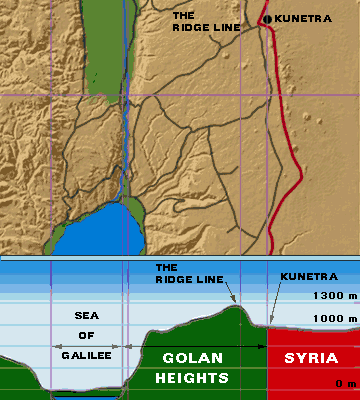

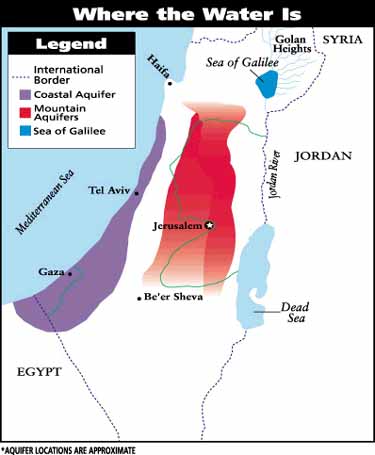
 During
the
During
the 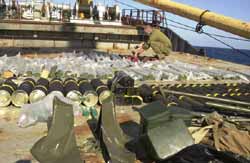 On
January 3, 2002,
On
January 3, 2002,