Syria
(Updated January 2017)
Syria is one of Israel’s principal immediate military threats. Syria's primary military objective following Israel's independence in 1948 had been the destruction of the Jewish State, however the IDF has defeated the Syrian army in every major military engagement since. Today, rather than use direct confrontations, Syria funds and arms terrorist organizations (primarily Hamas and Hezbollah) as proxies to attack Israel. Meanwhile, the Syrian regime of Bashar Assad continues to develop ballistic missile systems and weapons of mass destruction.
Since 2008, Syria has spent more than $3 billion on weapons procurement and development, up from less than $100 million in 2002. Syria also reportedly received $1 billion from Iran in late 2007 to buy surface-to-surface missiles, rockets, anti-tank missiles and anti-aircraft systems. “Iran and Syria share the same viewpoint regarding regional issues and efforts will be made to strengthen our shared interests and bilateral relations," said Hassan Turkmani, Syrian Defense Minister, who was dispatched to Tehran after Iranian officials condemned the resumption of negotiations with Israel in 2008.
Despite the threat of aggression from the Syrian side of the border, Israeli hospitals continue to treat wounded Syrians who cross the border seeking medical attention. Between 2013 and 2015, Israeli hospitals treated over 2,000 Syrians who sustained sometimes life threatening injuries.
- Situation Today
- Chemical Weapons
- Weapons of Mass Destruction
- Syria & Iran
- The Terror Connection
The Situation Today
The situation today vis-a-vis Syria's threat to Israel is muddled as a result of the ongoing bloody civil war. The fighting throughout Syria has created new instability on Israel's northern border, eliminated any hope of any near term peace agreement relating to the Golan Heights and increased the prospect of an even more dangerous radical Islamist regime coming to power.
The prospects for Syrian-Israeli peace are undermined by the likelihood that Bashar Assad will be replaced by someone even more extreme and less interested in a compromise with Israel on the Golan
Heights, and by increased Israeli concerns that an agreement would not be long-lasting because of the possibility of another change in regime.
Israel is also concerned about being drawn into the Syrian civil war if fighting spills over the border. In November 2012, a number of mortars were fired into Israel, likely by accident, but they triggered an Israeli response that demonstrated to both the Syrian government and the rebels that cross-border attacks on Israeli territory would not be permitted. The response, artillery targeting the the source of the fire in Syria, marked the first time the IDF fired into Syrian territory since the end of 1973 Yom Kippur War. In February 2013, after a few months of relative calm, a Syrian army tank shell - believed to have been an errant shot during a battle between government forces and rebels - landed near the norther Israeli town of Alonei Habashan. It was defused without any Israeli injuries.
In August 2013, as intelligence agencies reported that Assad's forces were using chemical weapons against the rebels, the specter of conflict spilling over into Israel became much more pronounced. As U.S. President Barack Obama considered a strike on Syria, Assad's allies in Iran made sure Israel knew it would be targeted in any conflict. "No military attack will be waged against Syria," Director-General of the parliament for International Affairs Hossein Sheikholeslam said in late August. "Yet, if such an incident takes place, which is impossible, the Zionist regime will be the first victim of a military attack on Syria." Khalaf Muftah, a senior Baath Party official who used to serve as Syria’s assistant information minister, echoed Sheikholeslam's statement: "[Israel] is behind the [Western] aggression and [it] will therefore come under fire ... We have strategic weapons and we're capable of responding. Normally the strategic weapons are aimed at Israel."
As of August 2013, the approximate breakdown for Syria's conventional forces was as follows:
Infantry: 304,000 Active; 315,000 Reserve. Armor: 4,800 tanks; 5,060 APC's. Air Force: 490 planes; 225 combat helicopters. Navy: 35 warships; 0 submarines.
On a more positive note, Israel has allowed a number of refugees to cross the border, primarily for medical treatment, and has set up a hospital near the border to offer care to injured Syrian civilians. At least 700 Palestinians have been killed in the fighting in Syria and I srael offered to allow Palestinians living in Syria to go to the West Bank; however, Palestinian Authority Pressident Mahmoud Abbas rejected the offer.
The potential upside of the civil war for Israel is that Bashar Assad will be driven from power and the new leadership - likely led by Sunni Muslims - will end Syria's alliance with Iran and Hezbollah, weakening both. That potential outcome explains why Iranian and Hezbollah fighters have joined the fight to try to save Assad.
In October 2013, al-Arabiya news confirmed that Israel struck two targets within Syria to destroy air defense and surface-to-air missiles that President Bashar Assad may have been trying to transfer to Hezbollah. The strike on the Syrian air defense base in Latakia was confirmed by a source in the Obama Administration. According to the report, Israel also struck near Damascus and destroyed SA-8 surface-to-air missiles that were destined for Hezbollah. Israeli military correspondant Ron Ben-Yishai said that Syria is constantly trying to move its weapons over the Lebanese border to Hezbollah.
In February 2014, James Clapper Jr., the director of U.S. national intelligence, said that Assad's hold on power in Syria had “strengthened” over the past year and that he had benefited from a deal to abandon his chemical weapons arsenal. Clapper also said it was possible the violence could rage on indefinitely, leading to “sort of a perpetual stalemate where neither the regime nor the opposition can prevail.”
Attacks on the Israel-Syria border increased in number during 2014 and 2015. In March 2014, an explosive device was detonated along Israel’s border with Syria, injuring four IDF soldiers. Israeli Prime Minister Netanyahu declared that the Syrian military aided and abetted the attack. In response, the IDF targeted military targets in southern Syria with artillery and air strikes. On September 23, Israel shot down a Syrian fighter jet in Israeli airspace over the Golan Heights. According to radio sources the jet was a MiG-21 fighter jet and had been shot down with a patriot missile. The jet was being tracked by the Israeli Air Force as it flew from Damascus and got closer and closer to the Golan Heights, and the patriot missile was fired the moment that the plane breached the cease-fire line between Syria and Israel. The aircraft landed in a plume of smoke on the Syrian side of the Golan Heights. Four individuals from Syria approached the Syria-Israel border armed with ammunition and explosives under the cover of darkness on April 25, 2015. These individuals were spotted by Israeli security services as they attempted to set up explosive devices on the border fence. The Israeli Air Force was informed of this suspicious activity, and all four individuals were killed in an air-strike soon after they were spotted. It was assumed after the attempted attack that these terrorists were members of Hezbollah.
Israeli officials expressed concern during mid-September 2015 amid confirmed reports that the Russian military had begun to become involved in the Syrian civil war, in support of the regime of Bashar al-Assad. Russia greatly expanded their military presence in Syria during September 2015, stationing fighter jets at Syrian air bases for the first time in history. Drones were deployed by Russian forces for surveliance missions over Syria. In response to these revelations Israeli Prime Minister Netanyahu scheduled a meeting during late September with Russian President Vladimir Putin, during which Netanyahu will try to influence Putin to help bring Assad to the negotiating table and end the Syrian civil war.
On September 23, 2015, Israel shot down a Syrian fighter jet in Israeli airspace over the Golan Heights. According to radio sources the jet was a MiG-21 fighter jet and had been shot down with a patriot missile. The jet was being tracked by the Israeli Air Force as it flew from Damascus and got closer and closer to the Golan Heights, and the patriot missile was fired the moment that the plane breached the cease-fire line between Syria and Israel. The aircraft landed in a plume of smoke on the Syrian side of the Golan Heights.
Chemical Weapons
The United States announced on August 18, 2014 that US personnel operating on the MV Cape Ray in the Mediterranean sea had successfully completed the neutralization and destruction of the complete known stockpile of Syria's chemical weapons. In a statement released by the White House, President Barack Obama praised the mission saying that it was completed weeks ahead of schedule and sends a message that the use of chemical weapons will not be tolerated on the international stage. Syrian President Bashar al-Assad's regime used the chemical weapons on their citizens during a civil war that ravaged the country begining in Spring 2011. Chemical weapons were expressely banned internationally by the 1993 Chemical Weapons Convention, but at the time of the convention's introduction Syria was one of a few countries who did not sign on. After signing the convention 20 years later in September 2013 the Organization for the Prohibition of Chemical Weapons found 1,300 tons of chemical weapons stockpiled in October. Later that month the OPCW and the UN came together and made a plan for the elimination of Syria's chemical weapons stockpile, and that plan was implemented and completed less than one year later.
A report released by the OPCW on September 10, 2014 presented hard clear evidence that a toxic chemical most likely to be chlorine gas was used by the Assad regime against the Syrian citizens during April 2014. This report indicated that even after the Syrian government signed the Chemical Weapons Convention in September 2013 they contiuned to use deadly chemical weapons on the opponents of the Assad regime. Evidence points to the fact that chlorine gas was used "systematically and repeatedly" in the villages of Talmanes, Al Tamanah and Kafr Zet in Northern Syria. Although the fact-finding report does not expressly indicate who they believe is responsible for the attacks, but there is little doubt that the Syrian government is behind the deployment of these chemical weapons. These findings were based on personal interviews with victims, doctors and medical workers as well as video documentation and medical records. These attacks were carried out before the declared weapons stockpile was destroyed in August and there is still international concern that Syria did not disclose all of it's chemical weapons and is still harboring them to use on it's citizens.
Syrian officials revealed three new facilities to the OPCW On September 17, 2014, capable of producing chemical weapons such as ricin and chlorine gas. These facilities were previously undeclared. The international community has been skeptical that the Syrian regime disclosed all of their facilities, and this revelation confirms these suspicions. This report confirms accounts released earlier this year of the Syrian army using chlorine "barrel bombs" against the citizens. Syria's use of chemical weapons is a clear violation of it's signatory to the 1997 Chemical Weapons Convention. According to Syrian sources these manufacturing facilities were not disclosed at an earlier time because they were in a rush to put together reports when they were first required to.
In late 2014 while the international focus in Syria was on the advance of the Islamic State, Syrian government forces used that as a distraction and renewed their attacks on Syrian citizens. Government bombings and warplanes killed multiple citizens in the towns of Bdama and Saraqeb, and helicopters rained down barrel bombs full of explosives on Aleppo. During the United States bombing campaign of the Islamic State, bombings by the Syrian army increased in areas without Islamic State insurgents such as Idlib and Damascus. A report released by Human Rights Watch in February 2015 included details that proved Assad's government had continued their assault on their own citizens during 2014, dropping barrel bombs and other air delivered munitions onto defenseless towns full of civilians. The conclusion that these attacks on Syrian civilians were continuing was reached by analyzing witness statements, satellite imagery, and video and photographic evidence. President Assad claimed that his government was not using barrel bombs on their citizens in a radio interview just two weeks before this report was released. Human Rights Watch discovered via satellite images over 1,500 sites that were attacked by the Syrian government during their investigation. Human Rights Watch documented hundreds of repeated barrel bomb attacks in the vicinity of schools, hospitals, mosques, and markets. The report provided evidence that “government forces targeted the entirety of the populated towns with explosive weapons over the course of months.”
Speaking under the condition of anonymity, a senior Israeli official stated on November 18, 2015, that Israeli intelligence services believed that the Syrian government had used approximately 90% of it's missile during the ongoing civil war. The Israeli clarified, “The number of (Syrian) ballistic missiles left is less than 10 percent. That could still change. They could start making them again.”As of November 2015, Hezbollah has a stockpile of 100,000 rockets, according to the Israeli official.
The Organization for the Prohibition of Chemical Weapons announced on January 31, 2015, that the destruction of the first of Syria's twelve chemical weapons production facilities was completed. Experts believed that approximately 98% of Syria's chemical weapons stockpiles were at that point destroyed.
Reports of the use of barrel bombs full of chlorine gas by the Syrian government were once again confirmed on March 20, 2015. Syrian government forces allegedly dropped chlorine gas bombs on the city of Sarmin in early March, accusations which they deny and blame on the rebel groups in the region. U.S. Secretary of State John Kerry said that the “entire international community must condemn” the use of chemical weapons by Assad's forces on their citizens. Assad's government continued to bomb civilians with chlorine gas in April and May 2015.
International inspectors found previously undisclosed evidence of sarin gas and VX nerve agent at a military research site in Syria during May 2015. Samples taken from the site during January 2015 tested positive for the dangerous chemical compounds, indicating to OPCW professionals that, “they have been lying about what they did with sarin.” This discovery reinforces the notion that all of Syria's chemical weapons stockpiles had not been previously disclosed to the international community.
Between March 16, 2015, and mid-May 2015, the Assad regime was accused of carrying out 35 attacks against their own citizens using chlorine barrel bombs.
In early August 2015, members of the U.N. Security Council approved a resolution aimed at creating a process of accountability for the use of chemical weapons in Syria.
Despite reports that all known Syrian chemical weapons stockpiles were destroyed earlier in the year, U.S. National Intelligence Director James Clapper testified before Congress on February 15, 2016, that the Syrian regime had not been honest or transparent when making disclosures. Clapper testified that, “Syria has not declared all the elements of its chemical-weapons program to the Chemical Weapons Convention (CWC). We continue to judge that the Syrian regime has used chemicals as a means of warfare since accession to the CWC in 2013.”
In April 2016, Syria used chemical arms against ISIS. After Assad used chemical weapons against rebel groups in 2013, the Obama administration declared that Syrian President Bashar Assad had crossed a red line and threatened to attack Syria; however, the president reversed course after reaching an agreement with Russia to dismantle Assad’s stores of chemical arms. All of Syria's chemical weapons were supposed to have been removed in 2014; however, we now know that Assad retained some of the weapons and, in the absence of a credible threat from the United States to use military force in response, Syria has launched new chemical attacks.
For the first time during the conflict, in August 2016 the United Nations officially determined that the Assad regime had used chemical weapons, specifically mustard gas, against civilians. A report released by the United Nations concluded that the Assad regime, as well as members of the Islamic State, had used mustard gas multiple times against civilians between 2014 and 2016, claims that had been widely speculated but not confirmed officially until the report's publication.
The Syrian government allegedly dropped chlorine gas bombs on an Aleppo neighborhood known to house opposition fighters during the first week of September 2016. Videos of wheezing children being doused with water and breathing through oxygen masks were posted on social media, and 80 civilians were reportedly injured.
For the first time, in January 2017 the U.S. government sanctioned 18 senior Syrian officials under the Chemical Weapons Convention for their government's use of chemical weapons against it's own people.
Weapons of Mass Destruction
Though it is party to the nuclear non-proliferation treaty, Syria was engaged in a covert nuclear program for more than a decade. On September 6, 2007, Israel
bombed a site in northern Syria that was later revealed by the CIA as a plutonium reactor being built with the help of North Korea. The
possibility that the site was related to
a nuclear program was supported by the
U.S. intelligence community which released reports
that said the covert Pakistani supplier
group headed by A.Q. Khan “offered
nuclear technology and hardware to Syria.” In February 2009, the International Atomic Energy Agency (IAEA) reported that samples
taken from the site revealed traces of processed
uranium.
Syria denied the site was
for a nuclear facility but IAEA investigators were
given very restricted access to the area and the Syrian government quickly destroyed any evidence that remained. Nevertheless,
a report was issued
on November 19, 2008, which said the IAEA
found a “significant
number” of uranium particles and concluded, “While
it cannot be excluded that the building in
question was intended for non-nuclear use,
the features of the building...are similar
to what may be found in connection with a
reactor site.”
In February 2011, commercial satellite photos published by Washington's Institute for Science and International Security identified another suspect nuclear installation in Syria. The photos provided evidence that Damascus may have been pursing atomic weapons prior to the 2007 Israeli strike and increased pressure for demands for a new round of expansive inspections of suspect Syrian facilities. Another IAEA report issued in May 2011, which cited both physical and photograhic evidence, confirmed that the Syrian project destroyed in the the Israeli air raid was a nuclear reactor intended for making material for nuclear bombs.
Syria
was already known to conduct nuclear research
at three facilities located at Dayr, Al Hajar
and Dubaya. “In
2004, Syria continued to develop civilian
nuclear capabilities, including uranium extraction
technology and hot cell facilities, which
may also be potentially applicable to a weapons
program,” the report said. As a signatory
to the nuclear Non-Proliferation Treaty,
Syria is required to submit to IAEA safeguards
and inspections. In January 2007, the United
States froze
the assets of three Syrian entities involved
in the development of nonconventional weapons. The entities - the Higher Institute of Applied Science and Technology (HIAST), the Electronics Institute and the National Standards and Calibration Laboratory (NSCL) - were sanctioned pursuant to Executive Order 13382, an authority aimed at freezing the assets of proliferators of weapons of mass destruction (WMD) and their supporters.
“Syria is using official government organizations to develop nonconventional weapons and the missiles to deliver them,” said Stuart Levey, Treasury's Under Secretary for Terrorism and Financial Intelligence (TFI). “We will continue to take action to prevent such state-sponsored WMD proliferators from using the international financial system.”
According to Gregory Schulte,
former U.S. envoy to the IAEA, Syria may
be operating more nuclear sites. In November 2011, an AP report seemingly confirmed those suspicions that Syria's nuclear weapons program was not confined only to the plutonium reactor destroyed by Israel in 2007. Rather, it seems that a suspect building in the northeastern town of Hasaka (about 100 miles from the destroyed reactor) was once a centrifuge plant where Syria intended to manufacture nuclear weapons. Though the building today houses a textile factory, its layout and blueprints match almost exactly with a centrifuge plant built by the Gaddafi regime in Libya. A working centrifuge plant could have produced highly enriched uranium which would have given the Syrian's an entirely separate route to an atomic bomb other than the destoryed plutonium reactor.
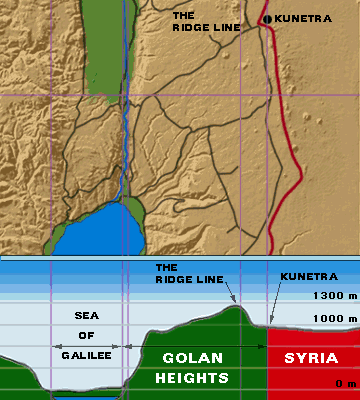
Israel's attack raised
tensions along
the Golan
Heights where Syrian actions had already
provoked concern about the possibility
of conflict. In
March 2007, it was reported that Syria has
positioned along the border with Israel
thousands of medium and long-range rockets
capable of striking major towns across northern
Israel, including Haifa.
A division was added to the Syrian army’s
forward deployment on the Heights and the
production of Scud missiles has
been accelerated. Many
of the rockets are hidden in underground
chambers and in camouflaged silos.
Syria expanded its arsenal of weapons
of mass destruction during the last decade. The Syrians can now
manufacture several hundred tons of chemical
warfare agents per year at four separate
production facilities. In late 2005, Jane's
Defence Weekly reported that Iran is
providing technical assistance to help Syria
develop the means to produce VX and Sarin
nerve agents and mustard blister agent. According
to a February 2009 report by Jane's, Syria
was constructing a new chemical weapons
facility in Al-Safir, the home of an existing
chemical weapons production facility and
a missile base with long-range Scud D ballistic
missiles.
The Syrian civil war has reduced the immediate threat of a Syrian attack on the Golan Heights, but also created new concerns about the security of Syria's weapons of mass destruction. Israel and Western nations are especially concerned that chemical weapons might fall into the hands of either rebel forces or, worse, be transferred across the border to Hezbollah. Israel reportedly attacked a convoy thought to be bringing Syrian weapons across the Lebanese border and the Israelis have made clear they will take measures to prevent efforts to smuggle weapons to Hezbollah.
Syria & Iran
Under a mutual defense pact
signed between Syria and Iran in
2005, Syria agreed to allow the deployment
of Iranian weapons on its territory. On June
15, 2006, Syria’s defense minister,
Hassan Turkmani, signed an agreement with
his Iranian counterpart for military cooperation
against what they called the “common
threats” presented by Israel and the
United States. “Our cooperation is
based on a strategic pact and unity against
common threats,” said Turkmani. “We
can have a common front against Israel’s
threats.” In December 2009, Syria and Iran signed an additional defense agreement aimed to face “common enemies and challenges.” In praising the agreement, Iranian Defense Minister Ahmad Vahidi said, “it is natural for a country like Syria - which has an inhumane and menacing predator like Israel in its neighborhood - to be always prepared [against possible foreign aggression].”
UN officials
said in June 2007 the Iranians were preparing
to transfer medium-range Shahab-3, Russian-made
Scud-C missiles and Scud-B missiles in preparation
for military action if it is attacked over
its nuclear program. Many of these missiles
can be fired from mobile launchers and are
capable of hitting targets throughout Israel. Syria has
already received, via Iran,
hundreds of extended-range North
Korean Scud-C missiles, and is reportedly
building its own ballistic missiles from
imported technology. North Korea has supplied
complete Scuds and production equipment to Syria.
In 2003, Syria was
said to have a new Scud-D missile, developed
with Korean assistance, which has a range
of 300 miles (sufficient to cover all of Israel).
The missile is also capable of carrying chemical
weapons. The May 2006 U.S. intelligence report
said Syria continues to seek help in building
solid-propellant rocket motors, and that
North Korea supplied equipment and assistance
to the missile program. Syria is building
its own liquid-fueled Scud missiles and is
developing a 500-mile-range Scud D and other
variants with help from North Korea and Iran,
the report said.
“Syria
test-fired three Scud missiles on May 27,
2005, including one that broke up over
Turkey,” the New York Times reported. “These
were the first such Syrian missile tests
since 2001, and were part of a Syrian missile
development project using North Korean technology
and designed to deliver air-burst chemical
weapons. The missiles included one Scud B
with a range of 185 miles, and two Scud Ds
with a range of 435 miles.” Months later,
Western experts who examined the remains of
the missile that fell in Turkey concluded Syria
had introduced significant
changes in the advanced model of the Scud D
missile that gives it greater guidance capability
and accuracy.
Over the objections of Israel
and the United States, Russia announced
plans in early 2005 to sell Syria advanced SA-18 anti-aircraft missiles. Russian
President Vladimir Putin told Prime Minister Ariel
Sharon that the weapons were not shoulder-missiles
favored by the terror organizations, but
rather they would be mounted on vehicles,
and therefore they would not endanger Israel.
Putin also said Syria's placement of the
missiles would be designed to avoid a change
in the balance of power in the area, but
would prevent Israeli war planes from being
able to fly over Syrian President Bashar
Assad's presidential palace in Damascus.
Israeli defense officials still expressed
concern that the mounted version could
be modified into a shoulder-held version
in a relatively simple process. From that
point, the officials said, the missiles
could easily reach insurgents in Iran or Hezbollah operatives
in Lebanon.
By the end of 2012, Syria maintains a larger standing army than Israel and
has nearly as many reserve troops, tanks, aircraft and naval warships as Israel. The Assad regime
fields armed forces totaling more than 420,000 men.
Syria's arsenal also includes approximately 10,000 tanks and armored personnel carriers, 35 warships and submarines and some 715 combat aircraft including helicopters.
Though the quality of Syrian
forces is regarded as inferior to that of
Israel, the deployment of these forces facing
the Golan indicated Assad was
keeping his military options open. The outbreak of the civil war in Syria, however, has forced Assad to direct all his military assets against his own people in an effort to cling to power.
In May 2013, while fighting raged across Syria between government forces and rebels, Iran reportedly tried using Syria as a route to ship advanced surface-to-surface missiles to Hezbollah in Lebanon. Israel interdicted the shipment and destroyed the missiles at the Damascus International Airport. President Obama said, "The Israelis, justifiably, have to guard against the transfer of advanced weaponry to terrorist organizations like Hizbullah."
In March 2014, the Israeli Navy seized the Klos-C ship off the coast of Sudan. The ship's weapons cargo included 40 Syrian-made M-302 rockets that the IDF said were flown from Syria to Iran before they were loaded onto the Panamanian-flagged ship in an Iranian port. This major weapons seizure highlights the increasingly close ties between Syria and Iran in rocket research, development and production, as well as Syria's successful expansion of its arsenal's reach.
The Terror Connection
Syria harbors
in Damascus representatives of ten Palestinian terrorist
organizations including Hamas, Islamic Jihad, the Democratic
Front for the Liberation of Palestine (DFLP), and the Popular
Front for the Liberation of Palestine all of which are opposed to
advances in the peace process between Israel and the Palestinian
Authority. These groups have launched terrible attacks against innocent
Israeli citizens, which have resulted in hundreds of deaths. Syria also supports the Iranian-funded Hezbollah.
For more than 30 years, Lebanon was
essentially controlled by Syria.
With Syrian acquiescence, Lebanon became
the home to a number of the most radical
and violent Islamic organizations. Hezbollah (Party
of God), in particular, has been used by
the Syrians as a proxy to fight Israel.
On October 19, 2004, the UN
Security Council released a demand
that Syria should abide by a resolution calling
on Damascus to withdraw its 14,000 troops
from Lebanon, dismantle the Hezbollah organization
and respect Lebanon’s independence.
Buoyed by the UN intervention, the
opposition in Lebanon grew more vocal demanding
an end to Syrian hegemony. After former Lebanese
Prime Minister Rafik Hariri
was assassinated on
February 14, 2005, the pressure on Syria
intensified and its troops were finally withdrawn
in April.
Nevertheless, Syria continues
to exercise great influence in Lebanon.
Syria and its allies are believed responsible
for a series of assassinations to undermine
Lebanese democracy that have eliminated anti-Syrian
members of the Lebanese parliament, the most
recent attack coming in September 2007. Syria
supplied Hezbollah with
weapons used in the war fought
with Israel in July 2006 and has been resupplying
the organization in defiance of the UN since
the war ended. Those rockets used in 2006 had ranges of 20 to 60 miles. In April 2010, the U.S. and Israel accused Syria of delivering shipments of long-range Scud missiles to Hezbollah in Lebanon. The Scuds have a range of more than 435 miles - placing Jerusalem, Tel Aviv and Israel's nuclear installations at risk.
Sources: Schwartz, Felicia. “U.S. Sanctions 18 Syrians for Chlorine-Gas Attacks,” Wall Street Journal, (January 13, 2017);
Davison, John. “Suspected Aleppo chlorine attack chokes dozens, rescue workers, monitors say,” Reuters, (September 7, 2016);
Harel, Amos. “Syria's Assad Used Chemical Arms Against ISIS,” Haaretz (May 2, 2016);
Rosen, Armin. “The US intelligence chief just acknowledged a major failure of the Syria chemical-weapons deal,” Business Insider (February 10, 2016);
OPCW (January 4, 2016);
Kareem Shaheen. “Assad regime accused of 35 chlorine attacks since mid-March,” The Gaurdian, (May 24, 2015)
Deutsch, Anthony. “Exclusive: Weapons inspectors find undeclared sarin and VX traces in Syria,” Reuters,(May 8, 2015);
Groll, Elias. “For Syria's chemical weapons plants it's 1 down, 11 to go,” Foreign Policy, (February 5, 2015):
Groll, Elias. “As Syria's civil war rages on, chemical weapons use persists,” Foreign Policy, (March 19, 2015);
American Israel Public Affairs Committee (AIPAC);
Levitt, Joshua. “Iranian official: Israel will be first victim of U.S. strike in Syria,” The Algemeiner, (August 26, 2013);
Couglin, Con. “Iran establishes missile defense shield in Syria,” New York Sun, (June 25, 2007);
Aluff, Ben. “Putin to Sharon: Russia to sell anti-aircraft missiles to Syria,” Haaretz, (February 16, 2005);
Aluff, Ben. “Israel worried about possible new Russia-Syria arms deals,” Haaretz, (October 26, 2005);
Schiff, Ze'ev. “Syria boosts accuracy of it's SCUD D Missile,” Haaretz, (December 5, 2005);
Ravid, Barak. “Israel, Germany plan international summit to stop Iran's nuke program,” Haaretz, (March 21, 2008);
Hadad, Shmulik. “Qassam lands near Negev synagogue, no injuries,” Ynet News, (May 29, 2008);
Daragahi, Borzou. “Speculation grows over Syria site,” LA Times, (November 20,2008);
Sobelman, Batsheva. “Bomb injures Israeli soldiers on border with Syria,” LA Times, (March 19, 2014);
Erlanger, Steven. “Syria Test fires 3 SCUD missiles, Israel says,” New York Times, (June 3, 2005) ;
Barnard, Anne. “Israel targeted Iranian missiles in Syria attack,” New York Times, (May 4, 2013);
Gordon, Michael/Mazzetti, Mark. “US spy chief says Assad has strengthened his hold on power,” New York Times, (February 4, 2014);
Cumming-Bruce, Nick. “Chlorine used as a weapon in Syria war, group says,” New York Times, (September 10, 2014);
Fisher, Gabe. “Syrian tank shell lands in Israeli Golan Heights town,” Times of Israel, (February 27, 2013);
Winer, Stuart/Ben Zion, Ilan. “IDf scores direct hit on Syria target, after another mortar hits the Golan,” Times of Israel, (November 12, 2012);
“Israeli team talks Egypt, Syria with Susan Rice,” Times of Israel, (August 27, 2013);
Levinson, Charles/ Solomon, Jay. “Syria gave SCUDs to Hezbollah,” Wall Street Journal, (April 14, 2010);
Solomon, Jay. “Second suspected Syrian nuclear site found,” Wall Street Journal, (February 24, 2011);
“Pakistani nuke supplier tied to Syria,” Washington Times, (May 13, 2006);
The White House;
“Syria gets Iranian boost,” Ynet News, (October 25, 2005);
Cohen, Dudi. “Syria says willing to step up cooperation with Iran,” Ynet News, (May 27, 2008);
Blanford, Nicholas. “Syria's secretive rocket industry spotlighted by Israeli weapons seizure,” Christian Science Monitor, (March 11, 2014);
Map: The Jewish Connection, Washington Institute (November 1, 2011), Council on Foreign Relations(November 1, 2011)
Map: The
Jewish Connection, Washington Institute (November 1, 2011), Council on Foreign Relations (November 1, 2011)
|