Table 1 Year-by-Year Data, According to the Palestinian Ministry of Planning
and International Cooperation (Since 1998) [Thousands of US Dollars]
However,
there are independent sources, such as Info-Prod, an economic research
center, that provide a different account, maintaining that the PA
has received a much larger sum.
Info-Prod’s
figures are as follows (in thousands of dollars):
[8]
Table 2 Year-by-Year Data, According to Info-Prod [Thousands of US Dollars]
The
2001 figure is an 80% increase over 2000. These sums do not include
UNRWA figures.
A
partial breakdown for 2001 is:
- US: $114 million - EU: $250 million - Arab States: $400 million Info-Prod’s
figures detail $4,466,868,000 through the end of 2001. Based on these
figures, and taking into account the known scope of EU and Arab Aid
to the PA (EUR 10 million per month from the EU, and 45 million per
month until April 2002 then 55 million per month from the Arab states),
a minimum of $4,938,868,000 was given to the PA by the end of August
2002.
Following
the Oslo Accords, donations from the EU included demands for accountability.
Similar demands were attached to the EU’s direct budgetary assistance
following the intifada. However, despite ostensible EU claims to the
contrary, no real efforts to monitor how the money was spent has ever
taken place. “”Everybody has known for quite some time that money
ended up in the wrong hands”
[9]
noted an EU diplomat. The EU claims that the IMF ostensibly
monitors the PA budget. This claim, however, is contradicted by the
IMF statement that “the Fund has not been monitoring spending under
individual budget lines nor can it ascertain whether a particular
spending commitment has been actually disbursed for the reported purpose.
This is an auditing function that goes beyond the fund’s present mandate.”
[10]
Nor was there ever any reason to expect that the PA
would meet any demands for accountability, in light of the fact that
Yasser Arafat declared as early as July 1994:
“I
refused and I will never accept!” Arafat said of the conditions imposed
for economic aid. “I completely refuse any controls by anybody on
Palestinian Autonomy, except the Palestinians themselves. We didn’t
finish military occupation to get economic occupation”
[11]
Clearly,
the international donor community did not take Arafat at his word.
This follows the same school of thought that holds that he does not
really mean it when he calls for suicide bombing and Jihad.
-
The
-
The EU has donated EUR 1B in loans and grants to the
PA. Its donations to UNRWA since 1994 total at least EUR 407 million.
[16]
In addition, EU member countries have donated
at least $1,260,022,000, according to Palestinian Ministry of Planning
and International Cooperation figures. All together, aid from
-
The United Nations Relief and Work Agency (UNRWA): UNRWA
is slated to have total disbursements of $521.7 million for 2002,
[18]
of which $110 million was to come from the
- The major increase by the Arab states followed a decision by the Arab League in October 2000. The money was sent through the Islamic Development Bank (IDB), and was transferred to the Palestinian Ministry of Finance. Funding to the PA from Crime and CorruptionThe total amount of money accumulated by the PLO from
its inception has been estimated by several sources. A 1990 CIA report
estimated that the PLO had between $8 – 14B in assets.
[20]
Two
British National Criminal Intelligence Service (NCIS) reports, (1993
and 1994) estimated that “despite denials to the contrary, it is
estimated that they [the PLO] have worldwide assets approaching $8-10
billion USD and an annual income of about $1.5-2 billion.” The report
noted that the PLO was in fact the wealthiest of the world’s terrorist
organizations.
[21]
The U.S. General Accounting Office performed an investigation
into this matter in 1995, but its findings were kept secret, due to
“national security reasons.” However, a source familiar with the investigation
said that the report found that Arafat and the PLO indeed held “well
over $10 billion is assets, even at a time when he was publicly claiming
bankruptcy.”
[22]
The
assets the PLO held were an open secret. Yet, the PA was never asked
to use the assets on behalf of the Palestinian people, and there was
no demand to account for the whereabouts of these assets.
Major Sources of the PA’s Illegal Revenues
Since
the PA has been engaging in criminal activities since its inception,
the full extent of the organization and its leadership’s illegal income
is impossible to determine. However, the following sources of revenue
have been documented:
- Palestinian Martyrs’ Sons Enterprises (Samed) - Monopolies and the Palestine Commercial Services Company (PCSC) - Personal Corruption - Crime. · PALESTINIAN MARTYRS’ SONS ENTERPRISES (SAMED) The
PLO formed Samed in 1970, to control and operate its economic activities.
Since then, Samed has been led by Ahmed Qurie, AKA
According
to the US House of Representatives Task Force on Terrorism and Unconventional
Warfare (October 1991), Samed had a penchant for airport-related investments.
These investments gave the PLO a base for the procurement of forged
travel documents and airline tickets.
[26]
It owned duty-free stores at airports in
In
December 1999, hackers that broke into the PA’s computer system discovered
at least “five billion pounds in numbered bank accounts in
·
MONOPOLIES AND THE PALESTINE COMMERCIAL SERVICES
COMPANY (PCSC)
The
scope of revenues from the monopolies in the PA was estimated in 2000
at $300 million annually.
[31]
None of this amount is accounted for. The damage to the
Palestinian economy goes beyond the loss in revenues, because it prevents
competition and results in higher prices for fewer products. Coupled
with the fact the monopolies are “on basic goods such as wheat, cement,
petrol, wood, gravel, cigarettes and cars are in the hands of Arafat's
aides and they exploit their positions to extract high profits,”
[32]
the dead-weight loss must be staggering.
The
Palestine Commercial Services Company is the economic arm of the Palestinian Authority. Yet it is not
supervised by its legislature or Finance Ministry.
[33]
It is run by Mohammed Rashid, Arafat’s economic advisor,
and it controls most economic activities in the PA territories. The
Palestine Commercial Services Company has “large minority stakes… in a Ramallah Coca-Cola bottler...
and myriad other businesses, plus full ownership of a cement plant
that had long enjoyed a government protected monopoly. The Palestine
Commercial Services Company had the single biggest holding in the
Researchers
have noted that “since the establishment of the PA, scores of monopolies
have been created by Arafat and are being operated by individuals
and organizations close to Arafat. These monopolies control and subvert
almost every potentially profitable aspect of daily Palestinian life.”
[38]
The Palestine Commercial Services Company has a 100% stake in the local cement
monopoly that was worth $50million in 2000.
[39]
Other Palestine Commercial Services Company monopolies include flour, oil, cigarettes,
iron, commercial sand, and the PA prohibits other companies from operating
in these fields.
[40]
Media
investigations and sources within the Palestinian territories revealed
that Palestinian officials close to Arafat that control monopolies
include: Arafat’s personal economic advisor Muhammad Rashid, who together
with Suha Arafat (Yasser Arafat’s wife) and communications advisor
Nabil Abu-Roudayna co-own pharmaceutical and apparel monopolies.
[41]
Rashid, together with another Arafat advisor, Hassan
Asfour, co-own an oil monopoly; Nabil Shaath, the Minister of Planning
and International Cooperation has a computer monopoly,
[42]
and Ahmed Qurie, speaker of the Palestinian Legislative
Council and founder of Samed, is co-owner of cigarettes, conserves,
and dairy monopolies.
[43]
The U.S. General Accounting Office’s (GAO) 1995
investigation into the PA’s finances received no cooperation from
the PA. But by 1997, following local pressure, the Palestine Legislative
Council (PLC) conducted an investigation into PA corruption. This
report, was suppressed by Arafat, but leaked. Jarar Kidwa, head of the PA’s financial monitoring institution,
disclosed that the PA had lost $326 million – 40% of its annual budget
for 1996 – to corruption and mismanagement. The PLC report also implicated
PA officials, some still serving in the cabinet.
[44]
The
PA system of monopolies has a long-term effect that is not immediately
quantifiable, because of lost economic opportunities.
· PERSONAL CORRUPTION Recent
reports by Israeli government officials put Arafat’s
personal holdings at about $1.3 billion. This includes $500 million
of the Palestine Liberation Organization’s money that Arafat also
controls. Wearing three hats, Arafat is the president of the Palestinian
Authority, chairman of the PLO, and is the head of the Fatah terrorist
organization and its al Aqsa Martyrs Brigades and the Tanzim.
[45]
As such, he controls the funds of all the terror organizations
under the PA umbrella.
There
has been a great deal written about Yasser Arafat’s secret bank account
in Tel Aviv. Under the 1994 Paris Agreement,
The
rest of the taxes that
Throughout
the years, the donor countries led by the
Some
of Arafat’s corruption is simply in the form of outright theft of
aid funds. For example, the Kuwaiti newspaper Al-Watan reported on
Jawad
Ghussein, until 1996 the Secretary General of the Palestinian National
Fund, told the Haaretz newspaper in August 2002 that Arafat “took
aid money and contributions that were earmarked for the Palestinian
people to his own account.” Ghussein should know, since it was he
who for years deposited $7.5-8 million each month into Arafat’s personal
bank account. By 1993, these deposits had totaled $540 million.
[52]
A
member of the Palestinian Legislative Council from
Following
the Oslo Accords, Arafat even took over PECDAR (the Palestinian Economic
Council for Development and Reconstruction), that was founded under
strict European conditions, as soon as it began operating. "His
[Arafat's] became the authorized signature. Today, no amount, no matter
how small, leaves the PECDAR funds without the president's signature."
[53]
Siphoning off the Pension Fund: In compliance with the Oslo Accords,
·
CRIME
- Counterfeiting Merchandise: [57] Under the PA’s control, massive merchandise counterfeiting enterprises flourish, “making millions of dollars a year,” with royalties going to “senior Palestinian Authority figures.” [58] The merchandise includes CD’s, DVD’s, clothing, cosmetics, and schoolbooks. This is done in cooperation with Hamas and other Palestinian terrorist organizations. - Counterfeiting Money: According to media reports, [59] counterfeiting of Israeli, Jordanian, and Kuwaiti currency, is an ongoing activity in the Palestinian territories. [60] In April 2002, the IDF found large quantities of counterfeit Israeli currency in 50, 100, and 200- Shekel denominations in Arafat’s compound in Ramallah. [61]
-
Shakedowns: According to confidential Palestinian sources,
[62]
arbitrary charges of traffic violations,
demands of large bribes, kidnapping for money, and extortion of 70
– 90% from the income of private businesses, are rampant in the PA.
These methods are similar to those employed by PLO in
-
Car theft from
-
Faisal Husseini: Documents found in Orient House in August 2001 show
that $1.8 million was funneled by Faisal Husseini’s into his private
bank accounts in
- Nabil Shaath and Yasser Abd Rabboh: The 1997 Palestine Legislative Council investigation into PA corruption implicated Minister of Planning and International Cooperation Nabil Shaath, and Minister of Information and Culture Yasser Abd Rabboh. The report claimed that both used government money for personal purposes. The report determined that Shaath had embezzled ministry funds, transferring them to accounts not subject to PA inspection. [66] The report also demanded that Shaath be removed from his position. [67] Yet, according to media reports, he has a monopoly on imported computer hardware into the PA [68] and both he and Abd Rabboh still hold the same posts. Of special concern should be the implication of Shaath, who as minister for Planning and International Cooperation, coordinates international aid and the negotiations to reform the PA.
-
Jibril Rajoub, Preventative Security Head in the
International Aid Directed to Terror
Recent
statistics provided by the Israeli Foreign Ministry show that since
the beginning of the intifada two years ago, one homicide bomber was
sent to
Despite
EU attempts to refute and downplay allegations that EU aid money was
used to fund terrorism, PA documents found by the IDF clearly show
that the PA diverted international aid to fund its terrorist activities.
Since we already know that the EU did not closely monitor the use
of the money, if even a single dollar went to finance terror, the
donor countries are guilty of aiding terrorism.
In
December 2000,
The
PA documents found in Ramallah and elsewhere in the
The
EU’s first response to these facts was to deny them. Yet, the Palestinian
Authority’s own documents substantiate these facts.
· FACT: The Palestinian Authority keeps a double reporting system for its salaries. It
claims it needs around $60 million per month for salaries. But in
fact, it needs only about $40.5 million. The balance is unaccounted
for.
 Figure 1 The EU Claims v. Reality
Unwilling
to assume responsibility, the EU claims that the IMF monitors the
Palestinian Authority budget.
[70]
The EU says, “ the IMF conducts a close review of monthly
fiscal information covering the whole of the PA budget, including
…the wage bill.”
[71]
In stark contrast, the IMF itself states that “the Fund
has not been monitoring spending under individual budget lines nor
can it ascertain whether a particular spending commitment has been
actually disbursed for the reported purpose. This is an auditing function
that goes beyond the fund’s present mandate.”
[72]
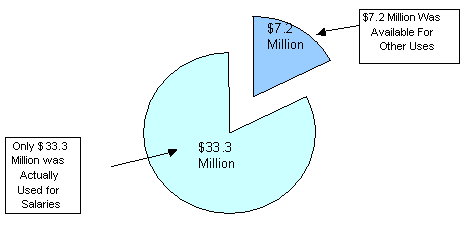
FACT: The Palestinian Authority was performing exchange rate fraud, paying salaries at an artificially low exchange rate (3.7 shekels/dollar vs. 4.4 at the end of 2001) The
following chart shows how $7.2 Million of the $40.5 Million used for
salaries was available for other uses, due to exchange rate fraud:
 EVIDENCE: Captured documents show the use of a 3.7 exchange rate.
[73]
EU CLAIM: “The economic aggregates, which the IMF monitors, include:
the total salary bill, the total number of employees, and the average
salary. Any “leakage” would be seen in discrepancies in these aggregates.
There is no evidence of this. On the contrary, the salary bill is
consistent with expectations.”
[74]
EVIDENCE: There is direct evidence contradicting this: PA documents
from late 2001 clearly show that dollars for salaries were converted
at a rate of 3.7.
[75]
The PA’s new Finance Minister, Salaam Fayed is reported
to have ended this process recently.
[76]
CONCLUSION: The EU’s claims are directly contradicted by documentary
evidence. In addition, the IMF stated that it does not monitor the
details.
FACT: The Palestinian Authority deducts a “Fatah Membership Fee” from all PA security personnel. EVIDENCE: PA documents show that the PA deducts 1.5 – 2% from
all PA security personnel salaries. The sum, which is equivalent to
$260,000 – 345,000 per month, is sent to Fatah.
[77]
It
is interesting to note that while not refuting this evidence, the
EU tries to argue that Fatah, a terrorist organization, is comparable
to European trade unions: “This system is not dissimilar to the mandatory
deductions from salaries for trade union members’ fees in some EU
countries.”
[78]
As
is evident in the PA documents, Fatah, the Tanzim, and the al Aqsa
Martyrs Brigades are the same organization. Documents with letterheads
carrying a joint al Aqsa Martyrs Brigades and Fatah logo attest to
that.
[79]
The al Aqsa Martyrs Brigades is classified as a terrorist
organization by both the
CONCLUSION: Fatah is a terrorist organization, and membership fees
originating from salaries paid by the EU help fund it.
· FACT: The Palestinian Authority pays salaries to Fatah activists and has recruited Fatah members into its ranks [83] EVIDENCE: PA documents show that it pays the salaries of Fatah
terrorists in the amount of $640,000 to $1 million per month.
[84]
There are letters of request to Arafat to approve putting
Fatah activists and other persons known to be involved in terrorism
onto the PA security apparatus payroll to pay for their terrorist
activities.
[85]
The documents are addressed to Arafat, and frequently
have his comments in own his handwriting on them.
[86]
By
claiming that there is no indication that any actual recruitment took
place, and that effective approval would require some other notation
from Arafat,
[87]
the EU is simply obfuscating the evidence. Even if Arafat
did not literally sign off on the hiring of certain terrorists, he
gave his tacit approval by forwarding the requests for their hiring.
The
EU makes the claim that “there is no evidence that any person involved
in terror attacks has actually been recruited into the PA security
services.”
[88]
This claim is demonstrably false. The PA’s own documents
show that many PA-salaried people were engaged in terrorist activities.
Consider
the following:
[89]
-
Marwan Barghouti - Leader of the terrorist organization Fatah/Tanzim
in the
-
Nasser Awis
[92]
- Was an officer in General intelligence
and General Security apparatuses and received regular salaries from
the PA. Head of al Aqsa Martyrs Brigades in
-
Zadki Zeru
[93]
- From
- Marwan Zallum [94] also a senior Fatah activist involved in “many lethal shooting attacks,” [95] who was given an official position in the PA.
-
Fuad Shubaki
[96]
- PA Chief Financial Officer, who was
involved in the Karine-A arms purchasing and smuggling operation.
[97]
He allocated $80,000 for a heavy arms factory
on behalf of the al-Aqsa Martyrs Brigades. Several PA documents, on
PA stationery, show PA officials requesting funding for known Fatah
terrorists, while praising their “fighting abilities.”
[98]
Palestinian Ministry of Finance official
documents dating back to 1998/1999 explicitly state “payment to Fatah
movement,”
[99]
Other documents from 2001, including documents
with Arafat’s own approval, list payments to Fatah/Tanzim activists.
Marwan Barghouti, head of Fatah/Tanzim in the
CONCLUSION: Despite all the evidence, the EU ignored even the PA’s
own documents explicitly requesting and granting funds for members
of Fatah/Tanzim and al Aqsa Martyrs Brigades terrorists. Instead,
the EU claimed that it needed the actual checks as proof.
[101]
Arafat’s Personal Involvement in Funding TerrorismPalestinian
Authority documents show that Arafat personally directed a transfer
of $600 to known terrorists, such as Ziad Muhammad Da’as, who commanded
the murder attack during the Bat-Mitzvah party in Hadera.
[102]
There are many other documents showing similar allocations
by Arafat.
[103]
Another
PA document shows that Arafat personally allocated $350 dollars each
to 24 Fatah members, including Atef Abayat, who headed the main terrorist
cell in the
By
“The
EU and the international community continually demand that the PA
prevent terror attacks, dismantle terror groups and arrest terrorists.
If any evidence comes to light that the PA is knowingly employing
members of terrorist organizations, the PA will need to act immediately
to take these people off the payroll and bring them to justice. The
EU will not accept that funds fall into the hands of terrorist organizations.”
[107]
Despite
all the evidence, the EU seems to argue that it will only accept that
Euros fund terrorism if there were mechanisms to identify how each
individual Euro is spent. But money is fungible, and since the EU
gave direct funding towards the PA salaries, the EU is responsible
for the money that the PA allocated to fund terrorism.
Additional Unacceptable Activities Funded by the PA
Fostering Hate in SchoolsThe
international donor community funds the Palestinian education system
through UNRWA (the United Nations Relief and Work Agency). UNRWA-paid
teachers in UNRWA-built schools are teaching from textbooks with vicious
anti-Semitic, anti-Israel, and anti-coexistence messages. Such incitement
is against the Joint Declaration by the European Parliament, the Council
and the Commission Against Racism and Xenophobia,
“(4).
Considers that incitement to racism, as well as the dissemination
and promotion of any type of revisionist thesis concerning the Holocaust
or denial that the Holocaust took place, should be considered a criminal
offence at Union level and calls on all the Member States accordingly
to adapt their legislation against the perpetrators of acts of racism.”
Significantly,
the Palestinian Authority is obligated by treaty to end such messages,
as stated in the preamble to the Oslo II Interim Accord:
The
government of
Examples from Palestinian TextbooksA
7th grade textbook asks a question referring to the poem
“The Shahid,” asks: which of the following is the meaning of the expression
“honorable death”? From
a 7th grade textbook “National Education”: “Question: how
many of the Palestinian villages have been destroyed and replaced
by imperialist settlements?”
[110]
Maps
of
In
the Alamari refugee camp in Ramallah, in an UNRWA-run school, “there
were posters displayed prominently glorifying suicide attacks, armed
struggle, and the leaders of the terrorist wing of Hamas”
[112]
Fostering
hate and encouraging homicide bombing is not limited to the Palestinian
educational system. Chairman Arafat himself, on many public, well-documented
occasions, has encouraged children to become shahidim (homicide bombers), and even as this report is being written, Arafat
repeated his promise to continue the armed struggle against
Another
example of the Palestinian Authority leadership’s mindset is best
illustrated by Mahmud Abas, Arafat’s Deputy’s statement to the Kuwaiti
newspaper Alzamin (Arabic) on
Hate PropagandaOn
In
a speech given
In
conclusion, the Palestinian Authority, led since its inception by
Yasser Arafat, has been engaged in massive-scale corruption and terrorism.
Yet, all this time, the international community has turned a blind
eye and continued its support.
References
[2]
Gil Feiler, forthcoming report, Info-Prod Research.
[3]
Azmi Shaibi, “Elements of Corruption in the
[4]
www.whitehouse.gov/news/releases/2002/20020624-3.html.
[5]
Palestinian Ministry of Planning and International Cooperation,
Aid Coordination Department, MOPIC’s
2001 First and Second Quarterly Monitoring Report of Donors’ Assistance,
2001
[6]
IDF Document: International Financial Aid to the Palestinian Authority
Redirected to Terrorist Elements,
[7]
IDF Document: International Financial Aid to the Palestinian Authority
Redirected to Terrorist Elements,
[8]
“Donor Funding for the Palestinian Authorities, 1998-2001, Info-Prod
document.
[9]
“Diplomats Say EU knew Palestinians Misappropriated Cash to Finance
Terrorism,” Rotterdam NRC Handelsblad (In Dutch),
[10]
International Monetary Fund, “The Palestinian Authority’s Fiscal
Situation, Policies, and Prospects,” Statement by Fund Staff Representative
to the Ad Hoc Liaison Committee Committee Meeting,
[11]
David Hoffman, “Arafat Denounces Conditions Imposed on Foreign Aid”,
[12]
Palestinian Ministry of Planning and International Cooperation,
Aid Coordination Department, MOPIC’s
2001 First and Second Quarterly Monitoring Report of Donors’ Assistance,
2001.
[13]
Vernon Silver, “Arafat’s
new Finance Minister Hunts for His Boss’s Billions,” Bloomberg Markets, September.
[14]
Douglas Waller, “Coming in from the Cold,” Time Magazine,
[15]
Amira Hass, “CIA begins training Palestinian officers,” Haaretz,
[16]
Letter from Chris Patten to EU foreign ministers,
[17]
“Donor Funding for the Palestinian Authorities, 1998-2001, Info-Prod
document.
[18]
http://www.un.org/unrwa/finances/index.html.
The total amount of funds given to UNRWA since 1993 is not available
on the UNRWA website.
[19]
“AIPAC facts: UNRWA camps used as terrorist strongholds” www.aipac.org/documents/aipacfacts16.html.
[20]
Rachel Ehrenfeld, “Down and out in
[21]
1994 British National Criminal Intelligence Service Report, p. 28.
[22]
Backgrounder: Corruption in the PLO’s Financial Empire, www.cdn-friends-icej.co/medigest/jul98/backgrnd.html.
[23]
David Bedein, editor, “PA Accountability”, http://israelbehindthenews.com/nov-22-99.htm
[24]
Ronen Bergman, “How much is the PLO really worth?” Haaretz,
[25]
1994 British National Criminal Intelligence Service Report, p. 28.
[26]
Task Force on Terrorism and Unconventional Warfare,
[27]
Sofya Vasilyeva and Serhey Podrazhansky, “The Black Budget of Yasser
Arafat,”
[28]
Israel Government Press Office
[29]
Sofya Vasilyeva and Serhey Podrazhansky, “The Black Budget of Yasser
Arafat,”
[30]
The Daily Telegraph,
[31]
Dani Naveh et al, “The Involvement of Arafat, PA Senior Officials
and Apparatuses in Terrorism against
[32]
Tuvia Blumenthal, econ.bgu.ac.il/facultym/tuvia/news10e.pdf.
[33]
David Bedein, editor, “PA Accountability”, http://israelbehindthenews.com/nov-22-99.htm.
[34]
FBIS-NES-2000-0706 “Report Cites Sha’ath, World Bank Official on
PA Transparency”.
[35]
William Orme, Jr., “Palestinian Investment Fund, No Longer Secret,
Will Close,” New York Times,
[36]
William Orme, Jr., “Palestinian Investment Fund, No Longer Secret,
Will Close,” New York Times,
[37]
“Palestinian Authority admits squirreling millions away in secret
slush fund”, Agence France Presse,
[38]
Stacy Lakind and Yigal Carmon, “The PA Economy – Free Market or
Kleptocracy? Part I: Economic Policy”, MEMRI
[39]
FBIS-NES-2000-0706 “Report Cites Sha’ath, World Bank Official on
PA Transparency”.
[40]
Stacy Lakind and Yigal Carmon, “The PA Economy – Free Market or
Kleptocracy? Part I: Economic Policy”, MEMRI
[41]
Should Congress Fund PLO Corruption and Violence?” The Jerusalem
Cloakroom #95, www.acpr.org.il.
[42]
Shimon Shiffer, “Bashar Assad is Playing With Fire,” Yediot Ahronot, Sabbath Supplement,
[43]
Should Congress Fund PLO Corruption and Violence?” The
[44]
Stacy Lakind and Yigal Carmon, “The PA Economy – Free Market or
Kleptocracy? Part I: Economic Policy”, MEMRI
[45]
Vernon Silver, “Hunt is on for Arafat’s Money Pots,” Bloomberg news,
[46]
Ronen Bergman, “The secret millions of senior PA officials,” Yediot Acharonot,
[47]
Ronen Bergman, David Ratner, “
[48]
Ronen Bergman, David Ratner, “
[49]
Ronen Bergman, David Ratner, “
[50]
Memri (www.memri.org):
[51]
Memri (www.memri.org):
[52]
Laurie Copans, “Ex-Aide Accuses Arafat of Corruption,” AP,
[53]
Rachel Ehrenfeld, “Arafat’s Stash,” National Review,
[54]
Stacy Lakind and Yigal Carmon, “The PA Economy – Free Market or
Kleptocracy? Part II: Fiscal Policies,” MEMRI,
[55]
“Palestinian Authority and P.L.O. Non-Compliance: A Record of Bad
Faith,” Israeli Government Publication, p. 25, November 2000.
[56]
Stacy Lakind and Yigal Carmon, “The PA Economy – Free Market or
Kleptocracy? Part II: Fiscal Policies,” MEMRI,
[57]
Amir Bohbot, “This is how the counterfeiting industry finances terror,”
Maariv Hayom,
[58]
Amir Bohbot, “This is how the counterfeiting industry finances terror,”
Maariv Hayom,
[59]
“The
[60]
“The
[61]
Michael Widlanski, “BULLETIN: YASSER ARAFAT’S HEADQUARTERS WAS CENTER
FOR COUNTERFEITING MONEY,” The
Media Line,
[62]
Rachel Ehrenfeld, field research, June 2002.
[63]
“PA probing alleged theft of $20mm,”
[64]
“First Disclosures From The Orient House Archives Robin Hood – In
Reverse,” Debkafile.com.
[65]
Should Congress Fund PLO Corruption and Violence?” The Jerusalem
Cloakroom #95, www.acpr.org.il.
[66]
Stacy Lakind and Yigal Carmon, “The PA Economy – Free Market or
Kleptocracy? Part II: Fiscal Policies,” MEMRI,
[67]
Stacy Lakind and Yigal Carmon, “The PA Economy – Free Market or
Kleptocracy? Part II: Fiscal Policies,” MEMRI,
[68]
Shimon Shiffer, “Bashar Assad is Playing With Fire,” Yediot Ahronot, Sabbath Supplement,
[69]
“Operation Clean-up,”
[70]
“Answers to Questions by Die Zeit Received on
[71]
“Answers to Questions by Die Zeit Received on
[72]
“The Palestinian Authority’s Fiscal Situation, Policies, and Prospects”,
Statement by Fund Staff Representative to the Ad Hoc Liaison Committee
Meeting, p. 8,
[73]
“International Financial Aid to the Palestinian Authority Redirected
to Terrorist Elements,” May 10, 2002, p. 23-30.
[74]
“Answers to Questions by Die Zeit Received on
[75]
“International Financial Aid to the Palestinian Authority Redirected
to Terrorist Elements,” May 10, 2002, p. 23-30.
[76]
“Answers to Questions by Die Zeit Received on
[77]
“International Financial Aid to the Palestinian Authority Redirected
to Terrorist Elements,”
[78]
“Answers to Questions by Die Zeit Received on
[79]
“The ‘Al Aqsa Martyrs Brigades’ (on US State Department list of
terror organizations) and the Fatah Organization are one and the
same, and Yasser Arafat is their leader and commander.”
[80]
Dani Naveh et al, “The Involvement of Arafat, PA Senior Officials
and Apparatuses in Terrorism against
[81]
Dani Naveh et al, “The Involvement of Arafat, PA Senior Officials
and Apparatuses in Terrorism against
[82]
Dani Naveh et al, “The Involvement of Arafat, PA Senior Officials
and Apparatuses in Terrorism against
[83]
“International Financial Aid to the Palestinian Authority Redirected
to Terrorist Elements,”
[84]
“International Financial Aid to the Palestinian Authority Redirected
to Terrorist Elements,”
[85]
Throughout “The Palestinian Authority Employs Fatah Activists Involved
in Terrorism and Suicide Attacks.”
[86]
For example, “The ‘Al Aqsa Martyrs Brigades’ (on US State Department
list of terror organizations) and the Fatah Organization are one
and the same, and Yasser Arafat is their leader and commander.”,
p. 10.
[87]
“Answers to Questions by Die Zeit Received on
[88]
“Answers to Questions by Die Zeit Received on
[89]
“The Palestinian Authority Employs Fatah Activists Involved in Terrorism
and Suicide Attacks.” P. 8-9.
[90]
IMRA
[91]
“International Financial Aid to the Palestinian Authority Redirected
to Terrorist Elements,”
[92]
“The Palestinian Authority Employs Fatah Activists Involved in Terrorism
and Suicide Attacks.” p. 8.
[93]
“The Palestinian Authority Employs Fatah Activists Involved in Terrorism
and Suicide Attacks.” p. 9.
[94]
““The Palestinian Authority Employs Fatah Activists Involved in
Terrorism and Suicide Attacks.” p. 14.
[95]
“The Palestinian Authority Employs Fatah Activists Involved in Terrorism
and Suicide Attacks.” p. 14.
[96]
“International Financial Aid to the Palestinian Authority Redirected
to Terrorist Elements,”
[97]
Dani Naveh et al, “The Involvement of Arafat, PA Senior Officials
and Apparatuses in Terrorism against
[98]
“The Palestinian Authority Employs Fatah Activists Involved in Terrorism
and Suicide Attacks.” pp. 15, 17.
[99]
“International Financial Aid to the Palestinian Authority Redirected
to Terrorist Elements,”
[100]
“International Financial Aid to the Palestinian Authority Redirected
to Terrorist Elements,” May 10, 2002, pp. 51-54.
[101]
“Answers to Questions by Die Zeit Received on
[102]
Dani Naveh et al, “The Involvement of Arafat, PA Senior Officials
and Apparatuses in Terrorism against
[103]
Dani Naveh et al, “The Involvement of Arafat, PA Senior Officials
and Apparatuses in Terrorism against
[104]
Dani Naveh et al, “The Involvement of Arafat, PA Senior Officials
and Apparatuses in Terrorism against
[105]
Dani Naveh et al, “The Involvement of Arafat, PA Senior Officials
and Apparatuses in Terrorism against
[106]
Dani Naveh et al, “The Involvement of Arafat, PA Senior Officials
and Apparatuses in Terrorism against
[107]
“Answers to Questions by Die Zeit Received on
[108]
Reuven Ehrlich, ed., “Incitement and Propaganda against
[109]
Reuven Ehrlich, ed., “Incitement and Propaganda against
[110]
Reuven Ehrlich, ed., “Incitement and Propaganda against
[111]
Reuven Ehrlich, ed., “Incitement and Propaganda against
[113]
Michael Widlanski, “DEFIANT ARAFAT, PALESTINIAN
MEDIA REVVING UP ATTACKS ON ISRAEL,
[114]
Julie Stahl, “
[115]
Julie Stahl, “
[117]
Fox News,
[118]
Wall St. Journal,
The author, Rachel Ehrenfeld, PhD, is director
of the American Center for Democracy (ACD) (previously the Center
for the Study of Corruption and the Rule of Law). She is an acknowledged
expert on corruption, money laundering, transnational organized crime,
international terrorism, drug trafficking, and substance abuse. Dr
Ehrenfeld is the author of Evil Money (HarperCollins, 1992; SPI paperback
edition, 1994) and Narco-Terrorism (Basic Books, 1990; reissued in
paperback in 1992). Her forthcoming book, Funding Evil, will be published
in 2003.
This report could not have been written without the help of Mr Ilan Weinglass. Sources: American Center for Democracy. Copyright � Rachel Ehrenfeld 2002. All rights reserved. Reprinted with Permission |
