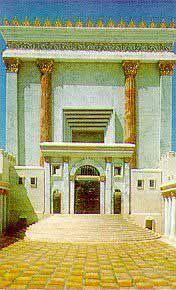
The First Temple - Solomon's Temple
The crowning achievement
of King
Solomon's reign was the erection of the
magnificent Temple (Hebrew- Beit haMikdash)
in the capital city of ancient Israel - Jerusalem. His
father, King
David, had wanted to build the great Temple a generation earlier, as a permanent
resting place for the Ark of the Covenant which contained the Ten Commandments.
A divine edict, however, had forbidden him
from doing so: "You will not build a
house for My name," God said to David,
"for you are a man of battles and have
shed blood" (I
Chronicles 28:3).
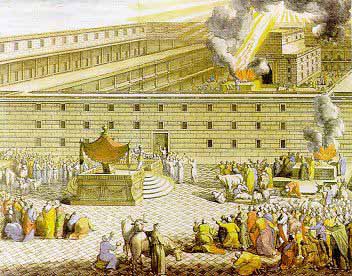 Artists rendering of Solomon's Temple
 |
The Bible's description of Solomon's Temple (also called The First Temple) suggests
that the inside ceiling was was 180 feet long, 90 feet wide, and 50
feet high. The highest point on the Temple that King Solomon built was
actually 120 cubits tall (about 20 stories or about 207 feet).
According
to the Tanach (II
Chronicles):
3:3- "The length by cubits after the ancient measure
was threescore cubits, and the breadth twenty cubits".
3:4- "And the porch that was before the house, the length of it, according
to the breadth of the house, was twenty cubits, and the height a hundred
and twenty; and he overlaid it within with pure gold."
Solomon spared no expense for the building's creation. He
ordered vast quantities of cedar wood from King Hiram of Tyre (I
Kings 5:2025), had huge blocks of the choicest stone quarried,
and commanded that the building's foundation be laid with hewn stone.
To complete the massive project, he imposed forced labor on all his
subjects, drafting people for work shifts that sometimes lasted a month at a time.
Some 3,300 officials were appointed to oversee the Temple's erection
(5:2730). Solomon assumed
such heavy debts in building the Temple that he is forced to pay off
King Hiram by handing over twenty towns in the Galilee (I
Kings 9:11).
When the Temple was completed, Solomon inaugurated it
with prayer and sacrifice,
and even invited nonJews to come and pray there. He urged God to pay
particular heed to their prayers: "Thus all the peoples of the
earth will know Your name and revere You, as does Your people Israel;
and they will recognize that Your name is attached to this House that
I have built" (I Kings 8:43).
Sacrifice was the predominant mode of divine service
in the Temple until it was destroyed by the Babylonians some four hundred years later, in 586 BCE. Seventy years later, after the story of Purim, a number of Jews returned to Israel - led by the prophets Ezra and Nehemiah - and the Second Temple
was built on the same site. Sacrifices to God were once again resumed. During the first century B.C.E., Herod, the Roman appointed head of Judea, made substantial modifications to the Temple and the surrounding mountain, enlargening and expanding the Temple.
The Second Temple, however, met the same fate as the first and was destroyed by the Romans in 70 C.E., following the failure of the Great
Revolt.
As glorious and elaborate
as the Temple was, its most important room
contained almost no furniture at all. Known
as the Holy of Holies (Kodesh Kodashim),
it housed the two tablets of the Ten Commandments inside the Ark of Covenant.
Unfortunately, the tablets disappeared when
the Babylonians destroyed the Temple and,
therefore, during the Second Temple era the Holy of
Holies was reduced to small, entirely bare room. Only
once a year, on Yom
Kippur, the High Priest would enter this
room and pray to God on behalf of the Israelite nation. A
remarkable monologue by a Hasidic rabbi in the Yiddish play The Dybbuk conveys a sense of
what the Jewish throngs worshiping at the
Temple must have experienced during this ceremony:
God's world is great and
holy. The holiest land in the world is the
land of Israel. In the land of Israel the
holiest city is Jerusalem. In Jerusalem the
holiest place was the Temple, and in the
Temple the holiest spot was the Holy of
Holies.... There are seventy peoples in
the world. The holiest among these is the
people of Israel. The holiest of the people
of Israel is the tribe of Levi. In the tribe
of Levi the holiest are the priests. Among
the priests, the holiest was the High Priest....
There are 354 days in the [lunar] year.
Among these, the holidays are holy. Higher
than these is the holiness of the Sabbath.
Among Sabbaths, the holiest is the Day of
Atonement, the Sabbath of Sabbaths.... There
are seventy languages in the world. The
holiest is Hebrew. Holier than all else
in this language is the holy Torah, and
in the Torah the holiest part is the Ten
Commandments. In the Ten
Commandments the holiest of all words
is the name of God.... And once during the
year, at a certain hour, these four supreme
sanctities of the world were joined with
one another. That was on the Day of Atonement,
when the High Priest would enter the Holy
of Holies and there utter the name of God.
And because this hour was beyond measure
holy and awesome, it was the time of utmost
peril not only for the High Priest but for
the whole of Israel. For if in this hour
there had, God forbid, entered the mind
of the High Priest a false or sinful thought,
the entire world would have been destroyed.
To this day, traditional Jews pray three times a day
for the Temple's restoration.
Over the centuries, the Muslims who eventually took control of Jerusalem built two mosques on the Temple Mount, the site of the two Jewish Temples. (This was no coincidence; it is a common Islamic custom to build
mosques on the sites of other people's holy places.) Since any attempt
to level these mosques would lead to an international Muslim holy war
(jihad) against Israel, the Temple cannot be rebuilt in the foreseeable
future.
Sources: Joseph Telushkin. Jewish
Literacy. NY: William Morrow and Co., 1991. Reprinted by permission
of the author.
|