|
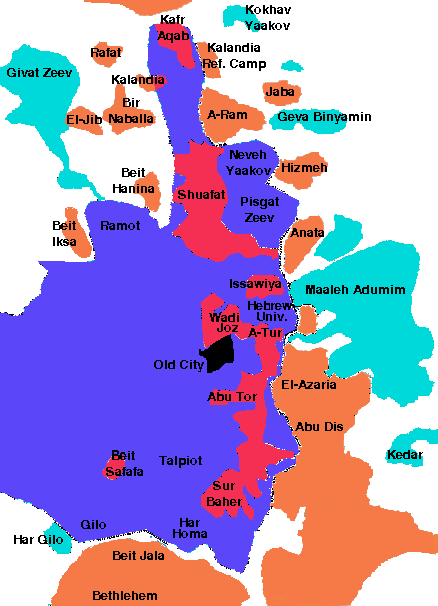
The Proposed Division of Jerusalem(July 2000)The map below is based on one which appeared in the Israel daily newspaper Maariv on July 27, 2000, just after the conclusion of the Camp David talks on the Israeli-Palestinian final status agreement. According to the accompanying article by reporter Ben Caspit, Israeli negotiators under Prime Minister Ehud Barak for the first time proposed to divide Jerusalem into two cities: a Jewish city to be known as Jerusalem which would serve as Israel's capital, as it does now; and an Arab city to be known as Al-Quds, the Arabic name for Jerusalem, which would serve as the capital of a new Palestinian Arab state.
The Israeli proposal included the following main points: 1. Jewish areas outside Jerusalem's municipal boundaries would be annexed to the city, including such population centers as Givat Ze'ev, Ma'aleh Adumim and Gush Etzion. (Gush Etzion is a major settlement block just south of Jerusalem, and is not shown on the map). 2. Arab areas outside Jerusalem's municipal boundaries would become the heart of the new Arab city of Al-Quds, including regions such as Abu Dis, el-Azaria, Beit Jala, Anata and A-Ram. 3. Arab neighborhoods inside Jerusalem's present boundaries would either be annexed to Al-Quds or would be granted extensive self-rule. Though some of these areas would remain formally under Israeli sovereignty, in practice Israel would have little authority over them. 4. Jerusalem's ancient, walled Old City would be divided, with the Muslim and Christian quarters offered autonomy under formal Israeli sovereignty, while the Jewish and Armenian quarters remained fully under Israeli rule. The Palestinian state would gain religious autonomy over the Temple Mount, though Israel proposed that an area be set aside for Jewish prayer on the site. The Palestinians rejected the proposal, sticking to their demand for full sovereignty over all of Jerusalem's Arab neighborhoods. An American compromise proposal granting them sovereignty over the Old City neighborhoods but autonomy over the city's other Arab neighborhoods, or vice versa, was also rejected, though the Israeli side had indicated its readiness to consider this as well. Since the Camp David meeting, negotiations have continued on and off with new ideas about Jerusalem being floated by the United States, Israel and the Palestinians. Source: IRIS |
|
|||||||||||||