PLACES TO VISIT:
Ashkelon
Israel has one of the world's most beautiful coastlines,
with white sandy beaches and spectacular Mediterranean views. The coast
stretches to the northern border with Lebanon at Rosh
Hanikra and south to the Gaza Strip. Just north of Gaza and 36 miles
south of Tel Aviv is the southernmost stop for most tourists, the city of
Ashkelon.
Israel Fact
Archaeologists have
unearthed a large cemetery for dogs in Ashkelon. They do not know the
significance of this cemetery or why dogs would have merited this
treatment. |
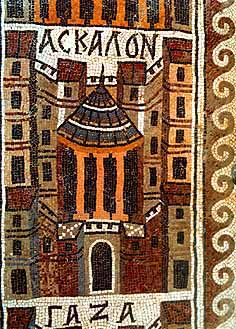
Like so many other places in Israel, Ashkelon is built
upon the ruins of past civilizations. This was one of five Philistine
city-states (along with Gath, Gaza, Ekron and Ashdod). The city also plays
a role in biblical history as the place where Delilah cut Samson's hair to
sap his strength (Judges XIV-XVI). Ashkelon was also a great trading center because it lay along the Via Maris, the route linking Egypt with Syria and Mesopotamia.
The city was first settled at the end of the third
millennium B.C.E. It
was conquered by the Philistines in the second half of the 12th century.
After the Israelite conquest of the rest of the area, the two peoples
engaged in several hundred years of conflict. After King Saul was slain by
the Philistines, David lamented:
Tell it not in Gath, publish it not in the streets of
Ashkelon; lest the daughters of the Philistines rejoice, lest the
daughters of the uncircumcised triumph. (II
Samuel 1:20)
Even after David defeated the Philistines in much of the
rest of the country, he could not dislodge them from Ashkelon. This was
finally accomplished by the Assyrian conqueror Tiglath-Pileser III in 734
B.C.E. After roughly 600 years in the region, the Philistines disappeared
forever.
The city passed through the hands of the region's subsequent invaders
before enjoying a renaissance under the Greeks and Romans. After the Jews,
under the leadership of the Maccabeans, overthrew the Greeks in the 2nd
century, Ashkelon became an autonomous city. It is believed that Ashkelon
was the birthplace of Herod (in 37 B.C.E.), who enlarged and beautified
the city, constructing a summer house, palaces and an aqueduct. Under
the Romans, Ashkelon was also granted the rare privilege of being exempt
from taxes. It became a flourishing trade center and, in particular, a
major wine producer.
The city became a Christian city in the Byzantine
period and was captured by the Muslims in 638 C.E. The Crusaders came next in 1153, but were defeated by Saladin. Richard the Lion Heart
led the Crusaders back, but they were eventually driven out in 1280 by
Sultan Baybars. The city was then abandoned until 1948 when the Jews of
the new State of Israel began to rebuild it. Ashkelon was reestablished
as an Israeli city in 1953.
Today,
Ashkelon is enjoying a growth spurt, fueled in part by immigrants from
the former Soviet Union. The population is now roughly 90,000. This is
primarily a place to hit the beach, though some interesting archaeological
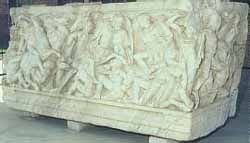
ruins are continuing to be unearthed. These include a Byzantine church, a Roman tomb and one
of the oldest arched gateways in the world. One of the most notable recent
finds is a bronze and silver calf that is more than 3,500 years old and
may be distantly related to the biblical tale of the golden calf.
The National Park
This is the site in Ashkelon
of the ancient cities. It is located on the
southern coast of modern Ashkelon. From the
entrance, the road passes through the 12th
century Crusader city walls and the Canaanite
earth ramparts. There are several ongoing
excavation sites near the sea, which reveal
the city's biblical roots. One of the most
intriguing sections of the Park is the sculpture
garden, in which many Roman statues stand.
There are also several ruins of Byzantine
and Crusader churches nestled within the Park.
Yad Mordechai
Just
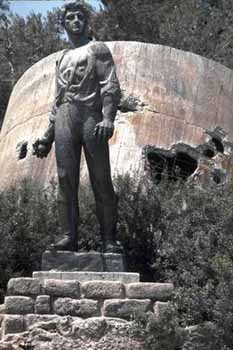
south of Ashkelon is Kibbutz Yad Mordechai, which was founded in 1943 and
named after Mordechai
Anilewicz, the leader of the Warsaw
Ghetto uprising. A giant statue of the hero overlooks the community.
Behind it is the Kibbutz's old water tower that was shelled by the
Egyptians during the 1948 War.
The kibbutz has a museum dedicated to the ghetto fighters. It also has its own exciting
history because it was on the frontline during the War
of Independence in 1948 and was captured and destroyed by the
Egyptians. The kibbutz was subsequently recaptured and rebuilt. The kibbutz
also has reconstructed a scene from the war with life-size cut-outs with
rifles and helmets representing the Egyptians.
Ashdod
Back
along the coastal road toward Tel Aviv is another of the major Philistine cities, Ashdod. It was the
Philistines who made the mistake of taking the Ark of the Covenant (I
Samuel 5, 1-6) and bringing it to Ashdod. Afterward, the community was
struck by a number of calamities that led the Philistines to return the Ark
to the Israelites.
About four miles south of the present city is Tel Ashdod,
the site of the biblical city that was first mentioned in the Tanakh as one of the cities allocated to the tribe
of Judah (Joshua 15:47).
Ashdod was an important city because of its location along the coastal
route leading from Egypt to Syria and Mesopotamia.
Ashdod also has significance to Christians because
Philip the Evangelist (or the Deacon) received "the call" to go
into the desert and preach to a eunuch, a minister of the queen of
Ethiopia. Philip converted and baptized the man and returned along the
coast through Ashdod where he preached to its citizens (Acts
8).
At the southern entrance of the city is a bridge where
the fledgling Israeli army stopped the Egyptian Army's advance toward Tel
Aviv in the 1948 War.
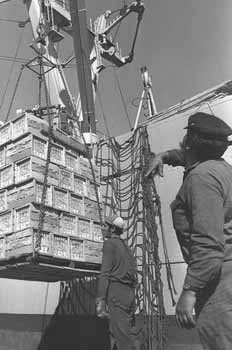
It was founded by the Jews in 1957, and has been rapidly
developing since. Today, Ashdod is a thriving city of 150,000 people,
which has surpassed Haifa as Israel's busiest port, which was constructed
in 1966. Ashdod's two power plants also supply roughly half of Israel's
electricity.
Rishon Lezion
Further north is Rishon Lezion, a town founded in 1882
by Russian immigrants that has grown into one of Israel's principal wine
centers. Baron Edmond de
Rothschild provided funding that helped establish the wine industry.
Free guided tours are available at the wineries. This is also where the
first kindergarten and elementary schools were founded.
Rehovot
Traveling inland not far from Rishon Lezion is Rehovot,
the home of the Weizmann
Institute of Science. The university was dedicated
in 1949 in honor of Chaim
Weizmann, Israel's first president, who actually founded the
institution as the Sieff Institute in 1934. Dr. Weizmann, who was a
renowned chemist himself, and his wife had a home on the campus as well,
which is now open to the public. Weizmann's tomb is also nearby.
Rehovot is also home to the Ayalon
Institute Museum. This was an underground munitions factory used during
the mandatory period.
Kiryat Gat
A rapidly growing town 15 miles east of Ashkelon, Kiryat
Gat is near the tel believed to be the site of Gath, one of the five
important Philistine cities and the birthplace of Goliath.
Lachish
The town of Lachish 20 miles east of Ashkelon may have
first been inhabited 5,000 years ago. It is first mentioned in the Bible
when Joshua killed all the people and hung its king (Joshua
10:22-32). King David developed the city and his grandson Rehoboam
fortified it. In the 6th century B.C.E., however, the Babylonian conqueror
Nebuchadnezzar destroyed the city. When Jews returned after their
Babylonian exile, they rebuilt
the city. It was abandoned again, however, after the destruction of the Second
Temple in 70 C.E. and was never resettled.
Beit Guvrin
When
Maresha fell in the 1st century BC, the nearby city of Beit Guvrin became
an important regional center. An ancient city 24 miles east of Ashkelon.
The city was at the center of the largest region in Palestine during the Roman occupation and was enlarged
and fortified by the Roman Emperor Septimus Severus. It was conquered
by the Crusaders who built
a citadel. Saladin destroyed the city. Evidence of Jewish life is the
3rd century synagogue ruins. The ornate Sidonian tombs are testaments
to the affluence of the 3rd and 4th century inhabitants.
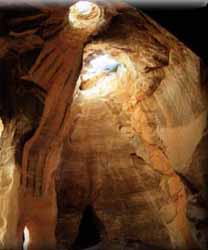
Not far from the Crusader ruins are a series of enormous limestone caves, some of the 800 in Beit
Guvrin, dating back to the Hellenistic times. The caves were used as water
cisterns, animal pens, burial, raising pigeons, oil industry and, more
recently, as one of the sets for the film Rambo III. Some caves
were also used as churches and you can still see crosses carved on the
walls. Ongoing excavations are uncovering a Roman amphitheater near the
entrance to Kibbutz Beit Guvrin.
Israel Fact
Small holes cut
into the limestone of the caves puzzled scholars for years until they
figured out they were used to raise pigeons for meat, communications
and sacrifices. |
Also nearby is Tel Maresha, another hill fortified by
Rehoboam. An interesting historical fact is that when the Hasmonean ruler, John Hyrcanus, captured the area in 125 B.C.E., he forcibly
converted the Idumean population to Judaism to ensure their loyalty.
Referring to Beit Guvrin as a “microcosm of the land of the caves,” the UN Educational, Scientific and Cultural Organization (UNESCO) designated the Beit Guvrin National Park as a UNESCO World Heritage site in April 2015. Beit Guvrin joined Masada, the Old City of Acre, the Baha'i holy places, and four others as designated UNESCO World Heritage sites in Israel
Amatzia
Another series of caves are in Amatzia, a small park
east of Ashkelon and south of Beit Guvrin. The complex of caves was used by
Jewish rebels during the Bar-Kokhba
Revolt in the 2nd century. Approximately 300 people
lived in the cavern's 35 rooms. The restored complex
includes an underground synagogue, a guard room, water
cisterns, store rooms, an oil press and secret hideaways.
Tel Ekron
Northeast of Ashkelon is another of the five great Philistine
cities, Ekron. The city was founded in the twelfth century B.C.; first
mentioned in the Bible in Joshua 13:2-3. Under Assyrian rule, Ekron became
the largest olive-oil production center in the ancient Near East.
More than 100 oil presses were found here. It supplied the Egyptian and
Assyrian Empire with as much as 700 tons of oil a year. Artifacts from
the Philistine period and a reconstructed Philistine street are in nearby
Kibbutz Revadim.
Previous
Next
|