Israel Cabinet & Ministers: Thirtieth Government
(February 28, 2003 - May 4, 2006)
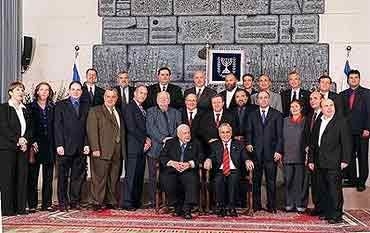 |
President
Moshe Katsav — President of the State of Israel:
Cabinet Ministers
Ariel Sharon - Prime Minister
Ehud Olmert - Acting Prime Minister since Jan 4 2006. Minister of Industry, Trade and Labor; Minister of Finance; Minister of the Interior; Minister of Social Welfare
Ronnie Bar-On - Minister of National Infrastructures; Minister of Science and Technology
Ze'ev Boim - Minister of Housing and Construction; Minister of Agriculture and Rural Develoment
Ya'akov Edery - Minister of Health, Minister for the Development of the Negev and Galilee
Gideon Ezra - Minister of Public Security; Minister of the Environment
Tzachi Hanegbi - Minister in the Prime Minister's Office
Abraham Hirchson - Minister of Tourism; Minister of Communications
Tzipi Livni - Minister of Foreign Affairs; Minister of Immigrant Absorption; Minister of Justice
Shaul Mofaz - Minister of Defense
Meir Sheetrit - Minister of Transportation and Road Safety; Minister of Education, Culture and Sport
Deputy Ministers
Eli Aflalo - Deputy Minister of Industry and Trade (Kadima)
Ruhama Avraham - Deputy Minister of the Interior (Kadima)
Shmuel Halpert - Deputy Minister of Transportation (Agudat Israel)
Avraham Ravitz - Deputy Minister of Social Affairs (Degel Hatorah)
Marina Solodkin - Deputy Minister of Immigrant Absorption (Kadima)
Majalli Whbee - Deputy Minister of Education, Culture and Sports (Kadima)
Senior Government Officials
Reuven Rivlin- Speaker of the Knesset
Aharon Barak - President of the Supreme Court
Micha Lindenstrauss - State Comptroller and Public Complaints Commissioner
Lieutenant-General Dan Halutz - IDF Chief of General Staff
Moshe Karadi - Commissioner of Police
Menachem Mazuz - Attorney General
Stanley Fischer - Governor of the Bank of Israel
Rabbi Shlomo Amar - Sephardi Chief Rabbi
Rabbi Yona Metzger - Ashkenazi Chief Rabbi
Tourism Minister Benyamin Elon (National Union) and Minister of Transportation Avigdor Lieberman (National Union) were fired by Sharon on June 4, 2004.
Minister of Housing and Construction Efraim Eitam (NRP), and Deputy Minister in the Prime Minister's OfficeYitzhak Levy (NRP) resigned on June 8, 2004.
National Infrastructure Minister: Joseph Paritzky (Shinui) was fired in July 2004.
Deputy Minister of Education, Culture and Sport: Zvi Hendel (National Union) — The National Union left the government in July 2004.
Environment Minister Yehudit Naot resigned September 20, 2004, for health reasons.
Minister of Labor and Social Affairs: Zevulun Orlev (NRP) resigned in November 2004 after the Knesset approved Sharon's disengagement plan.
Minister without Portfolio: Uzi Landau (Likud) was fired in November 2004 for opposing Sharon's disengagement plan.
Deputy Minister of Industry and Trade: Michael Ratzon (Likud) was fired in November 2004 for opposing Sharon's disengagement plan.
On December 1, 2004, Sharon fired the following ministers from the Shinui party for voting against the government's 2005 budget: Minister of Justice and Deputy Prime Minister: Yosef Lapid; Minister of National Infrastructures: Eliezer Sandberg; Interior Minister: Avraham Poraz; Minister of Science and Technology; Acting Minister of the Environment: Ilan Shalgi; Deputy Minister of the Interior: Victor Brailovsky.
In January 2005, a unity government was formed that included representatives of Likud, Labor and Meimad.
Minister without Portfolio Natan Sharansky (Yisrael b'Aliyah/Likud) resigned from the government on May 2, 2005.
Benjamin Netanyahu (Likud) resigned as Finance Minister in August 2005.
**Appointed by Sharon, but rejected by Knesset by the Knesset on November 8, 2005
Sources: Israeli Foreign Ministry

Download our mobile app for on-the-go access to the Jewish Virtual Library