Rome, Italy
The Jewish community in Rome is known to be the
oldest Jewish community in Europe and also one the oldest continuous
Jewish settlements in the world, dating back to the first century BCE.
- The Classic Period
- The Christian Empire
- The Middle Ages
- The Renaissance
- The Jewish Ghetto
- Late 19th-Early 20th Century
- Rome During World War II
- Rome Today
- Jewish Tourist Sites
- Former Jewish Cemetery of Rome
- Jewish Museum of Rome
The Classic Period
The Jewish community in Rome is known to be the
oldest Jewish community in Europe and also one the oldest continuous
Jewish settlements in the world, dating back to 161 B.C.E.
when Jason ben Eleazar and Eupolemus ben Johanan came as envoys of Judah
Maccabee. Other delegations were sent by the Hasmonean
rulers in 150 and 139 B.C.E. After the Romans invaded Judea in 63 B.C.E., Jewish prisoners of war were brought to
Rome as slaves, Jewish delegates came to Rome on diplomatic missions
and Jewish merchants traveled to Rome seeking business opportunities.
Many of those who visited Rome stayed and the Jewish population began
to grow.
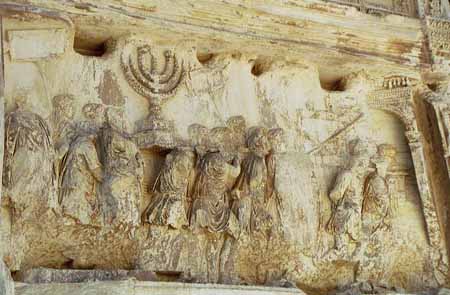 The Arch of Titus was built by the Roman
commander to commemorate his Judean victory in 70 C.E. It shows
the triumphal parade with the Temple vessels carried aloft.
The Arch of Titus was built by the Roman
commander to commemorate his Judean victory in 70 C.E. It shows
the triumphal parade with the Temple vessels carried aloft. |
While
the treatment of Jews by the Romans in Palestine was often harsh,
relations with the rulers in Rome were generally much better. Julius
Caesar, for example, was known to be a friend of the Jews; he allowed
them to settle anywhere in the Roman Empire. According to historians,
when Caesar was assassinated by Brutus in 44 B.C.E., Roman Jews spent
day and night at Caesar’s tomb, weeping over his death. His
successor, Augustus, also acted favorably toward the Jews and even
scheduled his grain distribution so that it would not interfere with
the Jewish Sabbath. Two synagogues were founded by slaves who had
been freed by Augustus (14 C.E.) and by Agrippa (12 B.C.E.).
Twice in the Classic period, Jews were exiled from
Rome, in 19 C.E. and in 49-50 C.E. The first exile took place due to
the defrauding of an aristocratic Roman woman Fulvia, who had been
attracted to Judaism. The second exile occurred because of
disturbances caused by the rise of Christianity. It is not certain,
though, that these measures were fully carried out or that the period
of exile lasted a long time.
During the Roman-Jewish wars in Palestine in 66-73
and 132-135, Jewish prisoners of war were brought to Rome as slaves.
A number of the oldest Jewish Roman families trace their ancestry in
the city to this period. Jewish scholars from Israel came to Rome in
95-96. In 212, Caracella granted the Jews the privilege of becoming
Roman citizens.
From the second half of the first century C.E.,
the Roman Jewish community became firmly established. A majority of
the community were shopkeepers, craftsman and peddlers, but other
Jews became poets, physicians and actors. Satiric poets of the time,
such as Juvenal and Martial, depicted the raucous activities of the
Jewish peddlers and beggars in their poetry. Evidence has been found
that twelve synagogues were functioning during this period (although
not at the same time). Unfortunately, none of those synagogues have
been preserved.
The Christian Empire
The Jewish position in Rome began to deteriorate
during the reign of Constantine the Great (306-336), who enacted laws
limiting the rights of Jews as citizens. Jewish synagogues were
destroyed by Christian mobs in 387-388 and in 493-526 (during the
reign of Theodoric). When Rome was captured by Vandals in 455, spoils
of the Jerusalem Temple were taken to Africa.
Once
Christianity became the official religion of the Roman Empire,
emperors further limited the civil and political rights of the Jews.
Most of the imperial laws dealing with the Jews since the days of
Constantine are found in the Latin Codex Theodosianius (438) and in
the Latin and Greek code of Justinian (534). Some of the relevant
decrees in these codes include prohibitions against making
proselytes, intermarriage, owning slaves (slave labor was very common
and this prohibition severely restricted the economic life of the
Jews), holding any esteemed position in the Roman state, building new
synagogues and testifying against Orthodox Christians in court.
During this period there was a revival of Hebrew
studies in Rome, centered around the local yeshiva, Metivta de Mata
Romi. A number of well-known scholars, Rabbi Kalonymus b. Moses and
Rabbi Jacob "Gaon" and Rabbi Nathan b. Jehil (who wrote a
great talmudic dictionary, the Arukh), contributed to Jewish learning and
development. Roman Jewish traditions followed those practiced in the
Land of Israel and the liturgical customs started in Rome spread
throughout Italy and the rest of the world.
The Middle Ages
From
the 1200's to the mid 1400's, treatment of the Jews varied from pope
to pope. For example, in 1295, Pope Bonifice VIII humiliated a
visiting Jewish delegation that was sent to congratulate him on his
ascendancy; whereas, Pope Boniface IX (1389-1404) treated the Jews
benevolently. He favored a succession of Jewish physicians and
recognized the rights of Jews as citizens. On the other hand,
Eugenius IV (1431-47) passed anti-Jewish legislation in the Council
of Constance.
The Renaissance
The
Jews of Rome fully participated in the flourishing economic and
intellectual climate of the Renaissance. They became merchants,
traders and bankers, as well as artisans. During the reign of Pope
Alexander VI (1492-1503), however, a special tax was imposed on the
Jews of Rome to pay for his military operations against the Turks.
Later popes during the first half of the 16th Century were more
sympathetic to the Jewish community than Alexander VI. The Medici
Popes, Leo X (1513-1521) and Clement VII (1523-1534), treated the
Jews well. Leo X abolished certain discriminatory levies, did not
enforce the wearing of the badges Jews had been forced to put on in
the 12th century and also sanctioned the establishment of the Hebrew
Printing Press. Leo X, as well as other popes from this period, such
as Sixtus IV, retained Jewish physicians in Rome.
The Jewish Ghetto
 Map of the Jewish Ghetto in Rome
 |
During the Reformation, in 1555, Pope Paul IV
decreed that all Jews must be segregated into their own quarters
(ghettos), and they were forbidden to leave their home during the
night, were banned from all but the most strenuous occupations and
had to wear a distinctive badge — a yellow hat. More than 4,700
Jews lived in the seven-acre Roman Jewish ghetto that was built in
the Travestere section of the city (which still remains a Jewish
neighborhood to this day) If any Jews wanted to rent houses or
businesses outside the ghetto boundaries, permission was needed from
the Cardinal Vicar. Jews could not own any property outside the
ghetto. They were not allowed to study in higher education
institutions or become lawyers, pharmacists, painters, politicians,
notaries or architects. Jewish doctors were only allowed to treat
Jewish patients. Jews were forced to pay an annual stipend to pay the
salaries of the Catholic officials who supervised the Ghetto Finance
Administration and the Jewish Community Organization; a stipend to
pay for Christian missionaries who proselytized to the Jews and a
yearly sum to the Cloister of the Converted. In return, the state
helped with welfare work, but gave no money toward education or
caring for the sick. These anti-Jewish laws were similar to those
imposed by Nazi Germany on the Jews during World War II.
During
the Reformation, talmudic literature as a whole was banned in Rome. On Rosh
Hashana 1553, the Talmud and other Hebrew books were burned. Raids of the ghetto were common,
and were conducted to insure that Jews did not own any
"forbidden" books (any other literature besides the Bible and
liturgy). It was forbidden to sing psalms or dirges when escorting the
dead to their burial place. Every Saturday, a number of Jews were
forced to leave the ghetto and listen to sermons delivered in local
churches. Also, whenever a new Pope was ordained, the Jews presented
him with a Torah scroll. Jews continued to live in the ghetto for
almost 300 years.
Late 19th - Early 20th Century
In 1870, Italy was united as a nation under King
Victor Emanuel, who decreed that the ghettos be dismantled and gave the
Jews full citizenship. Following the end of the papal states, Jews
fully integrated into Italian society. They comprised a significant
percentage of the university teachers, generals and admirals. A number
of Jews were involved in government and were close advisors of
Mussolini; they convinced Mussolini to intervene in the First World
War. Five Jews were among the original founders of the fasci di
combattimento in 1919 and were active in every branch of the
Fascist movement. Both Mussolini’s biographers, Margharita Sarfatti,
and his Minister of Finance, Guido Jung, were Jews.
Rome During World War II
In 1931, approximately 48,000 Jews lived in Italy.
By 1939, up to 4,000 had been baptized, and several thousand other Jews
chose to emigrate, leaving 35,000 Jews in the country. During the war,
the Nazi pressure to implement discriminatory measures against Jews
was, for the most part, ignored or enacted half-heartedly. Most Jews
did not obey orders to be transferred to internment camps and many of
their non-Jewish neighbors and government officials shielded them from
the Nazis. Some Jews were interned in labor camps in Italy.
After the north was occupied by the Germans in 1943,
the Nazis wanted to deport Italian Jewry to death camps, but resistance
from the Italian public and officials stymied their efforts. A gold
ransom was extorted to stop the S.S. commanding officer in Rome from
killing 200 Jews. Still, nearly 8,000 Italian Jews perished in the Holocaust,
but this number was significantly less than in most
countries in Europe. Roughly 80 percent of the Italian Jews
survived the war. In 2000, a stone plaque was unveiled at the Tiburtina
train station, the site of the deportations, to honor the memory
of Rome's Jews, whom the Nazis deported from the city on Oct. 16, 1943.
Rome Today
Today, a diverse community of 15,000 Jews lives in
Rome (communita Ebraica di Roma). The Jewish community’s
organization, based in Rome, the Unione delle Comunita Ebraiche
Italiane, is directly involved in providing religious, cultural,
and educational services and also represents the community politically.
The monthly publication Shalom is the Roman community's key
publication, and Rome also has Jewish cultural clubs and several
schools.
In 1987, the Jewish community obtained special
rights from the Italian state allowing them to abstain from work on the Sabbath and to observe Jewish
holidays At least 13 synagogues can
be found in Rome, including a special synagogue for the Libyan
Jews who immigrated to Rome after the Six-Day
War in 1967. Three of thirteen synagogues are located under the
same roof at Via Balbo 33 (Itlaki, Sephardic and Ashkenazi). The
Italian chief rabbi officiates at the Great Synagogue of Rome and heads
the country's rabbinical council.
The continual presence of a Jewish community in Rome
for more than two millennia has produced a distinctive tradition of
prayer — comparable to the Sephardic or Ashkenazi traditions —
called the Nusach Italki (Italian rite). The nusach has
its own order of prayer and tunes. A number of synagogues in Rome,
including the Great Synagogue, follow this tradition. Most synagogues
in Italy are Sephardic.
In October 2013, Rome's Jewish community gathered in the city's main synagogue to commemorate the October 16, 1943, roundup of Jews from the Rome Ghetto. The Jews were bound for Auschwitz; only a dozen survived. The community also discussed the passing of Nazi criminal Erich Priebke who was convicted for crimes against humanity from the massacre at the Ardeatine Caves outside Rome in which 335 civilians, mostly Jews, were slaughtered in cold blood.
Jewish Tourist Sites
Among the places worth visiting is Ostia Antica, the
ancient seaport near Rome. Jews in Ostia were middle class and
participated in a variety of trades, such as blacksmiths, tailors,
butchers and actors. They were better off than the Jews in Rome and
permitted to build and maintain a fine synagogue.
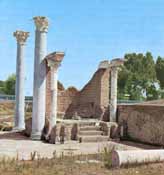
The
synagogue of Ostia Antica is among the oldest in Europe and one of the
oldest in the world. The remains of a 4th-century synagogue constructed
on the site of a synagogue from the 1st century B.C.E. and the
catacombs in Rome was discovered in 1961-62. Near the entrance
courtyard of the synagogue is an area that contained a large oven,
storage jars and a marble-topped table decorated with menorahs.
It is believed this was a kitchen and/or dining room. Next to this room
is one that includes benches that might have been used as beds by
traveling merchants.
Another
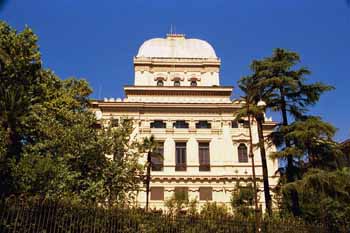
interesting synagogue to visit is the Synagogue of Rome, Longotevere
Cenci, which was built from 1874-1904 after the emancipation of the
Italian Jews following Italy’s unification. It has a unique Persian
and Babylonian architectural design that contrasts with the rest of the
city, which uses an ornamental baroque style. Inside the synagogue, a museum chronicles the history of Rome’s Jews.
It
is possible to visit the old ghetto in the Travestere section. The
first stop in the ghetto should be the Museo del Folklore, which
contains paintings depicting 19th Century Roman ghetto life. Also in
the ghetto, on Via Della Regiella, there is a narrow street lined with
seven-story buildings where the ghetto was so small Jews were forced to
build upward.
The place where Jews were sent for deportation
during the German occupation is in the piazza (square) between Portico
d’Ottavia and Tempo Maggiaore. A plaque on one of the buildings
reads, "On October 16, 1943, here began the merciless rout of the
Jews. The few who escaped murder and many others, in solidarity, pray
for love and peace from mankind and pardon and hope from God."
Many
of the Christian churches offer magnificent artwork that contain
biblical subjects and themes. Among Michelangelo’s many magnificent
works in Rome is the statue of Moses in the Church of San Pietro in
Vincoli. This is the sculpture with horns coming out of the head of
Moses. The depiction was apparently based on a mistranslation of the Bible,
which speaks of "rays" shining from Moses when he emerged
from Sinai with the Ten Commandments.
The Hebrew word for "rays" is similar to the word for
"horns."
One important relic that ties Rome and Israel
together is the Arch of Titus (opposite the Roman Forum). It was built
by the Roman commander to commemorate his Judean victory in 70 C.E. It
shows the triumphal parade with the Temple vessels carried aloft. A
replica of the arch is in Beth Hatefutsoth, the Museum of the Diaspora
in Tel Aviv.
Former Jewish Cemetery of Rome
In 1645, Pope Urban VIII began construction on a defensive perimeter wall for Rome that was going to interfere with the city's main Jewish cemetery of Porta Portese. In April of that year, the new Pope Innocent X arranged for the Jewish Society of Charity and Dead to purchase an area of land in Cerchi and the cemetery was moved to this plot. As this area began to fill up, in 1728 Pope Benedict XIII gave the Jewish Society permission to buy neighboring land in order to expand, and once this plot was full as well, Pope Pius VI in 1775 pressured another landowner to sell a plot for the expansion of the cemetery.
 All that remains of the cemetary is a road and a rose bed
 |
In 1934, more than a century and a half later, the government of Rome expropriated all land in the area of the 250 year old Jewish cemetery and began construction on a road that ran right through the heart of the burial ground. The cemetery was decided to be transferred to a part of the Campo Verano and working quickly to finish the road, the city exhumed and transferred bodies from the cemetery in a hurry, often times working on Jewish holidays and without religious Jewish supervision.
A total of 7,800 corpses were recovered from the cemetery, but unfortunately not all of the bodies were properly identified. Additionally, in the rush to finish the project, many bodies were recovered as late as two days before the road was inaugurated while some areas were not searched and others were so haphazardly investigated that it is likely that thousands of corpses remain buried.
In 1950, the city built a rose garden in the area, just a short distance from Circo Massimo and the Aventine hill. The president of the Jewish community at the time gave his consent for the construction of The Roseto Comunale of Rome with the condition that a single star be placed above the entrance to remind visitors of its sacred origin.
This star is still present today.
The other evidence of the Jewish connection to the site is the central staircase, which is in the shape of a menorah.
Jewish Museum of Rome
Over two millenia, the Jewish community
of Rome has left behind some of the most compelling records
and artifacts ever found in Europe. Many of these archaeological
finds are showcased in Rome's newly renovated Jewish
museum, the Museo Ebraico di Roma. Although the museum
has been open and functioning since 1959, a new European
Union-funded $2 million renovation gave the museum a
complete remodeling. Instead of merely exhibiting artifacts,
the museum incorporates them with photographs and documents
to narrate the history of Rome's Jewish community, the
oldest community of its kind in Europe.
The museum is host to several exhibits
which highlight the Jewish connection to Rome. The Gallery
of Antique Marbles is a collection of precious marbles
from the synagogues of the Ghetto of Rome. The Gallery
contains over 100 inscriptions and architectural elements
that vary in size and content. According to the museum,
“The subjects of the inscriptions
vary but together they illustrate the social fabric,
daily life and history of the Jewish Community and its
presence in Rome. They commemorate donations from wealthy
families and the purchase of cemetery plots. They forbid
bringing leavened bread into areas where unleavened
bread is baked and record the activities of the confraternities
of charitable works. There are also family coats of
arms decorating objects that the families donated to
the community.”
Another permanent exhibit is the textile
collection, which contains around 800 quality textiles
from the 15th to the 19th centuries. The museum has
planned to build a Textile Preservation Center, which
will house some of the museum's most important finds.
The fabrics will be placed in air-tight storage containers
to prevent dust and sunlight that could be harmful to
the antiques.
Sources: Bridger, David (ed.). The
New Jewish Encyclopedia. Behrman House, Inc. Publishers, New
York. 1962.
Eban, Abba. Heritage:
Civilization and the Jews. Summit Books, New York.1984.
Johnson, Paul. A
History of the Jews. Harper & Row. New York. 1987
Lachter, Lewis Eric. "When in Rome, feast on beauty and
history," Washington Jewish Week, May 4, 2000.
The
Jewish Community in Rome
"Rome." Encyclopedia
Judaica.
"Rome" Let’s Go Europe 1990, Harvard Student
Agencies, Inc.
Jewish
Communities of the World ;
The Roseto Comunale of Rome, Rome Tour.org;
Museo
Ebraico di Roma;
JTA,
(December 14, 2005);
Associated Press (October 16, 2013).
Photo Credits: Photos of medieval Jews, ghetto map, Ostia synagogue,
Travestere copyright � Jews and Synagogues. EdizioniStorti
Venezia. 1999, the remainder copyright � Mitchell Bard. |