|
This city's name is spelled so many different ways --
Tzefiya (in the Talmud), Safad, Zefat, Sefad -- it's easy to get confused
and think they are entirely different places.
Regardless, if you see any of
these on your itinerary, it's a place you'll want to visit.
At an altitude of 2,790 feet (850 meters), Safed is
Israel's highest town and probably its coldest.
Safed did not become an
important center of Jewish life until the late 15th and early 16th
centuries. It is not mentioned in the Torah and was apparently not settled until Roman
times.
The Crusaders erected a citadel in the city, which, like most of their other structures,
came under the control of the Muslim conqueror Saladin in the late 12th century. The Crusaders returned a half-century later and built the largest Christian fortress in
the East, but that eventually fell to the Mamluks in 1266 under Sultan Beibars, who cut off the heads of the men and sold the
women and children into slavery.
 |
Jews
began to come in large numbers after they were expelled
from Spain in 1492 (while Columbus was sailing the ocean blue). The city is most closely associated with
Jewish mysticism, the kabbalah,
whose foremost exponent, Rabbi
Isaac Luria, lived and taught there. Known as "Ha'Ari" (the
lion), Luria had come from Egypt in 1569 and died just three years later.
The "bible" of the kabbalists, the Zohar, was written by
the second-century talmudist Rabbi Shimon bar Yochai, who believed each
word and line of the Torah had a higher meaning. The author of the main part of the Zohar was
Moses de Leon (12th century) in Spain.
Besides the kabbalists, Safad also attracted numerous
other Jewish scholars and spirtualists, including Joseph
Caro, the author of the Shulchan
Aruch, Rabbi Moshe Cordovero and Solomon
Alkabetz, composer of the Sabbath hymn Lecha Dodi.
The
Jewish community thrived in Safed for more than 400 years before the
outbreaks of violence in Palestine provoked many residents to leave. The 1929
Arab riots stimulated a gradual decline that resulted in the Arabs
becoming the majority in the city. When the British withdrew from Palestine
in 1948 and handed the
Citadel over to the Arabs, the remaining Jewish residents, backed by
reinforcements from the Haganah,
held off the Arab forces and kept the city a part of the new state of
Israel.
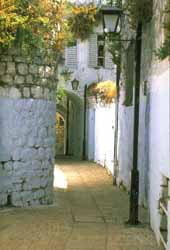
The city is a warren of cobblestone streets that lead to
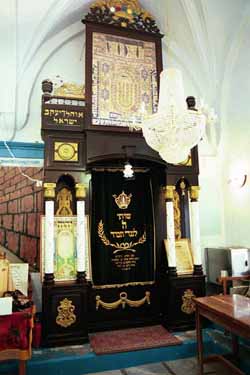
ancient synagogues. In the Caro Synagogue, named after the scholar, the Ark
contains a Torah scroll that is at least 400 years old. Many of the doors
of buildings in the city are painted blue to remind people of heaven.
Another pilgrimage site, just outside
Sefad, is the village of Meron. This
ancient city is mentioned in the records of Egyptian kings who invaded
the territory more than 3,000 years ago. A synagogue dating back 1,700
years was also found here. According to tradition, Rabbi Shimon bar Yochai
hid in a cave in nearby Peki’in and wrote the Zohar. Though one Jewish family claims to have lived
in the town since the days of the great Rabbi, today Peqiin is almost
entirely populated by Druze.
On Lag
Ba'Omer, thousands of Israelis hike up Mt. Meron (alt. 4,000 ft.)
to the tombs of Rabbi bar Yochai and his son Eleazer. People come to honor
the rabbi, who is said to have died on this date, and many have picnics
and go into the forest with bows and arrows. The following morning, three-year-old
boys are given their first hair cuts. Meron is also the final resting
place for the two great Talmudic sages, Hillel
and Shammai.
Down the Sefad road is the town of Rosh Pina, a name that means "cornerstone,"
which comes from Psalm 118:
"The stone that the builder has rejected has become the headstone
of the corner."
You can also contribute to the greening of Israel by
visiting the Jewish National Fund's Tree Planting Center just outside Safed.
For a small fee, you can plant a sapling, a tangible contribution like no
other you can make to Israel.
Israel Fact
A
tyrannical Arab governor of Sefad ordered
the Jews to bring him a certain number of
white chickens or face expulsion. The Jews went
to the grave of Rabbi Yossi Banai and prayed.
Miraculously, all the chickens in the town
turned white. |
Previous
Next
|