|
In 1947 and 1948, when the boundaries of the Jewish and
Arab states were being debated by diplomats, David
Ben-Gurion made it clear the Negev must be part of the Jewish state.
Though it was virtually uninhabited and thought by many to be uncultivable, Ben-Gurion knew
this region was needed if the state was to grow. He also had faith that the
desert could be tamed and turned into a place where Jews could settle and
prosper.
Many decades later, his vision has been realized. Still,
the desert remains untamed.
This is the wilderness where man met
God. Here Abraham communed with God, and, centuries later, the prophet Elijah came to the Mountain of God for a momentous encounter with the Creator.
This, in fact, is the region that gave birth to civilization on the banks
of the great rivers that surround the desert, and in the oases on the
fringes of the wilderness. The desert trails of the Negev were the conduits
for knowledge, culture and development.
Beersheba was first settled
during the Chalcolithic period. The inhabitants
lived in caves and worked in raising cattle
and the manufacturing of metal tools. At the
beginning of 2000 BCE, Abraham and Isaac arrived
in Beersheba. There they dug wells and also
formed alliances with Abimelech, the King
of the Philistines. During King
David's reign,
the Israelites conquered Beersheba, which
became a city of the tribe of Simeon and was
later incorporated into the tribe of Judah
(Josh. 15:28; 19:2).
The city became the capital of the “Negev
Yehuda." Following the Israelites
defeat from the conquering Babylonians, the
city was deserted for many years. However,
after the Jews return from Babylon it was resettled
(Neh.
11:27, 30). During the Roman-Byzantine period, after 70 CE, Beersheba became apart
of the frontier -line defenses against attacks
by the Nabateans. The town was abandoned in
the Arab period.
 |
The city was redeveloped by
the Turks in
1900. Jewish settlement also began to return
to the city during this time. On October 31,
1917, Beersheba was the first place in Israel
captured by the British in World War I. During
the British mandatory period, the city continued
to develop and grow in size. During the 1936-39
Arab riots, most of the
Jews left the city, but strong efforts were
made in the 1940s to purchase land for Jewish
settlement in the Negev.
Following the declaration
of independence of the State
of Israel, the invading
Egyptian army made Beersheba
its headquarters. On October 21, 1948, the
Israeli forces took the city in "Operation
Moshe"; upon the Israeli conquest, the
city was totally abandoned by its citizens.
Following the war, Jewish settlers, mostly
new immigrants, began to establish themselves
there.
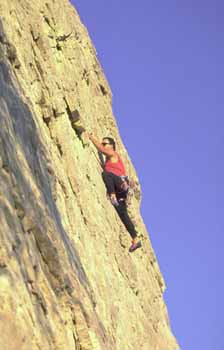
The Negev is still virtually unknown
to most travelers. Its hidden canyons, vast expanses,
clear blue skies, and stark promontories are still
off the beaten track and provide a worthy challenge
to those seeking adventure and thrills.
When Ben-Gurion spoke
of the future of the Negev, he was not doing so for mere rhetorical
flourish. He believed what he said and made his home there, joining Kibbutz
Sde Boker in 1953. Today, the hut where he lived is a small museum devoted
to Ben-Gurion's
legacy.
The gateway to the Negev is a place that once was little
more than a watering hole for Abraham's sheep. Today, Beersheba is a modern city of 130,000 and home to the Ben-Gurion
University. It is also a place where you can still buy sheep and camels
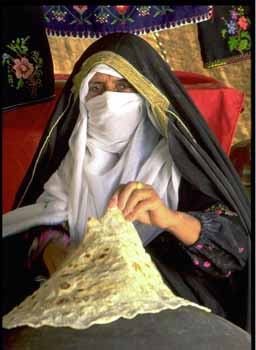
at the Bedouin market (open Thursdays 6 a.m.-1 p.m.). Roughly 27,000 Bedouin still live their nomadic lifestyle in the Negev.
A Bedouin woman making pita (Ministry of Tourism)
 |
The name Beersheba comes from "The Well of the
Oath" that Abraham made to Abimelech (Gen.
21:27 and 31). A stone-enclosed well said to be the
one used by Abraham is at the corner of Derekh Hebron and Rehov Keren. Isaac and Jacob also lived in
this area, which later was given to the Tribe of Simeon.
Though the city has remnants from
the Roman and Byzantine periods, it was really little more than a collection
of wells where Bedouin watered their flocks until the early 20th century when
the Turks built a small town. The city was held by
the Egyptians at the time of Israel's War
of Independence, and was conquered in "Operation
Ten Plagues" on
October 21, 1948.
Just outside Beersheba is Hatzerim,
the first air base built by Israel.
Today, it serves the Israeli
Air Force and hosts the pilot school. Next
door is the Air Force Museum, one of the
coolest museums for anyone interested
in airplanes, helicopters and Israeli history. In
addition to a gallery with displays of missiles and
rockets and information on Israel's elite rescue
squad and survival tactics, there is hall showing
films and a huge outdoor exhibition area with examples
of aircraft from the Israeli Air Force as well as
some of its enemies. Some of the highlights include
U.S.-made phantom jets, Soviet MiGs, the Israeli
Lavie and the “Bar Mitzvah Twins,” two
aircraft whose pilots each shot down 13 enemy aircraft
in combat. While visiting you’ll likely hear
the roar of engines from the base next door and may
even catch a glimpse in the sky of one of the Air
Force’s state-of-the-art fighter planes. Oh,
and the museum is also known for having some of the
most beautiful tour guides, all women performing
their compulsory military service in the Air Force.
Previous
Next
|