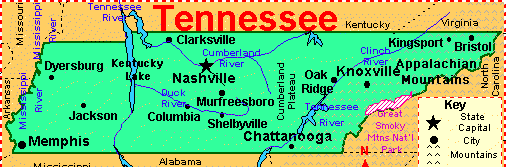
Tennessee and Israel
Trade and Population Statistics
| Exports to Israel (2013) |
$46,685,287 |
| Percentage Change (2012-2013) |
-18.55% |
| Total Exports to Israel (1996-Present) |
$819,131,887 |
| Israel's Trade Partner Rank (2013) |
51 |
| Military Contracts with Israel (2015) |
$1,666,984 |
| Jewish Population (2015) |
42,300 |
| Jewish Percentage of Population |
0.85% |
Binational
foundation grants shared by Tennessee and Israel
Grant recipients in
Tennessee from U.S.-Israel binational foundations:
Celerity Systems Inc.
Memphis State
St. Jude Children's Research Hospital
Tennessee Technological University
Tennessee Valley Authority (TVA Energy)
University of Tennessee
Vanderbilt University
Vanderbilt Medical School
World Health Organization
Bilateral
Institutions
American-Israel Chamber
of Commerce Southeast Division -
Though
based in Atlanta, the Southeast Division of the AICC was established
in 1992 to help Israeli businesses explore new markets and develop business
relationships with companies in Georgia as well as Tennessee, Alabama,
Mississippi, North Carolina and South Carolina. AICC-SD boasts over
450 members today amd has earned the reputation as one of the most successful
and effective bi-national business organizations in the United States.
Since its founding, AICC-SD has been involved in completed transactions
valued at over $700 million, thereby contributing to the economies of
both Israel and the Southeastern United States. To learn more about
the AICC Southeast Division, CLICK
HERE.
Cooperative
Agreements - "Memoranda of Understanding"
In 1996, Governor Don Sundquist signed
the Tennessee-Israel Cooperation Agreement to promote cooperation between
the two countries in trade, arts, culture, education, tourism and university/industry
alliances.
Tennessee Government Missions to Israel
August 2011 - Congressmen Scott DesJarlais
and Chuck Fleischman traveled to Israel as part of the 81-member delegation
to meet with top Israeli officials and learn more about the American-Israeli
relationship. The American Israel Educational Foundation funded the
trip.
Partners
For Change
The U.S.-Israel relationship is based on the twin
pillars of shared values and mutual interests. Given this commonality of
interests and beliefs, it should not be surprising that support for Israel
is one of the most pronounced and consistent foreign policy values of the
American people.
It is more difficult to devise programs that capitalize
on the two nations' shared values than their security interests;
nevertheless, such programs do exist. In fact, these SHARED VALUE
INITIATIVES cover a broad range of areas, including the environment,
science and technology, education and health.
As analyst David Pollock noted, Israel is an advanced country with a population that surpassed eight million people in 2013 and a robust, dynamic economy that allowed it to join the Organization for Economic Cooperation and Development (OECD). Between 2005 and 2013, Israel has represented a larger market for U.S. exports than Saudi Arabia. Although Israel's citizenry make up just 3 percent of the total region's population, Israel accounts for 25 percent of American exports in the Middle East.
"It has also been one of the top 20 foreign direct investors in the United States since 2009," Pollock confirms. He adds that "$2.25 billion of the $3 billion in annual U.S. aid to Israel comes back via Israeli purchases of U.S. military equipment - and that is just 5 percent of the total bilateral trade each year."
Today's interdependent global economy requires that
trade policy be developed at the national and state level.
Many states have recognized the opportunity for realizing
significant benefits by seeking to increase trade with Israel. Tennessee is one of 33 states that have cooperative
agreements with Israel.
In 2012, Tennessee exported over $61 million worth
of manufacturing goods to Israel. Since 1996, Tennessee exports to
Israel have totaled more than $709,713,315 and Israel now ranks as Tennessee’s
27th leading trade partner.
Additionally in 2012, Tennessee received more than
$9.5 million in foreign military financing (FMF) for US military aid
to Israel. Some of those companies that have received funding through FMF in 2012 or past years
include: Wellco Enterprises Inc. in Knoxville, BAE Systems in Kingsport and Tennalum in Jackson.
Israel is certainly a place where potential business
and trade partners can be found. It can also be a source, however, for
innovative programs and ideas for addressing problems facing the citizens
of Tennessee.
Israel has developed a number of pioneering education programs. For example, AICE introduced an innovative Israeli
peer tutoring program to North Carolina that educators adapted for use
in the United States. Now known as Reading Together, the program is
used in 28 states. The program is designed to help students achieve
reading fluency and is mostly used for children in second grade. The
hope is that with its implementation, increasing numbers of students
will perform at grade level or above.
A range of other exciting approaches to social problems
like unemployment, environmental protection and drug abuse have been
successfully implemented in Israel and could be imported for the benefit
of Americans.
The potential for greater cooperation with Israel for
the benefit of Tennessee is limited only by the imagination.
Tennessee Firms
Profit From Business With Israel
As the only country with free trade agreements with both
the United States and the European community, Israel can act as a bridge
for international trade between the United States and Europe. Moreover,
because of the deep pool of talent, particularly in high-technology areas,
Israel provides excellent investment opportunities. Some of the nation’s
largest companies, such as IBM, Microsoft, Motorola, Intel and McDonald’s
have found that it is indeed profitable to do business in Israel.
Seventy-five Tennesseans in the business, government,
arts, culture, education and university sectors spent one week in January
of 1997 on a trade mission to Israel. This was the first major initiative
of the Tennessee-Israel Cooperation Agreement that was signed by Governor
Don Sunquist in February 1996. The Tennessee-Israel Cooperation Committee
serves to enhance the technological, research and development
infrastructure of Tennessee and Israel; to increase cultural interchange
between the two and to promote a deeper understanding of shared values.
While on the trade mission, Governor Sunquist called on some of Israel’s
leading industrial companies, asking them to consider establishing
facilities in Tennessee or joint ventures with Tennessee companies.
Specific projects were proposed for the automotive and healthcare sectors.
More than 50 Tennessee companies have
discovered the benefits of doing business in Israel,
including Federal Express, Advanced Vehicle Systems
and Beck-Arnley World Parts.
In September 1997, the U.S.-Israel Automotive Industry
Business Exchange in Nashville, hosted by government agencies in Tennessee
and Israel, the Jewish community federations, the American Israeli Chamber
of Commerce and Saturn Corporation, brought together 26 leading American
automotive firms and 15 Israeli companies. The goal of the day was for
Israeli companies to interest their American counterparts in products such
as precision metals, hose assemblies, bonded rubber-metal engine parts and
innovative safety features. Among the high-tech parts shown that were
originally developed for military purposes was a Global Positioning
Satellite navigation system that can locate a stolen car or distressed
vehicle.
According to Link Magazine, one of the more promising
proposals for a joint venture in the automotive industry between the U.S.
and Israel, now under consideration in Israel, is the collaboration between
Chattanooga-based Advanced Vehicle Systems Inc. and Jerusalem-based
Electric Fuel. Advanced Systems is the designer of battery-powered buses
and Electric Fuel designs a superior electric battery. Together, these two
companies have jointly built 15 quiet, clean, zero emission AVS-built buses
that are already operating in downtown Chattanooga.
Ira Davis, President of Beck-Arnley World Parts not only
went on the trade mission with the Governor but also sponsored a reciprocal
trade mission for Israel. Davis has been importing auto parts from Israel
for about 20 years and said “it’s a good place to do business.”
Ofer Anaby, marketing manager for Flying Cargo, the
Israeli firm that holds the FedEx franchise in Israel, told Link that
Memphis-based Federal Express was one of the first express delivery
services to “recognize Israel’s emerging high-tech economy as a
business opportunity.” Flying Cargo was established in 1990 and today
employs 250 people. Anaby added that while Israel only accounts for $35
million of the company’s $15 billion global business, Israel is part of
FedEx’s global outreach strategy and has proven to be “a steadily
growing market” primarily due to the huge growth in Israeli
telecommunications software, hardware and pharmaceuticals.
One good way to break into the Israeli market is through
a joint venture with an Israeli company. Funding for such projects is
available from the Binational
Industrial Research and Development Foundation (BIRD). BIRD funds projects in 36 states and the District of
Columbia and hundreds of companies including AOL, GE, BP Solar, Texas
Instruments and Johnson & Johnson have benefitted from BIRD grants.
The United States and Israel established BIRD in 1977
to fund joint U.S.-Israeli teams in the development and subsequent commercialization
of innovative, nondefense technological products from which both the
Israeli and American company can expect to derive benefits commensurate
with the investments and risks. Most grant recipients are small businesses
involved with software, instrumentation, communications, medical devices
and semiconductors.
Since its inception, BIRD has funded more than 800
joint high-tech R&D projects through conditional grants totaling
more than $210 million. Products developed from these ventures have
generated more than $8 billion in direct and indirect revenues for both
countries and has helped to create an estimated 20,000 American jobs.
Dr. Eli Opper, the former Israeli chair of BIRD, has
said that BIRD is a strong pillar of US-Israel industrial
cooperation and that the extreme success of BIRD has
led Israel to adopt similar models of R&D with other countries.
Tennessee companies have benefited from nearly $125 million in BIRD grants over the last three decades.
Scientific Innovations
Tennessee researchers are making scientific breakthroughs
and developing cutting-edge technologies in joint projects with Israeli
scientists thanks to support from the Binational
Science Foundation (BSF). BSF was established in 1972 to promote scientific relations
and cooperation between scientists from the United States and Israel.
The fund supports collaborative research projects in a wide area of
basic and applied scientific field for peaceful and non-profit purposes.
Since its inception, BSF has awarded some $480 million
through more than 4,000 grants in 45 states and the District of Columbia.
BSF-sponsored studies are highly successful
in achieving their two main goals: strengthening the US-Israel partnership
through science and promoting world-class scientific research for the
benefit of the two countries and all mankind. The BSF grants help extend research resources to achieve milestones that might
not otherwise be attainable; introduce novel approaches and techniques
to lead American researchers in new directions; confirm, clarify and
intensify research projects; and provide unmatched access to Israeli
equipment, facilities and research results that help speed American
scientific advances. BSF has documented no less than
75 new discoveries made possible by its research grants and counts 37
Nobel Prize and 19 Lasker Medical Award laureates among its joint partners.
The University of Tennessee, St. Jude’s Children’s
Research Hospital and Vanderbilt University School of Medicine have
shared nearly $1.4 million in BSF grants since 1996.
Dr. James N. Ihle is the Howard Hughes Medical Institute
Investigator and chairman of the Department of Biochemistry at St. Jude’s
Children’s Research Hospital. He has been collaborating with Yakov
Weinstein at Ben Gurion University to study aspects of growth factors
and functions that affect blood cells. Ihle both hopes and expects that
their research will have an impact in the control of blood cell production
and that they will find new ways to treat leukemia and other blood cell
disorders. “I have had a very productive collaboration and it has
always been very positive,” said Dr. Ihle. “The BSF program is fantastic because otherwise Israel would have very little
money to do research with. Israel is a relatively small country with
very talented people that could do more research if they had more money. BSF has made a significant impact.”
Professor David Greenstein, assistant professor of cell
biology at Vanderbilt University School of Medicine has collaborated with
Millet Treitin of Hebrew University’s Hadassah Medical School to study
neurodegeneration using nematode worms. They use these worms to discover
molecules that are the cause of neurodegeneration and by using modern
techniques they will hopefully find the molecular basis for this problem.
By doing so, Greenstein and Treitin will further understand
neurodegeneration in humans and it may then be possible to create a drug
that can prevent ailments such as Alzheimer’s and Lou Gehrig’s disease.
The University of Tennessee's Albrecht Von Arnim is
currently studying how plants respond to a light environment. He and his
colleague at the University of Tel Aviv are interested in how various
organisms process and respond to light on a cellular and molecular level.
This sort of information varies with plants, yeast, humans and bacteria.
This basic research will hopefully lead to the generation of plants that
carry traits of commercial importance and that will only show up at certain
times of need. As of now, Von Arnim does not have enough information to do
this, but is hoping that his collaboration with Israel with help.
Dr. George Kablalka is in search of a potential new
drug for cancer therapy. Together with Dr. Peter Bendel of the Weizmann
Institute, Kabalka, Professor of Chemistry at the University of Tennessee,
builds a few molecules and then tests their basic properties. This project
took ten years to create and although the BSF grant
has expired, Kabalka and Bendel are still collaborating.
Some BSF projects have practical applications;
however other projects involve basic science and are meant only to stimulate
advances in a particular field. For example, Professor Jeff Becker of
the University of Tennessee along with Professor Levitzky and Professor
Kulka of the Hebrew University have had a very positive experience collaborating
together to study the molecular biology of cell membranes.
Agriculture Benefits
In 1978 the United States and Israel jointly created the Binational
Agricultural Research and Development Fund (BARD)
to help fund programs between US and Israeli scientists for mutually
beneficial, mission-oriented, strategic and applied research into agricultural
problems. Since its inception, BARD has funded more
than 1,000 projects in 45 states and the District of Columbia with a
total investment of more than $250 million. In 2000, an independent
and external economic review of 10 BARD projects conservatively
projected more than $700 million in revenue by the end of 2010, a number
which far outweighs the total investment in all BARD projects over its 33 year existence and helps to continually strengthen
the foundation.
Most BARD projects focus on either increasing agricultural
productivity, plant and animal health or food quality and safety and
have been influential in creating new technologies in drip irrigation,
pesticides, fish farming, livestock, poultry, disease control and farm
equipment. BARD funds projects in 45 states and the
District of Columbia and at present is beginning to administer collaborative
efforts between Australia, Canada and Israel as well. It is difficult
to break down the impact on a state-by-state basis, but overall, BARD-sponsored
research has generated sales of more than $500 million, tax revenues
of more than $100 million and created more than 5,000 American jobs.
The University of Tennessee received the first BARD grant in 2002 and since then other institutions have benefitted as well
to the tune of more than $600,000.
In 2009, Professor Terrence Dermody of Vanderbilt University
received a BARD grant to collaborate with Dr. Marcelo
Ehrlich of Tel Aviv University in order to develop a plasmid-based reverse
genetics system for the Bluetongue and Epizootic Hemorrhagic Disease
viruses, diseases that cause great harm to livestock such as sheep and
cattle and is known to exist throughout the two American continents,
Africa, the South Pacific and the Middle East. While the research is
only recently underway, the two professors have taken advantage of BARD resources to connect in person regularly. Professor Dermody attests
to BARD's helpfulness in making the collaboration fluidly
and easily and is excited about the possibility to receiving future BARD grants for research that he may pursue.
While on one hand pesticides are crucial to much modern
agriculture, they have also become a contamination problem of rural
water resources. American manufacturers produce more than 1.5 billion
pounds of pesticide a year and spend nearly $1 billion just to comply
with EPA regulations controlling waste discharge. This created a dilemma
that BARD grantees tackled. BARD researchers
developed a new economical procedure for diminishing water-born pesticides
using the sun. In the laboratory, scientists tested 69 dye sensitizers
that can oxidize pesticides when activated by visible light. After testing
the pesticide breakdown products they found that these treatments were
harmless and permitted normal germination and seed growth. After these
lab tests, a prototype was created in Livinsgston, Tennessee. In August
1986, the BARD Solar Wastewater Disinfection Plant
opened two 20,000 liter reactors to process multiple sewage. Simultaneously,
Israel opened a different prototype design in Herzilia. The goal of
removing injected pesticides by sunlight was successful. The BARD solar process also destroyed 99.9 percent of most bacterial pathogens
in the sewage within two hours.
Tennessee, one of the country's largest producers of
cotton (total U.S. production exceeds $5 billion a year) also benefits
from BARD research done outside of the state. Joint
research resulting from a BARD grant has shaped the
way cotton is grown today. BARD grantees from Israel
and Mississippi developed and tested a computer model that would reduce
the amount of water and fertilizer cotton farmers need to produce their
crops. Their research resulted in an invention called COTMOD, which
describes how water, soil, fertilizer and farming practices affect cotton
production. The model can also be expanded to predict the fate of pesticides
and environmental contaminations as well. The USDA combined this model
with two others and provide it, free of charge, to American farmers
and agricultural consultants. By advising growers, such as those in
Tennessee, on optimal irrigation and fertilization strategies, the system
can save farmers an average of about $60 per acre, or about $48 per
bale.
Other Cooperative
Programs
None. Help us build this section. Email
AICE with any additions, modifications, updates or comments. Thank
you for your support.
Sister Cities:
TENNESSEE. . . . . .. . .. . . .. . . .. . . ..
.. . . . . . . . . . . . . . . . . . ISRAEL |
Chattanooga |
Givatayim |
UJA Partnership 2000
Communities:
TENNESSEE. . . . . .. . .. . . .. . . .. . . ..
.. . . . . . . . . . . . . . . . . . ISRAEL |
Chattanooga |
|
|
|
|
|
State
Contacts:
Jewish Federation Of Greater Chattanooga
5326 Lynnland Terrace, P.O. Box 8947
Chattanooga, TN 37414
Tel. 423-894-1317
Jewish Federation Of Memphis
6560 Poplar Ave.
Memphis, TN 38138-3614
Tel. 901-767-7100
Jewish Federation Of Nashville
801 Percy Warner Blvd.
Nashville, TN 37205
Tel. 615-356-3242
Knoxville Jewish Community
P.O. Box 10882
Knoxville, TN 37939
Tel. 423-693-5837
Bill Baxter
Commissioner
Tennessee Department of Economic & Community Development
Rachel Jackson Bldg., 326 Avenue North
Nashville, TN 37243-0405
Tel. 800-251-8594
|