Potential Threats To Israel: Iran

by Mitchell Bard

(Updated June 17, 2009)


Recent Developments
The Brains Behind Iran's Nuclear Project
Iran's Secret Plants
Iran Admits Deception
A Commitment to Join the Nuclear Club
Point of No Return?
IAEA Refers Iran to Security Council
The NIE
Missiles and Biochemical Threats
Proliferation
Sponsoring Terror
Threats Against Israel and America
Threats Against Iran's Neighbors
Would Iran Use the Bomb?
A Military Response?

Iran is one of America's foremost self-proclaimed enemies. Iran has become one of the most serious threats to stability in the Middle East and has developed the means to strike Israel. American and Israeli intelligence assessments agree that the Islamic regime in Iran will be able to complete a nuclear weapon within five years — sooner if a device or substantial technical assistance is acquired abroad.

Iranian opposition figures have said the regime is intensifying its efforts to complete a weapon with the hope of building a device within the next two years.

The Brains Behind Iran's Nuclear Project

Iran has concluded agreements with China and Russia to obtain nuclear facilities. In 1990, China signed a 10-year nuclear cooperation agreement that allowed Iranian nuclear engineers to obtain training in China. In addition, China has already built a nuclear research reactor in Iran that became operational in 1994. In 2002, Iran revealed that it had purchased special gas from China that could be used to enrich uranium for the production of nuclear weapons. The gas purchase was supposed to be reported to the International Atomic Energy Agency (IAEA), but it was concealed instead. Chinese experts have also been involved in the supervision of the installation of centrifuge equipment that can be used to enrich uranium.

According to the CIA, “Iran continues to use its civilian nuclear energy program to justify its efforts to establish domestically or otherwise acquire the entire nuclear fuel cycle. Iran claims that this fuel cycle would be used to produce fuel for nuclear power reactors, such as the 1,000-megawatt light-water reactor that Russia is continuing to build at the southern port city of Bushehr. However, Iran does not need to produce its own fuel for this reactor because Russia has pledged to provide the fuel throughout the operating lifetime of the reactor and is negotiating with Iran to take back the irradiated spent fuel.”

The Bushehr project has provided valuable training to Iranian technicians and engineers, and expanded the regime's nuclear infrastructure. To allay U.S. fears that the fuel Russia is providing for the plant could be diverted to a weapons program, the Russians agreed to take back the spent fuel rods from the plant, but Iran has not agreed to this. Meanwhile, financial wrangling between the Russians and Iranians have delayed completion of the project, which was expected to be finished in 2006 and then pushed back to 2008. Russian officials said on March 12, 2007, that nuclear fuel would not be delivered to Iran because of its failure to make $25 million monthly payments for the plant and the project’s completion date would again be pushed back (Washington Post, March 13, 2007). A few days later Russia informed Tehran that it will withhold nuclear fuel for Bushehr unless Iran suspends its uranium enrichment (New York Times, March 20, 2007). In addition to Iran falling behind on its payments, delays in shipping parts pushed the completion date of the plant into 2008 (Forbes.com, July 4, 2007).

In December 2007, Russia reversed its position and delivered the long-delayed first shipment of nuclear fuel to Bushehr. The decision came after the release of a U.S. intelligence report that concluded Tehran had stopped its nuclear weapons program in late 2003. President Bush said, “If the Iranians accept that uranium for a civilian nuclear power plant, then there’s no need for them to learn how to enrich.” But a senior Iranian official said his country would under no circumstances halt its efforts to enrich uranium (Reuters, December 18, 2007 ).

Iran received the final shipment of uranium fuel on January 28, 2008. It now has 82 tons of fuel for the power plant, which may begin operating in the summer of 2008 at half its 1,000-megawatt capacity (Washington Post, March 13, 2007).

Though China and Russia have provided technology to Iran, the “brain” behind the Iranian nuclear program is believed to be Dr. Abdul Qadeer Khan, the father of Pakistan's nuclear program, who passed secrets and equipment to Iranian officials. Khan became involved in helping Iran in the mid-1990s. Pakistani investigators have told the International Atomic Energy Agency (IAEA) that centrifuges built by Iran closely resemble the design of Pakistani centrifuges. Khan also helped the Iranians to set up a secret procurement network involving companies and middlemen around the world. In March 2005, former Iranian president Hashemi Rafsanjani admitted Iran developed its nuclear program in secret, going to the black market for material.

Iran's Secret Plants

Israel first received reports about an Iranian nuclear program in May 1992 and Prime Minister Yitzhak Rabin tried to warn the Clinton Administration. The CIA, however, maintained that the Iranina program was civilian rather than military, an assessment the agency did not abandon until 1998 (New Republic, February 5, 2007).

In 2002, two previously unknown nuclear facilities were discovered in Iran. One in Arak produces heavy water, which could be used to produce weapons. The other is in Natanz. An Iranian opposition group claimed that Iranian officials removed sensitive equipment installed at Natanz to hide it from IAEA inspectors who were scheduled to visit the plant.

In February 2003, Iranian President Mohammad Khatami announced the discovery of uranium reserves near the central city of Yazd and said Iran was setting up production facilities “to make use of advanced nuclear technology for peaceful purposes” (AP, February 11, 2003). This was an alarming development because it suggested Iran was attempting to obtain the means to produce and process fuel itself, despite the agreement to receive all the uranium it would need for civilian purposes from Russia.

Though it is not the best method, Iran could "run the reactor at low fuel burn-up levels to produce weapons-grade plutonium or, alternately, separate reactor-grade plutonium from spent fuel awaiting reshipment to Russia," according to Michael Eisenstadt.

Eisenstadt also notes that Iran is North Korea's principal customer for arms, missiles, and nuclear technology. North Korea could export plutonium from its nuclear weapons program, as well as weapon design data, to Iran to earn desperately needed cash to bolster its weak economy. As it is, North Korean experts are believed to have helped Iran with its centrifuges.

The Iranian government, confronted in February 2004 with new evidence obtained from the secret network of nuclear suppliers surrounding Khan, acknowledged it had a design for a far more advanced high-speed centrifuge to enrich uranium than it previously revealed to the IAEA. This type of centrifuge would allow Iran to produce nuclear fuel far more quickly than the equipment that it reluctantly revealed to the agency in 2003. This revelation proved that Iran lied when it claimed to have turned over all the documents relating to their enrichment program.

In another disclosure that contradicted earlier claims, Iran admitted in June 2005 that it conducted experiments to create plutonium, which is used only in weapons and not for energy production, for five years beyond the date when it previously insisted it had ended all such work. Iran had said that the experiments were completed in 1993 and that no plutonium had been separated since then, but an IAEA investigation found that it had processed uranium as recently as 1998.

In 2005, the National Council of Resistance, an Iranian opposition group, which has given accurate information in the past on some of Iran's nuclear facilities, said Iran allocated $2.5 billion to obtain three nuclear warheads in mid-2004. The group, also said Iran was speeding up work on a reactor south of Tehran which could produce enough plutonium for an atomic bomb by 2007 (Reuters, March 31, 2005).

Iran is a signatory to the nuclear Non-Proliferation Treaty, which allows the peaceful pursuit of nuclear technology, including uranium mining and enrichment, under oversight by the IAEA. The IAEA wants Iran to agree to more stringent monitoring, which, in theory, would make it more difficult for Iran to divert fissile material to a weapons program.

Iran Admits Deception

Hassan Rowhani, the man who headed talks with Britain, France and Germany until 2005, told a meeting of Islamic clerics and academics that Iran played for time and tried to dupe the West after its secret nuclear program was uncovered by the Iranian opposition in 2002. He revealed that while talks were taking place in Teheran, Iran completed the installation of equipment for conversion of yellowcake – a key stage in the nuclear fuel process – at its Isfahan plant. Rowhani also said that on at least two occasions the IAEA obtained information on secret nuclear-related experiments from academic papers published by scientists involved in the work (Telegraph, (March 5, 2006).

The quickest way for Iran to complete a weapon would be to openly build a gas centrifuge plant to make weapons-grade uranium. This would end any doubt about Iran’s intentions so it is more likely that Iran will continue a covert program and it would be difficult for the IAEA to locate a clandestine facility. The IAEA has admitted that it cannot monitor Iranian activities outside the areas where the organization has containment and surveillance.

A Commitment to Join the Nuclear Club

In June 2004, Iranian Foreign Minister Kamal Kharrazi rejected further outside influence on Tehran's nuclear ambitions. “We won't accept any new obligations," Kharrazi said. “Iran has a high technical capability and has to be recognized by the international community as a member of the nuclear club. This is an irreversible path” (AP, June 12, 2004).

After pledging to suspend its nuclear program, the IAEA reported in June 2004 that Iran was continuing to make parts and materials that could be used in the manufacture of nuclear arms. The report also cited continuing evidence that Iran misled inspectors with many of its early claims, especially on questions about where it obtained critical components. For example, Iranian officials admitted that some of those parts were purchased abroad, after initially insisting that Iran had made them itself (New York Times, June 3, 2004).

On July 27, 2004, the Telegraph reported Iran had broken the seals on nuclear equipment monitored by UN inspectors and was again building and testing machines that could make fissile material for nuclear weapons. Teheran's move violated an agreement with European countries under which Iran suspended “all uranium enrichment activity.” Defying a key demand set by 35 nations, Iran announced September 21, 2004, that it has started converting raw uranium into the gas needed for enrichment, a process that can be used to make nuclear weapons. A couple of weeks later, Iran announced it had processed several tons of raw ''yellowcake'' uranium to prepare it for enrichment - a key step in developing atomic weapons - in defiance of the IAEA (AP, October 6, 2004).

South African Defense Minister Mosiuoa Lekota and his Iranian counterpart Rear-Admiral Ali Shamkhani signed a memorandum of understanding August 17, 2004, on bilateral cooperation. The agreement included an arrangement for South Africa to sell uranium to Iran, according to Israel's Channel 1 TV. Lekota reportedly said that making peaceful use of nuclear energy is the legitimate right of the Islamic Republic. The South African Ministry of Defense subsequently denied the report.

In another sign of Iran's determination to move forward with a nuclear weapons program, the government approved the establishment of a secret nuclear research center to train its scientists in all aspects of atomic technology (Telegraph, March 20, 2005).

Point of No Return?

Admiral Mike Mullen, Chairman of the U.S. Joint Chiefs of Staff, said on April 2, 2009, “I think the Iranians are on a path to building nuclear weapons...we don't have a lot of time” (Wall Street Journal, April 6, 2009). This follows release of a February 2009 IAEA report states that inspectors uncovered 209 kilograms of low-enriched uranium that the Iranians had failed to declare, which brings the total amount that Teheran has so far enriched to over a ton, enough, with additional purification, to produce a nuclear weapon. “It's worse than we thought. It's alarming that the actual production was underreported by a third,” said Gary Milhollin, the director of the Wisconsin Project on Nuclear Arms Control (Jerusalem Post, February 20, 2009).

According to a report submitted to French President Nicolas Sarkozy in the last days of 2008, Iran is a “short distance” from securing all it needs to make a nuclear warhead. The bipartisan team that prepared the report used facts officially acknowledged by the Islamic Republic and concluded that Iran will be a member of the nuclear club by the end of 2011 at the latest and that 2009 may be the last chance to prevent Iran from developing a bomb (Asharq Al-Awsat, January 7, 2009). A January 2009 study by the International Institute for Strategic Studies also forecast Iran will most likely have produced enough enriched uranium to make an atomic bomb by the end of 2009 (Jerusalem Post, January 27, 2009).

The CIA also believes Iran is progressing toward a bomb. Outgoing CIA director Michael Hayden said, “I’m amazed Iran is willing to run the costs they are running if they are not trying to keep the option open for a nuclear weapon” (AP, January 16, 2009).

Israeli intelligence officials have repeatedly revised their estimates of Iranian progress toward the development of nuclear weapons. “Iran is focusing its efforts in enriching uranium and improving the operational capabilities of its centrifuges,” the head of Israel’s Military Intelligence Research Division said in September 2008. “It is mastering the necessary technology and now has one-third of what it need to create a bomb.” Brigadier-General Yossi Baidatz added, “In view of the UN Security Council's inability to enforce a fourth round of sanctions, Iran's confidence is increasing and they now believe there is nothing the international community can do to stop them” (Ynet, ). In June 2009, Mossad director Meir Dagan estimated that Iran would have its first nuclear bomb ready for action in 2014 (Jerusalem Post, ).

The head of the IAEA, Mohamed ElBaradei, suggested the Iranians were potentially closer to building a bomb than either the U.S. or Israeli intelligence analysts predicted. Even though it may take two years for Natanz to become fully operational, ElBaradei, warned in December 2005 that once the facility is running, the Iranians could be “a few months” away from a nuclear weapon (The Independent, December 5, 2005). In 2007, he said Iran probably would have enough enriched uranium to build a nuclear bomb in three to eight years (Los Angeles Times, May 25, 2007; AFP, October 22, 2007).

Iran has secretly extended the uranium enrichment plant at the Natanz site, which has led analysts to suspect that Iran is stepping up the pace of its weapons program. Moreover, a U.S. intelligence report says that Iran’s facilities appear to replicate those used to produce fissile material for nuclear weapons in Pakistan (Telegraph, January 22, 2006). Iran also reportedly reached an agreement with North Korea to share all the data and information the Koreans received from their nuclear test in October 2006 with Teheran's nuclear scientists. Iran also stepped up its research activity and was said to be preparing for their own underground nuclear test (Daily Telegraph, January 24, 2007).

In February 2007, an internal European Union document said there was no way to prevent Iran from enriching enough weapons-grade uranium to produce a bomb and that the Iranian program had been slowed by technical limitations rather than diplomatic pressure. The Financial Times quoted the document as saying: “At some stage we must expect that Iran will acquire the capacity to enrich uranium on the scale required for a weapons program” and that “the problems with Iran will not be resolved through economic sanctions alone” (Jerusalem Post, February 13, 2007).

In April 2007, Iranian President Ahmadinejad announced that the Natanz facility had begun “industrial-scale” production of nuclear fuel. Iran claimed to be injecting uranium gas into a new array of 3,000 centrifuges (AP, April 12, 2007). A week later, the head of Iran's atomic energy agency, Gholam Reza Aghazadeh, admitted that some of the centrifuges blew up during the enrichment process. Without giving a precise number, he said that the damages ranged from ten to twenty per cent. Aghazadeh said Iran ultimately wants to install 50,000 uranium enriching centrifuges at the plant in Natanz. Aghazadeh said it would take four years for Iran to complete its own nuclear fuel cycle (Agence France-Presse, Haaretz, April 17, 2007). A month later, however, IAEA inspectors concluded that Iran appeared to have solved most of its technological problems and was starting to enrich uranium on a far larger scale than before (New York Times, May 15, 2007).

In June 2007, Iran’s interior minister said Iran had produced 100 kilograms (220 pounds) of enriched uranium. Experts say that about 500 kilograms (1,100 pounds) of enriched uranium would be needed for one bomb (AP, June 22, 2007). Iran’s spiritual leader’s representative to the Supreme National Security Council, Ali Larijani, said Tehran was committed to uranium enrichment and termed “nuclear fuel a strategic product for Iran.” He stated his country’s next strategic plan was to produce nuclear fuel locally (Reuters, December 20, 2007).

On April 8, 2008, Ahmadinejad announced that Iran has started to install 6,000 new centrifuges at its uranium enrichment facility at the underground Natanz facility, a worrisome development that accelerates their progress toward developing a nuclear weapon (Reuters, April 8, 2008). Iran's supreme leader, Ayatollah Ali Khamenei, added that Iran would not retreat in the face of demands by world powers for Tehran to halt sensitive nuclear work (Agence France-Presse, July 31, 2008).

The NIE

The highly publicized release of the National Intelligence Estimate (NIE) of the United States on November 2007 was portrayed in the media as an indication that the Bush Administration has been falsely and hysterically whipping up opposition against a non-existent Iranian nuclear weapons program to impose draconian sanctions on Iran and possibly justify military intervention. The finding that received the most publicity was that Iran halted its nuclear weapons program in 2003 and America’s spy agencies believe the program remains frozen. The report also said Iran is not expected to have the capability to build a weapon until the middle of the next decade.

If this information is correct, the international community, which has expressed its determination to prevent Iran from acquiring a bomb, has more time to pursue various non-military measures to ensure Iran never develops a nuclear weapon. It may also be the case that the sanctions that have been employed have had some impact on Iranian policy and raise the possibility they may succeed in permanently derailing the nuclear program.

Meanwhile, Iran continues to act like a country that is concealing its activities and publicly declaring at every opportunity its commitment to develop a nuclear capability that could have non-peaceful applications. The NIE reported that Iran is continuing to produce enriched uranium, in defiance of UN resolutions, which would allow Iran to produce a weapon, albeit later than previously believed.

The analysts who wrote the NIE also have no way of judging Iranian intentions. They cannot predict whether Iran plans to restart its program at any time in the future or if it is content to enrich uranium for the time being and then divert it to military purposes later. Furthermore, the report contradicts other evidence that Iran remains committed to aquiring a nuclear weapon, such as the installation of gas centrifuges that have the potential to eventually produce enough enriched uranium to provide fuel for a bomb.

Other nations immediately expressed skepticism of the NIE. The leaders of Great Britain, France and Germany, as well as the Gulf Arab States, have continued to voice their concerns based on their own independent evalautions of Iranian capabilities and intentions. French Foreign Minister Herve Morin, for example, stated on January 31, 2008, “Coordinated information from a number of intelligence services leads us to believe that Iran has not given up its wish to pursue its (nuclear) program,” and is “continuing to develop [it]” (Agence France-Presse, February 1, 2008). Israel, the one country that has been directly threatened by Iran, also remains convinced Iran could have a weapon by the end of the decade.

Negotiations

Iran agreed in a meeting in Tehran with French, German, and British ambassadors on November 14, 2004, to immediately suspend its nuclear programs in exchange for European guarantees that it will not face the prospect of UN Security Council sanctions as long as their agreement holds. Bushehr was not covered under the EU-Iranian deal. The Bush administration was dissatisfied and said Tehran needs to convince the world it is not a danger (Washington Post, November 15, 2004).

Shortly after the Iranian-European agreement, the National Council of Resistance said Iran had bought blueprints for a nuclear bomb and obtained weapons-grade uranium on the black market. The group also charged that Iran was still secretly enriching uranium at an undisclosed Defense Ministry site in Tehran. The claims could not be independently verified, and independent nuclear experts were divided about whether they could be true, but the group was responsible earlier for revealing the existence of two secret Iranian nuclear facilities. (New York Times, November 18, 2004).

Secretary of State Colin Powell also said the United States has intelligence indicating Iran is trying to fit missiles to carry nuclear weapons, which he intimated would only make sense if Iran was also developing or planning to develop a nuclear capability. “There is no doubt in my mind — and it's fairly straightforward from what we've been saying for years — that they have been interested in a nuclear weapon that has utility, meaning that it is something they would be able to deliver, not just something that sits there,” Powell said (Washington Post, November 18, 2004).

Iran's chief nuclear negotiator Hassan Rohani claimed a “great victory” over the U.S. at the end of November 2004 after the UN said it would not punish Iran's nuclear activities with sanctions. Rohani said Iran would never give up its right to nuclear power and stressed during talks with European countries that Iran's freeze on uranium enrichment was only temporary (BBC News, November 30, 2004). President Bush said on November 30, “The Iranians agreed to suspend but not terminate their nuclear weapons program. Our position is that they ought to terminate their nuclear weapons program” (Reuters, November 30, 2004).

In February 2005, Ali Agha Mohammadi, spokesman of Iran's Supreme National Security Council, said Iran will never scrap its nuclear program, and talks with the Europeans are aimed at protecting the country's nuclear achievements, not negotiating an end to them. This view was reiterated in March by Rohani, who said, the country would never permanently cease enriching uranium, and warned that if the United States went to the United Nations Security Council to seek sanctions against Iran, “the security and stability of the region would become a problem.”

In May 2005, Iran confirmed that it had converted 37 tons of uranium into gas, its first acknowledgment of advances made in the production process for enriched uranium. This means Tehran is in a position to start enriching uranium quickly if negotiations with the Europeans over the future of its nuclear program fail (AP, May 9, 2005). Iran’s departing president, Mohammad Khatami, said July 27, 2005, regardless of Europe’s position, “we will definitely resume work in Isfahan,” the site of a uranium processing plant. On August 1, Iran said Iranian technicians would break UN seals on the Isfahan nuclear plant, allowing uranium processing to resume. Reprocessing uranium is a step below uranium enrichment, which is to remain suspended (Jerusalem Post, August 1, 2005).

In late August 2005, European powers called off talks with Iran about its nuclear program scheduled for August 31. French Foreign Ministry spokesman Jean-Baptiste Mattei said talks on a formal European proposal made earlier this month would not go ahead because Iran had resumed certain nuclear work in breach of a promise to freeze it while talks lasted (Reuters, August 24, 2005).

On September 2, 2005, the IAEA reported that Iran had produced about seven tons of the gas it needs for uranium enrichment since it restarted the process the previous month. A former UN nuclear inspector said that would be enough for an atomic weapon. In unusually strong language, an IAEA report also said questions remain about key aspects of Iran's 18 years of clandestine nuclear activity and that it still was unable “to conclude that there are no undeclared nuclear materials or activities in Iran” (Chicago Tribune, September 3, 2005).

On September 20, 2005, Iran threatened to resume uranium enrichment and bar open inspections of its nuclear facilities if the IAEA refers it to the Security Council for sanctions. Newly elected Iranian President Mahmoud Ahmadinejad defended his country's right to produce nuclear fuel in a fiery speech to the UN General Assembly and later raised worldwide concern about nuclear proliferation when he said, “Iran is ready to transfer nuclear know-how to the Islamic countries due to their need” (AP, September 15, 2005). Iran’s Supreme Leader, Ayatollah Ali Khamenei, repeated the proliferation threat in April, telling the president of Sudan, “Iran’s nuclear capability is one example of various scientific capabilities in the country....The Islamic Republic of Iran is prepared to transfer the experience, knowledge and technology of its scientists” (New York Times, April 26, 2006).

In early November 2005, Iran rejected a call by European ministers for it to heed a resolution of the IAEA calling for a renewed freeze on all activities related to uranium enrichment. In another alarming development, Iran also approved a resolution accepting foreign participation in its nuclear enrichment plant (Jerusalem Post, (November 6, 2005). Iran began converting a new batch of uranium at the Isfahan facility, a move seen as provocative after rejecting international pleas to suspend such work (Washington Post, November 17, 2005). Meanwhile, the head of IAEA disclosed that in 1987 Iran obtained through the Khan network the blueprint for casting uranium required in making the core of a nuclear warhead, but this alone was not enough for the manufacture of a weapon (The Guardian, November 19, 2005). A few days later, a former spokesman for the National Council of the Resistance of Iran, an Iranian opposition group, said that, beginning in 1989, North Korea has helped Iran build dozens of underground tunnels and facilities for the construction of nuclear-capable missiles (ABC News, November 21, 2005).

In yet another apparent effort to demonstrate its unwillingness to be deterred by international opprobrium, Iran announced in early December 2005 plans to build two nuclear power plants in addition to the Bushehr reactor (Washington Post, December 6, 2005).

According to an intelligence assessment from July 2005 obtained by the Guardian in January 2006, Iran is aggressively trying to obtain the expertise, training, and equipment for developing nuclear weapons, a ballistic missile capable of reaching Europe, and biological and chemical weapons arsenals. The leak of the report came shortly after Iran notified the IAEA that it intended to resume nuclear fuel research (Guardian, January 4, 2006).

IAEA Refers Iran to Security Council

The five permanent members of the UN Security Council agreed on January 31, 2006, that the IAEA should refer Iran to the Security Council. The United States, Britain, China, Russia and France reached a compromise whereby the Security Council would wait until March before discussing any resolutions or punitive measures to give Iran an opportunity to change its policy. Earlier, Mohammed-Nabi Rudaki, deputy chairman of the Iranian parliament's National Security and Foreign Policy Commission, threatened to forcibly halt oil supply via the Straits of Hormuz if the UN imposed economic sanctions due to Iran's nuclear program (Haaretz, January 24, 2006).

The IAEA released a report February 1, 2006, which says the agency has evidence of links between Iran’s nuclear program and its military work on high explosives and missiles. The report documents work Iran has conducted on uranium processing, high explosives and a missile warhead design, which contradicts Iranian claims that it is only interested in electrical power. The IAEA also reiterated its past complaints that Iran has not been cooperative on all of the outstanding nuclear issues that the agency has been investigating (New York Times, February 1, 2006).

Following the IAEA decision, Iran announced that it had resumed uranium enrichment efforts and will no longer comply with voluntary measures designed to enhance international inspectors' access to its nuclear facilities (Washington Post, February 15, 2006).

Iran has begun testing about 20 centrifuges used in enriching fuel and is making improvements at its Natanz nuclear facility according to a February report by the IAEA. The organization also said that it was not “in a position to conclude that there are no undeclared nuclear materials or activities in Iran.” The report criticizes Iran for failing to reveal “the scope and nature” of its nuclear program despite three years of IAEA monitoring efforts (Washington Post, February 28, 2006).

The one remaining diplomatic option to avoid pursuing sanctions against Iran failed on on March 12 when Iran rejected an offer from Russia to enrich uranium on its behalf. Negotiations on the proposal were widely viewed as merely a tactical strategy Tehran was using to continue its program while staving off referral to the UN.

The Security Council urged Iran on March 29, 2006, to suspend its uranium-enrichment activities and asked the director of the International Atomic Energy Agency to report back on Iran's compliance within 30 days. The Council took its action in a presidential statement, a nonbinding declaration that needs unanimous support, which was possible only after the European authors of the final draft eliminated language suggesting that any Iranian drive to produce nuclear weapons would be a “threat to international peace and security” (New York Times, March 30, 2006).

Iran's Foreign Minister subsequently rejected the principle of a European package that would require Teheran to suspend uranium enrichment in exchange for support to a civilian nuclear program.

In May UN inspectors found traces of highly enriched uranium on equipment from an Iranian research center linked to the military. Initial reports suggested the density of enrichment was close to or above the level used to make nuclear warheads. But later a diplomat accredited to the IAEA said it was below that, although higher than the low-enriched material used to generate power and heading toward weapons-grade level (AP, May 13, 2006).

On July 31, 2006, the UN Security Council approved Resolution 1696, giving Iran until August 31 to verifiably suspend its uranium enrichment and reprocessing-related activities and implement full transparency measures requested by the IAEA. Though it is still unclear whether Russia and China will support more serious measures, the United States and its allies have made clear that they will ask the Security Council to impose economic and political sanctions if Iran fails to comply with the resolution. Iran immediately rejected the proposal and President Ahmadinejad called for the United States and Britain to be thrown off the Security Council, calling them criminals (JTA, August 2, 2006).

Iran's top nuclear negotiator, Ali Larijani, responded to the resolution by insisting that Iran will expand - not suspend - uranium enrichment activities. “We will expand nuclear activities where required. It includes all nuclear technology including the string of centrifuges,” Larijani said, referring to the centrifuges Iran uses to enrich uranium (AP, August 6, 2006).

After Iran ignored Resolution 1696 calling for a freeze on its nuclear activities, the United States had hoped the Security Council would begin to impose sanctions. When France publicly opposed sanctions, however, it meant that three members of the council with a veto (Russia and China are the others) would not support the U.S. position. President Bush was subsequently forced to agree to set yet another deadline, this time early October, for Iran to comply. This was the fourth time in four months the Iranians were given additional time to agree to stop its uranium enrichment program in exchange for a variety of incentives (Washington Post, September 21, 2006).

The six world powers failed on December 5, 2006, to agree to a draft UN resolution to apply sanctions against Iran. The Europeans, the United States, Russia and China remained divided over the proposed bans on exports of sensitive materials, an assets freeze and travel ban on individuals and groups involved in Iran’s nuclear program. EU diplomats say the sanctions will be largely symbolic but that unanimous approval of even mild sanctions will signal that the world is determined to stop Iran obtaining nuclear arms. Iranian President Mahmoud Ahmadinejad said his country would consider it an act of “enmity” if France, Britain and Germany tried to block Tehran’s nuclear development and would reconsider ties with them (Reuters, December 7, 2006).

On December 23, 2006, the Security Council unanimously passed resolution 1737 “blocking the import or export of sensitive nuclear materiel and equipment and freezing the financial assets of persons or entities supporting its proliferation sensitive nuclear activities or the development of nuclear-weapon delivery systems.” The resolution requires Iran to suspend “all enrichment-related and reprocessing activities, including research and development; and work on all heavy-water related projects, including the construction of a research reactor moderated by heavy water.” The Council also decided that “all States should prevent the supply, sale or transfer, for the use by or benefit of Iran, of related equipment and technology, if the State determined that such items would contribute to enrichment-related, reprocessing or heavy-water related activities, or to the development of nuclear weapon delivery systems.” The Council requested a report within 60 days from the Director General of IAEA on whether Iran had complied with the resoluiton.

The head of Iran’s Atomic Energy Organization, Gholamreza Aghazadeh, announced in January 2007 that Iran had stockpiled 250 tons of uranium hexafluoride gas (UF6), which is used to enrich nuclear fuel. Mark Fitzpatrick, nuclear non-proliferation analyst at London’s International Institute for Strategic Studies, said that if this amount of UF6 was enriched to 90 percent or higher, Iran would have the fuel for 50 nuclear warheads. “They [the West] should accept that this [nuclear work] is our national right and is irreversible,” said Aghazadeh. “This technology is Iranian-made and cannot be limited by sanctions” (IISS, January 2007).

On February 22, 2007, the IAEA found Iran in violation of a Security Council ultimatum to freeze uranium enrichment and other demands meant to dispel fears that it intends to build nuclear weapons. The organization also reported that Teheran continued construction of a heavy water reactor and related facilities that — along with enrichment — could help it develop nuclear arms. A few days later Iranian foreign minister Manouchehr Mottaki reiterated that Iran would never suspend uranium enrichment (AP, February 27, 2007).

On March 8, 2007, the IAEA announced the suspension of nearly two dozen nuclear technical aid programs to Iran as part of UN sanctions imposed because the country's nuclear defiance. Perhaps even more important was the decision two weeks later by Russia to withhold nuclear fuel for the Bushehr power plant unless Iran suspends its uranium enrichment.

The IAEA issued a report on November 15, 2007, which said Iran was cooperating with the agency, but also said that Iran has ignored for more than a year the Security Council’s demand that it stop enriching uranium. Moreover, the report warned that its understanding of Iran’s nuclear program “is diminishing” because Tehran was preventing more extensive inspections. In addition, Iran reportedly denied IAEA requests to interview at least two Iranians about their nuclear work. According to Newsweek, “ agency investigators are still waiting for Iranian explanations and documents about uranium contamination at a technical university, the operations of a uranium mine, and alleged studies related to atomic weapons research, including high-explosive testing and the design of a missile re-entry vehicle.” The magazine also noted, “The report was unequivocal in verifying that despite Security Council demands to the contrary, Iran is proceeding with uranium enrichment and construction of a heavy-water production plant, which would supply a heavy-water reactor capable of producing plutonium. The IAEA found that Iran had installed nearly 3,000 centrifuges at its main uranium enrichment plant as of November 3.” A week earlier, Iran gave the IAEA a document that essentially described how to make components for a nuclear bomb (Newsweek, November 15, 2007).

Iranian Foreign Minister Manouchehr Mottaki said on November 29, 2007, that nothing would deflect the Islamic Republic from its pursuit of nuclear technology and that Washington had “lost” in its attempts to stop them. “The Iranian nation will never return from the path that they have chosen and they are determined and decisive to continue this path (to obtain nuclear technology)” (Reuters, December 1, 2007).

Recent Developments

In May 2008, six world powers offered Iran new incentives to stop their nuclear program. Supreme Leader Ayatollah Ali Khamenei responded that Iran would not give up its “rights.” despite Western pressure. “Threatening the Iranian nation will not make it retreat,” he told a rally (Reuters, May 5, 2008). In December 2008, Iranian Foreign Ministry spokesman Hassan Qashqavi reiterated that “Iran will never suspend uranium enrichment” (Reuters, December 9, 2008), a few days after Mohamed ElBaradei, director-general of the IAEA admitted that sanctions have been “a failure” (Los Angeles Times, December 6, 2008). In May 2009, Ahmadinejad rejected a Western proposal for it to “freeze” its nuclear program in return for no new sanctions and ruled out any talks with major powers on the issue (Reuters, May 25, 2009).

The IAEA issued a report on May 26, 2008, that accused Iran of stonewalling the agency. “Iran has not provided the Agency with all the information, access to documents and access to individuals necessary to support Iran's statements” that its activities were purely peaceful in intent. The agency also noted that Iran had ignored three sets of Security Council sanctions calling for an end to its enrichment activities and, instead, expanded its operational centrifuges by about 500 since the IAEA’s February report (AP, May 26, 2008). The IAEA, moreover, found “substantial parts of the centrifuge components were manufactured in the workshops of the Defense Industries Organization.” It also describes evidence of detonators, testing systems, and missile configuration that can only go with a nuclear weapon (Christian Science Monitor, May 30, 2008).

In June 2008, the United States, Russia, China, France, Britain and Germany offered Iran technical and commercial incentives to suspend uranium enrichment. A few weeks later, the powers held talks in Geneva, attended for the first time by a senior U.S. official, aimed at reaching an agreement with Iran and forestalling further sanctions. A senior Iranian official, however, ruled out any freeze in uranium enrichment (Reuters, July 20, 2008). Five days later, the head of Iran’s nuclear agency, Iranian Vice President Gholam Reza Aghazadeh, announced Iran would no longer cooperate with IAEA experts investigating the country’s clandestine nuclear weapons program (Washington Post, July 24, 2008). Shortly thereafter, Ahmadinejad announced that Iran had 6,000 centrifuges operating at its uranium enrichment facility at the underground Natanz facility, double the number operating less than a year ago, a worrisome development that shows the progress Iran has made toward developing a nuclear weapon (Washington Post, July 26, 2008). The IAEA estimate was lower, its most recent figure was 5,600 centrifuges at Natanz, but this was a significant increase from the 3,800 working centrifuges the organization reported in November 2008 (Jerusalem Post, February 20, 2009). In May 2009, however, Ahmadinejad claimed the number had grown to 7,000 (Jerusalem Post, May 28, 2009).

After ignoring the deadline to respond to the sextet’s June offer to refrain from pursuing more UN penalties if Iran froze expansion of its nuclear work, Iran delivered a letter to European Union foreign policy chief Javier Solana promising a “clear response” at an unspecified date. “It is more of the same from the Iranians – obfuscation and delays,” according to a U.S. official (Reuters, August 6, 2008).

In September 2008, IAEA officials reported that enough enriched uranium to make six atom bombs (if processed to weapons grade level) disappeared from the main production facility at Isfahan. The officials suspect the material may have been moved to one of the installations spotted by American spy satellites, which intelligence officials believe are being used for covert research (Telegraph, September 12, 2008).

The European Union issued a statement on September 24, 2008, that said the IAEA’s information “leads one to think that Iran has methodically pursued a program aimed at acquiring the nuclear bomb.”

According to David Albright of the Institute for Science and International Security, that Iran has solved many of the problems it had with its centrifuges and they are now “running at approximately 85% of their stated target capacity, a significant increase over previous rates.” The IAEA’s latest report said Iran has produced nearly 1,000 pounds of low-enriched uranium; Albright says it needs a minimum of 1,500-pounds for a simple nuclear bomb, a figure it could reach in six months to two years (AP, September 24, 2008).

One proposal being floated to persuade Iran to give up its nuclear program is to guarantee guaranteed supplies of nuclear fuel from abroad. Iranian Foreign Minister Manouchehr Mottaki rejected that idea: “No ... Iran's uranium enrichment policy remains unchanged. Enrichment will continue until Iran becomes self-sufficient in fuel production for nuclear plants.” Iran will also not hesitate to proliferate nuclear technology. “As soon as we become self-sufficient in fuel production,” Mottaki said “we are ready to supply it to countries in need” (Reuters, October 5, 2008).

The IAEA reported on November 19, 2008, that Iran had produced 1,390 pounds of low-enriched uranium suitable for nuclear fuel. That milestone is enough to produce a single nuclear weapon, about the size of the bomb dropped by the U.S. on Nagasaki according to Thomas B. Cochrane of the Natural Resources Defense Council. He noted, however, that they still needed the technological knowhow to purify the fuel and produce a warhead (New York Times, November 19, 2008).

U.S. Defense Secretary Robert Gates said on June 9, 2009, “Our concern about the nature of the Iran problem has continued to rise as they continue to make further progress in enriching uranium...and also as they have enjoyed some success in their missile field” (AFP, June 9, 2009).

Missiles and Biochemical Threats

Iran was the third most active country in flight-testing missiles in 2007, behind Russia and China. “They’re developing ranges of missiles that go far beyond anything they would need in a regional fight, for example, with Israel,” according to the head of the United States’ missile defense program Lt. Gen. Henry Obering said. “Why are they developing missiles today that will be possible to reach Europe in few years?” (AP, January 17, 2008).

In May 2009, Iran tested a new missile, the Sejil, with a range of 1,200, that could reach Israel, U.S. regional bases and southeastern Europe (The Peninsula, May 21, 2009). The Sejil is similar to the Shahab-3 (“Shahab” means shooting star in Farsi), which was unveiled in September 2007. That missile’s range had been improved from 810 to 1,125 miles (JTA, September 23, 2007). The missile, which is capable of carrying a non-conventional warhead, could be stationed anywhere in Iran and reach Israel as well as parts of Europe. “I won't say the Iranians will be able to develop intercontinental ballistic missiles in the near future,” said Dvorkin, “but they will most likely be able to threaten the whole of Europe” (RIA Novosti, March 12, 2009).

Iran says the missile is entirely Iranian-made, but U.S. officials say the missile is based on the North Korean “No Dong” missile design and produced in Iran. The United States also accuses China of assisting Iran's missile program. Earlier, in June 2004, Iran announced that it was producing a stealth missile, a rocket that can evade electronic detection (AP, June 1, 2004).

Iran reportedly tested a Shahab-4 missile designed to have a range of 4,000 kilometers in January 2006. In addition, Iranian opposition figure Alireza Jafarzadeh told the AP that Iran is now producing 90 Shahab-3 missiles, more than four times its previous production rate (Scotsman.com, March 2, 2006). In January 2007, the deputy director of the Pentagon's Missile Defense Agency said North Korea and Iran are cooperating in developing long-range missiles. Iran, he said, is also working on a space launcher that could allow it to develop an intercontinental ballistic missile (ICBM) that could hit the U.S. (Washington Times, January 30, 2007). Iran said in November 2007, it had built a new missile with a range of 1,250 miles (Reuters, November 27, 2007).

In March 2005, Ukraine admitted that it had exported to Iran cruise missiles that are capable of reaching Israel and carrying nuclear weapons. In 2001, 12 Soviet-era X-55 cruise missiles with a range of 3,500 kilometers were exported to Iran. Israel is also concerned that Teheran is developing its own cruise missile to evade interception by the Arrow, the IDF's anti-ballistic missile defense system (Jerusalem Post, ).

Iran is also believed to have the capability to produce a variety of biological and chemical weapons. According to the CIA, “Iran may have already stockpiled blister, blood, choking, and possibly nerve agents — and the bombs and artillery shells to deliver them — which it previously had manufactured.” In addition, the CIA says, “Even though Iran is part of the Biological Weapons Convention (BWC), Tehran probably maintained an offensive BW program. Iran continued to seek dual-use biotechnical materials, equipment, and expertise that could be used in Tehran's BW program. Iran probably has the capability to produce at least small quantities of BW agents.”

In late 2005, Jane's Defence Weekly reported that Iran is providing technical assistance to help Syria develop the means to produce VX and Sarin nerve agents and mustard blister agent.

In December 2005, Russia announced plans to sell short-range, surface-to-air missiles to Iran. Moscow agreed to sell $1 billion worth of weapons to Iran, including up to 30 Tor-M1 missile systems over the next two years. Tor missiles can identify up to 48 targets and fire at two targets simultaneously at a height of up to 20,000 feet.

Iran has also acquired North Korean missiles capable of carrying nuclear warheads and reaching Europe, according to Israel’s military intelligence chief. Maj.-Gen. Amos Yadlin said Iran received a shipment of BM-25s, which have a range of 1,500 miles (JTA, April 28, 2006). By the end of 2008, Iran reportedly had tripled the number of long-range rockets in its arsenal (Jerusalem Post, ).

Proliferation

If Iran has nuclear weapons it can also pose an indirect threat by sharing the technology or an actual weapon with other Muslim countries or terrorists. Iran is a signatory to the nuclear Non-Proliferation Treaty, which allows the peaceful pursuit of nuclear technology, including uranium mining and enrichment, under oversight by the IAEA, but Ahmadinejad raised worldwide concern about nuclear proliferation when he told the UN General Assembly in September 2005, “ Iran is ready to transfer nuclear know-how to the Islamic countries due to their need.” Iran’s Supreme Leader, Ayatollah Ali Khamenei, repeated the proliferation threat several months later when he told the president of Sudan, “Iran’s nuclear capability is one example of various scientific capabilities in the country....The Islamic Republic of Iran is prepared to transfer the experience, knowledge and technology of its scientists.”

If Iran succeeds in getting a bomb, it will also create a potential arms race as Arab states see the need to obtain weapons to deter the Iranians. In fact, since 2006, 12 Middle East countries (Saudi Arabia, Algeria, Egypt, Jordan, Morocco, Tunisia, Turkey, Syria, Yemen, Iraq, Libya, and the Gulf Cooperation Council) have either announced plans to explore atomic energy or signed nuclear cooperation agreements. All say they are only interested in peaceful uses of nuclear technology, but the fear is that some or all may follow the Iranian example and work toward building a bomb.

As Iran is demonstrating, it is not so easy to achieve a nuclear capability, especially with the whole world watching, but the region will become far more dangerous as the number of countries engaged in nuclear activities grows.

Sponsoring Terror

Iran is the patron — spiritually and financially — for most of the region's Islamic militants. It is the Iranian model of revolution, its institution of Islamic law and its anti-Western philosophy that characterize the rhetoric of many extremist groups. And it is Iranian money that often pays for the weapons, training and literature that are the backbone of Islamic extremist violence.

In October 2005, a senior Palestinian intelligence official revealed that Iran has promised a reward of $10,000 to Islamic Jihad if it launches rockets from the West Bank toward Tel Aviv. The money is transferred from Iran to Syria, from where Ibrahim Shehadeh, Islamic Jihad’s head of overseas operations, forwards it to the West Bank (Sunday Times, October 30, 2005).

Tehran has been linked to numerous anti-West and anti-Israel terrorist attacks, ranging from taking hostages and hijacking airliners to carrying out assassinations and bombings. Some of these incidents include the taking of more than 30 Western hostages in Lebanon from 1984 through 1992, the bombings of the U.S. Embassy and the French-U.S. Marine barracks in Beirut in 1983, the 1992 terrorist attack on the Israeli Embassy in Buenos Aires and on the Argentine Jewish communal building in 1994. Iran also provides transit and temporary safe haven to members of al-Qaida.

Deadly terror weapons have also been smuggled into the hands of Iranian-sponsored groups such as Hezbollah and used against Israeli civilians in commando-style raids. New rockets, more advanced than the Katyusha, were delivered to Hezbollah by Iran and may be used to bombard northern Israel.

In March 2007, the chief of the Shin Bet reported that Hamas had sent dozens of men from Gaza to Iran for military training (New York Times, March 6, 2007) .

Threats Against Israel and America

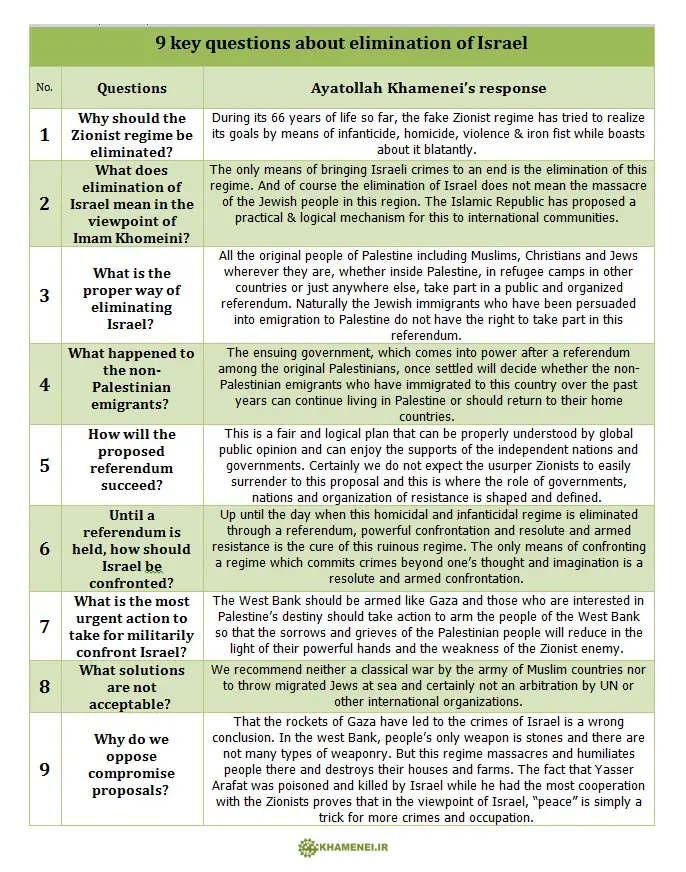
"The only way to confront the Zionist enemy is the continuation and fortification of resistance and Jihad," Ayatollah Ali Khamenei was quoted as saying September 3, 2005, in a meeting with the militant group Islamic Jihad's secretary general Ramazan Abdullah (AFP, September 3, 2005). In October 2005, recently elected President Mahmoud Ahmadinejad quoted Ayatollah Khomeini and declared, “As the Imam said, Israel must be wiped off the map.” The president added: “And God willing, with the force of God behind it, we shall soon experience a world without the United States and Zionism” (AP, October 26, 2005).

President Bush said February 16, 2005, “Iran has made it clear that they don't like Israel, to put it bluntly. And the Israelis are concerned about whether or not Iran develops a nuclear weapon, as are we, as should everybody....Clearly, if I was the leader of Israel, and I listened to some of the statements by the Iranian ayatollahs that regarded my security of my country, I'd be concerned about Iran having a nuclear weapon, as well. And in that Israel is our ally, and in that we've made a very strong commitment to support Israel, we will support Israel if their security is threatened.”

Iran's nonconventional weapons are not a threat only toward Israel, they also pose a danger to the United States and its interests around the world. And the American people recognize this danger. According to a January 2006 Gallup poll, 19% of Americans see Iran as an immediate threat to the United States and another 65% said Iran is a long-term threat.

On June 15, 2006, Iran’s defense minister, Mostafa Mohammad Najjar, signed an agreement with his Syrian counterpart, Hassan Turkmani, for military cooperation against what they called the “common threats” presented by Israel and the United States. “Our cooperation is based on a strategic pact and unity against common threats,” said Turkmani. “We can have a common front against Israel’s threats.”

Threats Against Iran's Neighbors

The Iranian nuclear program is also vigorously opposed by Iran’s Arab neighbors, who fear the country seeks to dominate them. In October 2007, a senior Iranian general said that suicide bombers were ready to strike at targets throughout the Gulf. The threat was aimed at Qatar, Saudi Arabia and the United Arab Emirates.

In December 2008, Egyptian President Hosni Mubarak warned “the Persians are trying to devour the Arab states” (Jerusalem Post, December 11, 2008). Mubarak said a few months later, “A nuclear armed Iran with hegemonic ambitions is the greatest threat to Arab nations today” (Wall Street Journal, March 23, 2009).

The perceived threat from Iran has provoked several Arab countries to announce their interest in nuclear power. Jordan, Egypt, Yemen, Algeria, Morocco, Tunisia, the UAE and Saudi Arabia wish to develop their own programs.

Would Iran Use the Bomb?

Mahmoud Ahmadinejad believes the most important task of the Iranian Revolution was to prepare the way for the return of the Twelfth Imam, who disappeared in 874, bringing an end to Muhammad’s lineage. This imam, the Mahdi or “divinely guided one,” Shiites believe, will return in an apocalyptic battle in which the forces of righteousness will defeat the forces of evil and bring about a new era in which Islam ultimately becomes the dominant religion throughout the world. The Shiites have been waiting patiently for the Twelfth Imam for more than a thousand years, but Ahmadinejad believes he can now hasten the return through a nuclear war. Ayatollah Hussein Nuri Hamdani explicitly said in 2005 that “the Jews should be fought against and forced to surrender to prepare the way for the coming of the Hidden Imam.” It is this apocalyptic world view, Middle East scholar Bernard Lewis notes, that distinguishes Iran from other governments with nuclear weapons.

Lewis quotes a passage from Ayatollah Khomeini cited in an 11th grade Iranian schoolbook, “I am decisively announcing to the whole world that if the world-devourers [the infidel powers] wish to stand against our religion, we will stand against the whole world and will not cease until the annihilation of all of them. Either we all become free, or we will go to the greater freedom, which is martyrdom. Either we shake one another’s hands in joy at the victory of Islam in the world, or all of us will turn to eternal life and martyrdom. In both cases, victory and success are ours.”

There are those who think that Muslims would never use such weapons against Israel because innocent Muslims would be killed as well, but Saddam Hussein did not hesitate to use poison gas on his own people. During the war in Lebanon in 2006, Hezbollah did not worry that rocketing cities with large Arab populations such as Haifa and Nazareth would kill non-Jews (and 24 of the 52 Israeli casualties were non-Jews). Muslims murder each other every day in post-Saddam Iraq. And Iran fought a ten-year war with Iraq in which as many as one million Muslims were killed. Ayatollah Ali Akbar Hashemi-Rafsanjani explicitly said he wasn’t concerned about fallout from an attack on Israel. “If a day comes when the world of Islam is duly equipped with the arms Israel has in possession,” he said “the strategy of colonialism would face a stalemate because application of an atomic bomb would not leave any thing in Israel but the same thing would just produce damages in the Muslim world.” As even one Iranian commentator noted, Rafsanjani apparently wasn’t concerned that “the destruction of the Jewish State would also means the mass killing of the Palestinian population as well.”

Iran would never launch a nuclear attack against Israel, some argue because, as the old Sting song used to say about the Russians, the Iranians “love their children too.” In the days of the Cold War we used to refer to this idea as MAD or Mutually Assured Destruction. No Muslim leader would risk an Israeli counterstrike that might destroy them. MAD also doesn’t work, however, if the Iranians believe there will be destruction anyway at the end of time. What matters, Bernard Lewis observed, is if the infidels go to hell and believers go to heaven. And if you believe that killing the nonbelievers will earn you a place in Paradise with 72 virgins, what difference does it make if you go out in a blaze of glory as a suicide bomber or in the shadow of a mushroom cloud?

Optimists also suggest the Iranians are driven more by rationality than theology and would not risk using nuclear weapons. Others believe they are irrational and therefore cannot be trusted to hold their fire. One does not have to believe the Iranians are irrational, however, to foresee the possibility of an attack on Israel with nuclear weapons. Rafsanjani, the President of Iran before the current one, was just as adamant about destroying Israel as his successor. Contrary to the old aphorism that you can’t win a nuclear war, he argued that Iran could achieve victory. He said that “ Israel is much smaller than Iran in land mass, and therefore far more vulnerable to nuclear attack.” Since Iran has 70 million people and Israel only has seven million, Rafsanjani believed Iran could survive an exchange of nuclear bombs while Israel would be annihilated. The rhetoric was bombastic, but he and other Iranian leaders might first consider the possibility that Israel could conceivably launch far more missiles and the outcome might be very different than he imagined.

Rafsanjani is correct about Israel’s vulnerability. Besides the population difference, the disparity in size of the countries is such that it does not take a whole arsenal of ICBMS like the old Soviet Union had to destroy Israel; Iran need only have three crude bombs to attack Israel’s three major population centers – Tel Aviv, Haifa and Jerusalem – and it’s goodbye Israel.

Iran will not have to use nuclear weapons to influence events in the region. Maj. Gen. Vladimir Dvorkin, head of the Moscow-based Center for Strategic Nuclear Forces, said the potential danger of an Iranian bomb is not the possibility of a nuclear strike against some countries, but the ability to assume a more bold approach in dealing with the international community after becoming a nuclear power. “The real threat is that Iran, which is already ignoring all resolutions and sanctions issued by the UN Security Council, will be practically ‘untouchable’ after acquiring nuclear-power status, and will be able to expand its support of terrorist organizations, including Hamas and Hezbollah” said Dvorkin (RIA Novosti, March 12, 2009).

Furthermore, by possessing a nuclear capability, the Iranians can deter Israel or any other nation from attacking Iran or its allies. When Hezbollah attacked Israel in 2006, for example, a nuclear Iran could have threatened retaliation against Tel Aviv if Israeli forces bombed Beirut. The mere threat of using nuclear weapons would be sufficient to drive Israelis into shelters and could cripple the economy. What foreign investors will want to risk their money going up in the smoke of a mushroom cloud? Will immigrants want to come to a country that lives in the shadow of annihilation? Will Israelis accept the risk? Israeli leaders will have to decide if they can risk calling the Iranians’ bluff.

A Military Response?

London's Sunday Times (March 13, 2005) claimed that Israel has a plan to attack Iran's nuclear reactor and that the U.S. would not block the attack if diplomatic efforts fail to contain Iran's nuclear development. Both Israel and the United States denied the report though both are widely believed to be contemplating military action if diplomacy fails. Labor MK Ephraim Sneh said that military action would be a last resort and Israel was hopeful the international community would reach a diplomatic agreement to stop Iran from obtaining nuclear weapons (Jerusalem Post, March 13, 2005).

A number of options are available for potentially attacking Iran. Some of those suggested in the media have included assassinating the country’s leaders or nuclear scientists; bombing the entrances to facilities to prevent scientists and others from reaching them; destroying Iran’s main oil terminals and crippling the economy; and bombing the enrichment sites. Press reports have also disclosed covert operations to disrupt the nuclear program. For example, Israel reportedly “used front companies to infiltrate the Iranian purchasing network...to deliver faulty or defective items that ‘poison’ the country’s atomic activities” (Telegraph, February 16, 2009).

Meanwhile, Iran was reportedly using reinforced materials and tunneling deep underground to store nuclear components in an effort to protect them in the event of an attack (AP, March 4, 2005). More recent reports have indicated that Iran is racing to dig a network of tunnels and upgrade its air defences to protect its nuclear facilities from possible attacks (Telegraph, January 25, 2006).

Masud Yazaiari, spokesperson of the Iranian Revolutionary Guards, warned in the past that Iran would respond to any Israeli efforts to stop their nuclear program. “Their threats to attack our nuclear facilities will not succeed,” Yazaiari said. “They are aware that Tehran's response would be overwhelming and would wipe Israel off the face of the earth” (Maariv, July 27, 2004). In April 2007, Mohammad Baqer Zolghadr, Iran’s deputy interior minister in security affairs, said Iran will strike U.S. interests around the world and Israel if attacked. “Nowhere would be safe for America with [Iran’s] long-range missiles ... we can fire tens of thousands of missiles every day,” Zolghadr said (Haaretz, April 26, 2007).


Sources: American Israel Public Affairs Committee (AIPAC), the Heritage Foundation, the Washington Post, (February 11 and 20, 2003, February 5, 2004; March 13, 2006), Michael Eisenstadt, "Iran's Nuclear Program: Gathering Dust or Gaining Steam?", Washington Institute for Near East Policy, (February 3, 2003); Ha'aretz, (February 23, 2003); New York Times, (February 13; June 3, 2004; March 6, 2005; June 16, 2005; July 28, 2005); Jerusalem Post, (July 4 & August 18, 2004, March 18 & December 5, 2005); AP, (August 11, 2004); Guardian, (February 2, 2005); Telegraph, (February 13, 2005); AP, (March 6, 2005); Ynet News, (October 25, 2005); Middle East Newsline, (March 1, 2006); Defensenews.com, (June 15, 2006); , “When could Iran get the Bomb?”