|
[By: Rebecca Weiner]
Throughout the country's stormy history - from
the Roman period through the present - Jews have
lived in France, their fate intimately tied
to the various kings and leaders. Despite
physical hardship and anti-Semitism,
Jewish intellectual and spiritual life flourished,
producing some of the most famous Jewish rabbis
and thinkers, including Rashi and Rabenu
Tam.
Jews have contributed to all aspects
of French culture and society and have excelled
in finance, medicine, theater and literature.
Currently, France hosts Europe’s largest
Jewish community - 480,000 strong - and Paris is said to have
more kosher restaurants
than even New York City. Between January and November 2015, 6,500 French Jews made aliyah, and thousands more are predicted to make their way to Israel by the new year.
- Roman-Medieval Period
- Middle Ages
- French Revolution & Restoration
- Early 20th Century
- The Holocaust
- Post-Holocaust Era
- Modern Community
- Threats to the Community in the 21st Century
- Relations with Israel
- Jewish Tourist Sites
Roman Period to the Medieval Period
A Jewish presence existed in France during the Roman period, but the
community mainly consisted of isolated individuals, rather than an
established community. After the Roman conquest of Jerusalem, boats filled with Jewish captives landed in
Bordeaux, Arles and Lyons. Archeological finds of Jewish objects with menorahs imprinted on them date back to
the first through fifth century.
Jewish communities have been documented in 465 in Vannes (Brittany), in
524 in Valence and in 533 in Orleans. Jewish immigration increased during
this period and attempts were made to convert the Jews to Christianity.
In the 6th century, a Jewish community thrived in
Paris. A synagogue was built on the Ile de la Cite,
but was later torn down and a church was erected instead.
Anti-Jewish sentiments were not common in this early period, in fact,
after a Jewish man was killed in Paris in the 7th century, a
Christian mob avenged his death.
During the 8th century, Jews were active in commerce and
medicine. The Carolingian emperors allowed Jews to become accredited
purveyors in the imperial court. Jews also became involved in agriculture
and dominated the field of viticulture; they even provided the wine for
Mass.
The Middle Ages
The First Crusade (1096-99) had
no immediate effect on the Jews of France, however, in Rouen, statements
were made by the Crusaders justifying their persecution of Jews across
Europe.
After the Second Crusade (1147-49), a long period of persecution began.
French clergyman gave frequent anti-Semitic sermons. In some cities, such
as Beziers, Jews were forced to pay a special tax every Palm Sunday. In
Toulouse, Jewish representatives had to go to the cathedral on a weekly
basis to have their ears boxed, as a reminder of their guilt. France’s
first blood libel took place in Blois
in 1171 and 31 Jews were burned on the stake.
The situation detiorated during the rule of King Philip Augustus. Philip
was raised believing that Jews killed Christians and, therefore, held an
ingrained hatred toward the Jews. After four months in power, Philip
imprisoned all the Jews in his lands and demanded a ransom for their
release. In 1181, he annulled all loans made by Jews to Christians and took
a percentage for himself. A year later, he confiscated all Jewish property
and expelled the Jews from Paris; he readmitted them in 1198, only after
another ransom was paid and a taxation scheme was set up to procure funds
for himself.
In 1215, the Fourth Lateran Council forced Jews to wear a badge in the
provinces of Languedoc, Normandy and Provence.
More anti-Jewish persecutions took place in the western provinces during
the rule of Louis IX (1226-70). In 1236, crusaders attacked the Jewish
communities of Anjou and Poitou and tried to baptize all the Jews, those
that resisted were killed. An estimated 3,000 Jews were murdered.
In 1240, Jews were expelled from Brittany and the famous disputation of
the Talmud began in
Paris. The Talmud was put on trial and was subsequently burned in 1242.
Despite the persecution, Jews managed to remain active in money-lending and
commerce. Jews expelled from England were also admitted into France. Again, in 1254, Jews were banished from
France, their property and synagogues were confiscated, however, after a couple of years, they were readmitted.
Phillip IV the Fair ascended to power in 1285. In 1305, he imprisoned
all the Jews and seized everything they owned except the clothing on their
backs. He expelled 100,000 Jews from France and allowed them to travel with
only ones day’s provisions. Phillip IV’s successor, Louis X, allowed
the Jews to return in 1315.
A Jewish presence was first mentioned in Besancon,
in eastern France, in 1245. Jews left the town in the 15th century,
and returned only after the French Revolution. Jews were first permitted
to reside in Belfort, the capital of the Belfort region in eastern France,
in the 1300s. By the time of the Nazi occupation there were 700 Jews
in the town, of which 245 were killed.
Between 1338-1347, 25 Jewish communities in Alsace
were victims of terror. Massacres in response to the Black Plague (1348-49)
struck Jewish communities throughout the east and southeast. The Jews
of Avignon and Comtat Venaissin were spared similar fates because of
intervention from the pope. Further bloodshed spread to Paris and Nantes
in 1380. The culmination of all the persecution and bloodshed was the
definitive expulsion of Jews from France in 1394.
Despite all the expulsions and persecutions, Jewish learning managed to
thrive during the middle ages. Both Il-de-France and Champagne became
centers for Jewish scholarship and other centers of learning grew in the
Loir Valley, Languedoc and Province. In the north, talmudic and biblical
commentary, as well as, anti-Christian polemic and liturgical poetry were
studied. Whereas, in the south, grammar, linguistics, philosophy and
science were studied. Also, in the South, numerous translations were made
of religious materials from Arabic and from Latin to French.
One of the foremost Jewish scholars during the Middle Ages was Rashi, who started his own yeshiva in
France. His biblical commentary is one of the most popular and widely known
works today.
Large numbers of Marranos, secret Jews, from Portugal came to France in
the mid-1500's. The majority of them did not remain faithful to Judaism and
assimilated into French society. This was the first time since 1394 when
Jews were allowed to legally live in the kingdom of France.
After the Chmeilnicki massacres in 1648, more Jewish settlers, fleeing
the Ukraine and Poland, came to
Alsace and Lorraine. An influx of immigrants came to southeast France, when
the Duke of Savoy issued an edict declaring Nice and Villefranche de-Conflent
free ports.
The communities of Avignon and Comtat Venaissin flourished in the 17th century. Jews became involved in commercial activity and frequently
attended the fairs and markets. Success spread to other nearby communities;
including the Jewish community of Alsace, who exploited the facilities
given to the Marranos, "Portugese Jews."
Jews began resettling Paris in the 18th century. Two groups
of Jews came to Paris: southern Jews mainly of Sephardic descent from Bordeaux,
Avignon and Comtat Venaissin and Ashkenazim from Alsace, Lorraine and a couple other northern cities. The wealthier
Sephardim settled on the Left Bank, while the Ashkenazim settled on the
Right. Paris’s first kosher inn opened in 1721 and its first synagogue opened in 1788.
Anti-Jewish laws began to be repealed in the 1780's, such as the
"body tax" which likened Jews to cattle. About 500 Jews were
living in Paris and about 40,000 in France at the time of the French
Revolution.
French Revolution & Restoration
After the French Revolution, citizenship was finally granted to the Jews
of France. The Sephardim received
citizenship in September 1790 and the Ashkenazim received it about six month later. Jews were given civic rights as
individuals, but lost their group privileges.
During the Reign of Terror (1793-94), synagogues and
communal organizations were closed down, along with other religious
institutions.
Napoleon considered the Jews, "a nation with a nation," and he
decided to create a Jewish communal structure sanctioned by the state.
Hence, in 1806, he ordered the convening of a Grand Sanhedrin, composed of
45 rabbis and 26 laymen. The Grand Sanhedrin paved the way for the
formation of the consistorial system, which were religious bodies
established in every department of France that had a Jewish population
numbering more than 2,000. The consistorial system made Judaism a recognized religion and placed
it under government control.
Despite the new found freedoms, anti-Jewish measures were passed in
1808. Napoleon declared all debts with Jews annulled, reduced or postponed,
which caused the near ruin of the Jewish community. Restrictions were also
placed on where Jews could live in an effort to assimilate them into French
society.
The Jews did not receive the Restoration
with any hostility. Jewish educational institutions
were be established. In 1818, schools were
opened in Metz, Strasbourg and Colmar. Other Jewish schools were opened
in Bordeaux and Paris. The Metz Yeshiva, which
was closed during the Revolution, was reopened
as a central rabbinical seminary. The seminary
was transferred to Paris in 1859, where it
continues to function today. Judaism was given
the same status as other recognized religions.
During the 19th century, Jews were extremely active in many
spheres of French society. Rachel and Sarah
Bernhardt are two Jewish women
who became famous acting at the Comedie Francaise in Paris. Bernhardt
eventually directed plays at her own theater and was given the title
"Divine Sarah" by Victor Hugo.
Jews became involved in politics; for example, Achille Fould and Isaac
Cremiuex served in the Chamber of Deputies. Jews also excelled in the
financial sphere, two leading families were the Rothschild and the Pereire
families.
In the field of literature and philosophy, well-known Jews included
Emile Durkheim, Marcel Proust and Salomon Munk.
While the situation improved for Jews in France, the Damascus Affair
served as a rude awakening. Accusation of a blood libel in Damascus led to
an outbreak of anti-Jewish disorders in France in 1848. General unrest led
to attacks in Alsace and spread northward, Jewish houses were pillaged and
the army had to be sent in to resume order.
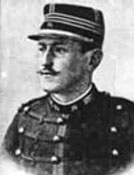 Dreyfus
 |
The 1870 war transferred the Jewish communities of Alsace and Lorraine
from French control to German control, a major loss for the Jewish
community.
An upsurge of anti-Semitism began in the late 1800's. Anti-Semitic
newspapers were circulated, including Edouard Drumont’s La France
Juive (1886), which became a best-seller. Jews were blamed for the
collapse of the Union Generale, a leading Catholic bank.
In this atmosphere, the infamous Dreyfus
case was tried. Captain Alfred Dreyfus was arrested on October 15,
1894, for spying for Germany. He received a life sentence on Devil’s
Island off the coast of South America. The government chose to repress
evidence, which came to light through the writings of Emile Zola and Jean Jaures. Ten years later, the French government fell and Dreyfus was
declared innocent. The Dreyfus case shocked Jewry worldwide and motivated Theodor Herzl to write the book "The Jewish State: A Modern Solution to the
Jewish Question" in 1896. The Dreyfus case also led to the French
law in 1905 separating church and state.
Early 20th Century
At the turn of the century, Jewish artists were extremely prominent,
including Modigliani, Soutine,
Kisling, Pisarro and Chagall.
France faced an increase in Jewish immigration in the early 1900's. More
than 25,000 Jews came to France between 1881 and 1914. Immigrants hailed
from all over Europe and the Ottoman
Empire. Although, for many of the immigrants, France served as a
transit point rather than a final destination.
The advent of World War I halted Jewish immigration and also put an end
to anti-Semitic campaigns because of
the need for a unified front. France was able to regain Alsace and Lorraine
and many Jewish families were able to reunite once Alsace and Lorraine
became part of France.
During the inter-war years, Jewish immigration from North Africa, Turkey
and Greece increased once again.
Immigration from Eastern Europe also skyrocketed, many came after the
pogroms in the Ukraine and Poland.
The trend continued especially after the United States prohibited free
immigration in 1924.
The Federation des Societes Juif de France (FSJF) was established in
1923 to take care of the needs of the French Jewish community.
The Holocaust
The Germans invaded France on May
10, 1940, and Paris fell on June 14th.
Two weeks later the armistice was signed and France
was divided into unoccupied and occupied zones, and
Alsace-Lorraine was annexed to the Reich. A Vichy government
was set
up in France. An estimated 300,000 Jews lived in
France prior to the invasion.
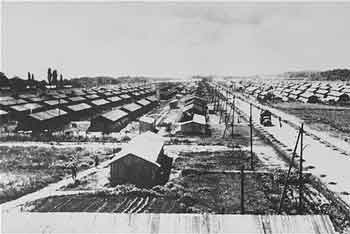 Gurs Transit Camp
 |
Between September 1940 and June 1942, a number of anti-Jewish measures
were passed, including expanding the category of who is a Jew, forbidding
free negotiation of Jewish-owned capital, confiscating radios in Jewish
possession, executing and deporting Jewish members of the resistance
movement, establishing a curfew, forbidding a change of residence, ordering
all Jews to wear a yellow badge and prohibiting access to public area.
The Vichy government established a Commissariat General aux Questions
Juives in April 1941 that worked with German authorities to "aryanize"
Jewish businesses in the occupied zone. French Jewry was represented in the
Union Generale des Israelites de France (UGIF) during the occupation.
Non-French Jews living in France were treated differently than French Jews
during this period. Non-French Jews were rounded up for deportation by the
French police, whereas French Jews were rounded up by the Gestapo, who did
not trust the French authorities to do so.
In March 1942, the first convoy of 1,112 Jews was deported to concentration camps in Poland and Germany. An infamous
roundup took place on July 16-17, 1942, when 12,884 people from Paris and
its suburbs were arrested. Another notorious round-up occurred on August
15, 1942, when 7,000 foreign Jews were arrested and handed over to the
Germans. Between 1942 and July 1944, nearly 76,00 Jews were deported to
concentration camps in the East via French transit camps, only 2,500
returned. Of those deported, 23,000 had French nationality, the rest were
"stateless."
France’s major transit camp, Drancy,
located outside Paris, was established in 1941. A number of other transit
camps were created throughout France and were run by the French police.
Drancy was designed to hold 700 people, but at its peak in 1940 it held
more than 7,000. Drancy served as a stopping point for thousands of Jews en
route Auschwitz.
There were also concentration camps located inside France, such as Gurs,
which opened in June 1940. By 1941, it housed about 15,000 inmates,
including foreign Jews; many perished there from malnutrition and bad
sanitation. More than 3,000 Jews died in these internment camps. When
Germany occupied all of France in late 1942, most of the inmates were sent
to concentration camps in Germany and Poland. After the deportations ended
in mid-1943, only 1,200 prisoners remained.
It is estimated that 25 percent of French Jewry died in the Holocaust.
Post-Holocaust Era
France became a haven for postwar refugees and within 25 years its
Jewish population tripled. In 1945, 180,000 Jews were living in France,
and, by 1951, the population reached 250,000. An influx of North African
Jews immigrated to France in the 1950's due to the decline of the French
empire. Subsequent waves of immigration followed the Six-Day War, when another 16,000 Moroccan and Tunisian Jews settled in France. Hence, by 1968, Sephardic Jews were the majority in France. These new immigrants were already
culturally French and needed little time to adjust to French society.
Today more than 600,000 Jews live
in France, 375,000 live in Paris. There are
230 Jewish communities, including Paris, Marseilles
(70,000), Lyons (25,000), Toulouse, Nice and Strasbourg.
Two of the major problems facing French Jewry are assimilation and anti-Semitism. Anti-Semitism has been
present throughout France’s post-war history. After the Six Day War in 1967, anti-Israel stances
were taken by de Gaulle and his government. Anti-Israel propaganda was
published in May 1968 by the New Left and supporters of Palestinian
terrorism; a number of physical clashes broke out between Jews and Arabs in
certain quarters of Paris. This atmosphere led to increased aliyah of
French and Algerian Jews in the late 1960's.
In the late 70's, a spate of racist and anti-Semitic attacks were
carried out against Jewish monuments and cemeteries. On October 3, 1980, a
bomb exploded outside a Paris synagogue, killing four people. Terrorism and anti-Semitism
continued to be a problem in the 1980's and 90's, as many synagogues, cemeteries and restaurants were
vandalized and desecrated. Few of the perpetrators have been apprehended.
In the late 1990's, Jews were concerned about the rise to power of the
National Front political party, who espouses anti-immigration and
anti-Semitic views.
Besides for problems with anti-Semitism, France has had difficulty
owning up to its role in the Holocaust. It
has taken many years to apprehend and try French war criminals. In the
1980's, a trial was held against Klaus Barbie, who received a sentence of
life imprisonment. In 1994, Paul Touvie, who was responsible for the
massacre of seven Jews in Lyon during World War II, was tried and condemned
to life in prison. A third trial, in 1997, tried Maurice Papon, a senior
official responsible for Jewish affairs in Bordeaux. Papon’s trial was
different than the other two because the other two were killers, whereas
Papon was a bureaucrat, who signed the death warrants for 1,560 French
Jews, including 223 children. Papon was found guilty for crimes against
humanity and was sentences to ten years in jail. The trial served as a
pretext for reexamining France’s role in the Holocaust. Debate arose
about the Vichy regime’s involvement in rounding up, deporting and
murdering French Jews.
Restitution for stolen era artwork from France is another
issue of controversy. In 1998, France finally created a centralized
body to investigate Holocaust restitution cases for heirs and descendants
of those whose property was confiscated during World War II. France’s
national museum is trying to track down the owners or heirs to more
than 2,000 pieces of unclaimed artwork in its possession. It is estimated
that over 100,000 pieces of artwork were taken from Jews and others in France alone; Jewish art collections
in France were among those coveted by the Nazis.
On December 11, 2005, a memorial to 86 Jewish victims
of Nazi physician August Hirt was unveiled at the Jewish cemetery in
Cronenbourg.
Modern Community
The Consistoire Central Israelite de France et d’Algerie, reopened
following the war. The Consistoire is responsible for training and
appointing rabbis, religious instruction for youth, kashrut supervision and the application
of Jewish law in personal matters. The Consistoire mainly represents Orthodox synagogues and so a number of
liberal synagogues fall outside its jurisdiction.
Another major organization, the Conseil Representaif des Juifs de France (CRIF) was founded in 1944 and today it is comprised of 27 Jewish
organizations, from Zionist to socialist. Since 1945, it has played a
significant role in the fight against anti-Semitism.
The major Jewish community organization is the Fods Social Juif Unife (FSJU),
which was founded in 1949. It is involved in social, cultural and
educational enterprises, as well as fundraising. The FSJU"s community
centers played a large role in the absorption process of new Jewish
immigrants.
Only 40 percent of French Jewry are associated with one of these
community bodies. It is also estimated that only 15 percent of French Jews
go to synagogue. Still Jewish life and
culture is flourishing. There are more than 40 Jewish weekly and monthly
publications, as well as numerous Jewish youth movements and organizations.
Most French Jews send their children to public schools, although there
is increased attendance in Hebrew day schools; today close to 25% of
school-age children attend full-time Jewish schools. In Paris alone, there
are 20 Jewish schools in the day school system. Hebrew is also being
offered as a foreign language in many state high schools. In 1985, a new
library sponsored by the Alliance Israelite Universelle (AIU) opened. It is
now the largest Jewish library in Europe.
During the 1980's, there was a rise in the number of ultra-Orthodox Jews
in France, especially Paris. The Lubavitch movement has done
a lot of outreach work in France, putting up bill-boards during the holiday
periods and holding public candle-lighting ceremonies on Chanukah.
There is also a bilingual English speaking community in Paris called Kehilat Gesher. Kehilat Gesher, a community of around 145 families, is the only French Anglophone liberal synagogue serving the greater Paris area, through two locations, Paris 17th and St-Germain-en-Laye.
The best high schools in France are Jewish schools, according to a comprehensive report ranking all of France's 4,300 high schools released in April 2015 by Le Parisien Daily. The Beth Hanna high school, part of France's Chabad Lubavitch school network, was ranked as the top school in the entire country, due to their impressive 99% success rate on matriculation exams. Jewish high school The Lycee Alliance was also ranked highly on the list. Many lists from other reputable sources including Le Figaro ranked the Jewish schools as some of the top-performing schools in the country.
Over 20,000 French Jews made aliyah to Israel between 2000 and 2015, according to the Jewish Agency. In 2014, a record number of 7,200 French Jews emigrated to Israel to seek a better life. Between January and July 2015, 4,260 French immigrants made their way to Israel, compared to 3,830 French immigrants during the same period the previous year.
The first French Jews to make aliyah to Israel following November 13, 2015's coordinated terror attack on Paris, arrived on November 16, 2015. A group of 52 Jews from France landed at Israel's Ben-Gurion airport on November 16, and “dozens more” were expected to follow within the week, a spokesman for the Jewish Agency stated upon their arrival. French Jews fleeing anti-Semitism and terror attacks have also increasingly chosen Britain as their new home. Israel welcomed 7,054 French Jews making Aliyah in 2015, while 5,000 French Jews made the move to Britain.
Threats to the Community in the 21st Century
For many years following the Holocaust, anti-Semitism in France was only a mild problem, but in the late 2000's the Jewish Community Protection Services reported a strong surge in anti-Semitic incidents and attacks. From 2008 to 2010 there was a nearly 75 percent increase in anti-Semitic incidents, many attributed to anger over Israel's Operation Cast Lead in the Gaza Strip and the ongoing conflict with the Palestinians.
Violence in France, especially directed at Jews, has been primarily perpetrated by Muslims. An estimated eight million Muslims live in France, compared to fewer than 500,000 Jews, and a large segment of that Muslim population has not successfully integrated into French society. Some came with radical views and others have become more extreme as a result of contact with Islamists inside and outside of France.
In 2011, an estimated 389 incidents of anti-Semitism were reported, and the severity of the threat to Jews grew to the point where Jews were discouraged from wearing clothes or jewelery or anything that might identify them as Jews.
On March 19, 2012, a radical Muslim fired at children entering a Jewish
school in Toulouse, killing a 30-year-old teacher and his three- and six-year-old children. A third child, aged eight, was also murdered and a 17-year-old student was seriously injured. After that deadly attack, 90 anti-Semitic attacks were recorded in the next 10 days. In October, a kosher grocery store was bombed in Sarcelles wounding two people. Overall, France saw an increase of 58 percent in anti-Semitic incidents in 2012 compared to the previous year, according to a study released in February 2013 by the SPCD, the security unit of France's Jewish communities. In addition, a 2012 Anti-Defamation League poll in France found that 58 percent of the respondents believed their government was not doing enough to ensure the safety and
security of its Jewish citizens. [Click
here for more French public opinion regarding Jews and Israel.]
The situation has continued to deteriorate. According to a survey conducted by the Foundation for Political Innovation released in November 2014, 16 percent of France's citizens believe there is a “Zionist conspiracy on a global scale.” One-fourth of the respondents said that “Zionism is an international organization that seeks to influence the world and society in favor of the Jews.” Out of all the individuals surveyed, 35 percent said that “Jews today, in their own interest, exploit their status as victims of the Nazi genocide during WWII,” and 25 percent stated that “Jews have too much power in the fields of economy and finance.”
The entire French nation was traumatized on January 7, 2015, when two Islamic extremists attacked a French satirical newspaper that had published cartoons of the Prophet Muhammad, killing 10 members of the staff and two police officers. Two days later, while the perpetrators of the Charlie Hebdo massacre were surrounded by police, an assailant believed to have killed a policewoman the day before, took hostages at a Kosher supermarket in eastern Paris. After murdering four of the hostages, the suspect was killed when police stormed the market. During the siege, Jewish schools and shops in the neighborhood were closed and, for the first time since World War II, the Grand Synagogue of Paris was closed for Friday prayers.
Three soldiers patrolling outside of a Jewish Community Center in Nice, Southern France, were attacked by an individual weilding a knife on February 3, 2015. The attacker was identified as 30 year old Mousa Coulibaly (no relation to the Kosher supermarket gunman Ahmed Coulibaly), and had apparently been expelled from Turkey during the previous week. Earlier that afternoon he had been riding on a tram in France when he was approached by a tram employee and could not produce a ticket. He was forced off of the train at the next stop, where he became irate and targetted the soldiers, slashing one soldier on the cheek, a second soldier on one of their legs, and a third soldier on the chin. He flew to Turkey on January 28 with a one-way ticket, which raised suspiscions with French authorities who asked the Turkish government to send him back.
On November 13, 2015, terrorists affiliated with the Islamic State carried out a planned and coordinated terror attack on seven separate targets in Paris, France. The first attack occured at the Stade de France, the country's national sports stadium. At a friendly football match (not played for rank) between France and Germany attended by French President Francois Hollande, a bomber detonated himself outside of the stadium at 9:20pm local time after his explosive vest was discovered by a venue security gaurd. A second bomber did not attempt to enter the stadium, and detonated himself a few moments after the first explosion. It is a popular practice for fans to light fire-crackers during the games, so the crowd was not dispersed and the teams kept playing folowing the initial explosions. President Hollande was evacuated immediately, and once security inside the stadium realized what was happening they stopped the game and had the fans come down onto the field. A third bomber detonated himself at a McDonalds restaurant close to the stadium thirty-three minutes after the second stadium bomber detonated.
At 9:20pm, almost simultaneous with the first suicide bomb detonation at the Stade de France, attackers opened fire at people eating dinner at Le Carillon cafe and Le Petit Cambodge on streets rue Bichat and rue Alibert. The assailants fled in two vehicles following the attack, in which they killed eleven people. Twelve minutes after the start of this attack, at 9:32pm, an attacker opened fire on the Cafe Bonne Biere killing five and injuring eight. Four minutes later, at nearby restaurant La Belle Equipe, multiple terrorists opened fire killing nineteen and injuring nine before fleeing in vehicles. At 9:40pm a suicide bomber was seated at the Comptoir Voltaire cafe, and placed an order before detonating his explosives killing himself and seriously injuring fifteen.
U.S. blues-rock band The Eagles of Death Metal were playing a sold-out show at the Bataclan theater on Boulevard Voltaire, when at approximately 9:45pm three men dressed in all-black toting AK-47 assault rifles entered the concert hall. Shouts of “Allahu Akbar” were heard and the gunmen started firing calmly into the crowd. Some concert-goers initially mistook the machine-gun fire for pyrotechnics, but it soon became clear that they were in danger. The initial attack lasted for 10-20 minutes, with the attackers re-loading three or four times each while lobbing grenades into the frenzied crowd. Band members managed to escape the theater soon after the attack began, but some of their crew members were killed. The attackers began to round up a group of 60-100 hostages at 11:00pm, and shortly after midnight French police launched an assault on the Bataclan theater. Two terrorists detonated their suicide vests when police stormed the building, one was shot by police, and one escaped. Eighty-seven people were killed by the terrorists at the Bataclan theater. Syrian and Egyptian passports were found on the bodies of the attackers, but these proved to be fake. In total these attacks killed 129 people and injured over 350.
A state of emergency was declared in France by President Hollande in the days after the attack, which was then extended until the beginning of 2016. The French army carried out it's largest air strikes on ISIS yet on November 15, 2015, dropping 20 bombs on the self-proclaimed capital in Raqqa. Hollande vowed to “mercilessly,” fight terrorism while on a visit to the Bataclan theater after the attacks.
During the first half of 2015, there was an 84% increase in anti-Semitic attacks compared with the same period the previous year. A Rabbi and his son were attacked outside of a synagogue in Marseille, France in mid-October 2015. In an interview after the fact, the Rabbi clafiried details about the attack, for example the attacker was allegedly drunk and stumbling. A Jewish school teacher in Marseille, France, was stabbed multiple times by youths professing allegiance to the Islamic State on November 18, 2015. Three teenagers, one wearing a shirt bearing the symbol of ISIS, approached the teacher on the street and taunted, insulted, and finally stabbed the victim three times before being chased away by a car.
On January 11, 2016, a 35-year old Jewish teacher who was wearing a traditional Jewish skullcap, or kippah, was assaulted by a teenager wielding a machete. The 15-year old attacker stated in police custody that he felt ashamed that he did not manage to kill his Jewish victim. Like many of the attacks during 2015 this one took place in Marseille, which has France's second largest Jewish population. In the days following the attack Jewish community leaders in France debated whether they should discourage the wearing of kippahs or not. France's top Jewish community leader, Zvi Ammar, recommended that Jewish men and boys refrain from wearing the skullcap “until better days.” French President Francois Hollande rejected this sentiment, stating that it is “intolerable that in our country citizens should feel so upset and under assault because of their religious choice that they would conclude that they have to hide.”(Daily Mail, January 15, 2016)
Seventy-three year-old French Jewish politician Alain Ghozland was found dead in his apartment from multiple stab wounds on January 12, 2016. It appeared that his apartment had also been robbed.
The increasingly hostile environment, combined with the economic problems in France, prompted a significant jump in immigration to Israel. After averaging roughly 2,000 emigres per year for the previous several years, 7,200 French Jews moved to Israel in 2014, and 7,900 made the move in 2015. Still, with nearly 500,000 Jewish residents, France remains the Diaspora's second-largest (after the United States) Jewish community.
Although Jews make up less than 1% of France's population, more than 50% of all reported racist attacks in France in 2015 were perpetrated against Jews.
Relations with Israel
France and Israel have maintained relations since before the founding of
the state. Strong contacts between the Yishuv and the Free French existed in the period before the War of Independence; France gave moral
and financial support to the illegal
immigrants of Palestine. In 1947, France supported the UN partition plan, but normalization
between the two countries was gradual.
Cooperation between France and Israel was at its height during the Sinai campaign in 1956 and afterward
until the Six-Day War in 1967. During
this period, France became one of Israel’s main arms suppliers and a
network of technical and scientific cooperation were established. A
cultural agreement was signed between France and Israel in 1959,
establishing French language and literature classes at Israeli universities
and Hebrew language instruction at French universities.
After De Gaulle came to power in 1958, France began reconsidering its
Middle East policy. Franco-Israeli relations detiorated after the Six-Day War when De Gaulle imposed an
arms embargo against Israel and supported the Arab position. France began
renewing its relations with Algeria and other Arab states, further
distancing itself from Israel. De Gaulle’s resignation in 1969 and his
subsequent death in 1972 did not lead to any change in policies toward
Israel. President Georges Pomidou endorsed a pro-Arab Middle East Policy.
After his sudden death in 1974, Alain Poer, a longtime friend of the Jews,
took over as acting president. Nevertheless, France still continued to
become closer with the Arab states and did not intervene in the boycott of
Jewish banks by Arab investors.
Francois Mitterand’s presidential election in May 1981 brought hope of
a favorable change in attitude toward Israel. These hopes were manifested
in Mitterand visit to Israel in early 1982. In this visit, Mitterand
expressed the need for a Palestinian state disappointing those who wanted
to see stronger support for Israel. During the Lebanon War, France tried to pass a
UN resolution pressuring Israel into accepting a cease-fire and not
entering Beirut; the UN resolution was vetoed by the United States.
Historically, France and Lebanon were close, since Lebanon used to be a
French colony.
In the 1990's, Mitterand sent forces to join the allies during the Gulf War. He also met with President Herzog in 1992 and
established Maison France-Israel, located in the heart of France. Despite
these positive developments, a questionnable friendship with Rene Bousquet,
secretary general of the police in the Vichy
government, who was assassinated in 1993, embittered many French Jews.
Mitterand was replaced by Jacques Chirac as president in 1995. Chirac
was the first head of state to address the Palestinian
legislative council in 1996. He also supports a larger European role in the
peace process, especially in mediating a peace agreement between Israel and Lebanon. Subsequent leaders have also sought to increase France's role in the region, and particularly in the negotiations between Israel and its neighbors, but the Israeli sense that France and other European countries side with the Palestinians has minimized their influence. Still, recent leaders, including Nicolas Sarkozy, and current president François Hollande have enjoyed good relations with Israel.
Those ties werre tested in December 2014, however, when the French Parliament, following the examples set by Ireland, Britain, Spain, and Sweden, voted to unilaterally recognize “Palestine.” The French Parliament released a statement saying it hoped to use the recognition of a Palestinian state as a means of resolving the conflict with Israel” (Haaretz, December 2, 2014). This vote was condemned by former French Prime Minister Nicolas Sarkozy, who referred to the security of Israel as the “fight of his life.” Sarkozy expressed support for a two state solution and recognition of a Palestinian state eventually, but he told members of his UMP party that “unilateral recognition a few days after a deadly attack and when there is no peace process? No!” Sarkozy was referring to the deadly attack in which two Palestinian cousins Ghassan and Uday Abu Jamal entered the Kehilat Yaakov synagogue in Jerusalem during morning prayers and massacred five individuals with guns, knives, and axes. In response to the vote, Israeli Prime Minister Benjamin Netanyahu asked, “Do they have nothing better to do at a time of beheadings across the Middle East, including that of a French citizen?” (International Business Times, November 26, 2014).
In light of these recent votes to recognize a Palestinian state, EU Foreign Policy Chief Federica Mogherini expressed doubts as to whether the movement to unilaterally recognize Palestine is beneficial to the peace process. Mogherini explained that “The recognition of the state and even the negotiations are not a goal in itself, the goal in itself is having a Palestinian state in place and having Israel living next to it.” She encouraged European countries to become actively involved and push for a jump start to the peace process, instead of simply recognizing the state of Palestine. Mogherini said that the correct steps to finding resolution to the Israeli-Palestinian conflict might involve Egypt, Jordan, and other Arab countries forming a regional initiative and putting their differences aside at the negotiation table. She warned her counterparts in the European Union about getting “trapped in the false illusion of us needing to take one side” and stated that the European Union “could not make a worse mistake” than pledging to recognize Palestine without a solid peace process in place (Bloomberg, November 26, 2014).
French officials announced on January 29, 2016, that they would be spearheading an initiative to resolve the Israeli-Palestinian conflict, and pledged to recognize the independent state of Palestine if their efforts were to fail. French Foreign Minister Laurent Fabius revealed preparation plans for an international conference “to preserve and make happen the two-state solution,” including American, European, and Arab partners. The French initiative to convene an international peace summit to solve the Israeli-Palestinian conflict was presented to Israeli diplomats on February 15, 2016. The French initiative includes a 3-step process: consulting with the parties involved, convening a meeting in Paris of the international negotiation support group including several countries wanting to jump-start the peace process, and finally the summit itself that will hopefully re-start negotiations between the Israelis and Palestinians. In contrast to the comments of Palestinian Authority Foreign Minister Riyad al-Maliki, who stated during a February visit to Japan that the Palestinians “will never go back and sit again in direct Israeli-Palestinian negotiations,” Palestinian Authority President Mahmoud Abbas said that he welcomed the French proposal. The proposal was scoffed at by Israeli Prime Minister Benjamin Netanyahu, who called the initiative “bizarre,” and maintained that bilateral negotiations between the Israelis and Palestinians was the only was to achieve lasting peace.
French President Francois Hollande's presidential plane was upgraded with an Israeli-made defense system in late 2016. The system, developed by Elbit, uses thermal-imaging cameras to detect incoming missiles or other threats and targets them with a laser beam that disrupts their tracking systems.
The French government announced a second Middle East peace conference to be held in Paris during January 2017,which the Israelis once again soundly rejected. Prime Minister Benjamin Netanyahu verbally assailed the organizers, referring to the conference as a “rigged conference, rigged by the Palestinians with French auspices to adopt additional anti-Israel stances.”
Jewish Tourist Sites
Paris:
Pletzel: The heart of Jewish Paris is the Pletzel, a Yiddish name
for the old 13th century Jewish quarter found in the Marais
district. Despite all the expulsions, Jews managed to find loopholes in the
ban, so there was never any time where Jews did not live in Paris. One of
the oldest spots in the neighborhood is a 16th century building
in the courtyard once called Hotel des Juif, located on rue Ferdinand Duval
20. It was one of the first places occupied by Jews from Alsace-Lorraine
and Germany.
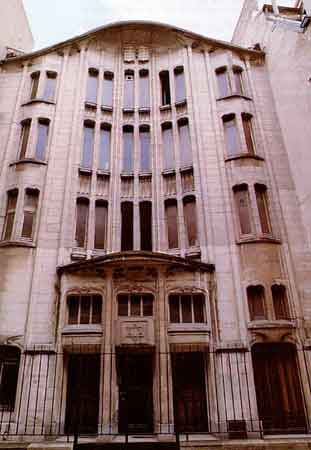 The
Art Nouveau synagogue,
agoudas hakehilos,
located on rue Pavee
10, is one of the
most interesting
buildings of the
district, the Art
Nouveau synagogue.
Built in 1913 for
Russian and Rumanian
immigrants, the synagogue
was designed by Hector
Guimard, who is most
famous for his designs
used for Paris’s
metro system. The
Art Nouveau synagogue,
agoudas hakehilos,
located on rue Pavee
10, is one of the
most interesting
buildings of the
district, the Art
Nouveau synagogue.
Built in 1913 for
Russian and Rumanian
immigrants, the synagogue
was designed by Hector
Guimard, who is most
famous for his designs
used for Paris’s
metro system.
In
the district, one
can find the museum
of the city of Paris,
Musee Carnavalet,
housed in the former
home of Madame de
Sevigne on rue de
Sevigne 23. Two rooms
in the museum are
dedicated to Jewish
personalities prominent
in the city’s
history, Rachel (a
famous 19th century Jewish actress)
and Marcel Proust.
A
two-minutes walk
from the museum is
Place de Vosges,
a famous Parisian
square, where some
of the city’s
early 17th century buildings
can be found. The
actress Rachel lived
in apartment house
nine. Victor Hugo
lived at apartment
number six and a
modest second-floor
synagogue can be
found at apartment
number 14.
One block west is the magnificent rue des Tounelles synagogue. Built in
1870, the synagogue originally catered to an Ashkenazi population, however,
after the influx of North African in the 1950's and 60's, it became Sephardic.
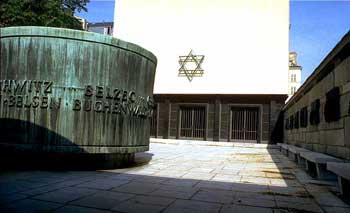 In
the heart of Pletzel is the Memorial to the Unknown Jewish Martyr (rue
rue Geoffroy-l'Asnier). The memorial consists of a four-story building,
inside the courtyard is a large bronze cylinder with the names of death
camps inscribed on it. The crypt contains ashes from concentration
camps, and the Warsaw
Ghetto. Alongside the memorial is a stone wall with engraved Holocaust scenes. Inside the building is artwork, photo exhibits, a Holocaust
documentation center and a library. In
the heart of Pletzel is the Memorial to the Unknown Jewish Martyr (rue
rue Geoffroy-l'Asnier). The memorial consists of a four-story building,
inside the courtyard is a large bronze cylinder with the names of death
camps inscribed on it. The crypt contains ashes from concentration
camps, and the Warsaw
Ghetto. Alongside the memorial is a stone wall with engraved Holocaust scenes. Inside the building is artwork, photo exhibits, a Holocaust
documentation center and a library.
Faubourg- Montmartre: Another Parisian quarter with many Jewish
sites of interest is the Faubourg- Montmartre district. Within the district
there are many synagogues, kosher restaurants and offices of various Jewish
organizations. In the neighborhood’s center is the synagogue located on
rue Buffault 28-30. The synagogue, opened in 1877, was the first synagogue
in Paris to become Sephardic, adopting Portuguese rite in 1906. Next to the
synagogue is a memorial plaque dedicated to the 12,000 Jewish Parisian
children deported to Auschwitz.
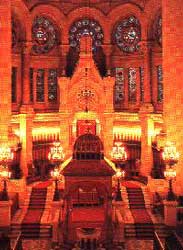 A second well-known synagogue in the district, is the Temple
Victoire,
located on rue de la Victoire 44; it is also known as the Rothschild
synagogue. Opened in 1874, the synagogue has special seats located on the
bimah for the chief rabbis of Paris and France. The rabbis leading the
service still wear Napoleanic -era costumes. A second well-known synagogue in the district, is the Temple
Victoire,
located on rue de la Victoire 44; it is also known as the Rothschild
synagogue. Opened in 1874, the synagogue has special seats located on the
bimah for the chief rabbis of Paris and France. The rabbis leading the
service still wear Napoleanic -era costumes.
Located at number 42 rue des Saules, in Montmartre, is the Museum of
Jewish Art. Inside one can find Chagall lithographs, sketches by Mane-Katz and paintings by Alphonse Levy.
Tombstones, ketubot, and Jewish ritual items can also be found in the
museum. Also there is an exhibit of synagogue models from across Europe.
The homes of former affluent Jewish can be found on Rue de Faubourg St-Honore,
including the former homes of the Rothschild (Nos. 33 and 35) and the
Pereires (Nos. 41 and 49), which are now embassies and ambassadors’
residences
Other districts: Jewish sites are not confined to these two main
districts. Near the Arc de Triomphe is the rue Copernic Synagogue, which
houses the largest non-Orthodox congregation. The synagogue was the target
of anti-Semitic attacks in 1980,
killing 4 people. Built in 1906, the synagogue contains plaques for those
who died in World War I and the 1980 bomb attack.
Another beautiful synagogue is located near the Eiffel Tower on rue
Chasseloup-Laubat 14. Completed in 1913, the synagogue has a yellow-stone
facade. It is attended by both North African Sephardim and Russian and
German Ashkenazim.
Close to the Seine, is the Theatre de la Ville de Paris, once the
Theatre de Sarah Bernhardt. On the second floor of the theater is a room
with her belongings, as well as memorabilia. Nearby is the Place de la
Theatre Francaise, where Rachel made her debut in 1838.
Inside the Louvre, are many items of Jewish interest, including the
doors from the Tomb of Kings in Jerusalem, renaissance works with biblical
themes, a 34-line Moabite language description from 824 describing a
Moabite victory over Israel. Paintings by Jewish artists, such as Chaim Soutine, can be found at the L’Orangerie. Another interesting collection
is the Strauss-Rothschild Collection found at the Cluny Museum.
One of the most famous sites in Paris is Notre Dame. On both sides of
the central portal are two female figures, one is Ecclesia and the other is
Sinagoga. Ecclesia, a beautiful women, represent Christianity, while
Sinagoga, a blind-folded women with a serpent around her eyes, represents Judaism.
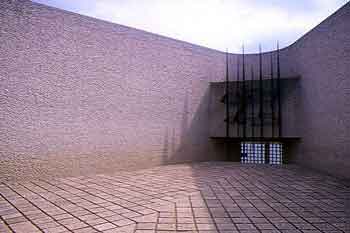 Behind Notre Dame, is square leading to a small Memorial to the
Deported, dedicated to French victims of Nazism. Inside are the names of the
German death camps where 200,000 French men, women and children were put to
death. Above the door, in French, are the words: "Forgive, but do not
forget." Behind Notre Dame, is square leading to a small Memorial to the
Deported, dedicated to French victims of Nazism. Inside are the names of the
German death camps where 200,000 French men, women and children were put to
death. Above the door, in French, are the words: "Forgive, but do not
forget."
Lyon
Two hours south of Paris is the city of Lyon, known for its culinary
delights, as well as for its silk and fabrics. Many Jewish resistance
fighters hid in the city during World War II leading Klaus Barbie,
"Butcher of Lyon," to set up his operations there. On the eve of
World War II, 5,000 Jews lived in Lyons, many of which perished. After the
War, many Jewish immigrants settled there and currently there is a sizeable
Jewish population of 20,000
Lyon has over 20 synagogues. Two of its most famous are the Grand
Synagogue and Neve Shalom. The Grand Synagogue, located on quai Tilsitt 14,
was built in 1864. Neve Shalom, is a beautiful Sephardic synagogue and
community center.
Lyon also has several kosher restaurants.
Arles
Arles
was once the Roman
capital and a major
medieval religious
center. One site
of Jewish interest
is the Arlaten Museum,
which contains local
judaica.
Rouen
Former
capitol of Normandy,
a Jewish presence
in Rouen dates back
to the 11th century.
During the 13th century,
it was a city of
historical and economic
importance to the
Jews. One of the
most amazing sites
in Rouen is a romanesque
stone structure,
dating back more
than a thousand years
and considered to
be the oldest Jewish
building in Europe.
Inscribed on it in
Hebrew are the phrases
"May the Torah
Reign forever"
and "This house
is supreme."
The structure is
now located underground.
Some theorize that
this structure is
a yeshiva from the
Middle Ages, the
only one of its kind
to still standing.
Comtat Venaissin
The Comtat Venaissin, which refers to the area including the cities of Carpentras, Avignon and Cavaillon, is a region that had a rich Jewish heritage. Jews lived in the south of France at relative peace until their expulsion in the 14th century when the region was united with the French Kingdom. The banished Jews, however, were granted refuge in the Comtat Venaissin and late came to be known as the "Juifs du Pape," of the Pope's Jews.
There are synagogues in Carpentras and Cavaillon that date back to the 18th century and are considered national monuments. A synagogue in Avignon, from
this era did not survive but was completely rebuilt in 1846.
In July 2013, the head of the Cavaillon tourism office applied for UNESCO World Heritage status to help preserve the Jewish ghettos, cemeteries and synagogues of the Comtat Venaissin.
“It is a protracted procedure that we’ve embarked on, but we are all so passionate about the history of our region and its connection to the Jews”, Annie Stoyanov said. “Cavaillon and the Vaucluse are home to a part of French and Jewish history that you won’t find in school books, or anywhere else in France for that matter, so it’s definitely worth the struggle.”
The synagogue in Carpentras, which is France's oldest active, was at one time the most emblematic places of Judaism in the region. Decorated in the Louis XV style, the edifice was built in 1367, extensively rebuilt in 1741-43 by the architect Antoine d’Allemand, and remodeled again soon thereafter.
“Carpentras was a key community, full of scholars and geonim,” historian Simone Mrejen-Ohana said. “This synagogue was the symbol of a Jewish renaissance in the region.”
Sources: Smith, Mike. “Netanyahu dismisses 'rigged' Paris peace conference,” Yahoo, (January 12, 2017);
Shavak, Tamar. “French presidential plane equipped with Israeli defense system,” YNet News, (November 3, 2016);
Ravid, Barak. “France Presents Middle East Peace Initiative to Israel,” Haaretz (February 15, 2016)
Dorell, Oren. “France threatens to recognize Palestinian state if no progress with Israel,” USA Today, (January 31, 2016);
Robinson, Julian. “President Hollande says it is 'intolerable' that French Jews feel they have to hide their religion after anti-Semitic attacks prompt call to abandon wearing the kippah,” Daily Mail (January 15, 2016);
Heller, Aaron. “Anti-Semitism drives record-high Western European immigration to Israel,” Times of Israel (January 14, 2016);
Dogget, Gina/Pinon, Bertrnd. “France debates Jewish skullcap after knife attack,” Yahoo News, (January 13, 2016);
"Some good news for French Jews: Two Jewish high schools sweep highest rankings". Haaretz (April 13, 2015);
"French soldiers wounded in Nice Jewish center attack," BBC (February 3, 2015);
"French lawmakers call on government to recognize Palestinian state", Haaretz (December 2 2014);
"16% of French believe in Zionist conspiracy on a global scale." Algemeiner, November 16 2014;
"Remnants of Provence's Jewry set to be UNESCO site," Times of Israel (November 27, 2013);
"'58% rise in anti-Semitic attacks in France in '12,'" Jerusalem Post, February 20, 2013;
"Alfonse D’Amato slams museums over stolen art." Nando.net, (February 8,
1998);
CNN (March 19, 2012);
"Fears
of Anti-Semitism: More and More French Jews Emigrating to Israel."
Der Spigel. March 22, 2012;
"France and the Final Solution.";
"France." Encyclopedia
Judaica. 1995;
"France." Virtual Jewish World;
France and Germany - Jewish Heritage Experiences. Kosher Expeditions;
"France outlines
measures to compensate Jews." November 28, 2000;
"Gurs" Encyclopedia
Britannica;
"Is French Jewish emigration driven by anti-Semitism," Jewish Telegraphic Agency, March 20, 2013;
Israeli Foreign Ministry;
"Thriving in France." Jewish Europe;
The
Jewish History Sourcebook: The Expulsion of the Jews from France,
1182 CE;
Jude Wanniski. Origins
of Anti-Semitism III. November 24, 1999;
"Judaism in France today." News from France Volume
95.03 - February 17, 1995;
Kamins, Toni L. Jewish Paris: Jewish Places and Jewish Paris: Kosher
food and Jewish life from Complete
Jewish Guides;
"An
overview of 2000 years of Jewish persecution.";
"Paris
the city of lights.";
Sauze, Elisabeth. The
Synagogues of the Comtat Venaissin;
Segal, Naomi. "Chirac seeks a wider Mideast role, meets Palestinians." San Francisco Jewish
Bulletin. October 26, 1996;
Tigay, Alan M. (ed.). The
Jewish Traveler. Jason Aronson, Inc. 1994;
Yanowitch, Lee. "Jews in France alarmed by National Front’s
success." Jewish
Bulletin of Northern California. May 30, 1997;
Photo Credits: Bernhardt Photo from Spartacus
Educational
Dreyfus photo from Homepage
of Michael Sinclair
Grand synagogue photo courtesy of Leo
Emanuel
Gurs photo from USHMM
General photos from FreeFoto.com
Guimard Synagogue and Memorial to the Unknown Jewish Martyr photos courtesy
of Norman Barth and The
Paris Pages.
|
