|
The history
of Spanish
Jewry dates back at least two thousand
years to when the Romans destroyed
the Second
Temple in Jerusalem,
and brought Jews with them back to Europe.
Since that time, the Jews of Spain (also known as Sephardim)
have experienced times of great oppression
and hardship, as well as periods of unprecedented
growth and renewal. Today the Jewish community in Spain is small - numbering approximately 12,000 - but growing, and the Jewish contributions to the nation and their influence on culture is still very much alive.
- Early History (205 BCE-711 CE)
- Muslim Rule (8-11th Century)
- Early Christian Rule (11-14th Century)
- Conditions Worsen (1369-1492)
- Inquisition & Expulsion
- Modern Community (1869-Present)
Early History (250 BCE - 711 CE)
While the area
of modern-day Spain (formerly
a collection of kingdoms which included Castile,
Aragon, and Catalonia) was still controlled
by the Holy Roman Empire, the Catholic Church
convened at the Council of Elvira where they
issued 80 canonic decisions, many of which
were intended to ostracize the Jews from
the general Spanish community. Canon 49, for example, prohibited Jews from blessing
their crops, and Canon 50 refused communion
to any cleric or layperson that ate with
a Jew.
During the early
5th century, the Visigoths captured
the Iberian Peninsula from Roman rule. While
initially anti-Christian, the Visigoths later
converted to Christianity and adopted many
of the previous laws that existed during Roman rule.
Under the rein of Toledo III, children of
mixed marriages were forcibly baptized and
Jews were barred from holding public office.
The situation got progressively worse and,
in 613 CE, the Jews were ordered to convert
to Christianity or face expulsion. Though
many Jews chose to leave rather than convert,
a large number of them still practiced Judaism in
secret, a tradition that survivedfor centuries.
In 633, the Fourth
Council of Toledo, convened to address
the problem of crypto-Judaism and Marranos (Jews who converted
to Christianity to escape persecution, yet
observed Jewish law in private).
While opposing compulsory baptism, the Council
decided that if a professed Christian was
determined to be a practicing Jew, his or
her children were to be taken away and raised
in monasteries or trusted Christian households.
Muslim Rule (8th - 11th Century)
In the 8th century,
the Berber Muslims (Moors) swiftly conquered
nearly all of the Iberian Peninsula. Under Muslim rule, Spain flourished,
and Jews and Christians were granted the
protected status of dhimmi.
Though this still did not afford them equal
rights with Muslims,
during this “Golden Age” of Spain,
Jews rose to great prominence in society, business,
and government.
The conditions
in Spain improved
so much under Muslim rule
that Jews from all across Europe came to
live in Spain during
this Jewish renaissance. There they
flourished in business and in the fields
of astronomy, philosophy, math, science,
medicine, and religious study. The same period
also witnessed a resurgence of Hebrew poetry
and literature from a traditional and liturgical
language to a living language able to be
used to describe everyday life. Among the
early Hebraists of the time were Yehudah
HaLevi who became known as one of the
first great Hebrew poets, and Menahem ben
Saruq who compiled the first ever Hebrew
dictionary.
The intellectual
achievements of the Sephardim (Spanish
Jews) enriched the lives of non-Jews as well.
In addition to contributions of original
work, the Sephardim translated
Greek and Arabic texts, which proved instrumental
in bringing the fields of science and philosophy,
much of the basis of Renaissance learning,
to the rest of Europe.
In the early
11th century, centralized authority based
at Cordoba broke
down following the Berber invasion and the
ousting of the Umayyads.
Rather than having a stifling effect, the
disintegration of the caliphate expanded
the opportunities to Jewish and other professionals.
The services of Jewish scientists, doctors,
traders, poets, and scholars were generally
valued by the Christian as well as Muslim rulers
of regional centers, especially as recently
conquered towns were put back in order.
Yet, despite
the Jews’ success and prosperity under Muslim
rule, the Golden Age of Spain began
to decline as the Muslims began to battle
the Christians for control of the Iberian
Peninsula and Spanish kingdoms in 722. The
decline of Muslim authority was matched with
a rise in anti-Semitic activity.
In 1066, a Muslim mob
stormed the royal palace in Granada,
crucified Jewish vizier Joseph ibn Naghrela
and massacred most of the Jewish population
of the city. Accounts of the Granada Massacre
state that more than 1,500 Jewish families,
numbering 4,000 persons, were murdered in
just one day. The conditions of Jews living on the
Iberian Peninsula (Spain and Portugal)
steadily began to worsen again. As a result,
many people started fleeing the Iberian Peninsula
to neighboring nations. Among those who fled
were the famed bible commentators Abraham
Ibn Ezra and Rabbi
Yosef Karo (author of the Shulchan Aruch),
as well as the families of Maimonides and
philosopher Baruch
Spinoza. (Christopher Columbus is also
suspected by many to have been a Marrano,
though there exists no conclusive evidence
to substantiate this claim.)
The centuries-long battle between Christians and Muslims,
(known as the Reconquista), divided
neighboring regions in the Iberian Peninsula
until the Christians finally took full control
of the entire peninsula in 1492. Though initially
as hostile to the Jewish population as the Muslim rulers
had become, the Christians soon realized
that the Jews could prove a strong ally and
enlisted many of them in their war effort.
The Christians relied on the Jews for assistance
in fighting the Muslim rulers since the Jews
were familiar with the local language and
customs. Collaboration between the Jews and
Christians brought the Jews increased persecution
from Muslim rulers, but full autonomy in
Christian controlled regions.
Early Christian Rule (11th - 14th Century)
The
early years of Christian rule over parts
of Spain seemed
quite promising for the Spanish
Jews. Alfonso VI, the conqueror of
Toledo (1085), was tolerant and benevolent
in his attitude toward them, for which
he won the praise of Pope Alexander
II. Soon after coming to power, Alfonso
VI offered the Jews full equality with
Christians and even the rights offered
to the nobility to estrange the wealthy
and industrious Jews from the Moors. Jews prospered under Alfonso and by 1098, nearly 15,000 Jews were living in Toledo, a city of 50,000.
To
show their gratitude to the king for the
rights granted them, the Jews willingly
placed themselves at his and the country’s
service. At one point, Alfonso’s army contained
40,000 Jews, who were distinguished from
the other combatants by their black-and-yellow
turbans. (So honored and important were
the Jews to the Spanish army that the Spanish
chose not to initiate the battle of Zallaka
until after the Sabbath had
passed). The king’s favoritism toward the
Jews became so pronounced that Pope Gregory
VII warned him not to permit Jews to rule
over Christians and roused the hatred and
envy of the latter.
After
the Christian loss at the Battle of Ucles
(1108), an anti-Semitic riot
broke out in Toledo; many Jews were slain,
and their houses and synagogues burned.
Alfonso intended to punish the murderers
and incendiaries, but died before he could
carry out his intention (1109). After his
death the inhabitants of Carrion slaughtered
the local Jews, others were imprisoned
and their houses pillaged.
In
the beginning of his reign, Alfonso VII
(1111) curtailed the rights and liberties
that his father granted the Jews. He ordered
that neither a Jew nor a convert may exercise
legal authority over Christians, and he
held the Jews responsible for the collection
of the royal taxes. Soon, however, he became
friendlier, confirming the Jews in all
their former privileges and even granting
them additional ones, by which they were
placed in parity with Christians. Judah
ben Joseph ibn Ezra had considerable influence
with the king, and after the conquest of
Calatrava (1147), the king placed Judah
in command of one of his fortresses, later
making him his court chamberlain.
Under
the reign of Alfonso VIII, the Jews gained
still greater influence, aided, doubtless,
by the king’s love of the beautiful Jewess
Rachel Fermosa of Toledo. When the king
was defeated at the battle of Alarcos,
many attributed the defeat to the king’s
love affair with Fermosa, and the nobility
retaliated by murdering her and her relatives
in Toledo.
Despite
the reclaimed status of the Jews
in Spain, their condition soon began
to worsen once again as the Crusaders unleashed
another round of anti-Semitic riots
in Toledo (1212), robbing and butchering
Jews across the nation. During the 13th century, Spanish
Jews of both sexes, like the Jews of France,
were required to distinguish themselves
from Christians by wearing a yellow badge
on their clothing; this order was issued
to keep them from associating with Christians,
although the reason given was that it was
ordered for their own safety.
During
this time, the clergy’s endeavors directed
against the Jews became increasingly pronounced
as well. A papal bull issued by Pope Innocent
IV in April 1250 further worsened the
situation of the Jews
in Spain by
prohibiting Jews from building new synagogues without
special permission, outlawing proselytizing
by pain of death, and forbidding most forms
of contact between Jews and Christians.
According to the decree, Jews were also
forbidden to appear in public on Good Friday.
The Jews of Spain were
also forced to live as a separate political
body in the Juderias (Jewish ghettos).
 Nachmanadies (Ramban)
 |
Although
the Spanish
Jews engaged in many branches of human
endeavor—agriculture, viticulture,
industry, commerce, and the various handicrafts—it
was the money business that procured them
their wealth and influence. Kings and prelates,
noblemen and farmers, all needed money,
and could obtain it only from the Jews,
who were forced to act as bailiffs, tax-farmers,
or tax-collectors since Christians were
forbidden from charging each other interest
rates. Becuase of their acquired wealth,
as well as government anti-Semitism,
Jews were also forced to pay many additional
and exorbitant taxes to the king.
Disputation
of Barcelona
Though
their holy texts were often burned by royal
decree, and many Jews were forced to convert
to Christianity, during the rule of King
James of Aragon (a Christian-ruled province
of Spain)
the Spanish monarchy started to take an
interest in Jewish philosophy and religion,
if only so that they could better understand
Jews and convince them to convert. In 1263,
King James convened a special council of
Dominican (Christian) and Jewish clergymen
to debate three key theological issues:
whether the Messiah had
already appeared, whether the Messiah was
divine or human, and which religion was
the true faith. Nachmanides (Rabbi
Moshe ben Nahman Gerondi, Ramban),
a Jewish theologian and philosopher was
called upon to represent the Jews; while
Friar Pablo Christiani, a Jew who later
converted to Christianity, represented
the Church.
The
disputation lasted four days and drew the
attention of the entire Jewish community.
Though the King granted Nachmanides the
freedom to speak freely, the Jewish community
feared that any statement that offended
the King would lead to increased persecution.
As the disputation turned in favor of Nachmanides the
Jews of Barcelona entreated
him to discontinue; but the King, whom Nachmanides had
acquainted with the apprehensions of the
Jews, desired him to proceed. At the end
of disputation, King James awarded Nachmanides a
prize and declared that never before had
he heard “an unjust cause so nobly
defended.” Despite the King’s declaration,
the Dominicans still claimed victory, which
led Nachmanides to
publish a transcript of the debate to prove
his case. From this publication, Christiani
selected certain passages which he construed
as blasphemies against Christianity and
denounced to his general Raymond de Penyafort.
A capital charge was then instituted, and
a formal complaint against the work and
its author was lodged with the King. King
James mistrusted the Dominican court and
called an extraordinary commission, ordering
the proceedings to be conducted in his
presence. Nachmanides admitted
that he had stated many things against
Christianity, but he had written nothing
which he had not used in his disputation
in the presence of the King, who had granted
him freedom of speech.
The
justice of his defense was recognized by
the King and the commission, but to satisfy
the Dominicans, Nachmanides was
sentenced to exile for two years and his
pamphlet was condemned to be burned. The
Dominicans, however, found this punishment
too mild and, through Pope Clement IV,
they succeeded in turning the two years
exile into perpetual banishment. Nachmanides left
Aragon never to return again and, in 1267,
he settled in the Land
of Israel. There he founded the oldest
active synagogue in
the Old City of Jerusalem,
the Ramban Synagogue.
The Reign of Pedro I
During
the reign of Pedro I (1350-1369), the quality
of Jewish life in Spain began
to improve and the King became a well-known
friend to the Jews. From the commencement
of his reign, Pedro so surrounded himself
with Jews that his enemies spoke derisively
of his royal court as “a Jewish court.” In 1357, Samuel Levi financed the construction of the Sinagoga del Transito, which served as the center of Todelo's Jewish life. It is also believed that during this time kosher slaughterhouses and butchershops sprang up along the main streets of Toledo.
Soon,
however a civil war erupted and a rival
army, led by Pedro I’s half brother
Henry II, attacked the Jews. During the
war, part of the Juderia of Toledo was
plundered and about 12,000 Jews were murdered
without distinction of age or sex. The
mob did not, however, succeed in overrunning
the Juderia proper, where the Jews, reinforced
by a number of Toledan noblemen, defended
themselves bravely.
The
friendlier Pedro was to the Jews and the
more he protected them, the more antagonistic
his half brother became. Later, when Henry
II invaded Castile in 1360, he robbed and
butchered the Jews living in Miranda de
Ebro and Najera.
Yet,
everywhere the Jews still remained loyal
to Pedro and fought bravely in his army.
In return, Pedro I showed his good will
toward them, and called upon the King of Granada to
also protect the Jews. Nevertheless, the
Jews suffered greatly. Villadiego (whose
Jewish community numbered many scholars),
Aguilar, and many other towns were destroyed.
The inhabitants of Valladolid, who paid
homage to Henry, robbed the Jews, destroyed
their houses and synagogues,
and tore their Torah scrolls.
Paredes, Palencia, and several other communities
met with a similar fate, and 300 Jewish
families from Jaen were taken prisoners
to Granada.
Pedro was eventually defeated and succeeded
by Henry de Trastamara.
Conditions Worsen (1369 - 1492)
When
Henry de Trastamara ascended the throne
as Henry II (1369), the Jews
of Spain witnessed
the dawn of a new era of suffering and
persecution. Prolonged warfare devastated
the land, and the people became accustomed
to lawlessness. The Jews were reduced to
extreme poverty and later expelled.
In
addition, Henry II decreed that Jews:
1)
Be kept far from palaces;
2)
Were forbidden to hold public office;
3)
Must live separate from Christians;
4)
Should not wear costly garments nor ride
on mules;
5)
Must wear distinct badges to indicate that
they were Jewish;
6)
Were barred from adapting Christian names;
7)
Were forbidden to carry arms and sell weapons.
Despite
his aversion for the Jews, Henry could
not dispense with their services. He employed
wealthy Jews—Samuel Abravanel and
others—as financial councilors and
tax collectors. He also did not prevent
them from holding religious disputations
or deny them the right to conduct their
own court proceedings.
Massacre of 1391
Under the rule of
John I (1379-1390), things grew even worse
for the Jewish community of Spain.
Jewish courts were forbidden from calling
for capital punishment, Jews were forced
to change prayers deemed offensive to the
Church, and people were forbidden to convert
to Judaism on
pain of becoming property of the State. Anti-Semitic violence
also increased during this period, and
Jews were often beaten or even killed
in the streets.
A
revolt broke out in Seville after
the death of King John I in 1390, leading
to a period of disorder which greatly affected
the Jewish
community of Spain in the coming years.
On Ash Wednesday 1391, Ferrand Martinez,
the Archdeacon of Ecija, urged Christians
to kill or baptize the Jews
of Spain. On June 6, the mob attacked
the Juderia in Seville from
all sides and murdered 4,000 Jews; the
rest submitted to baptism as the only means
of escaping death. The riots then spread
across the countryside destroying many synagogues and
murdering thousands of Jews in the streets.
During the months-long riots, the Cordova
Juderia was burned down and over 5,000
Jews ruthlessly murdered regardless of
age or sex. Again, more Jews converted
as the only way to escape death.
Soon
after, a series of laws were passed to
reduce the Jews to poverty and further
humiliate them. Under these laws, the Jews
were ordered to:
1)
Live by themselves in enclosed Juderias;
2)
Banned from practicing medicine, surgery,
or chemistry;
3)
Banned from selling commodities such as
bread, wine, flour, meat, etc.;
4)
Banned from engaging in handicrafts or
trades of any kind;
5)
Forbidden to hire Christian servants, farm
hands, lamplighters, or gravediggers;
6)
Banned from eating drinking, bathing, holding
intimate conversation with, visiting, or
giving presents to Christians;
7)
Banned from holding public offices or acting
as money-brokers or agents;
8)
Christian women, married or unmarried,
were forbidden to enter the Juderia either
by day or by night;
9)
Allowed no self-jurisdiction whatever,
nor might they, without royal permission,
levy taxes for communal purposes;
10)
Forbidden to assume the title of “Don”;
11)
Forbidden to carry arms;
12)
Forbidden to trim beard or hair;
13)
Jewesses were required to wear plain, long
garments of coarse material reaching to
the feet, and Jews were forbidden to wear
garments made of fine material;
14)
On pain of loss of property and even of
slavery, Jews were forbidden to leave the
country, and any grandee or knight who
protected or sheltered a fugitive Jew was
punished with a fine of 150,000 maravedís
for the first offense.
These
laws were strictly enforced, and calculated
to compel the Jews to embrace Christianity.
Though
these laws were targeted against the Jews,
with them suffered the entire kingdom of Spain.
Commerce and industry were at a standstill,
the soil was left uncultivated, and the
finances disturbed. In Aragon entire communities—as
those of Barcelona, Lerida, and Valencia—were
destroyed, and many had lost more than
half of their members and were reduced
to poverty.
After
the persecutions of 1391, many Jews converted,
and still thousands more continued to practice Judaism in
secret (these people were known as Marranos).
On account of their talent and wealth,
and through intermarriage with noble families,
the converts and Marranos gained
considerable influence and filled important
government offices. To restore commerce
and industry, Queen Maria, consort of Alfonso
V and temporary regent, endeavored to draw
Jews to the country by offering them rights
and privileges while making emigration
difficult by imposing higher taxes.
Inquisition & Expulsion
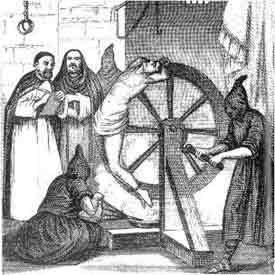 Sketch
depicting one of the brutal torture methods
used to interogate Marranos into
confessing that they were Jewish
during the Spanish Inquisition
Sketch
depicting one of the brutal torture methods
used to interogate Marranos into
confessing that they were Jewish
during the Spanish Inquisition |
By
the mid-15th century, hatred toward the
Neo-Christians exceeded that toward the
professed Jews. Later, in 1413, at
the behest of Pope Benedict
XIII, King Ferdinand I of Aragon called
for another religious disputation similar
to that held two centuries earlier. Yet,
unlike the disputation in which Nachmanides succesfully
defended the Jews
of Spain, the Disputation of Tortosa
was structured in such a way that it always
granted the final word to the Church. The
King also was not as favorable to the Jews,
and the representatives of the Jewish community
less eloquent and convincing than Nachmanides had
been. Jews were subsequently forcibly converted
and rabbinic texts were confiscated and
burned.
The
nobles of Spain later
found that they had only increased their
difficulties by urging the conversion of
the Jews, who remained as devout in
their new faith as they had been in the
old, and gradually began to monopolize
many of the offices of state, especially
those connected with tax-farming. In 1465,
a “concordia” was imposed upon
Henry IV of Castile, reviving all the former
anti-Jewish regulations. (So threatening
did the prospects of the Jews become that
in 1473 they offered to buy Gibraltar from
the king; the offer was refused.)
As
soon as the Catholic monarchs Ferdinand
and Isabella ascended their thrones (1479
and 1474, respectively), steps were taken
to segregate the Jews both from the “conversos” and
from their fellow countrymen. Though both
monarchs were surrounded by Neo-Christians,
such as Pedro de Caballeria and Luis de
Santangel, and though Ferdinand was the
grandson of a Jew, he showed the greatest
intolerance to Jews, whether converted
or otherwise.
Anti-Semitism in Spain peaked
during the rule of Ferdinand and Isabella
as they instituted the Spanish
Inquisition, a Church sponsored investigation
of anyone suspected of being a crypto-Jew
(Marrano).
On November 1, 1478, Pope Sixtus
IV published the bull Exigit Sinceras
Devotionis Affectus, through which
the Inquisition was
established in the Kingdom of Castile.
During this period, thousands of Marranos (Jews
who had converted to Christianity but still
practiced Judaism in secret) were interrogated
and executed. At first, the activity of
the Inquisition was
limited to the dioceses of Seville and Cordoba,
where Alonso de Hojeda had detected the
center of Marrano activity.
From there, the Inquisition grew
rapidly in the Kingdom of Castile. By 1492,
tribunals existed in eight Castilian cities: Ávila, Córdoba,
Jaén, Medina del Campo, Segovia,
Sigüenza, Toledo and Valladolid. The
first auto de fe (reading of a
decree against someone found to be a heretic,
followed by a prayer session and public
procession) was celebrated in Seville on
February 6, 1481 — six people were burned
alive.
Despite
the horrors of the Inquisition,
the cities of Aragón continued resisting,
and even saw periods of revolt, such as
in Teruel from 1484 to 1485. However, the
murder of inquisidor Pedro Arbués
in Zaragoza on September 15, 1485, caused
public opinion to turn against the Marranos in favor of the Inquisition.
The Inquisition was
extremely active between 1480 and 1530,
during which time about 2,000 Jews were
executed. Many Spanish
Jews immigrated to Portugal (from
where they were expelled in 1497) and to Morocco.
Much later the Sephardim,
descendants of Spanish
Jews, established flourishing communities
in many cities of Europe, North Africa,
and the Ottoman
Empire.
 The
Al Hambra Decree signed in 1492 by King
Ferdinand and Queen Isabella ordering the expulsion of
the Jews from all land under their control.
The
Al Hambra Decree signed in 1492 by King
Ferdinand and Queen Isabella ordering the expulsion of
the Jews from all land under their control. |
Approximately
40,000 Jews converted to Christianity to
escape death and expulsion. These conversos were
the principal concern of the Inquisition;
continuing to practice Judaism put
them at risk of denunciation and trial.
(During the 18th century the number of conversos accused
by the Inquisition decreased
significantly. Manuel Santiago Vivar, who
was tried in Cordoba in
1818, was the last person tried for being
a crypto-Jew.)
Expulsion of 1492
Finally,
Ferdinand and Isabella issued the Alhambra
Decree in 1492, which officialy called
for all Jews, regardless of age, to leave
the kingdom by the last day of July (one
day before Tisha
B’Av). It is estimated that more than
235,000 Jews lived in Spain before
the inquisition. Of these, approximately
165,000 immigrated to neighboring countries
(mostly to Italy, England, Holland, Morroco, Egypt, France,
and the Americas), 50,000 converted to
Christianity, and 20,000 died en route
to a new location.
Some
claim that Don
Isaac Abravanel, who had previously
ransomed 480 Jewish Moriscos of Malaga
from the Catholic monarchs by a payment
of 20,000 doubloons, offered Ferdinand
and Isabella 600,000 crowns for the revocation
of the edict of expulsion. As the story
goes, Ferdinand hesitated, but was prevented
from accepting the offer by Torquemada,
the grand inquisitor, who dashed into the
royal presence, threw a crucifix down before
the king and queen, and asked whether,
like Judas, they would betray their Lord
for money.
Many Spanish
Jews settled in Portugal,
which allowed the practice of Judaism.
In 1497, however, Portugal also
expelled its Jews. King Manuel of Portugal agreed
to marry the daughter of Spain’s
monarchs. One of the conditions for the
marriage was the expulsion of Portugal’s
Jewish community. In actuality, only eight
Jews were exiled from Portugal and
the rest converted, under duress, to
Christianity.
The Alhambra
Decree was overturned in 1968.
Modern Community (1869 - Present)
After
hundreds of years abroad, Jews were finally
permitted to return to Spain after the abolition of the Inquisition in 1834 and the creation of a new constitutional monarchy that allowed for the practice of faiths other than Catholicism in 1868, though the edict of expulsion
was not repealed until 1968. (From 1868
until 1968, Jews were allowed to live in Spain as
individuals, but not to practice Judaism as
a community.) The Spanish Moroccan War of 1859-60 also brought many Jews to southern Spain who were fleeing Morocco. Small numbers of Jews started
to arrive in Spain in
the 19th century, and synagogues were
eventually opened in Madrid and Barcelona.
Slowly things began to improve and Spanish
historians even started to take an interest
in the history of Spain’s
Jewish population and in the Sephardic
language of Ladino (Judeo-Spanish).
The government of Miguel Primo de Rivera
(1923-1930) even granted the right of Spanish
citizenship to Sephardim who
applied before December 31, 1931.
In 1917, the Jews of Madrid numbers around 1,000 people. Most were German, Austrian-Hungarian and Turkish citizens who fled to Spain at the beginning of World War I. They inaugurated their first synagogue in a small apartment. The world economic crisis of 1929 brought additional Jews to the country.
During
this period, Jews slowly began to return
to Spain and
take part in national affairs. During the
Spanish Civil War (1936-1939), many Jews
from all over Europe and America volunteered
to fight in support of the Spanish Second
Republic. Despite the easing of tensions
between the Spanish government and the
Jews, synagogues in Spain remained
closed.
The Holocaust
During World
War II , Franco-led Spain aided
the Jews by permitting 25,600 Jews to
use the country as an escape route from
the European theater of war, provided
they “passed through leaving no
trace.” Paradoxically, though Spain later
cultivated relations with Arab countries,
it also assisted Moroccan and Egyptian Jews
who survived pogroms.
Furthermore,
Spanish diplomats such as Ángel
Sanz Briz and Giorgio
Perlasca protected some 4,000 Jews
in France and the Balkans. In 1944, Spain accepted 2,750 Jewish refugees from Hungary.
Later, as the Franco regime
evolved, synagogues were
opened and the communities were permitted
to hold services discreetly.
Contemporary Period
Today,
there are approximately 12,000 Jews living
in Spain,
mainly of North
African-Sephardic descent. The Jewish
community is led by the central governing
body of the Federación de Comunidades
Judías de España (FCJE).
Like other religious communities in Spain,
FCJE has established agreements with the
Spanish government, regulating the status
of Jewish clergy, places of worship, teaching,
marriages, holidays, tax benefits and heritage
conservation. Jewish day schools have also
been established in Barcelona,
Madrid, and Málaga. In the 1970s,
there was also an influx of Argentinian
Jews, mainly Ashkenazim,
escaping from the military Junta. Spain
also grows kosher olives which they export
to Jews around the world.
The Spanish Jewish community is one of the few Jewish communities in Western Europe that is growing in both numbers and activities. The Spanish government has made an increased effort to increase the awareness of the role that the Jews once played in Spanish life and to combat anti-Semitism.
Despite
interest in Jewish culture, Jews are still
not completely safe from anti-Semitism.
Many Spanish-Jewish leaders
note that the presence of the “new anti-Semitism” is
growing. This new form uses anti-Zionism as
a disguise for anti-Semitism. A 2007 survey by the Anti-Defamation League revealed that Spain had the highest percentage of anti-Semitic views out of five European countries polled: Austria, Italy, the Netherlands, Spain and Switzerland. Spain also has an estimated 70 neo-Nazi and anti-Semitic groups with nearly 10,000 members, according The Movement Against Intolerance. Additionally, in 2008, Spain’s constitutional court ruled that imprisonment for Holocaust denial is unconstitutional since it violates freedom of expression. Until this ruling, Spain’s criminal code had provided for one to two years in jail for anyone who disseminated theories or teachings that denied or justified genocide or other crimes against humanity. The new ruling makes only the justification of genocide punishable by prison. Jewish community leaders worry that the court’s decision will strengthen the activities of neo-Nazi groups.
The Jewish community is centered in Madrid with around 12,000 Jews. Barcelona also has a sizeable Jewish community of 5,000 members. In addition, Jewish congregations, including a handful of Conservative and Reform communities, can be found in cities such as Valencia, Malaga, and Marbella as well as the Spanish North African enclaves of Ceuta and Melilla. In 2007, a modern Orthodox synagogue was established in the city of Alicante on the Costa Blanca, where about 1,000 Jews reside. There are also Jewish day schools in Madrid, Barcelona and Melilla.
The Conservative congregation in Madrid, Beit El, conducts weekly Shabbat services in a small hall in an apartment building. Beit El is one of five Conservative synagogues in Spain. These congregations are popular because many of Spains more recent immigrants follow the Ashkenazi tradition and do not observe the Sephardi traditions of the main Orthodox community. There is also an independent Reform congregation in Madrid but a large number of Jews remain unaffiliated.
In 1995, the Spanish goverment created the "Route of the Sephardim," a network of historical tours aimed to help reclaim the country's Jewish history while also generating tourism. The Route has grown to include 21 cities throughout the country.
In the small community that still exists in Toledo, a museum dedicated to the Sephardic Jewish community is now housed in the ancient Sinagoga del Transito. The synagogue itself has been restored to original beauty, which consisted of richly decorated columns in Arabic style with an exquisitely coffered pinewood ceiling and a large women's balcony, was founded in 1357 with the help of Jewish financier Samuel Levi. Following the expulsion in 1492, the synagogue was used as a hospital, a priory, and even as a military barracks.
In March 2013, the Spanish town of Ribadavia will host a Passover seder - the town's first since the explusion of Jews in 1492 - in order to "breathe new life into its old Jewish quarter." Ribadavia used to have a sizable Jewish population before the Inquisition, and in 1997, Judith Cohen, a scholar of Sephardic Jewry, wrote that Ribadavia had two Jewish households remaining, neither of them Sephardic. The seder is being organized by the municipality’s tourism department in partnership with the Center for Medieval Studies, a Ribadavia-based association that researches the history of Iberian Jews prior to their expulsion during the Spanish Inquisition that began in 1492.
 An inscribed tablet in the Barcelona Jewish Museum.
 |
The Spanish Parliament approved a measure on June 11, 2015, aimed at restoring citizenship to descendants of Sephardic Jewish individuals who were expelled during the Inquisition. The law allows relatives of individuals who were expelled to apply for dual citizenship within a three-year window. In order to prove citizenship however, Sephardic Jewish applicants will be tested in basic Spanish speech, be questioned about the history of Spain, and will have to demonstrate a connection to modern Spain. This law is similar to the law passed previously in Portugal, allowing relatives of expelled Sephardic Jews the right of return. Three months later, in October 2015, Spain granted restored citizenship to 4,302 descendants of Sephardi Jews expelled from Spain during the Inquisition. These people are now fully naturalized citizens of Spain, and most of them currently reside in Morocco, Turkey, or Venezuela.
This noble plan to reconnect Sephardic Jews with their Spanish roots inspired Israel Foreign Ministry Advisor Ashley Perry to launch the Knesset Caucus for the Reconnection with the Descendants of Spanish and Portuguese Jewish communities in October 2015.
On November 19, 2015, a Holocaust memorial in Oviedo, Spain was vandalized by unknown criminals. A plaque on the memorial, reading “Never again will the barbaric acts of the Nazis be repeated,” was ripped from it's place and stolen. The Jewish community appealed to their local government to restore the memorial to it's original condition.
Spain-Israel Relations
Even
with the gradual ease of tensions between
the Spanish government and the Jews
of Spain, Francoist Spain chose
not to establish diplomatic relations with
the new state of Israel. Israel,
in turn, opposed the admission of Spain into
the United
Nations as a friend of Nazi
Germany. Despite not engaging in diplomatic
relations with Israel, Spain maintained
a consulate in Jerusalem and
traded freely with Israel.
After years of negotiations, the Spanish
government of Felipe González established
relations with Israel in
1986. Today, Spain tries
to serve as a bridge between Israel and
the Arabs as reflected by hosting the Madrid
Peace Conference of 1991.
Casa Sefarad-Israel (The Israel-Spain House) was established in Madrid by the Spanish Foreign Affairs and Cooperation Ministry in June 2007. The cultural and educational center hopes to foster greater understanding of Jewish history and culture. It is completely financed by the Spanish government, and also promotes Sephardi culture as an integral and vibrant part of Spanish culture and aims to strenghten bonds between Spanish and Israeli societies.
On November 19 2014 members of Spain's Parliament voted 319-2 in favor of a measure demanding that the government of Spain officially recognizes the Palestinian state. This vote follows votes in British Parliament and the Irish Senate, as well as a pledge from the government of Sweden. Like all of these previous votes in other European countries in 2014, this vote is largely symbolic and in reality carries no weight or merrit. The vote was simply taken as a symbolic measure to encourage the peace process and spur negotiations forward. The text of the bill clarifies that the only possibility for peace is the existance of two independent states coexisting next to each other.
In light of these recent votes to recognize a Palestinian state, EU Foreign Policy Chief Federica Mogherini expressed doubts as to whether the movement to unilaterally recognize Palestine is beneficial to the peace process. Mogherini explained that "The recognition of the state and even the negotiations are not a goal in itself, the goal in itself is having a Palestinian state in place and having Israel living next to it." She encouraged European countries to become actively involved and push for a jump start to the peace process, instead of simply recognizing the state of Palestine. Mogherini said that the correct steps to finding resolution to the Israeli-Palestinian conflict might involve Egypt, Jordan, and other Arab countries forming a regional initiative and putting their differences aside at the negotiation table. She warned her counterparts in the European Union about getting "trapped in the false illusion of us needing to take one side" and stated that the European Union "could not make a worse mistake" than pledging to recognize Palestine without a solid peace process in place. (Bloomberg, November 26 2014)
The Spanish Armed Forces awarded Israeli firm Israel Military Industries (IMI) a contract worth $22.5 million Euro to supply the Spanish military with 5.56mm rifle cartriges. It was announced in October 2015 that Spain would be purchasing 5.56mm Razor Core rounds from Israel, which were developed in 2014. These 5.56mm Razor Core bullets are highly desirable because they can be used in both short and long barrel weapons.
A Spanish judge issued arrest warrants for Israeli Prime Minister Netanyahu as well as six other current and former Israeli officials during November 2015. The original case against Israel's leaders, in which Spanish victims of the Gaza Flotilla Incident sued Israeli authorities, was dismissed in 2010 by a Spanish judge who ruled that Spain did not have the authority to file lawsuits regarding international incidents. In 2015 however, Spanish Judge Jose De La Mata exploited a legal loophole, allowing him to re-open the case if one of the defendants were to set foot in Spain.
Contacts
Orthodox Beth El synagogue
in Marbella:
Urbanizacion El Real, KM 184, Jazmines
Str. 21
Telephone: +34-952-859395
Fax: +34-952-765783
E-mail: [email protected]
The Beth Minzi synagogue
in Torremolinos:
Calle Skal la Roca 13 29629
Telephone: +34-95-383952
Fax: +34-95-2370444
The e-mail of the local Rabbi, Rabbi Shaul
Khalili, is: [email protected]
The Malaga Synagogue:
Alameda Principal, 47 20B 29001
Telephone: +34-95-260409
Sources: DW (November 19 2014);
Wikipedia;
WAIS-Stanford;
James Reston, Jr., Dogs
of God: Columbus, the Inquisition, and the
Defeat of the Moors, NY: Anchor,
2006;
Gazzar, Brenda, “Taking Root, Again,” The Jerusalem Report (September 29, 2008);
Hedy Weiss, "The Jewish Traveler: Sefardic Routes," Hadassah Magazine, (June/July 2012);
"Spanish Town Preparing First Seder in 500 Years," JTA (March 11, 2013);
Neuger, James. “Palestine recognition 'not goal in itself' says EU's Mogherini,” Bloomberg (November 26, 2014);
Lappin, Yaakov. “IMI to supply Spain with NATO-qualified ammunition,” Jerusalem Post (September 30, 2015);
Borschel, Amanda. “Knesset caucus aims to ‘reconnect’ with descendants of Sephardi Jews,” Times of Israel (October 14, 2015)
Photo Credits:Nachmanides Potrait: Zohar-Hakabbalah
Inquisition Drawing: Australian Ejournal of Theology
Al Hambra Decree: Wikipedia
|
