|
[By: Alden Oreck]
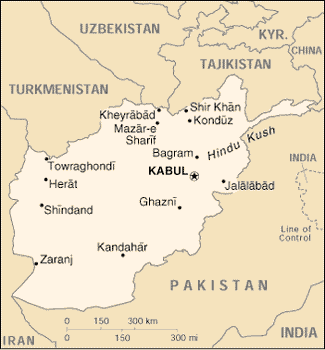
Afghanistan, also called Khorasan or Khurasan in medieval Muslim and Hebrew sources, has a Jewish history that may date back
2,700 years to the destruction of the Temple and the Babylonian exile.
Today, however, only one known Jew - Zablon Simintov - remains in Afghanistan. In 2013, a trove of ancient manuscripts discovered in former Taliban-controlled areas of Aghanistan and unveiled by Israel's National Library provided the first physical evidence of a thriving Jewish community from the area that was over a thousand years old.
In 2001 it was reported that two Jews live in Kabul, and approximately five Jewish families still live in the town of Herat. In 2015 it is believed that there is only one Jew left in Afghanistan, carpet-trader and restaurant-owner Zablon Simintov. Simintov announced in March 2014 that he was closing his restaurant, citing a decline in business due to the reduction in NATO forces stationed in the country.
- Early History
- "Afghan Geniza"
- Modern Community
Early History
 |
Several Jewish Afghan histories
are circulating. Early biblical commentators
regarded Khorasan as a location of the Ten Lost
Tribes. Today, several Afghan tribes including the Durrani, Yussafzai,
Afridi and Pashtun believe they are decedents of King
Saul. They call themselves Bani-Israel, similar to the Hebrew, B'nai Israel, meaning the children
of Israel. Even some Muslim scholars and writers accept this. The exiled Afghan Royal family also
traces its roots to ancient Israel, the tribe of Benjamin specifically. As evidence, they cite Makhzan-i-Afghani , a chronicle
published in 1635, in the time of King Jahangir by Khawaja Nimatullah
of Herat.
Because of its remoteness from the Jewish center in Babylonia, persons unwanted by the Jewish leadership, such as counter-candidates for the exilarchate, may gave went to live in or were exiled to Afghanistan.
The Pashtun, the main Afghan ethnic group and Taliban supporters, also
believe they are descended from the Ten Lost
Tribes of Israel , and
later converted to Islam. Dozens
of Pashtun names and customs sound Jewish, from the Pashtun tribe names
of Asheri and Naftali to the Pashtun custom of a wedding chupah and the circumcising of the sons on the eighth day after birth. The Pashtuns claim that the
city of Kabul stands for "Cain and Abel" and Afghanistan is
derived from "Afghana," the grandson of King Saul of the tribe
of Benjamin.
Another book, Taaqati-Nasiri, states that in the 7th century, a people
called Bani Israel settled in Ghor, southeast of Herat. According to
Taaqati-Nasiri as well as Pashtun legend, the Bani Israel soon accepted
Islam, after their leader, Qais, met with the Muslim Prophet Mohammed.
Various texts refer to a Jew named Akiva, who was a collector of taxes in the city of Merv during the begining of the 8th century. Explorers uncovered Hebrew tombstones whose dates go back to the 750's in the ancient city of Ghur in 1946. These tombstones provided details such as communal titles and functions in addition to names and dates.
Other reports tell of Persian Jews rejecting Islam and fleeing the Muslim conquest in the 7th
and 8th centuries and settling in Afghanistan. In 1080, Moses
ibn Ezra mentioned more than 40,000 Jews paying tribute in Ghazni,
a great city on the River Gozan. Benjamin
of Tudela, writing approximately 100 years later, echoed this claim,
adding that there were 80,000 Jews living there.
Medieval sources mention several Jewish centers in Afghanistan, of which Balkh was the most important. A Jewish community in Ghazni is recorded in Muslim sources, indicating that Jews were living there in the tenth and eleventh centuries. A Jew named Isaac, an agent of Sultan Mahmud (ruled 998–1030), was assigned to administer the sultan's lead mines and to melt ore for him. According to Hebrew sources, vast numbers of Jews lived in Ghazni but while their figures are not reliable,
Moses Ibn Ezra
mentions over 40,000 Jews paying tribute in Ghazni and
Benjamin
of Tudela describes "Ghazni the great city on the River Gozan, where there are about 80,000 [8,000 in a variant manuscript] Jews." In Hebrew literature, the River Gozan was identified with Ghazni in Khorasan from the assertion of
Judah Ibn Bal'am
that "the River of Gozan is that river flowing through the city of Ghazni which is today the capital of Khorasan."
Stone tablets with Hebrew inscriptions dating from 1115 to 1215 confirm
the existence of a Jewish community in Firoz Koh, located between Herat
and Kabul. Genghis Kahn's 1222 Mongol invasion, however, razed Afghanistan,
devastating the Jewish communities. Little is known about the small
and isolated Jewish community of Afghanistan that remained until the
19th century.
In 1839, thousands of Jews again fled Persia, where the Muslim authorities
began forcibly converting them, bringing Afghanistan's Jewish population
up to 40,000. They settled in Herat, and were mostly traders and dyers dealing in skins, carpets
and antiquities. Herat became the Jewish population center of Afghanistan during the 19th and early 20th centuries, but in recent years activity and participation dwindled and there is currently no organized Jewish life there. Four Synagogues were discovered in Herat during an archaeological expedition in 1978, and two of these synagogues have been recently repurposed as a school for boys and a Muslim house of prayer.
The decline came in 1870 after Afghan Muslim authorities enacted anti-Jewish
measures, triggering a mass exodus to Central Asia, Persia and Palestine.
The 1933 assassination of King Nadit Shah triggered another anti-Jewish
campaign. Jews were banished from most Afghan cities, limiting them
to Kabul, Balkh or Herat. In addition, Jews were forbidden to leave
town without a permit and forced to pay special taxes.
"Afghan Genizah"
In January 2013, Israel's National Library officially unveiled a large cache of Hebrew documents and manuscripts discovered from caves in former Taliban-controlled areas of Afghanistan that provide the first physical evidence of a Jewish community over a thousand years old.
The 29 documents run the gamut of life experiences - including biblical commentaries, personal letters and financial records - and researchers say the "Afghan Genizah" marks the greatest such archive found since the "Cairo Genizah" was discovered in an Egyptian synagogue more than 100 years ago. Genizah is a Hebrew term that loosely translates to "storage" and is used to refer to a storeroom in a synagogue or cemetery where Hebrew books and papers are kept. Under Jewish law, it is forbidden to throw away writings containing the formal names of God, so they are either buried or stashed away.
"We've had many historical sources on Jewish settlements in that area," Haggai Ben-Shammai, the library's academic director, said. "This is the first time that we have a large collection of manuscripts that represents the culture of the Jews that lived [in Afghanistan]. Until today we had nothing of this."
"First we can verify that [the Afghan Jewish community] actually existed - that is the most important point," said Aviad Stollman, curator of the library's Judaica collection. "And of course their interests. They were not interested only in commerce and liturgy; they were interested also in the Talmud and the Bible."
In November 2016, over 250 additional ancient texts from the same collection were aqcuired by and put on display at the National Library of Israel. These manuscripts, dating from the 11th, 12th, and 13th centuries, contain prayers as well as records of trade written in Hebrew, Persian, and Arabic.
Modern Jewish Community
By the time Israel was created in
1948, approximately 5,000 Jews remained in Afghanistan, but they could
not legally immigrate. Once the restriction was lifted in 1951, most
of the Afghani Jewish community made its way to Israel. By 1969, only 300 Jews lived in
Afghanistan, most of whom left in 1979 after the Soviet invasion. In
1996, 10 Jews remained in Afghanistan, nearly all in Kabul.
In 2005, there were two Jews in Afghanistan. Zablon
Simintov and Isaac Levy lived at separate ends of the same decaying synagogue in Kabul. The synagogue
was built 40 years earlier and probably avoided being destroyed by the
Taliban because it was unassuming, deserted, and in disrepair. Simintov
and Levy said they were protecting the synagogue, and each claimed to
be the rightful owner of the Torah and accused the other of stealing it. This feud was so heated that
both men spent time in Taliban jails for charges they brought against
each other, and were beaten with electric cables and rifle butts. Meanwhile,
the Taliban confiscated the Torah. Levy relied on charity to get by,
while Simintov, 41, owned a store that sold carpets, jewelry and handicrafts.
Both men said they got along with their Muslim neighbors.
Levy said he wanted to join his family in Israel, but
couldn't afford to leave. After the U.S. invasion of Afghanistan, Jewish
groups offered to help Levy emigrate, but he refused. In January 2005,
Levy died.
Now Simintov is the last Jew in Afghanistan. In 2001,
he said the Taliban stole all his supplies and he had to close his store.
He says he now has nothing and lives “like a dog.” He has
devoted himself to trying to recover the Torah stolen by the Taliban,
and enlisted the help of the U.S. Embassy and Afghan Interior Ministry.
He said he was told the man who stole the Torah is now in U.S. custody
in Cuba. Simentov's wife and two daughters live in Israel and, after Levy's death, said he was considering joining his family.
More than 10,000 Jews of Afghan descent now live in Israel. The second largest population
of Afghan Jews is New York, with 200 families. They mostly live in Flushing,
Jamaica and Queens. Rabbi Jacob Nasirov leads the Orthodox congregation of Anshei Shalom, the lone Afghan synagogue in the United
States. Members have roots not only from Afghanistan, but also Yemen, Syria, Russia, Iraq, Morocco and Lebanon.
Sources: Aharon, Sara. “Discovering Afghanistan's 1,000-year-old Jewish Life,” Jerusalem Post, (November 6, 2016);
Encyclopedia
Judaica;
Jewish
Telegraphic Agency;
World
Jewish Congress;
Moshiach.com;
BIBLIOGRAPHY: Nimat Allah, History of the Afghans (London, 1829), tr. by B. Dorn; Holdich, in: Journal of the Royal Society of Arts, 45 (1917), 191–205; H.W. Bellew, Races of Afghanistan (1880); I. Ben-Zvi, The Exiled and the Redeemed (1961), index; Fischel, in: HJ, 7 (1945), 29–50; idem, in: JAOS, 85, no. 2 (1965), 148–53; idem, in: JC, Supplement (March 26, 1937); idem, in: L. Finkelstein (ed.), Jews, their History, Culture and Religion, 2 (19603), 1149–90; G. Gnoli, Le iscrizioni giudeo-Persiane del Gur (Afghanistan) (1964), includes bibliography; E.L. Rapp, Die Juedisch-Persisch Hebraeischen Inschriften aus Afghanistan (1965); Brauer, in: JSOS, 4 (1942), 121–38; R. Klass, Land of the High Flags (1965); N. Robinson, in: J. Freid (ed.), Jews in Modern World, 1 (1962), 50–90. ADD. BIBLIOGRAPHY: B. Yehoshua-Raz, Mi-Nidḥei Yisrael be-Afganistan le-Anusei Mashhad be-Iran (1992); Peʿamim, 79 (1999); A. Netzer, "Yehudei Afganistan," in: G. Allon (ed.), Ha-Tziyyonut le-Ezoreiha (2005). |