Arye Mekel
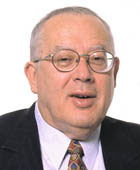
Ambassador Arye Mekel, Israel's
consul general in New
York, describes himself as the embodiment of the
wandering Jew. His parents and grandparents were from the Ukraine and Belarus, formerly Poland.
Born on a moving train in Kazakhstan as his parents were returning from the Soviet
Union to Poland after the Second
World War, his 18-year-old mother gave birth on the floor of the
train, without the help of a doctor or nurse.
Mekel, 58, whose grandfatherly appearance defies his
youthful intelligence and articulateness, says he uses his appearance
and his sense of humor to his advantage. “People see me like a
grandfather, which I am happy to be. They may think I am a traditional
diplomat, but I am not. I have spent much of my life in the media, as
a journalist for 20 years and president of the Israeli State TV and
Radio, and I have brought the skills gained through these experiences
with me to New York .”
Holding the ambassadorial post since August 2004, Mekel
is always happy to meet with journalists. His background includes advanced
degrees in political science, English language and literature, mass
communications and sociology, and service as a foreign policy advisor
to Prime Minister Yitzhak Shamir.
He has dealt with diverse issues and portfolios over the course of his
career, from combating antisemitism to presenting Israel's positions
on international television, to serving as chargé d'affaires
of the Israeli Embassy in Seoul , South
Korea .
Mekel is a man on a mission and wastes no time in revealing
his background and goals. He is charming and in command. This ambassador
is sitting in the right seat…and he earned it.
“My grandfather and grandmother, two sons and
a daughter on my mother's side, were murdered when my mother was 13
years old. She escaped and survived with two sisters. My 17-year-old
father was caught on the border when the Soviets overtook Poland and
was sent to the Gulag in Siberia. He later learned that 95% of the people
in Yivie, his shtetl, south of Vilna, were murdered by the Nazis and
their collaborators.”
Mekel's father met his mother when she was just 15.
They married on June 15, 1945. A year later, in April 1946, they were
allowed to return to Poland, where they stayed for six months.
"My father met people who had seen his father,
brothers and sister. They found each other, as well as my mother's two
sisters, and the entire group went to Germany.
The family had to cling to each other. In 1949 the time came to move
on. The refugees had two options: The U.S. was issuing visas for refugees
of the Holocaust or they could go to
the newly created State of Israel.
“My mother's sister went to America , settling
in Cleveland, Ohio. I now have cousins in New
Jersey and Florida . My
father was a Zionist from his youth
and wanted to go to Eretz Yisrael. He said, ‘I've been dreaming
since I was a child of going to Israel .' But my mother was frightened.
She said, ‘How can we go? We have a son. There is a war going
on in Israel .” He smiles. “But my father was confident.
He told her by the time their son grows up, there will be peace. In
1949, my father's side went to Israel and my mother's sister to America
.”
He remembers living for one year in a ma'abara—a
tent city—near Netanya, since there were no houses. He says, “In
1950, my parents were among the first to create the new town of Kiryat
Yam, north of Haifa , an immigrant, blue-collar community where I grew up. My father had
been a teacher. In Israel he became a policeman. He wanted to work in
security and was a sergeant in Haifa until he retired.
“The family eventually moved to Kiryat Chaim
and my parents had two more children—Shraga, also a former journalist,
who is now the development director for the Friends of Yad
Vashem, and
Yaacov, who lives in Ma'alot and works for the Israeli military industry.
My mother was a supermarket cashier for 25 years.”
Mekel feels blessed that his parents are still alive,
his father now 82, his mother 77. “My parents consider themselves
very fortunate. They beat all the odds,” he says with gratitude.
“They have three sons, seven grandchildren, and three great-grandchildren.
They still live near Haifa , have never owned a car and take buses or
walk everywhere.”
While speaking with Lifestyles in his modern office
on the 14th floor of a high-rise building in Manhattan , Mekel was enjoying
the company of his parents' visiting New York . During their visit,
he spoke at a dinner in honor of Yad
Vashem to more than 1,000 people, including the Minister of Education
of the State of Israel.
“Many of those there were survivors. I told them,
‘Each of your stories could be a book or a movie. They are all
different, but all are heroic. You are all winners because you are here;
you came out victorious. All of you built a new life.' I gave my parents
as an example and they had such nachas from it.”
Mekel recalls his high school years in Kiryat Motzkin,
an area that produced many future Israeli military, diplomatic and political
leaders. After high school, he attended Hebrew
University. “My father always encouraged me to study,”
he recalls. “I studied political science and English language
and literature. It was important to me to learn English well. I took
it very seriously. I graduated in 1967, a few months after the Six-Day
War.”
Mekel's interest in writing began at an early age,
and by the time he was 8 years old, he had already been published in
a children's magazine.
“When I was in Jerusalem,
I saw an advertisement for a training center for broadcasters. This
was before my military service and at 19 I became a broadcaster, at
first assisting and later working with the big names in Israeli broadcasting.
I would take a four-and-one-half-hour train ride on Monday morning to
Jerusalem , stay until Thursday and be home in Haifa for Shabbat.”
Next, at the age of 21, he was assigned to Galei
Zahal (Army Radio), where he spent three years as a military, and
then diplomatic, correspondent. “I was in the field with paratroopers
and artillerymen,” he recalls, “as part of the Karame Operation
in 1968, when we entered Jordan and tried to get Arafat.
Unfortunately, we did not.”
After more than a year as a military correspondent,
Mekel convinced his superiors to send him to Jerusalem to become Military
Radio's first-ever political and diplomatic correspondent. “I
asked to report on the government and the Knesset and they agreed,” he recalls.
At this time, now 22, he married Ruth, his wife of
36 years, a fellow soldier and journalist whom he knew from his early
broadcasting days in Jerusalem . They lived in Jerusalem, where he interviewed
all of the big names in Israeli history, among them Golda
Meir, Moshe Dayan, Abba Eban, Menachem
Begin and many others.
“Because I was now well known in broadcasting,
I was invited to join the Voice of Israel in November 1970 at 24 and
soon became its diplomatic and political correspondent—the youngest
ever to be in this position. I covered the 1973
Yom Kippur War. I remember that the government was silent until
the sixth day; it was as though the government disappeared. Then Moshe
Dayan spoke to the nation. Three reporters were asked to do the interview
on live television, and I was one of them. I am very proud of that moment.
It was a very dramatic interview.”
Mekel's education continued at Hebrew
University, where he received a master's degree in
mass communications. At one time, he considered becoming
an academic and was encouraged to pursue his Ph.D.
By 1976, Mekel and his wife had two children, Maayan,
now 32, and Tal, now 28, and he was offered a position
as community shaliach (representative) for the Jewish
agency in Cincinnati, Ohio.
“I was one of the first to do this job, really
kind of like a guinea pig,” he laughs. He spent three years there,
organizing student trips to Israel and working as an adjunct professor
at the University of Cincinnati , teaching a course about modern Israel
. At the same time, he continued to broadcast for Israeli radio. “I
reported on the death of Elvis Presley,” he says.
The family returned to Israel in 1978, after their
son Nitzan was born, and Mekel returned to radio. “After a while,
I was not happy with journalism,” he admits, “and I decided
to change course. I received a scholarship to Columbia University in
New York for graduate school in sociology. My goal was to get my Ph.D.
at Columbia and return to Hebrew University to teach mass communication
and sociology.
“At Columbia I worked on my Ph.D. during the
day and was a reporter for Israel radio at night. When it was midnight
here, it was 7 a.m. in Israel . I covered the Israeli Mission to the United Nations when Yehuda
Blum was ambassador. But before I could finish my doctoral dissertation,
I received an offer to join the Israeli foreign ministry. I was very
excited at the prospect, and accepted the offer.
“It was a big change to go from journalism to
the foreign ministry. After a year there, Yitzhak Shamir was looking
for an advisor in his office and I joined his office as first secretary—a
mid-level position. By 1985, I was an advisor to Shamir. The following
year, he became prime minister and asked me to go with him, so I became
a senior foreign policy advisor to the prime minister of Israel .”
Mekel's face gets animated as he recalls those times.
“It was very exciting. I was right in the middle of everything.
I met with [presidents] Reagan and Bush (Sr.). I was in the Oval Office.
We went to Africa, Italy and to the United States many
times. I was very close with Shamir and we often spoke Yiddish,
which is my mother tongue. I still speak to my parents and one aunt
in Yiddish,” he says smiling.
As his career advanced, another opportunity soon knocked.
“In 1989, they were looking for a president for the Israeli Broadcasting
Authority, effectively the czar of all broadcasting for the country,”
he explains. “One day, Shamir says to me, ‘Weren't you a
journalist?' I told him I had been for many years. He said that the
broadcasting job would be a very important service to the state. I said,
‘I am a soldier and you are my commander. If you send me, I will
be happy to go. So I became director general of the IBA. I was 43.”
Mekel held the post for four years.
Once again on the move, Mekel decided to return to
the foreign ministry. He was sent to Atlanta , as consul general, and
represented Israel throughout the southeastern United States , as well
as serving as a liaison with CNN.
Mekel recounts with amusement that
he had first met Ted Turner a few years earlier, when
Turner had visited Israel and Mekel was assigned to
be his official host. “I told him that I was
his Israeli equivalent,” he says, “just
with a difference of about five billion dollars! The
next time I met him was in Atlanta, where he referred
to me as the Israeli ambassador to CNN.” While
in Atlanta , the affable Mekel became friendly with
former president Jimmy Carter, Andrew
Young, Mrs. Coretta Scott King, the King children
and Newt Gingrich, among many others.
Also at this time, he regularly took
American governors, mayor, senators, congressmen and
members of arts councils to Israel . He even took
a theater group from Monroeville, Alabama, to Jerusalem,
where they performed the play To
Kill a Mockingbird.
He recalls, “These
were interesting times, and I had to explain government
policy changes and try to promote them.” Soon,
however, he was on the move again, returning to the
Israeli foreign ministry.
“I wore many hats,” the congenial ambassador
laughs. “I dealt with some 1500 journalists in the foreign media
when the intifada started. I was a government spokesman for the foreign
media, and appeared on CNN, FOX, ABC, NBC, CBS, BBC, as well as the
Arab stations. I was also an advisor on combating antisemitism.”
“Though I had no prior UN experience, in early
2003 I was asked to be deputy permanent representative to the United
Nations. I speak some Arabic, Russian and Polish, and served for one
and one-half years, working closely with Ambassador Dan
Gillerman. While there, we initiated some moves to become more assertive
in the UN. We were not sent there to be quiet! When attacked (by other
UN member countries), we responded—and responded fiercely.”
He paraphrases the Seinfeld episode about a “bizzarro
world” and applies it to the UN. “Throughout the building,
the bad guys are in control and the good guys are the minority. Then,
after over 20 annual anti-Israel resolutions, they serve you the bill!
The United States pays 22% of the UN budget.”
Eventually, he was approached by the foreign minister
to take on the role of consul general in New York , which he accepted
and began in August 2004. “There are nine Israeli consulates in
this country,” he explains, “and this one, covering the
tristate area of New York , New Jersey and Connecticut , is the largest.
The ambassador has already met with
senators Hillary Clinton and Chuck
Schumer of New York , as well as New York congressmen
Charles Rangel, Anthony
Weiner, Jerrold
Nadler, Edolphus
Towns, Gary
Ackerman and others. He has met with officials
in New Jersey, as well as Governor George Pataki,
New York Cardinal Edward Egan, Mayor Michael Bloomberg,
Attorney General Eliot Spitzer and many other dignitaries.
Asked how he felt he could help bolster Israel 's image,
the ambassador admits that it is a difficult job. “The last four
years have not been easy. What is captured on TV doesn't always look
positive. In 60 seconds you can't tell the whole story. But we have
now entered a new phase in our relationship with the Palestinians. If
the new Palestinian leadership is really ready to talk, and will dismantle the terrorist organizations,
2005 may well see historic progress toward peace.”
Asked about problems of Hasbara, which translates as
public information combined with “spin,” the ambassador
explains that it is “uniquely Israeli,” but a challenge
that he hopes his role will allow him to overcome. He speaks to all
media, news organizations and groups who request his presence and maintains
that Israel must be open to all, including Christian fundamentalists
who support Israel , because they are a true force to be reckoned with.
“Look at the impact that they
had on the U.S. election,” he points out. “The
70 million Evangelicals in America decided the American
presidency. And they support Israel . We accept this
support happily. In Atlanta, and elsewhere in the South,
I spoke before many churches and Christian audiences.
Many of them go to Israel as pilgrims. We welcome
them and their support.
“God works in mysterious ways,” Mekel
continues, when asked about Israeli industry. “In
our part of the world, there is only one little spot
with no oil: Israel! So we develop our natural resources;
we use our ‘Yiddishe Kop.' We are among the
top-five countries in hi-tech and have more companies
on the NASDAQ than any other country besides the U.S.
and Canada . That is why education is so important.
We must invest everything in the education of the next
generation. Recently, for the first time ever, two
Israeli scientists won the Nobel
Prize for chemistry!
This is our future. We must continue to educate our
children in Israel and around the world.”
After several months in office, the ambassador often
hears from observers that his assignment as consul general to the largest
Jewish community in the world is a “natural fit.”
“It does feel right,” he smiles. “I
feel this every day of the week. I feel it with leaders and everyday
people. I am endlessly impressed by what Israel has accomplished in
its short history. I am amazed and proud of what we have achieved, and
Israel is proud of the great Jewish community in America and its remarkable
achievements.
“I feel very fortunate to be here at this time
in this position. I am very privileged,” he says humbly. Returning
to the topic of his roots, he adds, “If only my grandparents knew
that one day their grandson would be a representative in America of
an independent Jewish state.”
Sources: Lifestyles
Magazine , article written by Nancy Kleinbaum |