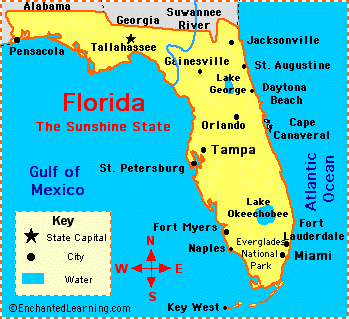
Florida and Israel
Trade and Population Statistics
| Exports to Israel (2015) |
$224,480,988 |
| Percentage Change (2014-2015) |
-2.5% |
| Total Exports to Israel (1996-Present) |
$3,332,412,474 |
| Israel's Trade Partner Rank (2015) |
47 |
| Military Contracts with Israel (2015) |
$66,906,218 |
| Jewish Population (2015) |
846,700 |
| Jewish Percentage of Population |
5.4% |
Binational
foundation grants shared by Florida and Israel
Grant recipients in
Florida from U.S.-Israel binational foundations:
Bausch & Lomb
Pharmaceuticals Inc.
Boston Whaler, Inc.
Computer Products Inc.
ECI Telecom Inc.
Encore Computer Corp.
Enhanced Vision Systems
Florida Institute of Technology
Florida International University
Florida State
Gen Mill Rest Group
Harris Corp. / Semiconductor Sector
Health Professions Conferencing Corporation
I.T.E. Inc.
Pharmos Corp.
Plant Food Systems Inc.
Plastigone Technologies Racal-Datacom Inc.
Sensormatic Electronics Corp. |
Telematics International
Inc.
US Geological Survey
Univeristy of Central Florida
University of Florida
University of Florida Medical Entomology Lab
University of Florida Medical School
University of Miami
University of Miami Medical School
University of South Florida
University of Tampa
USDA Crop Genetics & Environmental Lab
USDA Horticultural Research Lab
USDA Insect Attractants Research Lab
USDA S. Atlantic Area Medical & Veterinary Entomology
USDA Subtropical Horticulture Research S
WATSCO, Inc.
|
Bilateral
Institutions
America-Israel Chamber
Florida Chapter -
Established in 1993 by a group
of Florida industrialists, entrepreneurs and business professionals,
the Florida Chapter of the AIC sponsors events and offers networking
opportunities that promote and enhance business-to-business connections
between Florida to Israel and Israel to Florida. The Chamber assists
in promoting trade and joint business ventures between Israel and Florida.
The Chamber has a Business Development Department, which can help you
regarding your specific business needs. The Chamber has assisted with
the relocation and recruitment of many major companies to establish
businesses in Florida as well as in Israel. The Chambers’ network
is designed to connect companies in all industries. Read more about
the AIC Florida Chapter, CLICK
HERE.
Florida-Israel Business
Forum -
The FIBF was incorporated in 2008 as a
private, non-profit, non-governmental economic development organization
whose mission is to actively promote bilateral trade, commerce, and
economic relations between Florida and Israel. FIBF provides companies
with business matching solutions to fit their business needs and gives
these companies access to suitable partners and collaborators in both
Israel and Florida. Learn more about the Business Forum, CLICK
HERE.
Florida-Israel Institute
-
FII is a public organization that was created
by the Florida legislature and is jointly administered by Florida Atlantic
University and Broward College. Its primary purpose is to promote the
development of enhanced governmental, economic, technological, cultural,
educational and social ties between the State of Florida and the State
of Israel. This mission is achieved through the formation of cooperative
initiatives in research, academic development, student and faculty exchange,
cultural exchange, and technical assistance between FAU, BC and Israeli
institutions of higher learning as well as private sector commercial
endeavors. Learn more about FII, CLICK
HERE.
Cooperative
Agreements - "Memoranda of Understanding"
In March 2011, as part of Orlando
Mayor Buddy Dyer's mission to Israel, the Florida Hospital and the Sheba
Medical Center at Tel HaShomer in Israel signed a Memorandum of Understanding
for international collaboration and strategic relations. Working together,
Sheba Medical Center and the eight campuses of the Florida Hospital
will leverage their unique strengths, experience and perspectives in
delivering and improving patient care both in their respective communities
and internationally. Among the many areas of collaboration are robotic
surgical training, medical simulation, and stem cell transplant. Read
more about the breakthrough MOU, CLICK
HERE.
In December 1987, the Florida-Israel
Cooperative Venture (FICV) was created to foster cooperation in areas
of mutual benefit, including tourism, trade and investment and the advancement
of technologies. In August 1989, an Agreement of Cooperation was signed
by Gov. Bob Martinez to reinforce the FICV.
Florida
Government Missions to Israel
February 2013 - Senator Marco Rubio (FL-R) traveled to Israel as part of a larger Middle East trip and met with Israeli leaders including Prime Minister Benjamin Netanyahu and President Shimon Peres. While in Israel, Sen. Rubio told Peres that Jerusalem is "of course the capital of your country." To read more about the trip, CLICK HERE.
December 2011 - Florida Governor Rick
Scott led a five day trade mission to Israel with more than 30 senior
Florida business and government leaders to further strengthen the mutually
beneficial business and cultural ties between Florida and Israel. During
the trip, Gov. Scott met with top Israeli business and government leaders
in Jerusalem, Tel Aviv, and Beersheva, who are interested in expanding
their business to Florida. "I call on Israelis to come and do business
with us," Gov. Scott said during a panel discussion called "Business
Opportunities in Florida's Global Economy" at the Globes Israel
Business Conference in Tel Aviv. The governor emphasized the range and
diversity of industries and thus business opportunities in Florida.
"When you do business in Florida, you get two for the price of
one: access to US markets, but equally access to rapidly growing markets
in South and Central America. If we were an independent country, we'd
be number 22 in terms of business activity," he said. In particular,
Gov. Scott emphasized the agriculture, aerodynamics, aerospace and lifesciences
industries of Florida, the last of which is one of the state's growing
industries.
November 2011 - Miami-Dade County
mayor Carlos Gimenez traveled to Israel with the American Jewish Comittee
(AJC) and four other major U.S. city mayors as part of Project Interchange,
and AJC-run educational institute. Gimenez expressed his appreciation
to the AJC for the opportunity to learn about Israel as it is very important
to a large proportion of his constituents since his county is one of
the largest Jewish areas of the U.S.
August 2011 - Congresswoman Frederica
Wilson and Congressmen Steve Southerland and Allen West accompanied
the 81-member Congressional delegation to Israel to learn more about
regional politics and the U.S.-Israel relationship.
March 2011 - Orlando Mayor Buddy Dyer
and members of the Metro Orlando Economic Development Commission led
a trade and business development mission to Israel. The goal of the
trip was to encourage Israeli health care companies to participate in
the medical city at Lake Nona as well as to sign collaborative agreements
with medical institutions in Israel for cooperative research with Florida,
for which the delegation succeeed (see above section). The mayor also
met with Israel Aerospace Industries to see how they could help companies
in the Metro Orlando area as well as with Solel, Israel's leading solar
thermal energy company. Read more about the trip, CLICK
HERE.
October 2010 - US Representative Maria
Sachs (D-FL) led a delegation to Israel with the purpose of expanding
trade relations between the State of Florida and Israel. ep Sachs has
long been a proponent of renewable energy and smart, sustainable economic
models, things which she investigaed in Israel. “Developing a
green energy industry in Florida will diversify our economy, creating
more stable and sustainable avenues for growth. This new sector will
create hundreds of thousands of high tech jobs in research, manufacturing,
and distribution. By working with our friends in Israel, we can develop
this new sector faster and better and can bring new growth to both of
our economies sooner.” Said Rep Sachs. Read more about Rep. Sach's
mission to Israel, CLICK
HERE.
June 2007 - Commissioner Andrew Gillum,
the youngest person ever elected to the Tallahassee City Commission,
participated in a Tallahassee Sister City exchange trip to Ramat HaSharon.
May 2007 - Governor Charlie Crist
led a trade mission to Israel that was aimed at working to establish
a memorandum of understanding between Florida and Israel on bilateral
cooperation in private sector industrial research and development. After
meeting with Israeli Foreign Minister Tzipi Livni, Gov. Crist spoke
with reporters. "Israel is such a great trading partner with the
state of Florida and America," Crist said, ""It's important
for us to have the opportunity to express that face-to-face." Read
more about the mission, CLICK
HERE.
Partners
For Change
The U.S.-Israel relationship is based on the twin
pillars of shared values and mutual interests. Given this commonality of
interests and beliefs, it should not be surprising that support for Israel
is one of the most pronounced and consistent foreign policy values of the
American people.
It is more difficult to devise programs that capitalize
on the two nations' shared values than their security interests;
nevertheless, such programs do exist. In fact, these SHARED VALUE
INITIATIVES cover a broad range of areas, including the environment,
science and technology, education and health.
As analyst David Pollock noted, Israel is an advanced country with a population that surpassed eight million people in 2013 and a robust, dynamic economy that allowed it to join the Organization for Economic Cooperation and Development (OECD). Between 2005 and 2013, Israel has represented a larger market for U.S. exports than Saudi Arabia. Although Israel's citizenry make up just 3 percent of the total region's population, Israel accounts for 25 percent of American exports in the Middle East.
"It has also been one of the top 20 foreign direct investors in the United States since 2009," Pollock confirms. He adds that "$2.25 billion of the $3 billion in annual U.S. aid to Israel comes back via Israeli purchases of U.S. military equipment - and that is just 5 percent of the total bilateral trade each year."
Today's interdependent global economy requires that
trade policy be developed at the national and state level.
Many states have recognized the opportunity for realizing
significant benefits by seeking to increase trade with Israel. Florida is one of 33 states that have cooperative
agreements with Israel.
In 2012, Florida exported over $173,472,144.00 worth
of manufacturing goods to Israel. Since 1996, Florida exports to
Israel have totaled more than $2,884,003,019.00 and Israel now ranks as Florida’s
13th leading trade partner.
Additionally in 2012, Florida received more than
$93,597209.06 in foreign military financing (FMF) for US military aid
to Israel. Some of those companies that have received funding through FMF in 2012 or past years
include: Airlift Technologies International in Milton, Sonicare Solitions, Inc. in Boynton Beach, Powerlogics, Inc. in Tampa, and Lockheed Martin in Lakeland.
Israel is certainly a place where potential business
and trade partners can be found. It can also be a source, however, for
innovative programs and ideas for addressing problems facing the citizens
of Florida.
Israel has developed a number of pioneering education programs. For example, AICE introduced an innovative Israeli
peer tutoring program to North Carolina that educators adapted for use
in the United States. Now known as Reading Together, the program is
used in 28 states. The program is designed to help students achieve
reading fluency and is mostly used for children in second grade. The
hope is that with its implementation, increasing numbers of students
will perform at grade level or above.
A range of other exciting approaches to social problems
like unemployment, environmental protection and drug abuse have been
successfully implemented in Israel and could be imported for the benefit
of Americans.
The potential for greater cooperation with Israel for
the benefit of Florida is limited only by the imagination.
Florida Firms
Profit From Business With Israel
As the only country with free trade agreements with both
the United States and the European community, Israel can act as a bridge
for international trade between the United States and Europe. Moreover,
because of the deep pool of talent, particularly in high-technology areas,
Israel provides excellent investment opportunities. Some of the nation’s
largest companies, such as IBM, Microsoft, Motorola, Intel and McDonald’s
have found that it is indeed profitable to do business in Israel.
More than 250 Florida companies have
discovered the benefits of doing business in Israel,
including Tensolite, Homes of Merit and Cook Machinery.
Tensolite has provided Israeli companies with insulated
wire and cable used mainly in aircraft for the past several years. Teresa
Foster of Tensolite’s International Sales Department, said that they have
a sales representative in Israel who handles most of the direct contact
with the Israelis, and she believes Israel is a good market for these
products.
Homes of Merit, a mobile home distributor, ships
manufactured mobile homes to Israel. These homes are about 600 sq. feet
with two bedrooms and one bathroom. Although Homes of Merit does not
advertise in Israel, the Israeli clients came directly to Homes of Merit to
satisfy their requests.
Trak Microwave Corporation has been exporting various
types of microwave components to Israel for 15 to 20 years, said contract
administrator Ellen Glass. The company works in both the military and
commercial sectors as well through U.S. government contracts. In addition,
Trak also exports products directly to Israel. Glass has found it to be a
good market and easy to deal with Israeli businesses.
Another Florida company that works with Israel through
government contracts as well as private requests is Technical Systems
Associates. The company has been designing and manufacturing antenna
systems for companies in Israel since 1988.
According to John Cook, an engineer at Cook Machinery,
his company has been exporting citrus processing equipment to Israel for
30-35 years.
One good way to break into the Israeli market is through
a joint venture with an Israeli company. Funding for such projects is
available from the Binational
Industrial Research and Development Foundation (BIRD). BIRD funds projects in 36 states and the District of
Columbia and hundreds of companies including AOL, GE, BP Solar, Texas
Instruments and Johnson & Johnson have benefitted from BIRD grants.
The United States and Israel established BIRD in 1977
to fund joint U.S.-Israeli teams in the development and subsequent commercialization
of innovative, nondefense technological products from which both the
Israeli and American company can expect to derive benefits commensurate
with the investments and risks. Most grant recipients are small businesses
involved with software, instrumentation, communications, medical devices
and semiconductors.
Since its inception, BIRD has funded more than 800
joint high-tech R&D projects through conditional grants totaling
more than $210 million. Products developed from these ventures have
generated more than $8 billion in direct and indirect revenues for both
countries and has helped to create an estimated 20,000 American jobs.
Dr. Eli Opper, the former Israeli chair of BIRD, has
said that BIRD is a strong pillar of US-Israel industrial
cooperation and that the extreme success of BIRD has
led Israel to adopt similar models of R&D with other countries.
Several Florida companies, including Pharmos Corp.,
Encore Computer Corp., Sensormatic Electronics Corp., Telematics International,
Boston Whaler Inc., Computer Products, Enhanced Vision Systems, Bausch
& Lomb Pharmaceuticals, Harris Corp. and Racal- Datacom Inc, have
benefited from more than $2.2 million in BIRD grants
over the last three decades.
Racal-Datacom Inc. teamed up with NCC, a software
company in Israel, to create a frame relay network management system. This
grant was just awarded in 1997 so while some of their achievements have
reached the product level, they expect to complete the final project by the
end of 1998, said Luyuan Fang, a research staff member. She added, “This
relay network system is a type of network that is pretty popular right now.
This particular frame relay system will be used to configure, monitor and
trouble shoot the network.”
NCC and Racal-Datacom had been collaborating on a project
for two years prior to the BIRD grant. Fang said that
while they were discussing possible future research ideas, they decided
to collaborate and apply for a BIRD grant. Racal-Datacom
wanted to do the project with or without extra funding and, according
to Fang, if Racal-Datacom Systems is successful in their venture they
will return all of the royalties to BIRD and both companies
will benefit. The weekly or monthly conference calls and the one half
year report keep both partners in touch with each other. Fang said “overall,
it’s good.”
The wireless communications industry is one of the
fastest growing sectors in the international arena. Harris Corporation is a
worldwide company. One of their four divisions, Digital Telephone Systems
(DTS), is a supplier of business telephone systems (PBX’s) worldwide.
They joined up with CTP Systems of Israel, which specializes in wireless
communications and digital broadcasting systems. The result of the joint
venture was the development of a wireless PBX system. DTS developed the
switching features of the system while CTP developed the RF/Digital
Communications and the wireless telephone handset. This new system is
marketed by CTP under the name CTPhone and by Harris Corporation as
WireFree.
The BIRD Foundation approved in 2010
a project between Simbionix Ltd (Lod, Israel) and Health Professions
Conferencing Corporation (Tampa) which will develop a simulation model
for laparoscopic hysterectomy. Clinicians will be able to learn, practice
and receive feedback on performing the critical steps of the procedure
in a realistic enviornment without risk to actual patients.1
Scientific
Innovations
Florida researchers are making scientific breakthroughs
and developing cutting-edge technologies in joint projects with Israeli
scientists thanks to support from the Binational
Science Foundation (BSF). BSF was established in 1972 to promote scientific relations
and cooperation between scientists from the United States and Israel.
The fund supports collaborative research projects in a wide area of
basic and applied scientific field for peaceful and non-profit purposes.
Since its inception, BSF has awarded some $480 million
through more than 4,000 grants in 45 states and the District of Columbia.
BSF-sponsored studies are highly successful
in achieving their two main goals: strengthening the US-Israel partnership
through science and promoting world-class scientific research for the
benefit of the two countries and all mankind. The BSF grants help extend research resources to achieve milestones that might
not otherwise be attainable; introduce novel approaches and techniques
to lead American researchers in new directions; confirm, clarify and
intensify research projects; and provide unmatched access to Israeli
equipment, facilities and research results that help speed American
scientific advances. BSF has documented no less than
75 new discoveries made possible by its research grants and counts 37
Nobel Prize and 19 Lasker Medical Award laureates among its joint partners.
The University of Florida, University of Florida Medical
School, Florida State University, University of Miami Medical School
and Florida International University are among the many Florida institutions
that have shared more than $3 million through grants awarded by BSF since 1996 alone.
Doron Nof of Florida State received a BSF grant in 1997 to collaborate with Nathan Paldor of Hebrew University
in Jerusalem. Together they are studying the interactions between the
Red Sea and the Indian Ocean to determine how much water is transported
in and out. This research is important to the knowledge about the general
flow of the ocean and its effect on the climate. Professor Nof said
that he was attracted to the BSF program because he
and Paldor “had worked together before and wanted to continue to
do so.”
Florida State’s Tiruvalem Krishnamurti has been
studying aerosol radiation with Pinhas Alpert of Tel Aviv University. The
goals of their project relate to weather forecasting in the region, which
is a semiarid area. Weather is affected by solar radiation, which can be
depleted by dust, so the collaborators are studying the dust in the area by
satellites and research models. Although on opposite sides of the world,
Krishnamurti and Alpert use the same computer programs, which enable them
to better share their data and findings. Although the grant focuses on the
weather in Israel, it can also be applied to other semiarid regions such as
Texas. With the extreme dryness in Texas, dust can be lifted up and create
a dust bowl on a small-scale. When there are heat waves in the region,
hundreds of people may die, so Krishnamurti adds, “this research helps us
to understand the weather in the [Texas] region as well because of the same
semiarid conditions.”
Krishnamurti has had ties with Israel for a long time.
He says the present collaboration has “been very, very nice. They are
very bright people, very strongly motivated and a great pleasure to work
with.”
Rodney Bartlett is with the Quantum Theory Project at
the University of Florida. Together with Uzi Kaltor of Tel Aviv University
he is studying the theoretical quantum chemistry of molecules. Kaltor is
doing work on the relativistic corrections to quantum mechanical physics
and, together, they are working on finding new methods for the excited
states of molecules and also searching for further improvements to the
coupled-cluster theory. The two collaborators are doing basic research to
learn more about the chemistry of the upper atmosphere; however, there are
many practical applications that may be 10 to 20 years away. Some of these
include being able to detect and identify plumes of missiles and having the
ability to shoot them down, and the design of new drugs. Bartlett said, “both
Uzi and I have done a number of things during the duration of the grant.
All that I get out of it is money to go over to Israel to visit, but that
has turned out to be very profitable.”
Pharmacologist David Silverman of the University of
Florida Medical School has been very satisfied with his collaboration
with Professor Aaron Kaplan of Hebrew University. They are studying
the physiology of algae that take up CO2 from the atmosphere.
They have basic goals and applied goals, both of which were achieved.
Their basic goal was to understand the molecular mechanism of carbon
dioxide utilization of organisms. The applied goals were to help understand
the algae’s role in the environment – how much CO2 they
take up from the atmosphere and how to control algal blooms that can
be harmful to lakes and rivers. Silverman knew his counterpart previously
and this BSF grant gave him the opportunity to “collaborate
with outstanding Israeli scientists,” as he put it.
BSF-sponsored studies benefit the
United States by extending research resources to achieve milestones
that might not otherwise be attainable; introducing novel approaches
and techniques that can lead American researchers to move in new directions;
confirming, clarifying and intensifying research projects; providing
access to Israeli equipment and facilities and early access to Israeli
research results that speed American scientific advances. BSF documented no less than 75 new discoveries that probably would not have
been possible without foundation-supported collaboration.
Agriculture
Benefits
In 1978 the United States and Israel jointly created
the Binational Agricultural
Research and Development Fund (BARD)
to help fund programs between US and Israeli scientists for mutually
beneficial, mission-oriented, strategic and applied research into agricultural
problems. Since its inception, BARD has funded more
than 1,000 projects in 45 states and the District of Columbia with a
total investment of more than $250 million. In 2000, an independent
and external economic review of 10 BARD projects conservatively
projected more than $700 million in revenue by the end of 2010, a number
which far outweighs the total investment in all BARD projects over its 33 year existence and helps to continually strengthen
the foundation.
Most BARD projects focus on either increasing agricultural
productivity, plant and animal health or food quality and safety and
have been influential in creating new technologies in drip irrigation,
pesticides, fish farming, livestock, poultry, disease control and farm
equipment. BARD funds projects in 45 states and the
District of Columbia and at present is beginning to administer collaborative
efforts between Australia, Canada and Israel as well. It is difficult
to break down the impact on a state-by-state basis, but overall, BARD-sponsored
research has generated sales of more than $500 million, tax revenues
of more than $100 million and created more than 5,000 American jobs.
Florida institutions have shared grants worth just under $7 million
since 1979.
Studying diseases in tomatoes and pregnancy in cows
are just two examples of joint research projects conducted under the
auspices BARD in Florida.
Harold Kistler is a professor of plant pathology at the
University of Florida in Gainesville. He is studying two diseases, wilt
disease and root rotting disease, which are prevalent both in the Israel
and Florida. Kistler and his counterpart, Talma Katan of the Volcani
Center, are attempting to distinguish two pathogens in these diseases that
are controlled by different genes. Their ultimate goal is to control the
disease. So far they have been successful in characterizing the disease
genetically. “We have found many forms of the pathogens but it will take
much more detailed study to distinguish the reliability based on molecular
pathologies. The project is a lot harder than we originally thought,”
said Kistler. “We have had a great interaction and it has been a truly
cooperative project. Often one person does all of the work and the effort
is lopsided, but we are both benefitting from this interaction.”
Michael Fields studies reproductive physiology at the
University of Florida. He has known Mordechai Shemesh of the Kimron
Veterinary Institute since they were students together so the BARD program offered an excellent opportunity to work together. They are
studying pregnancy in cows and the role that the hormone oxytocin plays
in pregnancy and birth. Oxytocin is the most potent hormone in the world
and leads to contractions in pregnant mothers. This research is important
because in the U.S. alone 5-10 percent of all calves are lost at birth.
This translates into a minimum of a $600 million dollar loss without
taking into account the possibility of the mother’s death or the
future reproductive problems it may create.
Not much is known about the birthing process of cattle,
so their study of oxytocin will hopefully devise ways to reduce the
loss of calves. “The collaboration has been extremely productive.
Just out of one grant we’ve published 31 manuscripts and those
are in the leading scientific journals of the world. That’s awesome!”
said Fields. “Our research has brought enormous benefit and has
led to new discoveries such as regulating ovulation. In Florida we lose
25 percent of all embryos due to the harsh environment as well as other
factors.” Fields is currently in the process of applying for a
new BARD grant for research related to the oxytocin
regulation of prostaglandin synthesis, a spinoff from the initial grant.
The University of Florida’s Gloria Moore has received
several BARD grants to do research involving citrus.
She and her Israeli collaborator are interested in mapping genes related
to cold and salt tolerance and those influencing the color, taste and
texture of citrus. Moore is currently working with Godal Ben-Hayyim
of the Volcani Institute in Israel. Their research does not yet have
any immediate practical applications but they have identified regions
in the citrus genome that appear to be important in cold or salt stress.
This knowledge may ultimately help plant breeders distinguish between
desirable and undesirable plants.
High temperatures causing heat stress can create
fertility problems in cattle in both the U.S. and Israel. Bill Thatcher of
the Department of Dairy and Poultry Sciences at the University of Florida
and David Wolfenson of Hebrew University studied strategies to optimize
reproduction in heat stressed dairy cattle. For example, they created an
insemination program that would increase fertility and pregnancy rates
during the summer. This created an economic advantage of $60-70 per cow in
a herd. In addition, they applied this program to embryo transfer in cattle
and developed a nutritional approach to increase the chance of embryo
survival.
The two scientists became acquainted when Wolfenson
was a postdoctoral fellow in Thatcher’s lab. The BARD grant allowed them to take two different approaches to the same hypothesis
and test them in two different locations. “The interchange of ideas
with Israeli scientists was critical,” said Thatcher. “They
have expertise we don’t have and we have expertise they don’t
have, so together we are much more productive than as individual groups.”
Florida produces more than $100 million worth of potatoes
a year. New potato plants are started from the “eyes” of seed
potatoes. This method of reproduction allows for the transmission of
debilitating viral diseases, such as potato leaf-roll virus (PLRV) from
generation to generation, with substantial economic loss. For example,
downgrading U.S. Grade #1 potatoes to U.S. Grade #2 means a loss of
$400-600 per ton to the farmer. Thus, assuring virus-free seed potatoes
is extremely profitable to the industry. BARD grantees
improved techniques for extracting useable virus samples from diseased
plants and the samples were then injected into rabbits and sheep to
stimulate the production of antiviral antibodies. The grantees then
used their antibodies to develop a test that could detect many different
strains. The same method used in this process is also used in pregnancy
test kits. The new test, both cheaper and more general than its predecessors,
is now produced and distributed free of charge to certain agencies.
A diagnostic kit is also sold commercially to farmers through a U.S.
agricultural firm. The rate of PLRV infections has dropped drastically
since the invention of this new test thanks to this BARD-sponsored
research.
Flowers that propagate by bulbs, corns and tubers rather
than seeds are particularly susceptible to virus disease. BARD researchers developed highly sensitive tests to detect cucumber mosaic
virus, ben yellow mosaic virus and other viral infections in gladiolus.
These tests are already being used to produce virus-free breeding stock
for Israel and Florida and to develop effective methods for preventing
reinfection.
The Citrus Assessor’s Office in Charlotte County,
Florida uses a BARD computer program that analyzes
diseases in citrus orchards. They were able to halve their staff, and
still reduce surveying time twelve-fold. The programs involved are both
simple and small enough to run on personal computers.
Other Cooperative
Programs
In March 2011, four Israeli firefighters from the Hadera
area visited Lee and Charlotte counties as part of the Partnership 2000
program, which was recently renamed Partnership Together, and partners
Jewish communities around the world with Israeli communities. The Israeli
firefigheres took part in intensive professional contact with local
Florida fire departments.
As a follow-up to that exchange, in November,
six firefighters from Lee County joined two individuals from Partnership
Together's Southeast Consortium communities Knoxville, TN and Charlotte,
NC to visit Israel for eight days. The Hadera Fire Department firefighters
who had visited Florida in March hosted the American firefighters in
Israel. The trip provided for a wonderful professional as well as bonding
experience for all who participated. "There is nothing like seeing,
hearing, smelling, tasting, and walking this place to get a better understanding
of Israel," one American firefighter said.
Sister Cities
FLORIDA |
ISRAEL |
Cocoa |
|
Fort Lauderdale |
Haifa |
|
|
|
|
Miami |
Ramat HaSharon |
|
|
Sunny Isles Beach |
Netanya |
|
|
|
|
Deerfield Beach |
Acre |
|
|
UJA Partnership
2000 Communities
State
Contacts:
Hillel
Campus Profiles
American Israel Political Affairs Committee (AIPAC)
7770 W. Oakland Blvd., #405
Sunrise, FL 33351
Tel. 305-746-9144 |
Holocaust Learning Center
5850 South Pine Island Rd.
Davie, FL 33328
Tel. 305-434-0499 ext 314
Fax. 305-434-1741 |
Jewish Federation
713 E Broward Blvd
Fort Lauderdale, FL 33301-2015
Tel. 954-779-7301 |
Jewish Federation Greater Orlando
851 N Maitland Ave
Maitland, FL 32751-4426
Tel. 407-645-5933 |
Jewish Federation Palm Beach County
3625 S Congress Ave.
Boynton Beach, FL 33426-8410
Tel. 561-737-0746 |
Florida Holocaust Museum
55 5th St. South
St. Petersburg, FL 33701
Tel. 813-820-0100
http://www.flholocaustmuseum.org |
Holocaust Memorial Miami Beach
1933 Meridian Ave
Miami, FL 33139-1817
Tel. 305-538-1663 |
Jewish Federation
100 N Pine Island Rd
Fort Lauderdale, FL 33324-7805
Tel. 954-475-8399 |
Jewish Federation of Jacksonville
8505 San Jose Blvd.
Jacksonville, FL 32217
Tel. 904-448-5000 |
Jewish Federation Pine Inc
13191 Starkey Rd #-8
Largo, FL 34643-1438
Tel. 813-446-1033 |
Florida Int'l Affairs Commission
Executive Office of the Governor,
The Capital
Tallahassee, FL 32399
Tel. 904-922-0354 |
Holocaust Memorial Resource & Education Center
851 N. Maitland Ave.
Maitland, FL 32751
Tel. 407-628-0555 |
Jewish Federation Of Brevard
108-A Barton Ave.
Rockledge, FL 32955-2704
Tel. 407-636-1824 |
Jewish Federation Of Lee County
6315 Presidential Ct #-A
Fort Myers, FL 33919-3568
Tel. 941-481-4449 |
Jewish Federation of Pinellas County
301 South Jupiter Ave.
Clearwater, FL 34615-6561 |
FloridaIsrael Chamber of Commerce
225 South Federal Highway, 2nd Fl.
Deerfield Beach, FL 33441-4129
Tel. 954-420-5888
Email. [email protected] |
Israeli Consulate
100 N. Biscayne Blvd., #1800
Miami, FL 33132
Tel. 305-358-8111
Fax. 305-371-5034 |
Jewish Federation of Collier County
1250 Tamiami Trail North, #304C
Naples, FL 33940
Tel. 813-263-4205 |
Jewish Federation of Lee & Charlotte Counties
6237 - E Presidential Court
Fort Myers, FL 33919-3568
Tel. 813-481-4449 |
Jewish Federation Pinellas County Inc
13191 Starkey Rd
Largo, FL 34643-1400
Tel. 813-530-3223 |
Florida-Israel Institute
2912 College Ave.
Davie, FL 33314
Tel. 954-236-1056
http://www.fau.edu/other/flisrael/ |
Israel Economic Development Council
225 South Federal Hwy., 2nd Fl.
Deerfield Beach, FL 33441
Tel. 305-420-5888
Fax. 305-420-5273 |
Jewish Federation Greater Ft. Lauderdale
8358 W Oakland Park Blvd
Fort Lauderdale, FL 33351-7319
Tel. 954-748-8400 |
Jewish Federation of Miami
4200 Biscayne Blvd.
Miami, FL 33137
Tel. 305-576-4000 |
Jewish Federation S Broward Inc
2719 Hollywood Blvd
Hollywood, FL 33020-4821
Tel. 954-921-8810 |
Holocaust Documentation &
Education Center
Florida International University,
3000 N.E. 145 St.
North Miami, FL 33181
Tel. 305-940-5690
Fax. 305-940-5691 |
Jewish Community Relations Council (JCRC) of Broward County
3801 South Ocean Dr., 2V
Hollywood, FL 33019 |
Jewish Federation Greater Ft. Lauderdale
10101 W Sample Rd
Pompano Beach, FL 33065-3937
Tel. 954-344-6729 |
Jewish Federation Palm Beach County
4601 Community Dr.
West Palm Beach, FL 33417-2716
Tel. 561-478-0700 |
Jewish Federation Volusia & Flagler
733 S Nova Rd
Ormond Beach, FL 32174-7332
Tel. 904-672-2396 |
1 "BIRD to Invest $4.2 Million in Six Projects Involving Medical Simulations", US-Israel Binational Industrial Research and Development Foundation, (June 2010). |