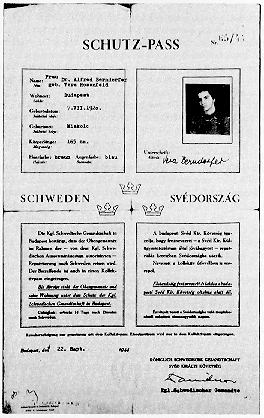
Per Anger
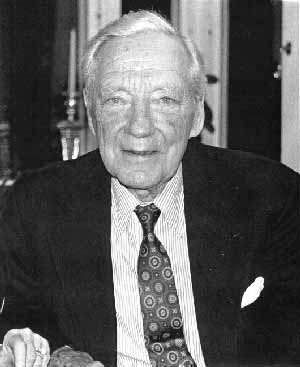
(1913 - 2002)
Per Johan Valentin Anger is among the non-Jews who risked their lives to save Jews from the Nazis during the Holocaust. He is honored by Israel's Yad Vashem Holocast Museum and listed among the Righteous Among the Nations.
Anger was born December 7, 1913,
in Gothenburg, Sweden. He studied law at the University of Stockholm,
and then later at the University of Uppsala. After he graduated in
November 1939, the same day as war broke out between the Soviet Union and Finland, Per Anger was drafted to the army. Shortly thereafter
the Foreign Department offered him a trainee position at the Swedish
legation in Berlin, Germany. Per Anger finished his army service in
January 1940, and by the end of that month he arrived in Berlin. This
is where his diplomatic career began.
- In Berlin (1941-1942)
- The Legation in Budapest
- The Holocaust
- Rescue Operations Begin
- Raoul Wallenberg Arrives in Budapest
- At the Train Station
- Along the Death Marches
- Soviets Arrive, War Ends
- Summary
In Berlin (1940-1941)
Per Anger was young and inexperienced when he arrived
in Berlin in January 1940. World War II had been going on for almost
five months at this time. He was placed in the trade department and
worked on trade between Sweden and Germany. From that position, he
witnessed the masses' fascination with Hitler and his propaganda.
Probably the most dramatic experience of his time
in Berlin was when the Swedish legation had received reliable information
from underground movements regarding the Nazi-German attack on Norway
and Denmark. There was uncertainty if Sweden was included in the plan.
Per Anger was now responsible for sending the coded telegram to Stockholm.
That night he couldn't sleep due to his thought that he might have
made a mistake when he sent the cipher, so that the Foreign Department
couldn't interpret it -- then one would read in future history books
about how "Sweden because of the Swedish attache Per Anger in
Berlin were taken by surprise by a German invasion army!"
The message got through as it should, but the Foreign
Department in Sweden didn't believe these statements and did not inform
its neighboring countries. A few days later the legation desperately
sent a new message to the Foreign Department with information from
an even more reliable source. Now it was taken seriously, and Norway
was warned. The Norwegian Foreign Minister Kut called for the German
military attache and asked if this information was accurate. The German,
of course, denied everything. The following day that same officer
took control over Oslo.
In June 1941, Anger returned to Stockholm and became
an official Swedish diplomat. He worked at the Foreign Department's
trade section on the relations between Sweden and Hungary until March
1942. The work mostly concerned the import of Hungarian food provisions
in exchange for Swedish steel.
The Legation in Budapest
On June 12, 1942, Per Anger was appointed second
secretary at the Swedish legation in Budapest, Hungary. On November
26, he began his duties there.
The Swedish legation in Budapest was a very small
unit at that time. The equivalent to ambassador was Minister Carl
Ivan Danielsson, and thereafter Per Anger in the order of precedence.
Formally he was the second secretary, but in protocol he acted as
first secretary. Further the legation consisted of Dénes von
Mezey, who was in charge of administration, Harry Wester who was the
military attache, Margareta Bauer and Birgit Brulin who were secretaries,
and finally the Swedish Red Cross representative in Budapest, Valdemar
Langlet.
Per Anger's main work was still Swedish-Hungarian
trade. The years from his arrival in Budapest until the German occupation
in 1944, Anger has described as relatively harmonious. There was no
shortage of food, the restaurants were open, and the Gypsies played
music in the restaurants, like before the war. The Jews were discriminated
against and didn't have the same rights as others, but their situation
was not as difficult as it would become after the German invasion.
The Holocaust
In his book, Per Anger describes how reports of
liquidation in gas chambers in Poland, had reached Budapest in 1942.
On March 19, 1944, Germany invaded Hungary. After
the German invasion the situation changed drastically. Per Anger witnessed
the Nazi persecutions and how their "final solution" plans
were put in motion. He was shocked the first day when suddenly every
fourth person on the street was wearing a yellow Star of David.
In an interview for the magazine Vi, Per
Anger recalled:
"First then everything was revealed. Mainly
by stories from people who managed to escape. We sent home reports
of extermination camps, sketches of the gas chambers in Auschwitz...//...
We became witnesses to what we didn't think was possible: a systematic
extermination of people."
The Rescue Operation Begins
In an interview with Dr. Paul Levine, Per Anger
speaks about the first days after the occupation:
"The first days we couldn't do so much.
I mean, we didn't know what was going to happen. We understood that
now would be a hard time for the Jewish population and it (the persecutions)
started just a few days later. So then we were forced to mobilize
our powers. From that moment everything that had to do with trade
with Sweden or other routine errands were of course put aside, and
we concentrated... the whole legation concentrated on one thing.
To save... try to save human lives."
Jews with relatives or business associates in Sweden
started to line up in front of the Swedish legation to ask for help.
Per Anger came up with the idea to issue provisional passports. The
passport was in fact a kind of travel document that was given to Swedish
citizens abroad who had lost their real passports. Minister Danielsson
gave his approval for them, but said that Per Anger would take responsibility
for them. Afterward, the Swedish Foreign Department also came to approve
the passports. Dénes von Mezey managed through his contacts with
the Hungarian authorities to negotiate that the bearer of such a passport
would be respected as a Swedish citizen, and that this person would
need to wear the yellow Star of David. This way interment and deportation
would be avoided.
Per Anger also came up with the idea to issue special
certificates to the many Jews who had applied for Swedish citizenship.
More than 700 provisional passports and certificates were issued at
first, and the rumor started to spread among the Jews of Budapest.
The documents completely lacked any form of legality in international
law.
Raoul Wallenberg's Arrival in Budapest
The Swedish legation acted on behalf of seven countries
in Hungary at this time. Simultaneously the stream of people seeking
help from the Swedes increased. This brought about the legation's
request for reinforcements. At the same time negotiations were taking
place between the American War Refugee Board, the Swedish Foreign
Department and the World Jewish Congress regarding sending a person
to Hungary with a mission to lead the rescue of Hungary's Jews.
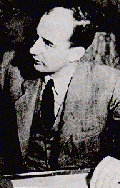 It
was Raoul Wallenberg who was appointed to be this person. He was given the status of legation
secretary in Budapest and arrived there July 9, 1944. It
was Raoul Wallenberg who was appointed to be this person. He was given the status of legation
secretary in Budapest and arrived there July 9, 1944.
Wallenberg looked at the old documents and then
presented the idea of a new document he thought would be more effective;
the protective passes -- Schutzpasse.
Wallenberg was well aware of how flashy papers printed in color with
signatures, seals and stamps impressed the Germans. The result was
a document printed in yellow and blue with the Tre Kronor--three
crowns from the Swedish state symbol--and the signature of the Minister.
Once again, these documents had no legal support whatsoever, but Germans
as well as Hungarians came to respect them.
In August 1944 Per Anger traveled to Stockholm to
request even more reinforcements for the legation. The new people
came to be the attache Lars Berg the administrator Göte Carlsson,
and the Swedish "Save The Children" representative Asta
Nilsson. Consul Yngve Ekmark was also tied to the legation and organized
storage and distribution of food, medicine and clothing for the rescue
operation.
At the Train Station
In an interview with the Los Angeles Times,
Per Anger was asked if he ever partook in the direct rescue of Jews.
He answered that he sometimes received calls from Wallenberg who asked
him to go to the train station to save people from the deportations
when he was hindered to do it himself.
This is how Anger described
one of those situations:
"When Wallenberg one day was somewhere
else, I went to a station from where a train with Jews was about
to depart. There was no time to be diplomatic with the Germans.
I explained that a terrible mistake had been done because they apparently
were on their way to deport Jews with Swedish protective passes.
If they weren't released immediately I would see to it that Veesenmayer
was notified. The German train commander didn't dare risking being
reported to the feared Veesenmayer. I went in to the wagons to call
for names, but only found two Jews with protective passes. With
the help of the present Hungarian police officer, Batizfalvy, who
in secrecy worked in cooperation with Raoul Wallenberg and me, I
succeeded, in defiance of the SS commanders order, to leave the
station with 150 Jews towards freedom, 148 of them without protective
passes."
Along the Death Marches
On November 10, 1944, the Russians and Americans
bombed the Hungarian railroads and made train deportations to Auschwitz
impossible. Adolf Eichmann then suggested letting the Jews in Budapest
march 180 kilometers to the Hungarian-Austrian border station at Hegyeshalom.
Possession of protective passes didn't help this time. Per Anger describes
in his book how "thousands of people were taken as they walked
and stood."
Raoul Wallenberg, Per Anger, and the legations of
other neutral countries reacted quickly. In his book Anger describes
one of their car trips along the death marches:
"One of the first days in December 1944 Wallenberg
and I took a car ride along the road the Jews [were] marching on.
We passed these crowds of miserable people, more dead than alive.
With gray faces they staggered forward under chops and hits from
the soldier's rifles. The road was lined by dead bodies. We had
our car filled with food that we managed to distribute in spite
of prohibitions, but it didn't last very long. At Hegyeshalom we
saw how the ones who arrived were handed over to a German SS commando
under Eichmann, who counted them like cattle. '489--correct' ('vierhundertneunundachtzig--stimmt
gut!'). The Hungarian officer received a receipt that everything
was in order.
Before this handing over we managed to save some
hundreds of Jews. Some had Swedish protective passes, others were
gotten out by pure bluffing. Wallenberg didn't give up and made
renewed journeys when he in similar ways managed to reunite some
additional Jews with Budapest."
The death marches to Hegyeshalom ended on December
10, 1944. At that time 37,000 Jews had been put on the march from
Budapest--27,000 arrived at the border station.
The Soviets Arrives & the War Ends
When the Soviet troops seriously got closer to Budapest,
the Swedish legation was offered the chance to leave the country by
the Foreign Department due to the large risks. In spite of bombs and
grenades falling over their heads, and their lives being threatened
by the Arrow Cross, everyone remained in Budapest, except one of the
women who was persuaded to go home. They knew that if they left the
country their proteges wouldn't stand a chance and all rescue work
would have been in vain. There was no other guarantee for their safety.
From now until the Soviet army's entry into Budapest,
everyone lived in constant fear. More time was now spent underground
in shelters than above. Dispersed over different places in the city,
the Swedes quickly lost contact with each other. After the Russians
arrived, everyone found each other again--except for Raoul
Wallenberg.
The last time Per Anger met Wallenberg was January
10, 1945. He had then asked Wallenberg to cancel his operation and
stay in the Buda-side of the city, otherwise his life would be in
great danger. Wallenberg refused to interrupt his work. On January
17, 1945, Raoul Wallenberg was taken away by the Russians. His fate
is a mystery to this day.
The members of the Swedish legation were put in
Soviet "custody" over some period, until order of their
return home came from Moscow. April 18, 1945, the Swedish legation
from Budapest arrived in Stockholm. This ended the "Budapest
adventure" for secretary Per Anger.
Summary
The war was over, but now Per Anger's search for
Wallenberg started. He has been one of the leading figures in this
search throughout the years, and he has also helped spread information
about Wallenberg's deeds around the world.
After Budapest, Anger continued his diplomatic career,
serving, for example, as Sweden's ambassador to Australia and Canada.
In 1989, as an example of Ambassador Anger's efforts,
he urged the German Chancellor Helmut Kohl to intervene in the Wallenberg
affair. Holding an extension phone, Anger listened as Kohl called
Mikhail Gorbachev and pleaded "let that old man go." The Russian had no answer, says Anger, who then went to Moscow to
appeal personally to the Soviet leader: "He showed no interest" and "implied that he had no control over the KGB."
Per Anger has received several awards throughout
the years. He was awarded as a "Righteous Among the Nations"
by the State of Israel and Yad
Vashem in 1982, an award given to gentiles who with danger for
their own lives rescued Jews during World War II. He has a tree planted
in his honor in "The Avenue of the Righteous" in Jerusalem.
In November 1995, he was honored with the Hungarian Republic's Order
of Merit, which was handed to him by the Hungarian President, Arpád
Göncz. In September 1996, he was honored by the Jewish Council
of Sweden.
In 1997, the first book about Per Anger was published, A
Quiet Courage—Per Anger, Wallenberg's Co-Liberator of Hungarian
Jews”. The book was written by Elisabeth R Skoglund
and published by Baker Books.
Per Anger died on August 25, 2002.
Sources: Per
Anger (c) David
Metzler
|