One of the longest surviving Jewish communities still
lives in Iraq. In 722 B.C.E.,
the northern tribes of Israel were defeated by Assyria and some Jews were taken to what is now known as Iraq. A larger community
was established in 586 B.C.E., when the Babylonians conquered the southern
tribes of Israel and enslaved
the Jews. These Jews distinguished themselves from Sephardim, referring
to themselves as Baylim (Babylonions). In later centuries, the region
became more hospitable to Jews and it became the home to some of the
world's most prominent scholars who produced the Babylonian
Talmud between 500 and 700 C.E.
During these centuries under Muslim
rule, the Jewish Community had it’s ups and downs. By World War
I, they accounted for one third of Baghdad’s population. In 1922, the
British recieved a mandate over Iraq and began transforming it into
a modern nation-state.
Iraq became an independent state in 1932. Throughout
this period, the authorities drew heavily on the talents of the mall
well-educated Jews for their ties outside the country and proficiency
in foreign languages. Iraq’s first minister of finance, Yehezkel Sasson,
was a Jew. These Jewish communities played a vital role in the development
of judicial and postal systems.
In the 1936 Iraq Directory, the “Israelite community” is listed among the various other Iraqi communities, such as Arabs, Kirds, Turkmen, Muslims, Christians, Yazidis and Sabeans, and numbering at about 120,000. Hebrew is also listed as one of Iraq’s six languages.
Yet, following the end of the British mandate, the
2,700-year-old Iraqi Jewish community suffered horrible persecution,
particularly as the Zionist drive for
a state intensified. In June 1941, the Mufti-inspired, pro-Nazi coup
of Rashid Ali sparked rioting and a pogrom in Baghdad during the Jewish Feast of Shavuot. Armed Iraqi mobs,
with the complicity of the police and the army, murdered 180 Jews and
wounded almost 1,000 in what became known as the Farhud pogrom. Immediately following, the British Army re-entered
Baghdad, and success of the Jewish community resumed. Jews built a broad
network of medical facilities, schools and cultural activity. Nearly
all of the members of the Baghdad Symphony Orchestra were Jewish. Yet
this flourisng environment abruptly ended in 1947, with the partition
of Palestine and the fight for Israel’s independence. Outbreaks of anti-Jewish
rioting regularly occurred between 1947 and 1949. After the establishment
of Israel in 1948, Zionism became
a capital crime.
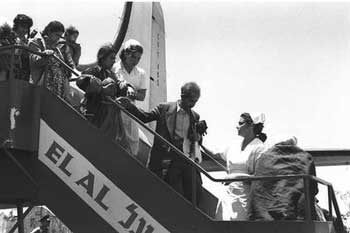 In
1950, Iraqi Jews were permitted to leave the country within a year provided
they forfeited their citizenship. A year later, however, the property
of Jews who emigrated was frozen and economic restrictions were placed
on Jews who chose to remain in the country. From 1949 to 1951, 104,000
Jews were evacuated from Iraq in Operations
Ezra & Nechemia (named after the Jewish leaders who took their people back to Jerusalem from exile in Babylonia beginning in 597 B.C.E.); another 20,000 were smuggled out through Iran.2
In
1950, Iraqi Jews were permitted to leave the country within a year provided
they forfeited their citizenship. A year later, however, the property
of Jews who emigrated was frozen and economic restrictions were placed
on Jews who chose to remain in the country. From 1949 to 1951, 104,000
Jews were evacuated from Iraq in Operations
Ezra & Nechemia (named after the Jewish leaders who took their people back to Jerusalem from exile in Babylonia beginning in 597 B.C.E.); another 20,000 were smuggled out through Iran.2
In 1952, Iraq’s government barred Jews from emigrating and publicly
hanged two Jews after falsely charging them with hurling a bomb at the
Baghdad office of the U.S. Information Agency.
With the rise of competing Ba’ath
factions in 1963, additional restrictions were placed
on the remaining Iraqi Jews. The sale of property
was forbidden and all Jews were forced to carry yellow
identity cards. After the Six Day
War, more repressive measures were imposed: Jewish
property was expropriated; Jewish bank accounts
were frozen; Jews were dismissed from public posts;
businesses were shut; trading permits were cancelled
and telephones were disconnected. Jews were placed
under house arrest for long periods of time or restricted
to the cities.
Persecution was at its worst at the
end of 1968. Scores were jailed upon the discovery
of a local “spy ring” composed
of Jewish businessmen. Fourteen men, eleven of them
Jews, were sentenced
to death in staged trials and hanged in the public
squares of Baghdad; others died of torture. On January
27, 1969, Baghdad Radio called upon Iraqis to “come
and enjoy the feast.” Some 500,000 men, women
and children paraded and danced past the scaffolds
where the bodies of the hanged Jews swung; the mob
rhythmically chanted “Death to
Israel” and “Death to all traitors.” This
display brought a world-wide public outcry that Radio
Baghdad dismissed by declaring:
“We hanged spies, but the Jews crucified Christ.”3 Jews remained under constant surveillance by the Iraqi
government. An Iraqi Jew (who later escaped) wrote
in his diary in February 1970:
Ulcers, heart attacks, and breakdowns are increasingly prevalent
among the Jews...The dehumanization of the Jewish personality resulting
from continuous humiliation and torment...have dragged us down to
the lowest level of our physical and mental faculties, and deprived
us of the power to recover.4
In response to international pressure, the Baghdad
government quietly allowed most of the remaining Jews to emigrate in
the early 1970’s, even while leaving other restrictions in force. Most
of Iraq’s remaining Jews are now too old to leave. They have been pressured
by the government to turn over title, without compensation, to more
than $200 million worth of Jewish community property.5
The government also
engages in anti-Semitic
rhetoric. One statement
issued by the government
in 2000 referred
to Jews as “descendents
of monkeys and pigs,
and worshippers of
the infidel tyrant.” 6
In 1991, prior to the Gulf
War, the State Department said “there is no recent evidence
of overt persecution of Jews, but the regime restricts travel (particularly
to Israel) and contacts with Jewish groups abroad.”
A Jerusalem Post report noted that
75 Jews have fled Iraq in the past five years, most relocating
to Holland or England.
About 20 emigrated to Israel.7
Only one synagogue continues to function
in Iraq, “a crumbling buff-colored building tucked away
in an alleyway” in Bataween, once Baghdad’s main Jewish
neighborhood. According to the synagogue’s administrator,
“there are few children to be bar-mitzvahed, or couples
to be married. Jews can practice their religion but are not
allowed to hold jobs in state enterprises or join the army.”8 The rabbi died in 1996 and none of the remaining Jews can
perform the liturgy and only a couple know Hebrew. The last
Jewish wedding was held in 1980.9
The Iraqi government has refurbished the
tombs of Ezekiel the Prophet and Ezra the Scribe, which are
also considered sacred by Muslims. Jonah the Prophet’s tomb
has also been renovated. Saddam Hussein also assigned guards
to protect the holy places during his reign. Each year, hundreds of Muslim pilgrims flock to the holy sites to pay hommage to these prophets.
In 2004,
approximately 35 Jews were living in Baghdad, but by 2008, the once-thriving community of Jews living in the Iraqi capital has dwindled to below 10, not enough to hold a minyan (the requesite 10 men needed for most religious rituals), and a handful more in the Kurdish-controlled
northern parts of Iraq.10 The community still lives in fear, scared even to publicize the exact numbers of Jews remaining in Baghdad, but the Jewish Agency estimates it at about seven. Most of those in Baghdad are elderly, poor and lacking basic needs
such as clothing, medication and food, but some remaining are middle class, including two doctors. The one synagogue, the Meir Taweig
Synagogue, was closed in 2003, after it became to dangerous to gather out in the open. Among the remaining Jews, one fearful man now in his early 40s describes himself as “the rabbi, slaughterer and one of the leaders of the Jewish community in Iraq.”11
Most traces of Jews living in Iraq are now gone, except for the Prat and Hidekel rivers, the Hebrew names for the Tigris and Euphrates Rivers. Baghdad’s Jewish quarter, in Taht al-Takia, no longer exists. The
end of Saddam
Hussein’s regime created
hopes of an improvement in the living conditions
of Jews, and the return of some of the émigrés.
Some hope also existed for rapprochement
with Israel.
In reality, the instability and sectarian
killings in Iraq made the dozen or so remaining
Jews there the most vulnerable and terrified
group in the country. Most Jews barely
leave their homes at all for fear of being
kidnapped or executed..12
Despite this life of seclusion and fear, the remaining Jews living in Baghdad simply say they are too old to leave. The Jewish Agency has sent appeals to the community, offering to relocate all of them to Israel and take care of all their absorption needs.
The Kurdish Parliament passed new laws in May 2015 which established government departments dealing with seven religious minorities in their region, including the Baha'i, Zoroastrians, Yazidis, and Jews. Sherzad Omer Mamsani was named the Jewish Affairs Representative in Kurdistan in late 2015, with the job of showing hospitality to local Jews and fostering positive relations with Israel and Jewish people worldwide. Mamsani was placed in charge of all Jews of Kurdish origin, whom number close to 300,000 and mostly reside in Israel.
On May 6, 2008, Abdurrahman Wahid, the former Indonesian president, received the Medal
of Valor from the Simon Wiesenthal Center. Wahid is best known as the president who shifted Indonesia to democracy from 1999 to 2001, but it is his work of introducing Muslim nations to truths about the Jews that has also gained him prominence. As opposition leader, he broke ground by visiting Israel in 1994, and last year, he participated in a Holocaust conference in Bali, Indonesia, conducted jointly by the LibForAll Foundation, a group that promotes moderate Islam, and the Simon Wiesenthal Center, where he called Iranian President Mahmoud Ahmedinejad a “liar” for denying the Holocaust.
After Wahid attended the Wiesenthal Center tribute dinner where he received his award, he then traveled to Israel to participate in Shimon Peres’ conference celebrating Israel’s 60th anniversary, “Facing Tomorrow.” Wahid’s message, including this active Jewish component, is to promote an ideology of moderate Islam by demonstraing that the radical factions are not pre-eminent and to promote a faith that preaches equality for women and tolerance of non-believers. The danger comes, Wahid says, when Western leaders try to accommodate Islamic extremists.
It was his relationship with an elderly Jewish man whom he befriended at a textile company where they both worked in Baghdad in 1966 (at the time, Wahid was a student at Baghdad University) that taught him everything he knew about Judaism. He remembers particularly the day in 1968 when nine Jews were hanged in Baghdad’s Tahrir Square after bing convicted on trumped-charges of syping for Israel. Wahid’s friend came to him and wept, wondering what would become of Iraq’s ancient Jewish community. “I said, ‘This is not only your fate, it is my fate,’” Wahid recalls. He then decided that “the Islamic people should learn” about the Jews and their faith, and it has been a central part of his mission to this day.13
Sources:
1David
Singer and Lawrence Grossman, Eds. American
Jewish Year Book 2003. NY: American Jewish Committee, 2003.
2Jerusalem
Post, (Dec. 13, 1997); Arieh Avneri, The
Claim of Dispossession, (Tel Aviv: Hidekel Press, 1984), p.
274; Maurice Roumani, The Case of the Jews from Arab Countries: A
Neglected Issue, (Tel Aviv: World Organization of Jews from Arab
Countries, 1977), pp. 29-30; Norman Stillman, The
Jews of Arab Lands in Modern Times, (NY: Jewish Publication
Society, 1991), pp. 117-119; Howard Sachar, A
History of Israel, (NY: Alfred A. Knopf, 1979), p. 399.
3Judith
Miller and Laurie Mylroie, Saddam
Hussein and the Crisis in the Gulf,
(NY: Random House, 1990), p. 34.
4Max
Sawadayee, All Waiting to be Hanged, (Tel
Aviv: Levanda Press, 1974), p. 115.
5The New
York Times, (February 18, 1973).
6U.S.
State Department Report on Human Rights
Practices for 1997.
7The Jerusalem
Post (Dec. 13, 1997).
8New
York Times Magazine, (February 3, 1985).
9Associated
Press, (March 28, 1998).
10The Jerusalem Post (September 28, 2002).
11Farrell, Stephen. “Baghdad Jews Have Become a Fearful Few.” The New York Times (June 1, 2008).
12The
Washington Post, (October 3, 2006).
13Kamepease, Ron. “With Rock Music, Islamic Teachings, Ex-Premier Fights for Moderate Islam.” San Francisco Sentinel (May 19, 2008).
Photo from the National
Photo Collection