When Hitler came to power, a central Nazi goal was to identify and destroy Germany's 600,000 Jews. To Nazis, Jews were not just those who practiced Judaism, but those of Jewish blood, regardless of their assimilation, intermarriage, religious activity, or even conversion to Christianity. Only after Jews were identified could they be targeted for asset confiscation, ghettoization, deportation, and ultimately extermination. To search generations of communal, church, and governmental records all across Germany-and later throughout Europe-was a cross-indexing task so monumental, it called for a computer. But in 1933, no computer existed. When the Reich needed to mount a systematic campaign of Jewish economic disenfranchisement and later began the massive movement of European Jews out of their homes and into ghettos, once again, the task was so prodigious it called for a computer. But in 1933, no computer existed. When the Final Solution sought to efficiently transport Jews out of European ghettos along railroad lines and into death camps, with timing so precise the victims were able to walk right out of the boxcar and into a waiting gas chamber, the coordination was so complex a task, this too called for a computer. But in 1933, no computer existed. However, another invention did exist: the IBM punch card and card sorting system-a precursor to the computer. IBM, primarily through its German subsidiary, made Hitler's program of Jewish destruction a technologic mission the company pursued with chilling success. IBM Germany, using its own staff and equipment, designed, executed, and supplied the indispensable technologic assistance Hitler's Third Reich needed to accomplish what had never been done before-the automation of human destruction. More than 2,000 such multi-machine sets were dispatched throughout Germany, and thousands more throughout German-dominated Europe. Card sorting operations were established in every major concentration camp. People were moved from place to place, systematically worked to death, and their remains cataloged with icy automation. IBM Germany, known in those days as Deutsche Hollerith Maschinen Gesellschaft, or Dehomag, did not simply sell the Reich machines and then walk away. IBM's subsidiary, with the knowledge of its New York headquarters, enthusiastically custom-designed the complex devices and specialized applications as an official corporate undertaking. Dehomag's top management was comprised of openly rabid Nazis who were arrested after the war for their Party affiliation. IBM NY always understood-from the outset in 1933-that it was courting and doing business with the upper echelon of the Nazi Party. The company leveraged its Nazi Party connections to continuously enhance its business relationship with Hitler's Reich, in Germany and throughout Nazi-dominated Europe. Dehomag and other IBM subsidiaries custom-designed the applications. Its technicians sent mock-ups of punch cards back and forth to Reich offices until the data columns were acceptable, much as any software designer would today. Punch cards could only be designed, printed, and purchased from one source: IBM. The machines were not sold, they were leased, and regularly maintained and upgraded by only one source: IBM. IBM subsidiaries trained the Nazi officers and their surrogates throughout Europe, set up branch offices and local dealerships throughout Nazi Europe staffed by a revolving door of IBM employees, and scoured paper mills to produce as many as 1.5 billion punch cards a year in Germany alone. Moreover, the fragile machines were serviced on site about once per month, even when that site was in or near a concentration camp. IBM Germany's headquarters in Berlin maintained duplicates of many code books, much as any IBM service bureau today would maintain data backups for computers. I was haunted by a question whose answer has long eluded historians. The Germans always had the lists of Jewish names. Suddenly, a squadron of grim-faced SS would burst into a city square and post a notice demanding those listed assemble the next day at the train station for deportation to the East. But how did the Nazis get the lists? For decades, no one has known. Few have asked. The answer: IBM Germany's census operations and similar advanced people counting and registration technologies. IBM was founded in 1898 by German inventor Herman Hollerith as a census tabulating company. Census was its business. But when IBM Germany formed its philosophical and technologic alliance with Nazi Germany, census and registration took on a new mission. IBM Germany invented the racial census-listing not just religious affiliation, but bloodline going back generations. This was the Nazi data lust. Not just to count the Jews — but to identify them. People and asset registration was only one of the many uses Nazi Germany found for high-speed data sorters. Food allocation was organized around databases, allowing Germany to starve the Jews. Slave labor was identified, tracked, and managed largely through punch cards. Punch cards even made the trains run on time and cataloged their human cargo. German Railway, the Reichsbahn, Dehomag's biggest customer, dealt directly with senior management in Berlin. Dehomag maintained punch card installations at train depots across Germany, and eventually across all Europe. How much did IBM know? Some of it IBM knew on a daily basis throughout the 12-year Reich. The worst of it IBM preferred not to know — "don't ask, don't tell" was the order of the day. Yet IBM NY officials, and frequently Watson's personal representatives, Harrison Chauncey and Werner Lier, were almost constantly in Berlin or Geneva, monitoring activities, ensuring that the parent company in New York was not cut out of any of the profits or business opportunities Nazism presented. When U.S. law made such direct contact illegal, IBM's Swiss office became the nexus, providing the New York office continuous information and credible deniability. Certainly, the dynamics and context of IBM's alliance with Nazi Germany changed throughout the twelve-year Reich....Make no mistake. The Holocaust would still have occurred without IBM. To think otherwise is more than wrong. The Holocaust would have proceeded — and often did proceed — with simple bullets, death marches, and massacres based on pen and paper persecution. But there is reason to examine the fantastical numbers Hitler achieved in murdering so many millions so swiftly, and identify the crucial role of automation and technology. Accountability is needed. In April 1941, a Romanian census taker came to the home of a suspected Roma Gypsy working as a blacksmith in the picturesque town of Schaas. The senior Nazi statistical official observing the process wrote, "He did not dare to deny his ethnical descent as Gypsy." The census taker instructed: "Now, please write: Gypsy." Shortly thereafter, that Gypsy blacksmith's census questionnaire, filled out by simple pencil, joined thousands of similar questionnaires at the Romanian Central Institute for Statistics facility. This facility was equipped with the latest IBM Hollerith high-speed punch-card machines, specifically programmed for the Romanian census. IBM's Hollerith punch-card system stored any information, such as ethnic type, profession and residential location, in the rows and columns strategically punched. The cards could then be counted and cross-tabulated at the rate of 24,000 cards per hour, yielding almost any permutation of data. To help systematize the persecution and extermination of minorities, the Romanians used custom-designed punch cards, printed exclusively by IBM, which included special columns and rows for all ethnic groups, including Roma Gypsies. The printed census forms were approved for compatibility by IBM engineers, ensuring each of the numbered boxes on the printed census forms corresponded to the designated punch-card column. Because this was a state-of-the-art census, the women operating IBM equipment were all at least high school educated. Within a year of being identified, an estimated 25,000 Gypsies were rounded up pursuant to the Romanian Interior Minister's order #70S/1942. Typically, roadblocks were set up on the outskirts of town as gendarmes, with lists of names, fanned out to arrest the Gypsies. Gypsies were then deported in trains, which were scheduled and tracked by IBM's leased and regularly serviced Hollerith machines. Their destination was a death of starvation, beatings or execution every bit as horrible as that experienced by the Jews of Romania. The Nazi census expert observing the Romanian census was Friedrich Burgdörfer, president of the Bavarian Office for Statistics in Munich. Ludwig Hümmer, an IBM punch-card expert working in IBM's German subsidiary, Dehomag, accompanied Burgdörfer to Romania. Hümmer went to Romania only reluctantly since he was not receiving a commission on the punch-card business in Romania. Romania was a sales territory operated directly from New York. But Hümmer was specifically instructed to assist in the Romanian census by Werner Lier, IBM's general manager in Geneva, Switzerland. Lier acted with the full knowledge of IBM president Thomas J. Watson. Recently, IBM's role as a willing accomplice in the mass murders of Gypsies — and indeed, the larger question of its Swiss operation — has come back to haunt the technology company. Big Blue has refused to answer the charges since the first simultaneous disclosures in 40 countries on February 11, 2001, that IBM knowingly systemized Hitler's persecution and extermination of Europe's Jews, directly from New York and through its subsidiaries in Europe coordinated through the Swiss office. But on June 22, a Swiss appellate Court ruled that a compensation suit filed by the Gypsy International Recognition and Compensation Action could proceed. "The precision, speed and reliability of IBM's machines," the Swiss judge ruled, "especially related to the censuses of the German population and racial biology by the Nazis, were praised in the publications of Dehomag itself, the branch of respondent IBM. It does not thus seem unreasonable to deduce that IBM's technical assistance facilitated the tasks of the Nazis in the commission of their crimes against humanity, acts also involving accountancy and classification by IBM machines and utilized in the concentration camps themselves."
The judge's ruling pointedly added: "In view of the preceding, IBM's complicity with material and intellectual assistance in the criminal acts of the Nazis during the Second World War by means of its Geneva establishment does not appear to be ruled out, as there is a great deal of evidence indicating that the Geneva establishment was aware that it was aiding and supporting these acts." IBM has consistently stated through its spokesmen that it has no information about how its machines were being used. But that is the opposite of what IBM itself stated during World War II to American investigators probing IBM's Geneva office. Werner Lier, IBM's European manager in Geneva until Germany surrendered, was the company's top officer in Europe, involved with virtually every transaction in every country throughout the war. Lier himself defined IBM Geneva not as an autonomous, detached office — but as a nexus, which simply implemented the business decisions made by IBM New York. On April 29, 1942, Lier outlined for the American consul in Geneva exactly how IBM Geneva operated. "You will readily understand," explained Lier, "that this office is a clearing office between the local organizations in the various countries and the New York Headquarters." Lier added that IBM New York made all the decisions. His function was simply to monitor the business and keep the records. "The European Headquarters in Geneva," Lier explained, "are, in a way, a representative of the World Headquarters in New York, whose job it is to manage and control European affairs... In short, the functions of the Geneva Office are purely administrative." Lier emphasized, "When the local offices [in different countries] require machines or material from our factories in the United States, they pass the order to the Geneva Office which, in turn, transmits it to the New York Headquarters for handling and supplying the machines direct to the local office." Switzerland was the commercial nexus of World War II. Its famous financial secrecy laws, neutrality and willingness to trade with enemies made Switzerland the Third Reich's preferred repository for pilfered assets and a switchboard for Nazi-era commercial intrigue. In 1935, when talk of war in Europe became pervasive, Watson moved the company's European headquarters from Paris to Geneva. As a Swiss national, Lier freely traveled to and from Germany, the occupied territories and neutral countries, micro-managing company affairs for Watson. Census was one of Lier's most important projects. IBM, through Lier and the Swiss office, moved its machines from place to place around Europe as Nazi-allied regimes required them. For example, the Romanian census presented a huge business opportunity involving many machines and millions of custom punch cards — which only IBM printed. Watson had been preparing for the Romanian census and similar censuses for years. As far back as 1938, Geneva official J C. Milner advised New York, "During 1940, the census will be taken in several countries, and we expect a number of orders." Milner hoped IBM New York could develop a special IBM census tabulator in time. On October 10, 1941, Lier visited Berlin to review arrangements to supply the Romanians. He wrote to Watson's personal assistant Harrison K. Chauncey in New York: "As regards the Census... neither we nor the Dehomag have been able to obtain any precise information as regards the specifications of the machines which are needed in Bucharest. I agreed, exceptionally, to Mr. Hümmer going to Bucharest together with a representative of the German Statistical Office [Friedrich Burgdörfer] in order to analyze the whole situation. The commercial side of these two subjects has been dealt with direct with [two IBM executives in Geneva] Mr. [Jurriaan] Schotte and Mr. [J.C.] Milner." The Romanian business was not in Dehomag's commission portfolio. It was an enterprise of IBM New York. Because Dehomag employees received no commission outside the Reich, IBM New York and IBM Geneva were uncertain whether German employees could be relied upon to carry out IBM projects elsewhere in Europe. Weeks before in 1941, when Watson's personal assistant Chauncey had inquired whether tabulators had been dispatched to Romania, German manager Karl Hummel responded with what seemed like a lack of initiative: "We have not furnished any to Romania." He seemed to be waiting for direct orders, saying, "If Geneva gives us an order for Romania, we will fill it." But for Lier, Romania was clearly a priority. When he arrived in Berlin in the fall of 1941, "One of the first matters discussed with them," Lier reported to Chauncey on October 10, 1941, "was that of the Romanian census and the machines destined for this business, which are actually blocked in Poland." The day before, Lier had sent a more formal letter to Watson himself to allay any concerns: "On the occasion of my visit to Berlin," Lier wrote, "I also settled a few pending matters, such as the machines blocked in Poland [and] the Romanian census... I am addressing separate reports to the executives concerned in New York." Lier felt that if only he could contact the Romanian embassy, diplomats could use their connection with Reich offices in occupied Poland to forward the machines through the war zone. He called IBM's best contact in Berlin, American commercial attaché Sam Woods. "Thanks to Mr. Woods," Lier reported to IBM New York, "I obtained an interview with the Romanian Commercial Attaché who immediately endeavored to obtain the freeing of approximately seventeen machines at present blocked in Poland from the Devisenstelle [Foreign Currency Office] and the German Authorities... I have been given every assurance as to the satisfactory outcome of this demand." Shortly thereafter, Lier did effect the transfer of Dehomag machines to IBM's Romanian subsidiary. Even Nazi census master Burgdörfer admitted, in a journal article, that Romania's Central Statistical Institute was "unusually well-equipped." Romania's massive census was so sophisticated it even enumerated which Roma Gypsies were already refugees or already interned in concentration camps. Hence, IBM's punch card was designed to record such designations as "temporarily absent" for refugees and "in a concentration camp." No wonder that even Burgdörfer praised the census as "an extraordinarily extensive (maybe even too vast) program of registration." Burgdörfer elaborated on how the census takers handled Gypsies afraid to admit their extraction. "Settled gypsies," wrote Burgdörfer, "wanted to avoid answering on the question of ethnicity with the specific term 'gypsy' and often claimed they were Romanians... Therefore, counting officials and inspectors received orders to make the official entries according to the countees' wishes, but add a comment stating that in their opinion or in the general opinion of the community they were considered to be Gypsies." Hence, the IBM tabulations would record them as Gypsy regardless of the ethnic box checked. "Even more difficult is the statistical registration of so-called forest gypsies and wandering gypsies," Burgdörfer continued. "We met a number of forest gypsies (these are gypsies, who — for a small compensation to the owner of the forest — settle temporarily in a part of the woods, in order to produce wooden spoons and the like, which they proceed to sell on towns' markets) in the area of Strehaia. And soon afterwards in the same region we met so-called wandering gypsies, who make their camps somewhere along the road and who earn their living by mending pots and the like, apart from begging and thievery. In this case, we could check if the registration of wandering gypsies worked this time... but wasn't successful in earlier censuses." Burgdörfer explained how special measures were needed to make sure all three types of Gypsies were registered. "At the census of 1941 police stations," he recounted, "... each police station had to try on the date of the census to register all wandering gypsies using the census lists. They had to report to the Central Institute of Statistics, if there were wandering gypsies present in their territory at the time of the census and if this was the case, they had to include them in the census; if it wasn't reported, than it was 'a dead loss.' Dead losses were to be examined in a special post-control. In this fashion it is hoped that in the census of 1941 all gypsies — not only settled, but also forest gypsies and primarily wandering gypsies — are registered completely." The census was also used as an identification card. "Every head of the household recorded in the census," stated Burgdörfer, "has to receive a receipt and carry it at all times. On the road Dr. Golopentia stopped a group of wandering gypsies and demanded to see their certification, which they could produce — much to my surprise." The same method of census-receipt identification had been pioneered against Jews in Poland just before they were sent to concentration sites and ghettos. Prior to IBM's 1941 system of census cross-tabulation, all three different types of Gypsies in Romania, regardless of whether they wandered, resided in forest camps or settled in villages, could not all be efficiently identified. "An exact investigation of gypsies in numbers has not been possible until today," boasted Burgdörfer, "but everyone hopes that by special control measures for wandering gypsies, etc., this census will result in a somewhat proper registration of gypsy totality." That said, he remained skeptical about Gypsies of mixed descent. He lamented that it was "bordering on impossible, to statistically register Gypsy half-breeds, who pose a serious problem, from a race-psychological perspective." He concluded, "The total number of [Romanian] Gypsies (without counting Gypsy half-breeds) is estimated to be 300,000." IBM's subsidiary in Bucharest was incorporated on March 4, 1938, as Compania Electrocontabila Watson with approximately $240,000 in equipment, punch cards and leaseable machines. The unit quickly became profitable. The subsidiary's main clients were the Communications Ministry, census bureaus, statistical offices and railroads. Watson's decision to incorporate coincided with Romania embarking on an enhanced war footing. This martial program would include massive orders of Hollerith equipment and punch cards. IBM Europe was unable to fill all the leases requested by Bucharest, but it ramped up production to meet the need. IBM New York was kept apprised of the progress by Geneva. Company executives had worked with Romanian military committees early in the war to scrutinize each commercial installation in the country, identifying which could be requisitioned by the War Ministry. These machines were to be relocated to secure sites in the countryside when fighting broke out. Special arrangements with the Romanian War Ministry exempted IBM supervisors and engineers from the draft to assure continuity of service. A few months after Lier arranged the shipment of 17 additional machines from Poland to Bucharest to process the Romanian census, the United States declared war. Shortly thereafter, Axis-aligned Romania was deemed enemy territory under General Ruling 11. But IBM needed to finalize commissions owed to the Italian bank in Bucharest that covered delivery guarantees. Writing on June 18, 1942, on corporate letterhead displaying equally the name of IBM in New York and IBM Europe in Geneva, Lier tried to secure from the American commercial attaché in Bern a special license to pay the bank commissions. Lier wrote, "In the middle of last year, our Romanian company contracted a large order with the Romanian census authorities for the execution of the census of the population of Romania. Prior to giving that order to our Romanian company, the Romanian Government required a bank guarantee to be filed with the Banque Commerciale Italienne et Roumaine in Bucharest to cover the delivery of the equipment foreseen by the order... May we therefore request you to issue a license which would authorize us to cover the amount of Lei 111,348 by remitting this amount in Swiss Francs to the Societe de Banque Suisse in Geneva." The American legation denied Lier's request and suggested he contact the Treasury Department in the United States. Lier asked IBM New York to handle the matter directly with Washington. As late as January 1944, Jurraand Schotte, formerly of the Swiss office and now Lier's counterpart in New York, acknowledged to Justice Department investigator Harold Carter that he knew that punch cards at the Central Institute of Statistics contained information on census, population trends and "special studies of all minority groups in Romania." Schotte also confirmed that Romania's railroads maintained "a large installation of machines" located at the Communications Ministry. The railroad's Statistical Department alone utilized as many as 1.7 million cards annually, and its Traction Department 3.34 million more. Those cards were printed on IBM's Swift Press in its busy Bucharest facility, which was functioning at its absolute capacity of 20 million cards per year. Romania was liberated from fascist domination by Russian forces in late August 1944. On September 2, 1944, IBM Bucharest cabled a report to IBM Geneva: "Company in working order. Cable instructions for changed circumstances. Arrange urgently protection of property and personnel." IBM New York later sent a note: "Your telegram of the 12th October seems to indicate that your present situation is normal and that you are proceeding with your work as best you can." The company then asked for a comprehensive 11-point report on all financial statements, including profit or loss, and rental revenues by customer, for the years 1942, 1943 and 1944. In addition, the company also wanted an immediate estimate of future prospects in war-ravaged Romania, broken down by machines that could be immediately rented, personnel needed and spare parts required. New York also wanted to know if Romania had made its quota: asking for "points installed and uninstalled to date." This way, the Romanian subsidiary could take its rightful place in IBM's 100 Hundred Percent Club for outstanding performance. Romania was liable for war reparations, including $20 million to pay American claims, $50 million to Britain for its claims and approximately $300 million for Russian claims. By late July 1945, IBM had lodged its own compensation claims for war damage. The total of $151,383.73 included $37,946.41 for damaged Hollerith machines. It also called on State Department intermediaries to secure its bank accounts in Romania. Romania was not the only place IBM assisted in the identification and persecution of the Gypsies. For example, in Czechoslovakia, Gypsies constituted the second largest ethnic minority. Nazi raceologists and population statisticians were especially concerned about racial contamination from Czech gypsies.
In November, 1936, Watson approved a card printing plant in a small town near Prague, where 16 presses and two cutting machines were installed. The next year, Georg Schneider was hired as an additional salesman for Prague. Within about a year, Schneider was transferred to Dehomag in Berlin "as a salesman and studying the German organization." He met Watson in Berlin, as well as the company's leading Swiss-based supervisors. By that time, Czechoslovakian State Railways was utilizing 52.2 million punch cards per year. In 1939, IBM Geneva and Dehomag agreed that Schneider should return to occupied Prague, where about 60 employees worked, as the new co-manager working with director Emil Kuzcek, where some 60 employees worked. At about that time, just after the invasion, the Third Reich opened the Statistical Office for the Protectorate of Bohemia and Moravia, located in Prague. IBM did not list itself in Czech commercial registries as owning its own subsidiary. Instead, 102,000 of the subsidiary's 200,000 Kroner value was held by IBM's attorney in Prague, Stefan Schmid, and 98,000 by then-IBM European General Manager John Holt, both men acting as nominees for IBM New York. On July 4, 1945 — just weeks after the war ended — Schneider, the manager of IBM's Czech subsidiary, wrote a warm letter to Watson in New York, summarizing his loyal efforts on behalf of the New York office. "I beg to give you my report about the IBM office in Prague, Czechoslovakia... All the interests of the IBM were in good hands. The $-rentals were transferred to the account of IBM in Geneva, after begin [sic] of war with U.S. All $-rentals must be converted at the rate of exchange of K25.02 Crowns = $1 and stored on the blocked account of IBM in Prague." Schneider added that he met Watson's emissary Chauncey in Berlin, after the United States entered the war, to obtain IBM New York's permission to disguise German machines as Czech. "I made in 1942," Schneider reminded Watson, "with Mr. Chauncey, visiting Berlin, an agreement and so we were authorized to buy machines from the Dehomag and to sell or lend [lease] in our name. From each machine we had to pay a license-tax [royalty] to the IBM."
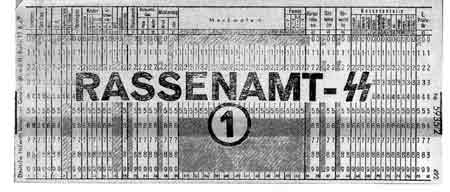
In the concentration camps, IBM's code for Jews was 8. Its code for Gypsies was 12. General executions were coded as 4, death in the gas chambers as 6. Only Jews and Gypsies were systematically murdered in gas chambers. When Gypsies were allowed to work in camps, they received a prisoner number compatible with the IBM tracking systems maintained by the S.S. Economics Administration, which operated all camps. All Gypsy cards, once processed, were stamped with IBM's trademark name, Hollerith Erfasst — German for "registered by Hollerith." Gypsies worked in camps across the Third Reich, including Mauthausen, IBM coded 7; Buchenwald, IBM coded 2; and Auschwitz, IBM coded 1. Nearly every concentration camp maintained an IBM customer site called Hollerith Abteilung, or "Hollerith Department," some with machines, some just with card-sorting operations and some just with forms that prisoners prepped for Hollerith processing. IBM machines required on-site service, whether that was in the huge Hollerith Büro situated in the I.G. Farben factory complex — housed in Barracks 18 next to German Civil Worker Camp 7, about two kilometers from Auschwitz III, also known as Monowitz Concentration Camp — or in the Hollerith Service across from the parade plaza in Mauthausen, or in the bombproof Hollerith Bunker just outside the gate at Dachau. No machines were sold, only leased. They always remained IBM property. Although IBM Geneva left a massive paper trail, it has been hard to unravel and decipher it. Deals and denials characterized virtually the length and breadth of IBM's wartime presence in Geneva. Murky transactions were fundamentally untraceable since they could filter through a maze of banks or their branches, many of them newly created by Germany and scattered across occupied and neutral countries. New York branches of Swiss banks only complicated the trail, prompting Treasury officials in Washington to dispatch squads of investigators to Manhattan seeking evidence of trade with the enemy. During the war years, IBM's own internal reviews conceded that correspondence about its European business, primarily through its Geneva office, was often faked. Dates were falsified. Revised contract provisions were proffered to hide the true facts. Misleading logs and chronologies were kept.
For instance, in late March 1942, Lier negotiated contracts with two blacklisted Swiss munitions companies. Yet on April 27, 1942, Lier sent a cable to IBM New York pretending that the two newly negotiated contracts had actually been signed before the war, and then openly asking New York to petition the U.S. government for a special exemption: "U.S. Commercial Attaché Bern requests we cancel contracts," cabled Lier. "Can you intervene to maintain installations on basis contracts signed before war." But IBM's own internal review later confirmed, "This is a definitely misleading statement because, apart from the two contracts here under consideration, three other contracts had been signed by the customer after the United States had entered into the war... the machines were supplied and billed by Geneva, and payment accepted. Mr. Lier made thereby a deliberately misleading statement... This deception is the more serious since none of the contracts signed before the war existed any longer." IBM also found a pattern of falsified dates. For instance, Lier sent IBM New York a cable July 21, 1942 asserting that a Type 954 Hollerith was installed at a blacklisted customer site in Switzerland on December 31, 1941, just before tough new trading with the enemy regulations went into effect. However, IBM's own fraud review, citing its Installation Report No. 22, proved the machine was actually installed on March 31, 1942 with rent beginning in April 1942. Foot-dragging, false logs and contrived chronologies were commonplace at IBM Geneva. For example, Lier had created an extensive log to demonstrate how he regularly complied with American consular officials in Bern who demanded IBM cease business with blacklisted companies. Eventually, IBM had to admit in a letter: "Thus it has taken Mr. Lier thirteen days to inform Mr. Herzog [an IBM sales manager] that two of his customers appeared on the 'Black List,' when he [Lier] could have informed Mr. Herzog by telephone on the day he was in possession of this information — namely on March 25 [1942]. In consequence," the company letter continued, "[American Commercial Attaché Daniel] Reagan had pierced the mystery surrounding this case and [refused]... to accept Mr. Lier's... chronological report, inasmuch as he accuses him of having had these contracts five days after he [Lier] knew that these customers were on the Black List." On occasion, even IBM New York could no longer unravel the ruses its key managers were weaving. IBM's own internal review of one case confessed that after June 1942, "we lose track of the case as the correspondence relating thereto was withdrawn from the files." Despite IBM's own internal reviews summarizing a pattern of improprieties, Watson allowed Lier to continue at his pivotal post. Just after the war, with the authorities trying to arrest him, Lier was smuggled back into the United States. IBM has consistently refused to allow access to its Swiss office files, its Polish files, its Romanian files or its Vichy files, which include spare-part shipments to the Third Reich. However, in 1999, History Associates, a Rockville, Md.-based corporate archival service, announced its newest project in a client newsletter: "IBM Corporation: processing 8,500 cubic feet of archival materials from the origins of the company up through the 1990s." The notation follows an article headlined: "American Corporations Research Ties With World War II-Era European Subsidiaries." Records measuring 8,500 cubic feet would fill a small warehouse twenty feet long, twenty feet wide and more than 21 feet tall with thousands of file boxes. But the 8,500 cubic feet reflect only the American holdings, and not the many thousands of boxes held overseas. IBM's explanation? "We're a technology company, not historians," spokesman Carol Malkovich told media outlets throughout 2002. When IBM's director of worldwide media relations, John Bukovinsky, was asked about the disclosures in 2001 and 2002 of the company's involvement in facilitating the extermination of millions of Jews, Gypsies and others, he replied, "That was six years ago [sic]." When a reporter pointed out that the Holocaust itself was some 60 years ago, Bukovinsky quipped, "So what. What is the point?" Sources: Reprinted with permission of the author. Photos provided by
author. Credits: |