
As of September 2026, Israel’s population stood at 10,305,000, nearly 13 times what it was when Israel was founded in 1948.
Diversity & Growth
Religious Observance
Christians
Gender
Holocaust Survivors
Immigration & Naturalization
A Young Population
Distribution
Birth & Marriage
Income
Diversity & Growth
Israel’s population growth was 1.1% in 2025, unchanged from 2024, for the first time since the state’s founding, marking a sharp demographic shift. Researchers attribute the slowdown to three factors: rising mortality as the population ages, negative net migration, and declining fertility. The Taub Center for Social Policy Studies in Israel reported that Israel has entered a new demographic era: the long period of exceptionally high natural population growth has ended, and migration now plays a much larger role as fertility declines and the population ages.
Israeli Population Growth
(2020-2025)

On the eve of Rosh Hashanah 2026, Israel’s population was provisionally estimated at 10.305 million. Of the country’s Israeli population, approximately 7.828 million were Jews and others (78.3%), and 2.173 million were Arabs (21.7%); an additional 304,000 residents were foreigners. The Israeli population grew by about 124,000 people, or 1.2%, since the previous Rosh Hashanah. The CBS category “Jews and others” includes non-Arab Christians, members of other religions, and people whose religion is not classified in the Population Registry.
The average population density is 461 people per square kilometer.
Since the approval of the National Outline Plan 35, annual growth rates have been 1.4% in the north and 2.4% in the south.
The Tel Aviv metropolitan area is experiencing an annual growth rate of 1.8%.
In 2023, the population by religion was roughly 74% Jewish (7,400,000), 21% Muslim (2,100,000), 5% (500,000) Christian Arab and foreign citizens. Just under 2% of the population (180,300) are non-Arab Christians and 1.6% (152,000) are Druze.
When the state was established, there were only 806,000 residents, and the total population reached its first and second million in 1949 and 1958, respectively.
In addition to these numbers, approximately 304,000 people are foreigners.
Of the 16.8 million Jewish people worldwide, 45.5% reside in Israel.
The average gross earnings per household is NIS 22,013 (approximately $5,864).
Roughly 50,000 deaths were reported on the eve of Rosh Hashanah 2025 compared to the year prior.
Israel is the 100th most populous country in the world, not including the over 250,000 illegal foreign workers and African migrants residing in Israel.
Among Israelis aged 20 and older, 92.2% were satisfied with their lives, including 92.6% of Jews and others and 90.6% of Arabs. Some 70.2% were satisfied with their financial situation, including 71.6% of Jews and others and 64.6% of Arabs, while 53.8% expected their financial situation to improve in the coming years.
Religious Observance
As of Rosh Hashanah 2026, among Jewish Israelis aged 20 and older, 39.6% identified as nonreligious or secular, 21.8% as traditional but not very religious, 14.0% as traditional-religious, 12.4% as religious, and 11.5% as Haredi.
A May 2025 survey shows that 6% of Israeli Jews identify as Reform, doubling from 3% in 2022, while 2% identify as Conservative, up from 1%. Orthodox-affiliated groups remain dominant, with 28% identifying as religious-Zionist and 10% as Haredi (ultra-Orthodox). The largest segment, 50%, remains unaffiliated. Despite 40% of respondents saying Reform Judaism aligns with their values, 69% have no intention of joining. Attendance remains low, with only 8% participating in a Reform service in the past two years, though nearly 20% have attended life-cycle events officiated by Reform rabbis.
According to a poll by the NGO Hiddush published in September 2019, 58% of Jewish citizens do not affiliate with any religious stream, 18% are “Zionist Orthodox,” 12% are “ultra-Orthodox” (including 2% “Zionist ultra-Orthodox”), 7% “Reform,” and 6% “Conservative.”
Ultra-Orthodox Jews as a Percentage of the Population | ||||||
| 2009 | 2014 | 2020 | ||||
| Number | % of Total | Number | % of Total | Number | % of Total | |
| Ultra-Orthodox | 750 | 10% | 911 | 11% | 1,175 | 13% |
| Other Jews | 5,267 | 70% | 5,560 | 68% | 5,695 | 61% |
| Arab Israelis | 1,536 | 20% | 1,713 | 21% | 1,956 | 21% |
| Total | 7,553 | 8,184 | 8,826 | |||
| Note: Total does not include non-Arabs. Percentages for 2020 are of the total Israeli population, including non-Arabs. | ||||||
| Source: Israel Democracy Institute | ||||||
Christians
Just under 2% of the population (180,300) are Christians. They comprise 7% of the Israeli Arab community. Most Christians (77%) are Arabs. The majority of non-Arab Christians living in Israel are citizens who immigrated to Israel since 1990, together with Jewish family members under the Law of Return.
Most Arab Christians reside in the Northern District (70.2%) and the Haifa District (13.6%). The largest Arab Christian cities are Nazareth (21,400), Haifa (16,500), Jerusalem (12,900), and the Galilee city of Shfaram (10,300). Among non-Arab Christians, 39% reside in the Tel Aviv and Central Districts, compared with 36.3% in the Northern and Haifa Districts.
In 2024, the total fertility rate for Christian women was 1.61 children per woman.
In the 2021/22 school year, 26,752 Christian students – 1.4% of the total students – attended primary and secondary schools. Nearly 84% of Christian 12th-grade students were eligible for a matriculation certificate. Just under 53% of the Arab Christians continued their studies toward a first degree within eight years of graduating high school, compared to only 31.2% of the total number of high-school graduates in the Arab school system and 48.2% in the Hebrew education.
The proportion of Hebrew students was higher than that of women among the total number of students in the advanced degrees: 65.2% and 53.1%, respectively, of those studying for a third degree, and 73.8% and 64.2%, respectively, of those studying for a second degree.
Compared with Muslim students, the percentage of Christian-Arab students studying for a first degree (bachelor’s degree) was lower in the following fields of study: education and teacher training, business and management sciences, and paramedical studies. In contrast, the percentage of those who studied social sciences (excl. business and management sciences), law, mathematics, statistics, and computer sciences was higher.
Among students studying for a first degree, Christian students were most represented in the following subjects: musicology (15.7%), management information systems (10.5%), and food engineering and technology (9.9%).
The average age at the first marriage of Christian grooms was 30.6, and that of Christian brides was 26.8. These ages are higher than the average marriage ages across other religions for both grooms and brides.
In 2021, the labor force participation rate among Christians aged 15 and over was 66.3% (69.2% among men and 64.1% among women). This figure was 56.4% among Christian Arabs (63.8% of men and 49.2% of women).
In 2021, the average monthly salary was about $11,773.
Approximately 16,300 Christians – a rate of 89.7 per 1,000 persons – were registered at the Ministry of Welfare and Social Affairs in 2021.
In 2021, about 4,400 Christians – a rate of about 24.4 per 1,000 persons – were placed in social service frameworks.
In the year of judgment 2020, the rate of persons judged in criminal trials among the Christian population in Israel was about 208 per 100,000 persons; out of those judged, the rate among non-Arab Christians was substantially higher than the rate among Arab Christians (about 289 and 181 per 100,000 persons, respectively).
The rate of convicted Christians was about 185 per 100,000 persons. The rate of non-Arab Christian persons convicted was substantially higher than the rate of Arab Christians (about 252 and about 164 per 100,000 persons, respectively).
The most common offenses among persons convicted from the Christian population in Israel are as follows: offenses against public order (22.9%), bodily harm (21.8%), property offenses (16.1%), and morality offenses (15.0%).
In 2021, 84% of Israeli Christians reported being satisfied with their lives.
Gender
As of 2022, 4,808,925 individuals (50.3%) were women, while 4,748,581 (49.7%) were men.
Holocaust Survivors
A total number of 147,199 Holocaust survivors were living in Israel as of 2023, 60% - about 89,000 people - are women. The youngest survivor is 76 years old; 21% (about 31,000) are over 90 years old, and more than 100 are over 100 years old.
One in three survivors lives under the poverty line, despite governmental assistance.
Immigration & Naturalization
In the year since Rosh Hashanah 2025, Israel welcomed about 24,000 new immigrants arrived in Israel, along with approximately 4,000 people through family reunification and 21,000 returning Israelis. About 57,000 Israelis emigrated, producing a negative international migration balance of approximately 8,000 people. Since Israel’s founding, 3.51 million immigrants have arrived in the country.
Of all the immigrants in 2023, 83.6% came from the former USSR—mainly from Russia (73.0% of all immigrants), Ukraine (4.6%), and Belarus (4.1%); 5.3% came from the United States, and 2.2% from France.
Following October 7, 2023, there was a temporary decline in the number of immigrants. This decline slightly stabilized, and the number of immigrants rose again in the first half of 2024 (provisional data).
Since Israel’s founding, 3.46 million people have immigrated to the country, 47% of them arriving since 1990.
“Most of the immigrants coming to Israel from Russia and Ukraine in recent years do not qualify as Jewish under religious law, even if they are eligible for citizenship,” Judy Maltz noted, “To qualify for citizenship under the Law of Return, an individual must have at least one Jewish grandparent, a Jewish spouse or have undergone a conversion in a recognized Jewish community (it does not have to be an Orthodox conversion). To qualify as a Jew under religious law, an individual must have been born to a Jewish mother or have undergone an Orthodox conversion by rabbis recognized by Israel’s Chief Rabbinate.”
Rising anti-Semitism in France likely accounts for the increase in immigrants from that country. Maltz noted that many French Jews who moved to Israel returned to France because of difficulties integrating into Israeli society, stemming from their inability to master Hebrew and to find jobs that matched their skills.
In 2020, 78% of the Jewish population were “Sabras” - born in Israel - compared with just a 35% native-born population at Israel’s independence in 1948. More than half of the Jewish population is Israeli-born, with at least one parent also Israeli-born. Those of European and American ancestry constitute approximately 2.2 million (36%) of the Jewish population in Israel, while Africans constitute another 14.5%, and Asians 11.2%.
A study performed by the Pew Forum on Religion and Public Life found that one in four Jewish individuals currently lives in a country other than the one in which they were born. In contrast, one in twenty Christians and one in twenty-five Muslims live in a country other than that of their birth. This makes Jewish individuals the world’s top migrants.
As of Independence Day 2024, the number of Israelis residing abroad was 56,000 (negative).
A Young Population
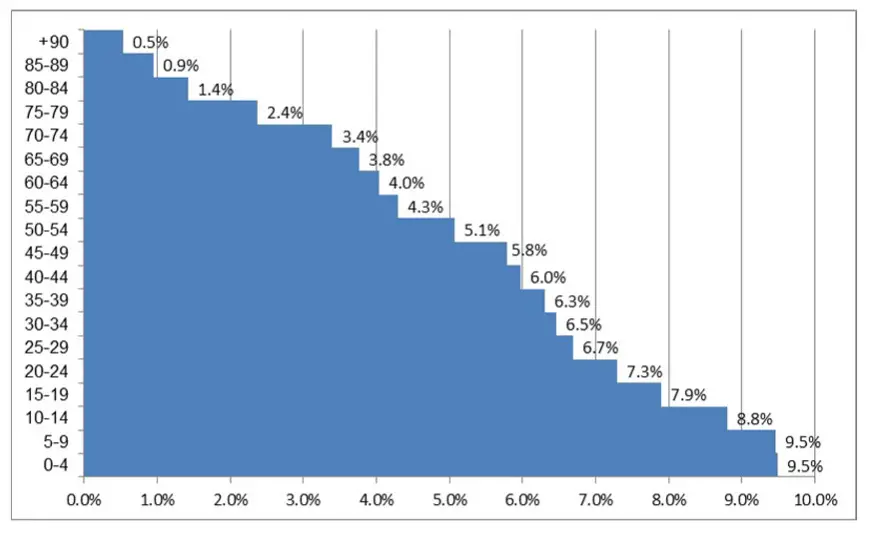
Israel’s population is considered relatively young compared with that of other Western countries.
As of 2024, 28% of the population was 0-14, while only 12% were older than 65. The OECD average is 18.5% (0-14) and 15% (65+). Israel’s average age, however, is getting older. In 2011, the average age was 29.5 years, compared with 27.6 in 2000. The average age worldwide is 28.4 years for men and 30.6 years for women.
As of 2023, 3,266,714 individuals (27.8%) were aged 0-18, 5,551,150 (47.3%) were aged 18-65, and 1,182,136 (10.1%) were over the age of 65. Additionally, 3,328 individuals were over 100 years old.
Israeli Population by Age (%)
2022
Life expectancy in Israel is among the highest in the world. According to data from the Central Bureau of Statistics (CBS), in the early 1970s, life expectancy for men was 70.1 years. A decade later, this figure rose to 72.1, and by 2000, it had reached 76.7 years. In 2025, the figure stands at 81.4 years.
Women have also seen an increase in life expectancy. In the early 1970s, women’s life expectancy was 73.4 years, rising to 75.7 in 1980. By 2000, the life expectancy for Israeli women had jumped to 81.9 years, and in 2025 it stands at 85.9 years. Israeli women ranked eighth, at 85.4 years compared with an OECD average of 83.8.
Israel’s infant mortality rate was 2.5 deaths per 1,000 live births, below the OECD average of 4.2.
In 2017, life expectancy for Arab women was 79.5 years, and for men, 77.4 years.
The World Health Organization issued a report in May 2016 concluding that, on average, people lived five years longer than in 2000. Israel was ranked 8th globally in life expectancy, higher than the United States, Canada, France, Russia, and other highly developed nations. Life expectancy in 2020 was 83.5 years for all Israelis, 84.9 for women, and 82 for men.
As of October 2025, Israel’s life expectancy has risen to 83.8 years, placing it fourth among OECD countries behind Switzerland, Japan, and Spain, according to new OECD data released by Israel’s Health Ministry. The report highlights a sharp increase from 2022 to 2023 in both men and women and attributes Israel’s success to effective public health policies, preventive care, and vaccination rates exceeding 90%. Despite investing only 7.6% of its GDP in health, Israel boasts one of the lowest preventable mortality rates in the OECD at 134 deaths per 100,000 and a low infant mortality rate of 2.7 per 100,000 births. Deaths from heart disease have also declined significantly. However, challenges remain, notably Israel’s relatively high smoking rate of 16%, linked to about 8,000 deaths annually.
Distribution
Israel’s population is unevenly distributed, with the most densely populated areas concentrated in the central and coastal regions.
The Tel Aviv District is the most densely populated, with 1,507,300 residents and a staggering 22,693 people per square mile.
Close behind, the Jerusalem District has 1,239,300 residents and a density of 4,912 people per square mile.
The Central District, home to 2,347,700 residents, follows with a density of 4,698 people per square mile.
The Haifa District, housing 1,124,400 residents, has a density of 3,368 people per square mile.
In contrast, the Northern District, with 1,542,100 residents, has a relatively lower density of 894 people per square mile.
The Southern District, with 1,422,700 residents, is the least densely populated, with just 259 people per square mile.
The Judea and Samaria District, with 478,600 residents, does not provide a specific density figure but indicates a more dispersed population than the central regions.
Birth & Marriage
In 2025, 183,678 babies were born in Israel, and the total fertility rate was 2.88 children per woman, more than twice the OECD average of 1.41. In 2024, 53,025 couples married and 16,499 divorced.
Israel had 3,029,300 private households and 2,362,900 nuclear families in 2025. The average household contained 3.17 people, compared with approximately 2.5 across the OECD.
The fertility rate for Jewish women has declined from 4.02 children per woman in 1951 to 3.06 in 2024.
Among Muslim women, there has been a significant decrease in fertility from 9.31 children per woman in 1960 to 2.75 in 2024.
Since 2018, fertility rates in Israel have declined, with the exception of a small increase during the COVID-19 pandemic. The fertility of Israeli Jewish women in 2018 exceeded that of Arab women for the first time. The rate among Jewish women living in Israel and in settlements in the West Bank was 3.05 compared to 3.04 for Israeli Arab women.
The overall fertility rate in Israel in 2018 was 3.17 children per woman. By 2022, it had dropped to 3.03. The declines in the Muslim (3.20 to 2.91), Druze (2.16 to 1.85), and Christian (2.06 to 1.68) communities were even more pronounced. By comparison, the average fertility rate in 2022 across all OECD member countries was 1.59, down from 1.65 in 2017.
Some 179,000 babies were born in the year since Rosh Hashanah 2024.
The average age at marriage for Israeli women in 2016 was 26.1 years, and the average age at first childbirth was 28.3 years. Teen births are uncommon in Israel, with births to women aged 19 and under accounting for 0.5% of national births during 2016.
Income
In 2025, the average monthly wage per salaried job for Israeli workers was NIS 13,884, up 3.2% in current prices from 2024. After adjusting for price changes, the average was virtually unchanged.
In 2023, average monthly household income was NIS 26,330 gross and NIS 21,606 net. Average monthly cash expenditure was NIS 14,823, while consumption expenditure, including housing services, averaged NIS 18,088. Women’s gross income averaged 61.7% of men’s among salaried workers and 50.9% among the self-employed.
In 2021, the average net household income was NIS 16,649, with monthly expenditures averaging nearly NIS 15,122. The average gross income of self-employed women was 54% of men's, and female employees earned, on average, 66% of men's salaries.
In the tech sector, the average salary in April 2023 was NIS 29,219 (approximately $8,140), up 5.4% from April 2022.
Between May 2022 and May 2023, the number of salaried jobs in the Israeli economy grew by 1.1%.
In 2025, Israel’s economy expanded by 3.1%, while GDP per capita rose by 1.7% to approximately $56,460 per person. The increase marked a return to modest per capita income growth after two consecutive years of decline and reflected a stabilization in living standards amid the broader economic recovery.
Sources: Israel Central Bureau of Statistics.
Maytal Yasur Beit-Or. Israel boasts highest fertility rate among OECD nations, Israel Hayom, (November 13, 2017).
Amir Alon. Nearing nine million: Israel in numbers on eve of 2018, YNet News (December 31, 2017).
Ofer Aderet. Israel’s Population Near Nine Million on Eve of 70th Independence Anniversary, Haaretz, (April 16, 2018).
Ilan Lazarovich, As new year approaches, Israelis say they are happy, healthy, Israel Hayom, (September 5, 2018).
“Israel.s population 8.972m on eve of 2019,” Globus, (December 31, 2018).
Judy Maltz, “Number of Russians Moving to Israel Sees Dramatic Rise, American Aliyah Figures Drop,” Haaretz, (December 27, 2018).
Zeev Klein, “Israel reaches another milestone as population crosses 9 million,” Israel Hayom, (May 2, 2019).
“Israel.s population tops 9 million as Jewish new year approaches,” Times of Israel, (September 26, 2019).
Maayan Jaffe-Hoffman, “Number Of Jews In Israel And Worldwide On The Rise – Reports,” Jerusalem Post, (September 27, 2019).
Ronny Linder, “New Report Shows Significant Discrepancy in Life Expectancy Between Israeli Cities,” Haaretz, (December 5, 2019).
Eytan Halon, “Israel.s Christian population grows to 177,000 citizens,” Jerusalem Post, (December 23, 2019).
“Israel.s population at 9,136,000 on the eve of 2020,” Jerusalem Post, (January 1, 2020).
Ofer Aderet, “For the First Time in Israel.s History, Jewish Fertility Rate Surpasses That of Arabs,” Haaretz, (December 31, 2019).
Worldometer.
“Ahead of 72nd Independence Day, Israeli population stands at 9.2 million,” Times of Israel, (April 26, 2020).
“Israel.s population up to 9.25 million, though growth rate, immigration down,” Times of Israel, (September 16, 2020).
U.S. State Department.
Moshe Cohen, “Jewish population at lowest percentage since founding of Israel,” Jerusalem Post, (April 12, 2021).
Ofer Aderet, “On Jewish New Year’s Eve, Israel’s Population Reaches 9.4 Million,” Haaretz, (September 5, 2021).
“Israel’s Christian community is growing, 84% satisfied with life here – report,” Times of Israel, (December 22, 2021).
“Israel’s population at nearly 9.5 million as it enters 2022,” Jerusalem Post, (December 30, 2021).
“Israel’s population nears 10 million, report,” Ynet, (September 20, 2022).
“Israel’s population approaches 9.7 million as 2022 comes to an end,” Times of Israel, (December 29, 2022).
Noam Fruchter, “Why does Israel fail to support Holocaust survivors?” Jerusalem Post, (January 20, 2023).
Meirav Cohen, “Holocaust Remembrance Day: How many survivors are living in Israel?” Jerusalem Post, (April 16, 2023).
“Israel’s Independence Day 2023,” Central Bureau of Statistics, (April 25, 2023).
“Average salary in Israel rises 5.3%,” Globes, (July 5, 2023).
“Israeli population rises to 9.795 million on Rosh Hashanah eve,” Times of Israel, (September 14, 2023).
Judy Siegel-Itzkovich, “Israeli Demography: Declining Fertility, Migration, And Mortality,” Jerusalem Post, (January 22, 2024).
Yaron Druckman, Gad Lior, Nir Tzadok, “Israel’s Population Reaches 10 Million: What Does This Mean for Us?” Ynet, (2024).
“Israel’s Independence Day 2025,” CBS, (April 28, 2025).
Judy Maltz, “‘Proof of a Thirst’: Percentage of Reform Jews in Israel Doubles in Recent Years,” Haaretz, (May 21, 2025).
“Israel in Figures - Rosh Hashana Selected Annual Data 2025,” CBS, (September 16, 2025). [Hebrew]
Yaron Drukman, “Israel’s population grows to 10.1 million on Rosh Hashanah eve despite record emigration,” Ynet, (September 17, 2025).
Diana Bletter, “Israelis’ life expectancy rises to 83.8, making it 4th among OECD countries,” Times of Israel, (October 20, 2025).
“In first, Israeli population growth said to drop below 1%; life expectancy also down,” Times of Israel, (December 31, 2025).
Zev Stub, “2025 saw sharp drop in immigration to Israel even as arrivals from Western nations surged,” Times of Israel, (December 29, 2025).
Oren Dori, “Israel’s economy grew 3.1% in 2025,” Globes, (February 16, 2026).
Mathilda Heller, “Surge in Aliyah of young, skilled olim despite wartime challenges, 22,522 moved to Israel in 2025,” Jerusalem Post, (June 28, 2026).
“Israel in Figures - Rosh Hashana Selected Annual Data 2026,” Israel Central Bureau of Statistics, (September 9, 2026) [Hebrew].
Graph - Israel Central Bureau of Statistics.