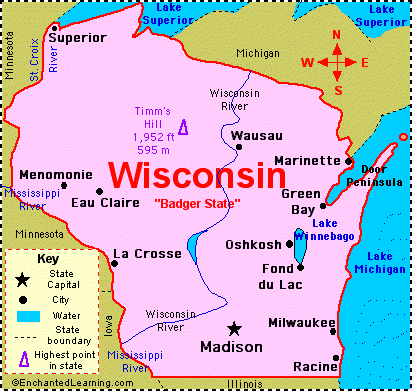
Wisconsin and Israel
Trade and Population Statistics
| Exports to Israel (2015) |
$83,060,997 |
| Percentage Change (2014-2015) |
-7.56% |
| Total Exports to Israel (1996-Present) |
$1,181,629,593 |
| Israel's Trade Partner Rank (2015) |
33 |
| Military Contracts with Israel (2015) |
$15,032,129 |
| Jewish Population (2015) |
34,700 |
| Jewish Percentage of Population |
0.8% |
Binational
foundation grants shared by Wisconsin and Israel
Grant recipients in
Wisconsin from U.S.-Israel binational foundations:
Germania Dairy Automation Inc.
Johnson Controls
Manpower, Inc.
Medical College of Wisconsin
Nicolet Biomedical Inc.
Nicolet Instrument Corp.
University of Madison
University of Wisconsin
University of Wisconsin Medical
USDA-ARS Agronomy/Horticulture Research Lab
Virent Energy Systems
Bilateral
Institutions top
Wisconsin Department
of Commerce Global Ventures, Israel - In
December 2010 the DOC officially announced plans to build and strengthen
bilateral ties with Israel which they hope to do through their Global
Ventures office. Currently, Governor Doyle has put out a formal Request
for Proposals (RFP) to solicit companies and researchers interested
in the development of joint Wisconsin-Israel R&D Partnerships. Learn
more about the RFP and the budding program, CLICK
HERE.
Committee for Economic
Growth of Israel - Founded
by by entrepreneur and Jewish philanthropist, Elmer Winter, at the request
of Israeli Prime Minister Yitzhak Rabin in 1976. CEGI was established
to help expand and grow trade between Israel and the state of Wisconsin,
in particular, and the entire US in general. It deals with business
promotion in both Wisconsin and Israel, much the same as the various
Chamber of Commerce. Learn more about CEGI, CLICK
HERE.
Cooperative
Agreements - "Memoranda of Understanding" top
In November 2009, Governor
Jim Doyle and Israeli Minister of Industry, Trade and Labor Benjamin
Ben-Eliezer signed a memorandum of understanding and a bilateral cooperative
trade agreement with the hopes of promoting collaboration and a strong
working relationship between Wisconsin and Israel in research and development.
In fostering this development, the Department of Commerce has partnered
closely with the Israeli Economic Mission to coordinate targeted investment
attraction and matchmaking events in areas of innovative technology.
Read a press release on this MOU and the 2010 RFP, CLICK
HERE.
Wisconsin Government Missions to Israel top
August 2011 - Congresswoman Gwen Moore
accompanied the 81-member Congressional delegation to Israel to learn
more about regional politics and the U.S.-Israel relationship.
November 2009 - Governor
Jim Doyle and Department of Commerce Secretary Aaron Olver led a delegation
from Wisconsin on a trade mission to Israel. The group arranged a number
of targeted investment meetings with Israeli firms who could benefit
by expanding into Wisconsin. During the trip, Gov. Doyle signed a cooperative
agreement with the Israel Ministry of Trade that was facilitated by
the DOC's Global Ventures office. See pictures from the mission, CLICK
HERE.
2005 - Congressman
Paul Ryan visited Israel as part of a large Republican Congressional
delegation trip facilitated by the American Israel Education Foundation,
a charitable organization associated with the American Israel Public
Affairs Committee. He and the other congressmen met with then-Prime
Minister Ariel Sharon and visited strategic sites in Jerusalem, as well
as Israel’s northern borders with Syria and Lebanon.
Partners
For Change
The U.S.-Israel relationship is based on the twin
pillars of shared values and mutual interests. Given this commonality of
interests and beliefs, it should not be surprising that support for Israel
is one of the most pronounced and consistent foreign policy values of the
American people.
It is more difficult to devise programs that capitalize
on the two nations' shared values than their security interests;
nevertheless, such programs do exist. In fact, these SHARED VALUE
INITIATIVES cover a broad range of areas, including the environment,
science and technology, education and health.
As analyst David Pollock noted, Israel is an advanced country with a population that surpassed eight million people in 2013 and a robust, dynamic economy that allowed it to join the Organization for Economic Cooperation and Development (OECD). Between 2005 and 2013, Israel has represented a larger market for U.S. exports than Saudi Arabia. Although Israel's citizenry make up just 3 percent of the total region's population, Israel accounts for 25 percent of American exports in the Middle East.
"It has also been one of the top 20 foreign direct investors in the United States since 2009," Pollock confirms. He adds that "$2.25 billion of the $3 billion in annual U.S. aid to Israel comes back via Israeli purchases of U.S. military equipment - and that is just 5 percent of the total bilateral trade each year."
Today's interdependent global economy requires that
trade policy be developed at the national and state level.
Many states have recognized the opportunity for realizing
significant benefits by seeking to increase trade with Israel. Wisconsin is one of 33 states that have cooperative
agreements with Israel.
In 2012, Wisconsin exported over $68,962,204 worth
of manufacturing goods to Israel. Since 1996, Wisconsin exports to
Israel have totaled more than $1,019,913,570 and Israel now ranks as Wisconsin’s
26th leading trade partner.
Additionally in 2012, Wisconsin received more than
$12,089,933 in foreign military financing (FMF) for US military aid
to Israel. Some of those companies that have received funding through FMF in 2012 or past years
include: Kearfott Guidance & Navigation in Milwaukee, Twin Disc Inc. in Racine and Therma-Stor LLC Boumatic in Madison.
Israel is certainly a place where potential business
and trade partners can be found. It can also be a source, however, for
innovative programs and ideas for addressing problems facing the citizens
of Wisconsin.
Israel has developed a number of pioneering education programs. For example, AICE introduced an innovative Israeli
peer tutoring program to North Carolina that educators adapted for use
in the United States. Now known as Reading Together, the program is
used in 28 states. The program is designed to help students achieve
reading fluency and is mostly used for children in second grade. The
hope is that with its implementation, increasing numbers of students
will perform at grade level or above.
A range of other exciting approaches to social problems
like unemployment, environmental protection and drug abuse have been
successfully implemented in Israel and could be imported for the benefit
of Americans.
The potential for greater cooperation with Israel for
the benefit of Wisconsin is limited only by the imagination.
Wisconsin Firms
Profit From Business With Israel
As the only country with free trade agreements with
both the United States and the European community, Israel can act as
a bridge for international trade between the United States and Europe.
Moreover, because of the deep pool of talent, particularly in high-technology
areas, Israel provides excellent investment opportunities. Some of the
nation's largest companies, such as IBM, Microsoft, Motorola, Intel
and McDonald’s have found that it is indeed profitable to do business
in Israel.
At least 180 Wisconsin companies have discovered the
benefits of doing business in Israel, including Nicolet, GE Medical
Systems, Manpower Inc. and Sunlite Plastics Inc.
Manpower Inc., a temporary help/staffing business based
in Wisconsin, has 35 offices in Israel. James Fromstein, senior Vice
President of Manpower Inc., said what attracted Manpower to do business
in Israel is the high level of education of Israelis and their aggressive
nature in structuring their economy. The company’s experience in
Israel has been “very positive.”
In April 2010, Milwaukee based A.O. Smith Corporation
entered into a strategic business cooperative agreement with Chromagen,
a leading manufacturer of solar water heating solutions located in Sha'ar
Ha'amakim in Israel, to develop advanced solar technology for water
heating applications. Under the agreement, A.O. Smith will become Chromagen's
exclusive marketer and distibutor in the USA and Canada of its solar
collectors for both residential and commercial use. Chromagen, with
estimated 2009 sales of $50 million, has two manufacturing operations
in Israel and distributes products in more than 35 countries worldwide.
A. O. Smith Corporation, with 2009 sales of $2.0 billion, is a global
leader applying innovative technology and energy-efficient solutions
to products marketed worldwide. The cooperation between these two powerhouse
companies will only mean greater opportunities for both Israel and the
USA. Read more about their partnership, CLICK
HERE.
Wisconsin benefits by importing from Israel as well
as exporting. GE Medical Systems has been exporting diagnostic medical
equipment to Israel since the 1950's. Aside from exporting devices used
for CTs, MRIs, X-Rays, and Ultrasounds, they also import medical nuclear
scanners manufactured in Israel. According to Tony Hahn of the International
Sales Department, “the business/medical clientele in Israel is
very experienced and there is a good business community.”
Nicolet Instrument Corporation has been doing business
in Israel for about fifteen years, says Bruce Jamison, area manager
for Nicolet in the Middle East and South Asia. The company has been
selling spectrometers used for analyzing chemical composition and materials
to Israel. Jamison says it’s a reasonable market for the size of
its population (roughly six million) and that, relative to other countries
in the area, doing business with Israel is easy.
One good way to break into the Israeli market is through
a joint venture with an Israeli company. Funding for such projects is
available from the Binational
Industrial Research and Development Foundation (BIRD). BIRD funds projects in 36 states and the District of
Columbia and hundreds of companies including AOL, GE, BP Solar, Texas
Instruments and Johnson & Johnson have benefitted from BIRD grants.
The United States and Israel established BIRD in 1977
to fund joint U.S.-Israeli teams in the development and subsequent commercialization
of innovative, nondefense technological products from which both the
Israeli and American company can expect to derive benefits commensurate
with the investments and risks. Most grant recipients are small businesses
involved with software, instrumentation, communications, medical devices
and semiconductors.
Since its inception, BIRD has funded more than 800
joint high-tech R&D projects through conditional grants totaling
more than $210 million. Products developed from these ventures have
generated more than $8 billion in direct and indirect revenues for both
countries and has helped to create an estimated 20,000 American jobs.
Dr. Eli Opper, the former Israeli chair of BIRD, has
said that BIRD is a strong pillar of US-Israel industrial
cooperation and that the extreme success of BIRD has
led Israel to adopt similar models of R&D with other countries.
At least four Wisconsin-based companies - Manpower,
Nicolet Instrument Corp., Germania Dairy Automation Inc. and Virent
Energy Systems - have taken advantage of the BIRD program,
and shared grants with Israeli partners totaling more than $700,000.
In the summer of 2010, BIRD awarded
more than $4.2 million in grants for joint development projects between
companies based in the United States and Israel in the areas of biofuels,
wind energy, solar energy and energy efficiency. Five different projects
awarded this funding will help address critical shared bilateral energy-related
goals, and will leverage private sector cost-share for a total project
value of $12.8 million. One of the projects awarded is based locally
in Wisconsin. HCL CleanTech Ltd., from Tel Aviv, Israel and Virent Energy
Systems, based in Madison, will jointly develop and test a process to
produce biogasoline from cellulosic non-food sources.
In 2011, Milwaukee-based technology company Johnson
Controls was awarded funding through the BIRD Foundation
to partner with EnVerid Systems to develop a novel air handling technology
for reducing energy consumption of HVAC (heating, ventilation, and air
conditioning, or the collective technology of indoor and automotive
comfort). This grant was part of over $8.1 million awarded by BIRD to nine new projects in December 2011 to companies throughout
the US and Israel.
Nicolet Instrument Corporation, a world leader in the
design, manufacture and marketing of instrumentation for assessing nerve,
muscle, hearing/vestibular, sleep, epilepsy and brain blood flow disorders,
teamed up with Isorad Ltd., an Israeli company that develops mid-infrared
fiberoptic materials. Their BIRD grant supported the
development of a fiberoptic chemical sensor to identify harmful chemical
materials in the environment and for the performance of safe quality
control analysis on toxic chemical products. Once this “FiberCell”
was developed, the two companies applied for another BIRD grant to develop a complete fiberoptic sampling system that could be
integrated with commercial infrared spectrometers.
Nicolet also partnered with Medoc Ltd., an Israeli-based
company that develops, manufactures and markets devices for the small
fibers of the peripheral nerve system. Medoc’s creation of a Thermal
Sensory Analyzer (TSA) is considered the best of its kind in the world.
Through a BIRD mini project, Medoc’s TSA device
has been modified into a compact accessory for Nicolet’s own diagnostic
system, the Nicolet Sensation, launched in 1996. Since their original
joint venture, the two companies have expanded their working relationship
into additional marketing efforts.
Germania Dairy Automation, Inc. has been the sole distributor
in North America of Afimilk, a milk meter and computerized dairy management
system, made by the kibbutz-based company Afikim. In 1996, the two companies
received a BIRD grant to create a milk component analyzer.
This product analyzes the different components of milk such as the amount
of butterfat and the somatic cell count, which indicates the level of
bacteria in milk. “Germania and Afikim already had a good working
relationship so we decided to go together on this project,” said
Germania’s general manager Robert Russell.
Scientific Innovations top
Wisconsin researchers are making scientific breakthroughs
and developing cutting-edge technologies in joint projects with Israeli
scientists thanks to support from the Binational
Science Foundation (BSF). BSF was established in 1972 to promote scientific relations
and cooperation between scientists from the United States and Israel.
The fund supports collaborative research projects in a wide area of
basic and applied scientific field for peaceful and non-profit purposes.
Since its inception, BSF has awarded some $480 million
through more than 4,000 grants in 45 states and the District of Columbia.
BSF-sponsored studies are highly successful
in achieving their two main goals: strengthening the US-Israel partnership
through science and promoting world-class scientific research for the
benefit of the two countries and all mankind. The BSF grants help extend research resources to achieve milestones that might
not otherwise be attainable; introduce novel approaches and techniques
to lead American researchers in new directions; confirm, clarify and
intensify research projects; and provide unmatched access to Israeli
equipment, facilities and research results that help speed American
scientific advances. BSF has documented no less than
75 new discoveries made possible by its research grants and counts 37
Nobel Prize and 19 Lasker Medical Award laureates among its joint partners.
The University of Wisconsin and its medical school
are among the institutions that have shared have shared with their counterparts
in Israel nearly $2.5 million in BSF grants awarded
since 1996 alone.
Professor John W. Valley is the chairman of the department
of geology and physics at the University of Wisconsin-Madison. In 1995
he received a BSF grant to do joint research with Professor
Matthews of Hebrew University in Jerusalem to study the geology of rocks
in Greece. Through this study they learned that the rocks of the Alpine
belt were once at sea level and then due to tectonic forces, such as
the formation of mountain belts, they were then buried 50 km. below.
Today these rocks are once again at the mountain surface. This discovery
has helped geologists to better understand the geological history of
Southern Europe. Practical applications resulting from this research
include exploration for metallic ore deposits as well as oil and gas
deposits. Valley has been to Israel twice and will likely go back when
Professor Matthews takes his sabbatical at the University of Wisconsin
next year. A postdoc who was also working with the two professors built
her own geochemistry lab at Hebrew University based on her experience
working with Valley and Matthews.
Professor Arthur B. Ellis of the University of Wisconsin
received a BSF grant in 1996. Since then he has been
working with the Weizmann Institute of Science to research chemical
sensoring. This consists of putting certain molecules on the surface
of semiconductors to create a sensor that can determine the presence
of other compounds and their concentration in the gas and liquid phase.
“This is basic scientific research,” said Ellis, “we
are not engineers so we don’t actually create the sensors, but
we do background research.” Professor Ellis has “had a very
positive experience” and said that “the professors at Weizmann
were very good colleagues [to work with] and had great ideas.”
University of Wisconsin Professor of Chemistry Robert
C. West has received several BSF grants and has been
collaborating with Israel since about 1988. Professor West works with
Professor Yitzchak Apeloig at the Technion in Haifa to research novel
types of multiple bonds to silicon. The team in Haifa does all of the
theoretical work and calculations behind the creation of new compounds
using the element silicon and then the scientists at Wisconsin do the
experimental and laboratory work to create new compounds. When comparing
the experience of collaborating with Israel to other countries, West
said that he has “never been so successful as [he has] been in
Israel.” Professor West has also been doing joint electrochemistry
research with James Becker at the Ben-Gurion University in Beersheva
for the past five years.
Agriculture Benefits top
In 1978 the United States and Israel jointly created
the Binational Agricultural
Research and Development Fund (BARD)
to help fund programs between US and Israeli scientists for mutually
beneficial, mission-oriented, strategic and applied research into agricultural
problems. Since its inception, BARD has funded more
than 1,000 projects in 45 states and the District of Columbia with a
total investment of more than $250 million. In 2000, an independent
and external economic review of 10 BARD projects conservatively
projected more than $700 million in revenue by the end of 2010, a number
which far outweighs the total investment in all BARD projects over its 33 year existence and helps to continually strengthen
the foundation.
Most BARD projects focus on either increasing agricultural
productivity, plant and animal health or food quality and safety and
have been influential in creating new technologies in drip irrigation,
pesticides, fish farming, livestock, poultry, disease control and farm
equipment. BARD funds projects in 45 states and the
District of Columbia and at present is beginning to administer collaborative
efforts between Australia, Canada and Israel as well. It is difficult
to break down the impact on a state-by-state basis, but overall, BARD-sponsored
research has generated sales of more than $500 million, tax revenues
of more than $100 million and created more than 5,000 American jobs.
Wisconsin institutions have shared grants worth more than $2 million
since 1979.
Professor Gary Splitter of the University of Wisconsin
is closer to his goals of finding a cure for T-cell leukemia and stopping
the Brucella Melitensis endemic thanks to his joint research under the
auspices of a BARD grant.
Professor Splitter has received BARD grants every few years since 1989 to study the bovine leukemia virus,
which is very similar to T-cell leukemia in humans. These viruses are
major problems in both countries—approximately 30,000 cattle in
Wisconsin alone are affected. Splitter is working with a collaborator
from the Israeli Veterinarian Institute, part of the federal laboratory,
to monitor the disease in Israel. Together they are trying to learn
why the virus persists in the host that eventually causes cancer.
Splitter and his Israeli colleagues are also studying
Brucella Melitensis, a bacterium which is currently a serious problem
in sheep, goats and cattle in Israel. These bacteria can be found in
the milk of these animals and transmitted to humans when they eat non-pasteurized
dairy products, which is extremely common in Israel. Because this disease
is not found in the U.S. anymore, going to Israel gives him a better
perspective of how the disease occurs worldwide. He can see the disease
up-close and talk to Bedouins, Israelis, Palestinians and kibbutzniks
who have been affected. Through this collaboration, Wisconsin and Israel
not only share data but also send reagents back and forth. Overall,
this joint research has been “very, very helpful,” said Professor
Splitter.
In a 2009 study supported by the BARD Fund, Professors Jess Reed and Mark Richards of the Department of Food
Science at the University of Wisconsin-Madison collaborated with a number
of Israeli scientists to investigate the effects of red wine, which
contains polyphenols - chemical substances found in many fruits, vegetables,
and their derived beverages believed to protect the body against some
common health problems - on the stomach's production and body's absorption
of malondialdheyde- an "advanced lipoxidation end product"
(ALE) that is involved in the thickening of arteries, a disease that
has been known to cause heart attack, stroke or even death.
Overall, the scientists' research results indicate
that while a diet consisting solely of red meat leads to an increase
in malondialdheyde levels, both in the stomach and in the blood's plasma,
the addition of wine to the meal helps maintain malondialdheyde at healthy
levels. These findings have led the scientists to suggest that the main
benefit of including polyphenol-rich fruits, vegetables and their derived
beverages, such as wine, in the diet as an integral part of the meal
arises from their ability to counteract the generation and absorption
of ALEs.
The collaborative team from Wisconsin and Israel has already published
two papers about this BARD-supported research, one
of which is being used to help secure future funding for related projects.
As Professor Richards attests, "Collaborating with Dr. Kanner [Volcani
Center, Israel] was a rewarding experience that has provided knowledge
that I utilize today in my own teaching and research." Without
the help of BARD, this research and the important findings
it entailed may never have been possible. To read more about the research
and the findings in layman's terms, please CLICK
HERE.
On another BARD project, Professor
Thomas German from the University of Wisconsin collaborates with researchers
from the University of California-Davis, University of Georgia and Hebrew
University in Jerusalem to find a way to control the tomato tospovirus.
This virus affects more than 1,000 species of plants including tomatoes
and peppers, causing billions of dollars of damage worldwide. This virus
is transmitted by a tiny insect that is hard to control because of its
enormous reproduction rate. These collaborators are studying the mechanism
by which the insects transmit the disease in hopes of finding new methods
to prevent it.
Wisconsin produces more than $100 million worth of
potatoes a year. Today, many U.S. seed potatoes are checked for debilitating
diseases, which may cause substantial economic losses, using a new test
developed by BARD grantees. Wisconsin, being a large
dairy farming state, also benefits from research done regarding inert
fats in the diet. Since BARD grantees proved that inert
fats in the diet are healthy, nutritional and also affect fertility,
they have become part of commercial rations in both the U.S. and Israel.
Madison's Saxon Homestead Farm invested in the Israeli-based company SCR that makes a system involving electronic cow collars that help farmers use data to determine when to breed them. Karl Klessig, whose family owns a dairy farm and cheese-making business in eastern Wisconsin, was the among the first American to invest, in 2009, in the SCR-sold system. This technology is just one example of how Israeli agricultural innovation is helping farmers around the United States, like previous inventions such as Netafim's drip irrigation that revolutionized crop growing.
Other
Cooperative Programs top
GE Medical Systems of Milwaukee received a grant from
the U.S.-Israel Science & Technology Commission for a joint project
with ISORAD to develop high performance imaging cameras for medicine.
Sister Cities: top
None.
UJA Partnership 2000
Communities:
WISCONSIN. . . . . .. . .. . . .. . . .. . . ..
.. . . . . . . . . . . . . . . . . . ISRAEL |
Milwaukee |
|
State
Contacts: top
Elmer Winter
Committee for Economic Growth in Israel
5301 Ironwood Rd.
Milwaukee, WI 53201
Tel. 414-961-1000
Fax. 414-906-7878
Email. [email protected]
Kenosha Jewish Welfare Fund
600 68th Place
Kenosha, WI 53143
Tel. 414-697-0300
Madison Jewish Community Council
6434 Enterprise Lane
Madison, WI 53719-1117
Tel. 608-278-1808
Fax. 608-278-7814
Milwaukee Jewish Council for Community Relations
1360 North Prospect Ave., 2nd Fl.
Milwaukee, WI 53202-3091
Tel. 414-276-7920
Fax. 414-276-7902
Email. [email protected]
Milwaukee Jewish Federation
1360 North Prospect Ave.
Milwaukee, WI 53202
Tel. 414-390-5700
Sherwin Pomerantz, Israel Director
Wisconsin Department of Commerce
c/o Atid EDI Ltd
Bldg. 2, Har Hotzvim, P.O. Box 45005
Jerusalem
Israel 91450
Tel. 25710199
Fax. 25710713
Email. [email protected]
URL: www.atid-edi.com/wisconsin.htm
Wisconsin Dept. of Development
123 West Washington Ave., P.O. Box 7970
Madison, WI 53707
Tel. 608-267-9330
Fax. 608-266-5551
|