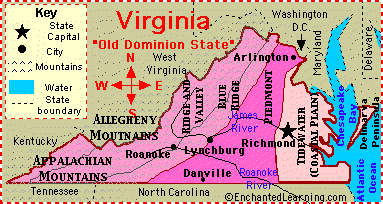
Virginia and Israel
Trade and Population Statistics
| Exports to Israel (2015) |
$59,187,697 |
| Percentage Change (2014-2015) |
-21.42% |
| Total Exports to Israel (1996-Present) |
$1,958,590,730 |
| Israel's Trade Partner Rank (2015) |
46 |
| Military Contracts with Israel (2015) |
$6,638,825 |
| Jewish Population (2015) |
141,700 |
| Jewish Percentage of Population |
2.25% |
Binational
foundation grants shared by Virginia and Israel
Grant recipients in
Virginia from U.S.-Israel binational foundations:
America Online Inc.
Bosch Telecom Inc.
CACI International
George Mason
GTE Spacenet
Kollmorgen Motion Technology Group
MedCPU
Naval Surface Weapons Center
Perceptronics
Pulse Communications Inc.
Rockwell Collins, Vision Systems International
University of Virginia
University of Virginia Medical School
Virginia Institute of Marine Sciences
Virginia Polytechnic University
Virginia Commonwealth University
Virginia State University
Virginia Tech
William & Mary
Bilateral
Institutions top
Virginia Israel Advisory
Board - The VIAB serves as the bridge for Israeli
companies who want to establish and/or expand their business in the
USA and locate in Virginia. We do this by opening doors using the right
contacts and providing the best support to help grow their U.S. business.
Due to its close proximity to Washington DC and the nation's seat of
power, the VIAB has made connecting with various government departments
and institutes much more easy and streamlined. Learn more, CLICK
HERE.
Virginia Israel Commission
- Established in 1986, the Virginia Israel Commission
is dedicated to investigating the cultural, educational and economic
development opportunities between the two states. In 1988 Gov. Gerald
Baliles signed a new agreement with Israel, but the commission's activities
waned. In 1995, Gov. George Allen created a new Virginia-Israel Partnership
to focus on promoting trade, art, education and general government.
Norfolk Program /
Tochnit Norfolk - Instituted in 2005 during Norfolk's
mayors trip to Israel, the Norfolk Program seeks to lure Israeli companies
to Norfolk, home to the worlds largest naval base, by using incentives
for collaboration between Israeli companies and Norfolk-based companies.
Israeli firms that take advantage of the program are eligible for financial
assistance of up to $1 million to defray such costs as moving, transport
and setup. Read more about the program, CLICK
HERE.
Virginia Israel Technology
Alliance - Located in Blacksburg,
VITAL was created out of a partnership between the Virginia Tech Corporate
Research Center (VTCRC) and the VIAB. Its mission is designed to help
post-incubator, commercial-ready Israeli companies build strong foundations
for growth in the U.S., and bring their products to market. The VITAL
program offers specialized assistance in business development, advanced
research for applications and marketing expertise. Learn more, CLICK
HERE.
US-Israel Business
Exchange - Based in Vienna,
US-IBEX is an independent, non-profit organization. It was created as
an initiative of the Embassy of Israel in collaboration with the Greater
DC business community in March 2000 to help Israeli and American companies
to create opportunities for collaboration. More info, CLICK
HERE.
Cooperative
Agreements - "Memoranda of Understanding" top
In September 2008, Governor Timothy
M. Kaine of Virginia and Ambassador of Israel Sallai Meridor signed
an agreement to strengthen bilateral cooperation between the Commonwealth
of Virginia and the State of Israel on private sector industrial research
and development. Under the agreement, an approved joint research and
development project will receive financial support from the governments
of Virginia and Israel, which will significantly reduce the costs that
Virginian and Israeli companies would normally have to incur if they
were to conduct the project independently. For more information, CLICK
HERE.
Virginia Government Missions to Israel top
July 2016 - During a 46-hour visit to Israel, Virginia Governor Terry McAuliffe and a delegation of Virginia leaders held over 20 high-level meetings with Israeli senior officials, and signed a Memorandum of Understanding (MOU) between Virginia Tech and the Israeli food and beverage company the Strauss Group, to collaborate on food technology research.
November 2011 - Governor Bob McDonnell
traveled to Israel with a delegation for four days in hopes of bringing
more Israeli business to Virginia. He is very optimistic that he will
soon be able to annouce new joint business ventures. While there, he
met with President Shimon Peres for an hour and was invited by Ofra
Strauss of Strauss Foods to a breakfast with leading Israeli industrialists.
Gov. McDonnell's delegation included the Secretary of Agriculture and
Forestry Todd Haymore, Secretary of Commerce and Trade Jim Cheng, First
Lady Maureen McDonnell, and senior officials from Virginia's Economic
Development Partnership, Virginia Tourism Corporation and the Virginia
Department of Agriculture and Consumer Services. To read more, CLICK
HERE.
August 2011 - House Majority Leader
Eric Cantor (R) was one of three senior members who led the 56-member
House Republican delegation of the politicians' recent trip to Israel.
The trip is the largest ever visit of U.S. lawmakers to Israel and gave
them and opportunity to learn about the US-Israel relationship and Israel's
national security. To read more, CLICK
HERE.
April 2009 - Governor Timothy Kaine,
Secretary of Commerce and Labor Patrick Gottschalk and Rick Richardson
of the Virginia Economic Development Partnership led a delegation to
the Middle East and Israel to promote Virginia to foreign businesses
and government leaders. In Israel, Gov. Kaine met with Prime Minister
Benjamin Netanyahu and President Shimon Peres as well as will leaders
of three business which had, earlier in 2009, invested heavily in infrastructure
within the state. Read more, CLICK
HERE.
September 2008 - Delegate Brian Moran
(Alexandria) and State Senator R. Creigh Deeds (Bath) took a ten day
mission to Israel with the aim of bolstering economic ties between Israel
and Virginia. The trip, sponsored by the Northern Virginia Jewish Community,
was planned to help the northern Virginia communities get further insight
into ways of expanding their businesses and companies into Israel as
well as attract Israeli companies and venture capital to Virginia. "We're
continuing the globalization of our economy," Del. Moran said.
"This technology can be a great benefit to [Virginia], particularly
with the struggling economy." Learn more about their mission, CLICK
HERE.
October 2007 - Attorney General Robert
F. McDonnell led a ten day mission to Israel where he took the opportunity
to learn about Israeli counter-terrorism efforts and other legal procedures
for dealing with terrorism suspects.
Partners
For Change
The U.S.-Israel relationship is based on the twin
pillars of shared values and mutual interests. Given this commonality of
interests and beliefs, it should not be surprising that support for Israel
is one of the most pronounced and consistent foreign policy values of the
American people.
It is more difficult to devise programs that capitalize
on the two nations' shared values than their security interests;
nevertheless, such programs do exist. In fact, these SHARED VALUE
INITIATIVES cover a broad range of areas, including the environment,
science and technology, education and health.
As analyst David Pollock noted, Israel is an advanced country with a population that surpassed eight million people in 2013 and a robust, dynamic economy that allowed it to join the Organization for Economic Cooperation and Development (OECD). Between 2005 and 2013, Israel has represented a larger market for U.S. exports than Saudi Arabia. Although Israel's citizenry make up just 3 percent of the total region's population, Israel accounts for 25 percent of American exports in the Middle East.
"It has also been one of the top 20 foreign direct investors in the United States since 2009," Pollock confirms. He adds that "$2.25 billion of the $3 billion in annual U.S. aid to Israel comes back via Israeli purchases of U.S. military equipment - and that is just 5 percent of the total bilateral trade each year."
Today's interdependent global economy requires that
trade policy be developed at the national and state level.
Many states have recognized the opportunity for realizing
significant benefits by seeking to increase trade with Israel. Virginia is one of 33 states that have cooperative
agreements with Israel.
In 2012, Virginia exported over $86,966,420 worth
of manufacturing goods to Israel. Since 1996, Virginia exports to
Israel have totaled more than $1,833,202,811 and Israel now ranks as Virginia’s
23rd leading trade partner.
Additionally in 2012, Virginia received more than
$7,217,791.71 in foreign military financing (FMF) for US military aid
to Israel. Some of those companies that have received funding through FMF in 2012 or past years
include: American Rheinmetall Munition, Inc. in Stafford, Ashbury International Group Inc. in Ruckersville and Computer Marketing Associates in Tysons Corner.
Israel is certainly a place where potential business
and trade partners can be found. It can also be a source, however, for
innovative programs and ideas for addressing problems facing the citizens
of Virginia.
Israel has developed a number of pioneering education programs. For example, AICE introduced an innovative Israeli
peer tutoring program to North Carolina that educators adapted for use
in the United States. Now known as Reading Together, the program is
used in 28 states. The program is designed to help students achieve
reading fluency and is mostly used for children in second grade. The
hope is that with its implementation, increasing numbers of students
will perform at grade level or above.
A range of other exciting approaches to social problems
like unemployment, environmental protection and drug abuse have been
successfully implemented in Israel and could be imported for the benefit
of Americans.
The potential for greater cooperation with Israel for
the benefit of Virginia is limited only by the imagination.
Virginia
Firms Profit From Business With Israel top
Because of Israel's unique status as the only
country with free trade agreements with both the United States and
the European Community, it can act as a bridge for international
trade between America and Europe. Moreover, because of the deep pool
of talent, particularly in high-technology areas, Israel provides
excellent investment opportunities. Some of the nation's largest
companies, such as IBM, Microsoft and Intel have found that it is
profitable to do business in Israel.
Indeed, more than 150 Virginia companies
have discovered the benefits of doing business in Israel,
including Philip Morris, Rubbermaid and Hamilton Beach.
One good way to break into the Israeli market is through
a joint venture with an Israeli company. Funding for such projects is
available from the Binational
Industrial Research and Development Foundation (BIRD). BIRD funds projects in 36 states and the District of
Columbia and hundreds of companies including AOL, GE, BP Solar, Texas
Instruments and Johnson & Johnson have benefitted from BIRD grants.
The United States and Israel established BIRD in 1977
to fund joint U.S.-Israeli teams in the development and subsequent commercialization
of innovative, nondefense technological products from which both the
Israeli and American company can expect to derive benefits commensurate
with the investments and risks. Most grant recipients are small businesses
involved with software, instrumentation, communications, medical devices
and semiconductors.
Since its inception, BIRD has funded more than 800
joint high-tech R&D projects through conditional grants totaling
more than $210 million. Products developed from these ventures have
generated more than $8 billion in direct and indirect revenues for both
countries and has helped to create an estimated 20,000 American jobs.
Dr. Eli Opper, the former Israeli chair of BIRD, has
said that BIRD is a strong pillar of US-Israel industrial
cooperation and that the extreme success of BIRD has
led Israel to adopt similar models of R&D with other countries.
At least seven Virginia-based companies — America
Online, Bosch Telecom, GTE Spacenet, CACI International, Kollmorgen
Motion Technology Group, Perceptronics and Pulse Communications —
have shared BIRD grants with Israeli firms worth nearly
$3.2 million.
Glenn Sacra, President of GTE Spacenet International
Corp., wrote in the 1991 BIRD annual report: “GTE
Corporation, a $21.4 billion multinational company, is among the world's
telecommunications giants. GTE Spacenet, a subsidiary...with satellite-based
telecommunications experience in more than 50 countries, accepted a
unique opportunity with Gilat Communications Systems Ltd. in 1988-89
to commence joint development of a new class of satellite communications
systems.”
The BIRD Foundation's encouragement
and support were vitally important in bringing GTE Spacenet and Gilat
together. Peter Nielson, from GTE Spacenet's marketing group, noted
that large companies are sometimes reluctant to work with smaller companies,
but BIRD reduces the risk and in this case helped promote
a very good investment.
The companies developed a revolutionary data communications
network that is ideal for high volume data transactions such as check
and credit card authorization, reservation booking, inventory control
and ATM transactions. The project was so successful, BIRD awarded the companies additional support to develop a new generation
of ultra-small aperture terminals.
In addition to the BIRD projects,
GTE Spacenet does a great deal of business in Israel related to earth
stations and telecommunications.
Medical Electronic Systems (MES) Ltd., an Israeli manufacturer
of medical electronics focusing on male infertility, has teamed with
Progeny Systems LLC, a U.S. veterinary instrument company specializing
in the application of high technology information solutions to agriculture.
The two companies are jointly developing a next-generation system for
sperm analysis both for the human fertility market as well as for the
animal food production market. The goal of the project is for this new
analytical approach to set a new standard in the human and veterinary
markets. The innovative Sperm Quality Analyzer will offer a more reliable,
simple-to-use and inexpensive solution than exists today for evaluation
of sperm quality. In addition, the application of new hardware and software
techniques will increase market penetration of instruments and disposable
kits in both the human and veterinary markets.
This year, InSightec Ltd. (Israel) and Focused Ultrasound Surgery Foundation (Virginia) received funding from BIRD to develop jointly non-invasive brain surgery for movement disorders.
Scientific
Innovations top
Virginia researchers are making scientific breakthroughs
and developing cutting-edge technologies in joint projects with Israeli
scientists thanks to support from the Binational
Science Foundation (BSF). BSF was established in 1972 to promote scientific relations
and cooperation between scientists from the United States and Israel.
The fund supports collaborative research projects in a wide area of
basic and applied scientific field for peaceful and non-profit purposes.
Since its inception, BSF has awarded some $480 million
through more than 4,000 grants in 45 states and the District of Columbia.
BSF-sponsored studies are highly successful
in achieving their two main goals: strengthening the US-Israel partnership
through science and promoting world-class scientific research for the
benefit of the two countries and all mankind. The BSF grants help extend research resources to achieve milestones that might
not otherwise be attainable; introduce novel approaches and techniques
to lead American researchers in new directions; confirm, clarify and
intensify research projects; and provide unmatched access to Israeli
equipment, facilities and research results that help speed American
scientific advances. BSF has documented no less than
75 new discoveries made possible by its research grants and counts 37
Nobel Prize and 19 Lasker Medical Award laureates among its joint partners.
Institutions in Virginia have shared with their counterparts
in Israel nearly $1.8 million in BSF grants awarded
since 1996 alone. Those that have benefitted from the program include
the University of Virginia, University of Virginia Medical School, Virginia
Commonwealth, Virginia State, Virginia Tech and William & Mary.
The world's food supply is limited by the available
fertilizer, according to Prof. Dennis Dean, a microbiologist at Virginia
Tech. Working under a BSF grant, he is trying to understand
the enzyme involved in the mechanism by which nitrogen is converted
to ammonia. The ultimate goal is to improve the biological process so
that fertilizer can be produced more cheaply and without the use of
fossil fuels. "If the fertilizer can be controlled so that more
goes directly to the plant, it helps reduce pollution," he says.
Dean is "delighted" with the
collaboration, which gives him access to new information about
proteins. "The Weizmann Institute in Rehovot has developed a
technique for looking at proteins that Virginia does not have,"
he said.
Gary Long is also a professor at Tech who is
working with scientists at Weizmann. He is interested in
understanding how heavy metals interact with the environment and,
more specifically, groundwater. In Virginia, a significant amount of
water comes from wells, he says, and it is important to filter out
particulates. Israel has developed a sampling device that collects
water and colloidal materials and allows environmental engineers to
get a better look at metal concentrations in water. The tool is
especially useful in locating industrial spills in a scientific and
cost-effective manner.
According to Long, the Israelis were interested in
measuring the water quality of the coastal aquifer around Herzliya,
which could be vital to the nation's security if the peace process
alters their access to other sources. Herzliya, Long adds, is similar
to the West Coast, particularly Los Angeles, which relies on
aqueducts for its water. "It is therefore important to know
about contamination of underground water sources," he says.
Long adds that he has excellent relations with his
collaborators and considers Weizmann's scientists "the best in
the world." He also believes the grant was important. "BSF allowed us to verify our research; otherwise, it would have been another
unproven technology."
Less tangible benefits come in fields like mathematics.
Prof. Charles Johnson of William & Mary believes BSF plays an important role in supporting "extraordinarily high quality"
math projects and helping to insure a flow of top mathematicians to
the university. Johnson finds it extremely useful to talk to someone
with a different point of view. "I get more things done and pursue
ideas I wouldn't otherwise be able to do," he says.
In 2010, a Virginia-based technology company called
Cupron that has offices in Herzliya,
Israel sent its Cupron Enhanced socks to the Chilean miners on day 36
of their entrapment in the San Jose copper-gold mine in the Atacama
Desert. The socks helped the miners fight foot fungus and their foot
symptoms significantly improved or were resolved within four to seven
days after being rescued.
Virgnina company Appalacian Biofuels opened a new production facility in Russel County, Virginia in November 2014 that will use an enzyme manufactured and developed in Haifa to produce biodiesel.
ImmunArray, based out of Richmond Virginia and Rehovot Israel was awarded a $300,000 grant from the NFL's Head Health Challenge in late 2014. The company is a developer of a breakthrough microchip technology that detects certain anti-bodies in the human bloodstream.
Virginia based Lockheed Martin, and Yissum Research Development Company based out of the Hebrew University of Jerusalem signed an agreement in late 2014 to conduct collaborative research in different scientific fields.
Agriculture
Benefits top
In 1978 the United States and Israel jointly created
the Binational Agricultural
Research and Development Fund (BARD)
to help fund programs between US and Israeli scientists for mutually
beneficial, mission-oriented, strategic and applied research into agricultural
problems. Since its inception, BARD has funded more
than 1,000 projects in 45 states and the District of Columbia with a
total investment of more than $250 million. In 2000, an independent
and external economic review of 10 BARD projects conservatively
projected more than $700 million in revenue by the end of 2010, a number
which far outweighs the total investment in all BARD projects over its 33 year existence and helps to continually strengthen
the foundation.
Most BARD projects focus on either increasing agricultural
productivity, plant and animal health or food quality and safety and
have been influential in creating new technologies in drip irrigation,
pesticides, fish farming, livestock, poultry, disease control and farm
equipment. BARD funds projects in 45 states and the
District of Columbia and at present is beginning to administer collaborative
efforts between Australia, Canada and Israel as well. It is difficult
to break down the impact on a state-by-state basis, but overall, BARD-sponsored
research has generated sales of more than $500 million, tax revenues
of more than $100 million and created more than 5,000 American jobs.
Virginia institutions have shared grants worth more
than $2.4 million since 1979. Virginia Tech and Virginia State are among
those that have received significant funding through BARD.
The Virginia State project focused on ways to improve
the aquaculture potential of hybrid striped bass. According to Prof.
Scott Newton, Israel developed a diet to help young fish survive and
thereby increase the number available for possible export. If the diet
works, it could be manufactured in Virginia and marketed on the east
coast.
In February 2011, Professor Eric Hallerman, of Virginia
Tech, published the results of his 3-year collaborative study with scientists
at the Hebrew University in Jerusalem and at the Natioanl Center for
Cool and Cold Water Aquaculture in Leetown, West Virginia that was facilitated
by BARD funding. The original goal of the project was
to provide scientific and technical basis for initiating certain breeding
protocals in the common carp to make the fish more resistant to viral
disease.
Professor Hallerman's research was incredibly important
because the common carp is one of the most widely farmed freshwater
fish species in the world. Additionally, edible carp is second only
to tilapia in Israeli aquaculture production and ornamental carp (koi)
is an important product in both the US and Israel. In recent years,
the carp industry worldwide has suffered enormous economic damage due
to a viral disease caused by Cyprinid herpes virus 3 (CyHV-3). The BARD-supported
research was important to finding a sustainable solution to this problem
that will lead to the establishment of a genetic improvement program
for the fish.
For such an important and timely project such as this,
it was of utmost importance that all the researchers could work well
together and complement each others skills. BARD facilitated
excellent communication between the groups in Israel and the United
States and the research was was greatly promoted by this good exchange
of materials, practices and theory. Overall, the collaboration led to
the publication of three joint studies in peer reviewed journals, one
that has been submitted for publication and yet another one that is
in the process of preparation in order to be submitted for publication.
To read more about this project, CLICK
HERE.
BARD has also supported several projects
at Virginia Tech related to the poultry industry. One, for example,
examined factors that determine the rate at which chickens lay eggs.
Israel has developed a DNA fingerprinting method that
Prof. Ann Dunnington was using under another BARD grant
to identify specific traits in chickens. The idea is to develop the
ability to screen the DNA so that producers can breed chickens with
the traits consumers want, such as less fat.
Prof. Paul Siegel has worked on a number of BARD-sponsored
projects at Tech and gives high grades to BARD. "It
wouldn't have been possible to do the research without the Foundation's
support." He also lauds his Israeli counterparts as "first-rate
scientists, doing first-class research."
Some of the benefits to Virginia from BARD research are more indirect. For example, BARD grantees
have developed techniques to help preserve the color, taste and texture
of apples, one of the State's important crops.
A team of agricultural economists from the University
of Maryland and University of California found that the economic benefits
of just five projects — related to cotton, pecans and solarization
— exceeded all U.S. investment in BARD.
It is difficult to break down the impact on a state-by-state
basis, but, overall, BARD-sponsored research has generated
sales of more than $500 million, tax revenues of more than $100 million
and created more than 5,000 American jobs.
Other Cooperative
Programs top
In October 2012, the Virginia Israel Advisory Board ran a three-day
business development program called "Gateway USA: Defense &
Homeland Security" in Virginia to help Israeli companies enter
the US market. During the intensive program, companies benefited from
interactive development meetings with specific US companies and other
top experts. To learn more, CLICK
HERE.
Sister
Cities: top
None.
UJA Partnership 2000
Communities:
State
Contacts: top
Jewish Federation of Richmond
5403 Monument Ave., P.O. Box 17128
Richmond, VA 23226
Tel. 804-288-0045
Zvi Yanai (Turbo)
Shoval-Saar Ltd
POB 1642
Caesarea 38900
Tel. 06-626-0629
Fax. 06-626-3686
Email: [email protected]
United Jewish Community of the Virginia Peninsula
2700 Spring Rd.
Newport News, VA 23606
Tel. 804-930-1422
Fax. 804-872-9532
Email. [email protected]
Web. http://www.ujcvp.org/
United Jewish Federation of Tidewater
5000 Corporate Woods Drive, Suite 200
Virginia Beach, VA 23462
Tel. 757-965-6100
Fax. 757-965-6102
Email. [email protected]
Web. www.jewishVA.org
Ralph Robbins
Executive Director
Virginia-Israel Advisory Board
CIT Tower, Suite 107
Herndon, VA 20170-4200
Tel. 703-481-7494
Fax. 708-481-7498
Email. [email protected]
Web. http://vaisrael.vipnet.org/
|