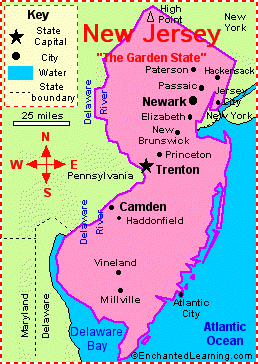
New Jersey and Israel
Trade and Population Statistics
| Exports to Israel (2015) |
$776,475,044 |
| Percentage Change (2014-2015) |
+4.76% |
| Total Exports to Israel (1996-Present) |
$14,297,998,484 |
| Israel's Trade Partner Rank (2015) |
13 |
| Military Contracts with Israel (2015) |
$42,503,534 |
| Jewish Population (2015) |
484,600 |
| Jewish Percentage of Population |
7.2% |
Binational
foundation grants shared by New Jersey and Israel
Grant recipients in
New Jersey from U.S.-Israel binational foundations:
Aqua
Products Inc.
AT&T Labs
Ballantine Labor, Inc.
Bell Laboratories
Lucent Technologies
Bell Telephone Labs
Bogen Communications Inc.
Cantar / Polyair Corp.
Covanta Energy
Decision Systems Inc.
Educational Tech. Inc.
ElectroCatheter Corp.
Enforsys, Inc
Exxon Res & Eng Res Lab
Fairleigh Dickinson
FMC Corporation
General Instrument Corp.
Geotek Communications, Inc.
IDT Corp.
Integrated Network Corp.
Integrated Photonics Comp. Rsch.
JDS Uniphase Corp.
New Jersey Inst. of Technology
New Jersey Medical School
OnPath
O.P.T. Industries Inc.
|
Orthofeet Orthotic Sys.
Pharmacopeia, Inc.
PrenticeHall Software
Princeton
Princeton Applied Research
Princeton Instruments
Princeton Video International Inc.
Quest Diagnostics, Inc.
RAD Data Commun. Inc.
Roche Inst. of Molecular Biology
Rutgers University
Rutgers Medical School
Sharplan Lasers Inc.
Software Center Inc.
Syllogy Corp.
TASCO Electronic Inc.
TASCO Inc.
Telenex Corp.
Teleos Communications Inc.
University of Medicine & Dentistry
Universal Sonics
Vestcom International, Inc.
|
Bilateral
Institutions
New Jersey-Israel
Commission - Established
in 1988 by a state Executive Order, the NJIC fosters and enhances the
relationship between New Jersey and the State of Israel with regard
to economic development and bi-lateral trade, education and culture
and tourism. It is comprised of 125 members appointed by the Governor
and 8 members of and appointed by the Legislature. The Commission operates
out of the New Jersey Commerce & Economic Growth Commission. Learn
more about the NJIC, CLICK
HERE and read the updated, Executive Order extending the commission
through January 2012 - CLICK
HERE.
New Jersey Department
of Commerce and Economic Development Israel Office - In
1994, the New Jersey DCED officially opened a branch in the Israeli
city of Ra'anana, a sister city of the New Jersey MetroWest community.
The office has successfully negotiated tens of economic schemes between
New Jersey and Israel, principally in the high-tech arena. Several American-based
companies working with Israel have relocated to New Jersey, in order
to enjoy the benefits available through these offices. Learn more about
the NJDCED's Israel office, CLICK
HERE.
Cooperative
Agreements - "Memoranda of Understanding"
Representatives from Rutgers University, Choose NJ, the New Jersey State Government, and Israel's Tel-Hai College Economic Development Taskforce met in New Jersey on September 21, 2015, to discuss a joint program between Rutgers and Tel-Hai Universities. At the end of the meeting the officials signed a Memorandum of Understanding, launching the New Jersey-Israel Health, Functional, Medical Foods Alliance. Director of the Rutgers food innovation center, Lou Cooperhouse, explained that the partnership is based on principles of scientific research and academic cooperation, public policy, entrepreneurship training, corporate research and development, student cooperation, and community health. To read more about the MOU, CLICK HERE.
In October 2003 Governor James McGreevey
and Vice Prime Minister Ehud Olmert of the State of Israel signed a
Memorandum of Understanding officially declaring collaboration in the
Life Sciences. This collaboration was enhanced a year later when a strategic
partnership between the BIRD foundation and the New Jersey-Israel Commission
was cemented in a number of key life sciences research and development
sectors. Read more about the MOU, CLICK
HERE.
In November 1996 a slew of memoranda
were signed between the state of New Jersey and Israel: :
- Memorandum of Intent Concerning a Joint Israel-New
Jersey Program to Promote the Establishment of Environmental Management
Systems. Read the MOI, CLICK
HERE.
- Memorandum of Understanding Between The Commission on Science and
Technology of the State of New Jersey and The Ministry of Science
of the State of Israel - The New Jersey-Israel Cultural Cooperation
Committee Memorandum of Intent
- Declaration of Mutual Intent Concerning Cooperation for the Advancement
of the Competitiveness of Their Industries and Industrial Research
and Development.
New Jersey Government Missions to Israel
April 2012 - Govornor Chris Christie
made his first official overseas trip to Israel in a four-day trade
and diplomacy mission, accompanied by a delegation of 14 business and
Jewish leaders. The mission is called "Jersey to Jerusalem: economic
growth, diplomacy, observance." Gov. Christie met with Israeli
Prime Minister Benjamin Netanyahu to discuss the recent changes across
the Middle East, the threat from Iran, and the diplomatic and economic
ties between the state of New Jersey and Israel. During the trip, Gov.
Christie said that "This is my first visit abroad as governor and
there was never any question of where we would come first, so I'm glad
we did." To read more about Gov. Christie's mission, CLICK
HERE.
July 2008 - Governor Jon Corzine made his first official visit to Israel. On the
mission, Gov. Corzine focused on identifying new opportunities to foster
trade, investment, commercial, and cultural relationships between New
Jersey and Israel. During the four day trip, Corzine met with numerous
high ranking Israeli government officials and key business leaders to
explore partnership opportunities in such industries as stem cell research,
alternative energy, green technologies, and research and development
in high-tech fields. Read more about Gov Corzine's mission, CLICK
HERE.
April 2000 - Governor
Christine Whitman made a special visit to Raanana for the ceremony bestowing
honorary citizenship of the City of Raanana on Mr. Shimon Peres, Minister
for Regional Cooperation. As a result of that visit, during which Governor
Whitman and Mayor Bielski discussed anti-violence initiatives, Raanana
hosted a delegation in September 2000, headed by the Secretary of State
for New Jersey, DeForest “Buster” Soaries. Read more about
this trip and others, CLICK
HERE.
Partners
For Change
The U.S.-Israel relationship is based on the twin
pillars of shared values and mutual interests. Given this commonality of
interests and beliefs, it should not be surprising that support for Israel
is one of the most pronounced and consistent foreign policy values of the
American people.
It is more difficult to devise programs that capitalize
on the two nations' shared values than their security interests;
nevertheless, such programs do exist. In fact, these SHARED VALUE
INITIATIVES cover a broad range of areas, including the environment,
science and technology, education and health.
As analyst David Pollock noted, Israel is an advanced country with a population that surpassed eight million people in 2013 and a robust, dynamic economy that allowed it to join the Organization for Economic Cooperation and Development (OECD). Between 2005 and 2013, Israel has represented a larger market for U.S. exports than Saudi Arabia. Although Israel's citizenry make up just 3 percent of the total region's population, Israel accounts for 25 percent of American exports in the Middle East.
"It has also been one of the top 20 foreign direct investors in the United States since 2009," Pollock confirms. He adds that "$2.25 billion of the $3 billion in annual U.S. aid to Israel comes back via Israeli purchases of U.S. military equipment - and that is just 5 percent of the total bilateral trade each year."
Today's interdependent global economy requires that
trade policy be developed at the national and state level.
Many states have recognized the opportunity for realizing
significant benefits by seeking to increase trade with Israel. New Jersey is one of 33 states that have cooperative
agreements with Israel.
In 2012, New Jersey exported over $803,544,160 worth
of manufacturing goods to Israel. Since 1996, New Jersey exports to
Israel have totaled more than $12,696,121,218 and Israel now ranks as New Jersey’s 5th leading trade partner.
Additionally in 2012, New Jersey received more than
$45,704,041 in foreign military financing (FMF) for US military aid
to Israel. Some of those companies that have received funding through FMF in 2012 or past years
include: Diesel Engineering in Englewood Cliffs, Radbit Computers in Mahwah and Marine Electric Systems in South Hackensack.
Israel is certainly a place where potential business
and trade partners can be found. It can also be a source, however, for
innovative programs and ideas for addressing problems facing the citizens
of New Jersey.
Israel has developed a number of pioneering education programs. For example, AICE introduced an innovative Israeli
peer tutoring program to North Carolina that educators adapted for use
in the United States. Now known as Reading Together, the program is
used in 28 states. The program is designed to help students achieve
reading fluency and is mostly used for children in second grade. The
hope is that with its implementation, increasing numbers of students
will perform at grade level or above.
A range of other exciting approaches to social problems
like unemployment, environmental protection and drug abuse have been
successfully implemented in Israel and could be imported for the benefit
of Americans.
The potential for greater cooperation with Israel for
the benefit of New Jersey is limited only by the imagination.
New Jersey
Honors Israel's 60th top
June 2008 - The New Jersey Legislature expressed the state’s
strong friendship with the State of Israel by passing Senate Concurrent
Resolution No. 71. The Senate resolution congratulated Israel on its
60th anniversary of independece from the United Kingdom and highlighted
the state’s historical ties to the Jewish people, the state’s
vibrant trading relationship with Israel. New Jersey and Israel share
a robust friendship built on economic cooperation and common values.
The resolution states, “Since its establishment, the modern State
of Israel has rebuilt a nation, forged a new and dynamic society, and
created a unique and vital economic, political, cultural and intellectual
life,” and also adds that, "The New Jersey- Israel relationship
has blossomed in the area of economic, cultural, technological and people
to people exchanges through the agencies of mutual cooperation such
as the New Jersey- Israel Commission to the benefit of the citizens
of each sovereign entity." Israel is also one of New Jersey’s
top trading partners. Since 1996, Israel has purchased over $11 billion
in goods and services from the Garden State. The two have also shared
millions of dollars in binational grants, supporting their respective
universities as they strive to make new technological and medical advances.
This resolution joined similar resolutions also passed in Georgia, South
Carolina, Tennessee, North Carolina and Mississippi. Read the joint
declaration, CLICK
HERE.
New Jersey Firms
Profit From Business With Israel
As the only country with free trade agreements with
both the United States and the European community, Israel can act as
a bridge for international trade between the United States and Europe.
Moreover, because of the deep pool of talent, particularly in high-technology
areas, Israel provides excellent investment opportunities. Some of the
nation’s largest companies, such as IBM, Microsoft, Motorola, Intel
and McDonald’s have found that it is indeed profitable to do business
in Israel.
More than 700 New Jersey companies have discovered
the benefits of doing business in Israel, including American Gas and
Chemicals, Ace Locksmith, Johnson and Johnson and Hewlett Packard.
American Gas and Chemicals has been doing business
with Israel for more than 10 years. The company supplies private companies
in Israel with oxygen leak detectors used in aircraft. American Gas
and Chemicals also buys products from Israel used in leak testing. These
leak detectors are primarily used to protect people and facilities.
Thanks to inquiries made via the company’s web site, more business
is being generated than 10 years ago. “The Israeli market is a
market that we should explore more,” says Jerry Anderson, President
of American Gas & Chemicals. “We should also import more because
there are a lot of products in Israel that we don’t take advantage
of.” Anderson added, “Israel has been very easy to deal with,
more so than other countries where English isn’t as widely used.
That’s certainly an advantage.”
One good way to break into the Israeli market is through
a joint venture with an Israeli company. Funding for such projects is
available from the Binational
Industrial Research and Development Foundation (BIRD). BIRD funds projects in 36 states and the District of
Columbia and hundreds of companies including AOL, GE, BP Solar, Texas
Instruments and Johnson & Johnson have benefitted from BIRD grants.
The United States and Israel established BIRD in 1977
to fund joint U.S.-Israeli teams in the development and subsequent commercialization
of innovative, nondefense technological products from which both the
Israeli and American company can expect to derive benefits commensurate
with the investments and risks. Most grant recipients are small businesses
involved with software, instrumentation, communications, medical devices
and semiconductors.
Since its inception, BIRD has funded more than 800
joint high-tech R&D projects through conditional grants totaling
more than $210 million. Products developed from these ventures have
generated more than $8 billion in direct and indirect revenues for both
countries and has helped to create an estimated 20,000 American jobs.
Dr. Eli Opper, the former Israeli chair of BIRD, has
said that BIRD is a strong pillar of US-Israel industrial
cooperation and that the extreme success of BIRD has
led Israel to adopt similar models of R&D with other countries.
Many New Jersey companies, including Princeton Video
International, IDT Corp., Bogen Communications, Telenex Corporation
and Universal Sonics, have taken advantage of this opportunity to reduce
the risk of new ventures and tap into the deep pool of Israeli talent
through the BIRD program. These companies and others
in New Jersey have shared over $5.28 million worth of BIRD grants with Israeli firms since the program started.
In the summer of 2008 the New Jersey-Israel Commission
and BIRD renewed their partnership and representation
agreement to promote collaboration between New Jersey and Israeli companies
who jointly develop and commercialize products based on innovative,
novel technologies. Under the collaborative agreement, the New Jersey-Israel
Commission serves as the BIRD Foundation’s official
representative for the state. This designation allows the commission
to work toward creating strategic commercial ties between New Jersey
and Israeli companies through financial support on behalf of the BIRD Foundation to those who qualify. Said then-Governor Corzine, “Since
2004, this collaboration has enhanced the state’s relationship
with Israel as significant global trading partners and places particular
emphasis on New Jersey’s strength as a foremost leader in research
and development. The agreement will continue to cultivate new opportunities
to form strategic commercial ties to advance our strongest industry
sectors. Read more about this research, CLICK
HERE.
Bogen Communications created a call interceptor with
Artuv Communications and Software. Bogen was referred to Artuv through
another Israeli company they did business with and the collaboration
has been extremely successful. The product, now on the market, gives
the user the option to store a message or has the ability to bypass
the unit by hitting any digit on the keypad. The call interceptor also
gives the user the option to record both a day and a night message that
can be used, for example, during the work day or after hours. The system
catches a call as soon as it is entered, plays the greeting and allows
users to reach other lines by punching in the extension. “All in
all the collaboration worked out pretty good,” said John Veneziali,
an application engineer at Bogen. “Artuv worked mainly on the software
while Bogen tackled the hardware issues. If we found a bug, we would
go to Artuv for feedback. Overall, this was very successful,” added
Veneziali.
Telenex Corporation also had a very successful collaboration
with TTI of Israel. Together they produced what is called an SS7 Surveillance
System. Prior to the grant, both companies had products that were not
marketable by themselves. TTI had a network management server application
and Telenex had the hardware that physically connected to the telephone. BIRD sponsored the production of the API Programming
Interface that allowed both products to interact with each other. The
result, the SS7 Surveillance System, which determines if the line being
called is busy or answered. In addition, it allows the phone company
to determine fraud, keep call data records, perform diagnostics and
control billing. “The product lends itself to any of these applications
depending on what the customer wants,” said Dan Guzik, director
of the 7-View Product.
This product, which has been on the market for the
past three to four years, is sold to telephone companies throughout
the world. The collaboration “worked fantastic and is still working.
We are further developing the product, enhancing it and creating new
applications,” Guzik added. “[The collaboration] has been
a very positive venture and rather unique. We had no contract together
but worked as a team. I haven’t seen two U.S. companies do that
to be honest with you.”
Two BIRD-sponsored products were combined
to create a third stand-alone medical unit. ITS Sharplan Lasers, a distribution
company for medical lasers, teamed up with I Sight Ltd., an Israeli
manufacturer of digital video cameras, to create the I Sight™ medical
video camera. This video camera is used mainly with endoscopes and laparoscopes
in gynecology and urology.
Universal Sonics Corporation, an internationally recognized
expert in the ultrasound market, saw the need for a high performance,
affordable product for the laparoscopic/minimal invasive surgery (MIS)
market. Through a BIRD grant they developed a platform
for a family of low cost, high performance ultrasound scanners. The
company was also seeking systems that could be mounted on this platform
and teamed up with Laser Industries, a market leader in CO2 laser surgery systems and the parent company of U.S. subsidiary Sharplan
Lasers. The result of the collaboration was the combination of the Universal
Sonics Platform and the I Sight™ Medical Video Camera, which resulted
in the development of the U Sight System™.
With all of these products mounted onto one big video
cart, a doctor can do an ultrasound and ultrasonography at the same
time. According to Tom Paulino, business applications manager for Sharplan,
the item is sold out of Israel to the U.S. and worldwide. “There
is a very competitive market for this product with major companies that
work heavily in ultrasound. It is difficult to get a piece of the pie
in this market. While a few have sold in the U.S., sales in the Far
East and South America have been much better,” he said.
Telcordia Technologies Inc., of Piscataway, NJ, and
Uniper, an Israeli-based company, received approval of a BIRD grant for cutting edge telecommunications development. The $1 million
grant was awarded to Telcordia and Uniper for the design of intelligent,
policy-based hand-off (switching) between communications networks based
on different technologies, while maintaining session continuity.
“The partnership the New Jersey-Israel Commission
has forged with the BIRD Foundation has proved extremely
beneficial to both New Jersey and Israeli companies,” said Commerce
Secretary Virginia S. Bauer.
“Telcordia is pleased to be working with Uniper
to collaborate for the betterment of technology, benefiting not just
the U.S. and Israel, but the global technology community as a whole,”
said Dr. Adam Drobot, Telcordia CTO & President, Advanced Technology
Solutions Group.
Eitan Yudilevich, Executive Director of the BIRD Foundation, agreed. “The State of New Jersey is home to many companies
that are industry leaders, Telcordia being one of them. Partnering these
companies with Israeli cutting edge companies leads to the potential
for great technological and commercial success.”
Enforsys, Inc., of Roseland and Svivot, an Israeli-based
company, in 2006 received approval of a BIRD grant
for the development of an information sharing and intelligence analysis
system, according to Commerce Secretary Virginia Bauer. This particular
collaborative effort will help public safety and homeland security agencies
prevent and solve crimes and terrorist acts by making quicker and more
accurate decisions.
"Enforsys is excited to be working with Svivot to further
enhance and improve information sharing and build information management
infrastructures that give law enforcement officers and criminal justice
agencies access to vital information,” said George M. Lieberman,
CEO of Enforsys. “We are honored that both the New Jersey-Israel
Commission and the BIRD Foundation understands the
impact of superior information sharing for improved Homeland Security
initiatives and that Enforsys and Svivot are the right partners to deliver
that functionality." Read more about this collaborative effort, CLICK
HERE.
In 2011, two New Jersey-based companies were awarded BIRD Foundation grants to partner with Israeli companies
to work on innovative projects. Marlton-based OnPath was awarded funding
to partner with the Israeli company QualiSystems to develop an advanced
platform for network lab management. Additionally, Morristown-based
company Covanta Energy will partner with Israeli Rafael Advanced Defense
Systems Ltd to develop a biomass-to-fuel mobile system. These grants
are part of over $8.1 million awarded by BIRD to nine
new projects in December 2011 to companies throughout the US and Israel.
Scientific
Innovations
New Jersey researchers are making scientific breakthroughs
and developing cutting-edge technologies in joint projects with Israeli
scientists thanks to support from the Binational
Science Foundation (BSF). BSF was established in 1972 to promote scientific relations
and cooperation between scientists from the United States and Israel.
The fund supports collaborative research projects in a wide area of
basic and applied scientific field for peaceful and non-profit purposes.
Since its inception, BSF has awarded some $480 million
through more than 4,000 grants in 45 states and the District of Columbia.
BSF-sponsored studies are highly successful
in achieving their two main goals: strengthening the US-Israel partnership
through science and promoting world-class scientific research for the
benefit of the two countries and all mankind. The BSF grants help extend research resources to achieve milestones that might
not otherwise be attainable; introduce novel approaches and techniques
to lead American researchers in new directions; confirm, clarify and
intensify research projects; and provide unmatched access to Israeli
equipment, facilities and research results that help speed American
scientific advances. BSF has documented no less than
75 new discoveries made possible by its research grants and counts 37
Nobel Prize and 19 Lasker Medical Award laureates among its joint partners.
Institutions and companies in New Jersey have shared
with their counterparts in Israel nearly $8.3 million in BSF grants awarded since 1996 alone. Rutgers, Princeton, Bell Telephone
Labs and NEC Research Institute have all received BSF grants.
Dr. Yael Niv, of Princeton University, was awarded
a large BSF grant in late 2009 to collaborate with
Dr. Genela Morris of the University of Haifa in Israel on a project
looking into how humans use our brains in learning. Though the actual
research had not begun by the begining of 2011, Dr. Niv is confident
that the BSF-sponsored project will further revolutionize
what scientists already know about the brain and how we can use this
information to better facilitate multidimensional learning.
Gene Grossman is a professor of economics in the Woodrow
Wilson School at Princeton University. He has received several BSF grants to collaborate with Professor Yohanan Helpman of Tel Aviv University
on trade issue and political economy. Recently, they have studied two
different topics — the relationship between trade and growth, and
the political economy of trade policy. Specifically, they are studying
the links between special interest groups, mainly industry groups, and
trade policy outcomes. Their goal is to design better rules for the
international trade system. A book has been written on trade and growth
and one is currently being written on the political economy of trade
policy. Grossman said, “I’ve been working with my Israeli
collaborator for 10 or 11 years and we have received many other grants
that didn’t provide for travel costs. The BSF grant was a way to fund travel so we could visit each other. It has
been a very positive experience.”
Frederic Cosandey specializes in ceramic and material
engineering at Rutgers. Along with his Israeli collaborator Yigal Komen
of the Technion, he is studying materials used for gas sensors, such
as the semiconductor material used for detecting pollution and other
toxic gases. So far, the researchers have presented their findings at
conferences and have prepared papers. Although this is basic scientific
research, practical applications might include environmental control
devices and emission control for cars.
Cosandey already knew his Israeli colleague and shared
an interest in developing a research program. “BSF requires the two investigators to meet face to face at least once a
year to see each other’s labs and see how things progress. I’ve
been to Israel twice and he [Komen] has been to New Jersey. This is
not only a successful mechanism for having interaction between different
countries, but also a mechanism for interaction to happen,” said
Cosandey.
Princeton’s Shivaji Sondhi, and the University
of Haifa’s Efrat Shimshoni, are studying the theory of condensed
matter, in particular, the quantum hole effect. The two scientists are
looking at the nonlinear transport of electrons that live in a plane
as opposed to a 3-dimensional area. “Fascinating things happen
to 2-dimension electron gases when put in an electronic field,”
said Sondhi. Although this project is related to semiconductor technology,
practical applications are far down the line. The most technological
advancement that could result using information gained from this grant
would be in making the smallest possible transistor using only one electron.
Noamie Benczer-Koller of Rutgers and Michael Hass of
the Weizmann Institute are doing research on the forces binding nucleons
in the atomic nucleus. This work has possible long-term applications
in the development of nuclear technology. Benczer-Koller said the collaboration
has been “very productive and resulted in good scientific interactions. BSF is an excellent program for both sides. It is a
very good influence on young Americans who are working with Israelis
and vice versa.”
The joint American-Israeli team of Professor Reshef
Tenne at the Weizmann Institute of Science in Rehovot, David Srolovitz
of Princeton University, Lev Repoport of Holon Academic Institute of
Technology and Samule Safran of the Weizmann Institute of Science have
been recognized for their achievement in nanotechnology. These particles
are especially useful because they are not susceptible to extreme temperatures
of heat and cold. As well as providing a better lubricant for cars,
instead of the old method of lubrication by oil, this new nanotechnology
can be used for trains, factories, competitive sports equipment and
military tanks. In the future, Tenne has already started to apply the
use of nanoparticles to the microelectronics and hopes to apply it in
the future to the semiconductor industry.
Although most of the research being done by BSF grantees is just basic science, much of the work will one day have very
practical applications. This is the case for research being done by
Chung Law, a professor of mechanical and aerospace engineering at Princeton.
He and his Israeli counterpart are studying combustion in terms of flame
structure and dynamics. Ultimately, this research could have applications
related to improved combustion in internal combustion engines.
One BSF project that did should result
in a commercial product was conducted by Lisa Klein, of the Ceramics
Department at Rutgers. Along with David Avnir of Hebrew University,
she created new materials for use as sensors. An example of this is
a small sensor that can be inserted into a blood sample to measure its
oxygen level. Although this particular device is still in the development
stage, Avnir has several others that are in production. “This [device]
is just one more in a list of things he’s working on,” said
Klein. Although the Israeli side of this collaboration is working on
the commercialization of the product, New Jersey will also benefit.
Hebrew University has an agreement with Johnson and Johnson that allows
the company to use some of their technology in the future. One of the
most positive aspects of the BSF program is that it
provides for travel between the U.S. and Israel.
BSF-sponsored studies benefit the
United States by extending research resources to achieve milestones
that might not otherwise be attainable; introducing novel approaches
and techniques that can lead American researchers to move in new directions;
confirming, clarifying and intensifying research projects; providing
access to Israeli equipment and facilities and early access to Israeli
research results that speed American scientific advances. BSF documented no less than 75 new discoveries that probably would not have
been possible without foundation-supported collaboration.
Agriculture
Benefits
In 1978 the United States and Israel jointly created
the Binational Agricultural
Research and Development Fund (BARD)
to help fund programs between US and Israeli scientists for mutually
beneficial, mission-oriented, strategic and applied research into agricultural
problems. Since its inception, BARD has funded more
than 1,000 projects in 45 states and the District of Columbia with a
total investment of more than $250 million. In 2000, an independent
and external economic review of 10 BARD projects conservatively
projected more than $700 million in revenue by the end of 2010, a number
which far outweighs the total investment in all BARD projects over its 33 year existence and helps to continually strengthen
the foundation.
Most BARD projects focus on either increasing agricultural
productivity, plant and animal health or food quality and safety and
have been influential in creating new technologies in drip irrigation,
pesticides, fish farming, livestock, poultry, disease control and farm
equipment. BARD funds projects in 45 states and the
District of Columbia and at present is beginning to administer collaborative
efforts between Australia, Canada and Israel as well. It is difficult
to break down the impact on a state-by-state basis, but overall, BARD-sponsored
research has generated sales of more than $500 million, tax revenues
of more than $100 million and created more than 5,000 American jobs.
New Jersey institutions have shared BARD grants worth more than $1.2 million since 1979.
In 2008, a three year BARD grant was
awarded to team of researchers that included James Simon, a professor
of plant biology and pathology at Rutgers University's School of Enviornmental
and Biological Sciences. Professor Simon collaborated with fellow Americans
Natalia Doudareva at Purdue University and Eric Pichersky at the University
of Michigan and together they worked with an Israeli team made up of
researchers and scientists from Ben Gurion University of the Negev as
well as the Volcani Center.
This particular BARD-supported project
revolved around finding a way to produce better tasting fruits such
as tomatoes. In recent years, farmer and growers have sacrificed flavor
in their fruits and vegetables in order to produce ones that are more
attractive to the eye and have a longer shelf life. Professor Simon
and his colleagues from Purdue and Rutgers have found a way to genetically
enhance the aroma and taste of these fruits without harming their look
or shelf-life.
Thanks to the support from BARD, these
researchers from the United States and Israel also believe that these
genetically enhanced fruits and vegetables will also be marked by improved
quality. Their achievements so far have actually been widely praised
in print media and television and they hope this research will lead
to improved crop yields and better produce at your local grocer. Read
a summary of this project and its initial findings, CLICK
HERE.
In another BARD supported research
project, two professors at Rutgers are both working on different aspects
of food preservation.
Thomas Montville, Chair of the Department of Food Science
at Rutgers, and Ronny Shapira of Hebrew University, are researching
natural preservatives that might make foods safer from microbial pathogens.
They are studying naturally occurring protein found in fermenting foods
to gain a better understanding of how they work so they can be used
more intelligently, for example to extend the shelf life of refrigerated
foods. The results from this BARD grant provided a
basic scientific knowledge that has become the foundation for further
research for both the New Jersey and Israeli labs.
Montville said what attracted him to the BARD program was the “interest and capability of my Israeli colleagues.
He [Shapira] had genetic expertise and molecular modeling facilities
that we didn’t have and we had biochemical facilities that he didn’t
have. It was a mutually advantageous relationship. I thought the collaboration
was very useful on several levels. He came to my lab and worked with
my students and I was also able to go to Israel to spend time with his
students. For the students at Rutgers, these visits made them more aware
of the international arena of scientists and of other international
facilities. It helps foster the growth of the scientific community.”
The benefits of these binational relationships often
transcend science. “On a personal level,” Montville added,
“no one can understand the politics of the Middle East without
having been there. On my visit I had one day to spend in Jerusalem and
it made a world of a difference. The BARD program builds
ties.”
Rutgers entomologist Randy Gaugler has also had a very
positive experience with the BARD program. He and Mark
Glazer of the Volcani Institute are developing biological insecticides
as an alternative to chemical ones. Chemical insecticides have a longer
shelf life, but also have numerous harmful side-effects. For example,
they are often toxic and contaminate groundwater, kill wildlife and
create residue problems. These insecticides also create the problem
of chemical trespassing, currently a hot topic in New Jersey. This grant
provides for mainly “exploratory research. It will probably be
three years before we know if our research is successful,” said
Gaugler. “Research money is a scarce resource and any scientist
is always looking for new venues. Nowadays to be a scientist also means
to be an entrepreneur to fund your lab. My lab probably costs several
hundred thousand dollars a year. BARD is very competitive
and a good venue. It has been very supportive of my research.”
New Jersey also benefits from research done outside
the state. For example, certain fruits and vegetables are very profitable
in New Jersey, such as apricots and peaches. Once they are picked and
sorted they often face the problem of over ripening and decay. During
harvest season, overloaded processing plants need to store fresh apricots
and peaches without losing their firmness, fresh taste and attractive
appearance. Thanks to BARD grantees, this is now possible.
Researchers have found that modified atmospheres containing 5 percent
CO2 and 2 percent oxygen help preserve color, taste and texture
for subsequent canning.
Other Cooperative
Programs
In June 2004, New Jersey State Police Superintendent
Richard Fuentes sponsored a homeland security conference at Princeton
University where Israeli security professionals shared their experiences
and expertise with more than 400 American law enforcement officers,
including police, FBI, Secret Service and the U.S. Marshalls Service.
The conference was precipitated by Superintendent Fuentes' trip to Israel
during which he studied the Israeli security apparatus.
In 1998, New Jersey made plans to create a not-for-profit
corporation to support the development of Israeli companies hoping to
establish operations in the United States. The New Jersey-Israel Technology
Marketing Corporation (NJITMC) will provide opportunities for emerging
high-tech companies to achieve strategic marketing and investment relationships
in the United States. The NJITMC will also provide services to non-technology
companies that demonstrate potential business opportunities in New Jersey.
Natan Linial and Gil Kalai of Hebrew University worked
together with Jeff Kahn and Michael Sacks from Rutgers University in
New Jersey and Stanely Richard at the Massachusetts Institute of Technology
in Cambridge to attempt to ensure that computerized elections are fair
and accurate. Using a mathematical theory called influence theory, they
constructed computerized models, assigning each method of government
a certain probability of vote outcome. Researchers of the BSF project
may be able to predict election results that could have surprising results.
Sister Cities
NEW
JERSEY. . . . . .. . .. . . ..
. . .. . . .. .. . . . . . . . . . . . . . . . . . ISRAEL |
MetroWest |
|
UJA Partnership 2000
Communities:
NEW
JERSEY. . . . . .. . .. . . ..
. . .. . . .. .. . . . . . . . . . . . . . . . . . ISRAEL |
Northern
New Jersey |
|
|
|
|
|
|
|
|
|
|
|
State
Contacts:
Hillel
Campus Profiles
The America-Israel Chamber of Commerce
Central Atlantic Region
200 South Broad St., #700
Philadelphia, PA 19102
Tel. 215-790-3722
Fax. 215-790-3600
Email. [email protected]
Jewish Federation of Atlantic & Cape May Counties
3393 Bargaintown Rd., P.O. Box 617
Atlantic & Cape May Cnty, NJ 08232-0617
Tel. 609-653-3030
Jewish Federation Central New Jersey
1391 Martine Avenue
Scotch Plains, NJ 07076
Tel. 908-889-5335
Fax.908-889-5370
Web. http://www.jfedcnj.org/
Jewish Federation of Cumberland County
629 Wood St., #204
Vineland, NJ 08360
Tel. 609-696-4445
Jewish Federation Greater Clifton
199 Scoles Ave
Clifton, NJ 07012-1125
Tel. 201-777-7031
Jewish Federation Greater Monmouth
100 Grant Ave
Deal, NJ 07723-1506
Tel. 908-531-6200
Jewish Federation Greater Middlesex
100 Metroplex Dr #-101
Edison, NJ 08817-2684
Tel. 908-985-1234
Jewish Federation Greater Middlesex
230 Old Brige Turnpike
South River, NJ 08882-2000
Tel. 908-432-7711
Web. http://www.jfgmc.org/
Jewish Federation of Greater Monmouth County
100 Grant Ave.
Deal, NJ 07723-0210
Tel. 732-531-6200
Fax. 732-531-9518
Email. [email protected]
Web. http://www.jewishmonmouth.org
Jewish Federation of Mercer County
999 Lower Ferry Rd.
Trenton, NJ 08628
Tel. 609-883-5000
Jewish Federation of MetroWest
901 Route 10
Whippany, NJ 07981
Tel. 973-929.3000
Fax. 973-884.7361
Web. http://www.ujfmetrowest.org/
UJA Federation of Northern New Jersey
111 Kinderkamack Rd.
River Edge, NJ 07661
Tel. (201) 488-6800
Web ww.ujannj.org
Jewish Federation of Ocean County
301 Madison Ave.
Lakewood, NJ 08701
Tel. 908-363-0530
Jewish Federation of Princeton
15 Roszel Rd.
Princeton, NJ 08540
Tel. 609-243-9440
Web. http://www.ujfpmb.org/
Jewish Federation Somerset
1011 Rt. 22 West, P.O. Box 6455
Bridgewater, NJ 08807
Tel. 908-725-2231
Jewish Federation Somerset
Talamini Rd
Bridgewater, NJ 08807
Tel. 908-725-5850
Jewish Federation of Southern New Jersey
1301 Springdale Road
Cherry Hill, NJ 08003
Tel. 856-751-9500
Web: www.jewishsouthjersey.org
Dr. Michael Reiner, Director
William Geller, Associate Director
New Jersey Department of Commerce & Economic Development
Israel Office
3 Tel Hai St.
Raanana, Israel 43405
Tel. 97480883
Fax. 9760-2245
Email: [email protected]
Andrea Yonah
Executive Director
New Jersey-Israel Commission
20 West State St., CN 820
Trenton, NJ 08625-0820
Tel. 609-633-8600
Fax. 609-633-3675
Email. [email protected]
|