Paul von Hindenburg
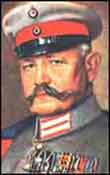
(1847 - 1934)
Paul von Hindenburg was born in Posen in 1847. After
being educated at the cadet schools at Wahlstatt and Berlin he fought at the Battle of Koniggratz (1866) and in the Franco-Prussian
War (1870-71). He was promoted to the rank of general in 1903. Hindenburg
retired from the army in 1911.
On the outbreak of the First World War Hindenburg
was recalled to the German Army and after being sent to the Eastern
Front he won decisive victories over the Russians at Tannenberg (1914)
and the Masaurian Lakes (1915). Seen as the saviour of East Prussia,
he was promoted to field marshal and on August 29, 1916, he became Chief
of Staff of the German Army.
With the support of senior military officers and right-wing
industrialists, Hindenburg and his quartermaster general, Erich von
Ludendorff, formed what became known as the Third Supreme Command. This
military-industrial dictatorship held power until September 29, 1918,
when with defeat inevitable, the government of Germany was returned
to the Reichstag.
Hindenburg retired from the German Army in October,
1918, but continued to take an active interest in politics. In 1925,
Hindenburg replaced Friedrich Ebert as President of Germany. Re-elected
in 1932 he did not oppose the rise of Adolf
Hitler and, in January 1933,
appointed him Chancellor. Paul von Hindenburg was so popular with the
German people that Hitler was unable to overthrow constitutional government
until his death in 1934.
Sources: Spartacus |