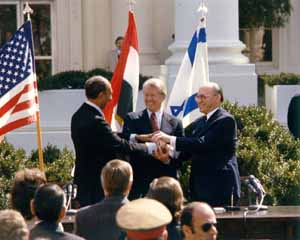
On March 26, 1979, sixteen months after Egyptian President Anwar Sadat's dramatic visit to Jerusalem, Israel and Egypt - long standing enemies - signed a peace treaty on the lawn of the White House in Washington, DC.
 Sadat Speaks at the Israeli Parliament
 |
This peace drive, however, did not begin with Sadat's trip to Israel, but rather came only after more than a half-century of efforts by early Zionist and Israeli leaders to negotiate peace with the Arabs. Every
government in Israel's history had declared its desire to live in peace
with all Arab states, including those who had ruthlessly attacked the Jewish state in 1948 and again in 1967 and 1973.
Israeli Prime Minister Menachem
Begin, like Sadat,
was willing to go the extra mile to achieve peace. Although he faced
intense opposition from within his Likud
Party, Begin froze Israeli settlements in the West Bank to facilitate the progress of negotiations.
Despite the Carter Administration's tilt toward Egypt during the talks, Begin remained
determined to continue the peace process. In the end, he agreed to return to Egypt the strategically critical Sinai — 91 percent
of the territory won by Israel during the Six-Day
War — in exchange for Sadat's promise to make peace.
In recognition of his willingness to join Sadat in making compromises for peace, Begin shared the 1978 Nobel Peace Prize with the Egyptian leader.
Israel - which had repeatedly been the target of shipping blockades, military assaults and terrorist attacks staged
from the Sinai - made far greater economic and strategic sacrifices in
giving up the region than Egypt did in normalizing relations with Israel.
While it received additional U.S.
aid for withdrawing, Israel gave up much of its strategic depth
in the Sinai, returning the area to a neighbor that had repeatedly
used it as a launching point for attacks. Israel also relinquished
direct control of its shipping lanes to and from Eilat, 1,000 miles
of roadways, homes, factories, hotels, health facilities and
agricultural villages.
Because Egypt insisted that Jewish civilians leave
the Sinai, more than 7,000 Israelis were uprooted from their homes and
businesses, which they had spent years building in the desert. This
was a physically and emotionally wrenching experience, particularly
for the residents of Yamit, who had to be forcibly removed by
soldiers from their homes.
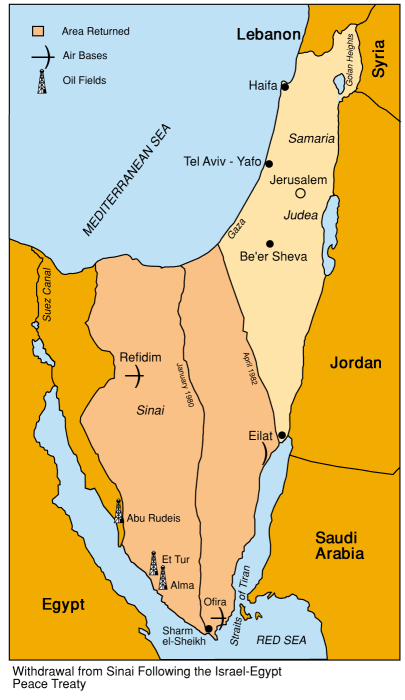 Map of Israeli Withdrawal from Sinai
 |
Israel also lost electronic early-warning stations
situated on Sinai mountaintops that provided data on military
movement on the western side of the Suez Canal, as well as the areas
near the Gulf of Suez and the Gulf of Eilat, which were vital to
defending against an attack from the east. Israel was forced to
relocate more than 170 military installations, airfields and army
bases after it withdrew.
By turning over the Sinai to Egypt, Israel may
have given up its only chance to become energy-independent. The Alma
oil field in the southern Sinai, discovered and developed by Israel,
was transferred to Egypt in November 1979. When Israel gave up this
field, it had become the country's largest single source of energy,
supplying half the country's energy needs. Israel, which estimated
the value of untapped reserves in the Alma field at $100 billion, had
projected that continued development there would make the country
self-sufficient in energy by 1990.
Israel also agreed to end military rule in the West
Bank and Gaza, withdraw
its troops from certain parts of the territories and work toward
Palestinian autonomy. The Begin government did this though no
Palestinian Arab willing to recognize Israel came forward to speak on
behalf of residents of the territories.
In 1988, the Jewish State relinquished Taba —
a resort built by Israel in what had been a barren desert area near
Eilat — to Egypt. Taba's status had not been resolved by the Camp
David Accords. When an international arbitration panel ruled in
Cairo's favor on September 29, 1988, Israel turned the town over to
Egypt.
More than three decades have passed since Israel and Egypt signed their treaty and peace has been maintained. Still, it is
regarded as a cold peace because relations between the two peoples
have not significantly improved and, in the wake of the Arab Spring national uprising in 2011, have even slightly deteriorated. Trade and tourism are primarily in
one direction - from Israel to Egypt. Under former president Hosni
Mubarak, the government-controlled press
and the intellectual elite remained hostile toward Israel and anti-Semitic
articles and cartoons were widely published in newspapers and magazines. Mubarak was an active participant in the peace process, though more often than not he contributed to the hardening of Arab positions toward Israel. He has also refused to visit Israel with the lone exception being to attend the
funeral of Prime Minister Yitzhak
Rabin.