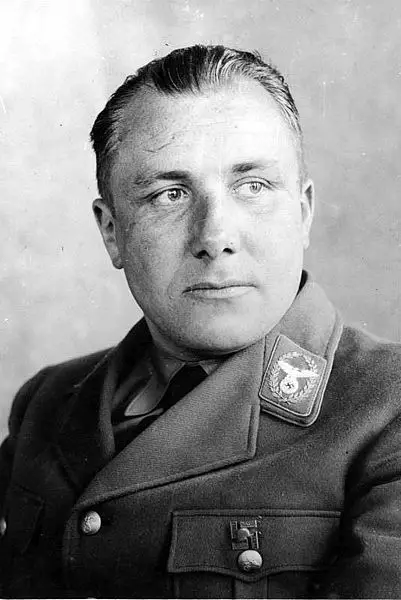
Bormann, in the beginning a minor Nazi, but then steadily
rose to a position of power and, particularly in the closing days, of
great influence over Hitler.
He was active in the Party's rise to power and even more so in the consolidation
of that power. He devoted much of his time to the persecution of the
churches and of the Jews within Germany.
The evidence does not show that Bormann knew of Hitler's
plans to prepare, initiate or wage aggressive wars. He attended none
of the important conferences when Hitler revealed piece by piece these
plans for aggression. Nor can knowledge be conclusively inferred from
the positions he held. It was only when he became Head of the Party
Chancellery in 1941, and later in 1943 secretary to the Fuehrer when
he attended many of Hitler's conferences, that his positions gave him
the necessary access. Under the view stated elsewhere which the Tribunal
has taken of the conspiracy to wage aggressive war, there is not sufficient
evidence to bring Bormann within the scope of Count One.
By decree of 29th May, 1941, Bormann took over the
offices and powers held by Hess; by the decree of 24th January, 1942,
these powers were extended to give him control over all laws and directives
issued by Hitler. He was thus responsible for laws and orders issued
thereafter. On 1st December 1942, all Gaus became Reich Defense districts,
and the Party Gauleiters responsible to Bormann were appointed Reich
Defense Commissioners. In effect, this made them the administrators
of the entire civilian war effort. This was so not only in Germany,
but also in those territories which were incorporated into the Reich
from the absorbed and conquered territories.
Through this mechanism Bormann controlled the ruthless
exploitations of the subjected populace. His order of 12th August, 1942,
placed all party agencies at the disposal of Himmler's programme for forced resettlement and denationalisation of persons in
the occupied countries. Three weeks after the invasion of Russia, he
attended the conference of 16th July, 1941, at Hitler's field quarters
with Goering, Rosenberg and Keitel, Bormann's report
shows that there were discussed and developed detailed plans of enslavement
and annihilation of the population of these territories. And on 8th
May 1942, he conferred with Hitler and Rosenberg on the forced resettlement
of Dutch personnel in Latvia, the extermination programme in Russia,
and the economic exploitation of the Eastern Territories. He was interested
in the confiscation of art and other properties in the East. His letter
of 11th January 1944, called for the creation of a large-scale organisation
to withdraw commodities from the occupied territories for the bombed-out
German populace.
Bormann was extremely active in the persecution of
the Jews, not only in Germany but also in the absorbed and conquered countries. He took part in the
discussions which led to the removal of 60,000 Jews from Vienna to Poland in co-operation
with the SS and the Gestapo.
He signed the decree of 31st May, 1941, extending the Nuremberg Laws
to the annexed Eastern Territories. In an order of 9th October, 1942,
he declared that the permanent elimination of Jews in Greater German
territory could no longer be solved by emigration, but only by applying
"ruthless force " in the special camps in the East. On 1st
July, 1943, he signed an ordinance withdrawing Jews from the protection
of the law courts and placing them under the exclusive jurisdiction
of Himmler's Gestapo.
Bormann was prominent in the slave
labour programme. The Party Leaders supervised slave labour matters
in the respective Gaus, including employment, conditions of work, feeding
and housing. By his circular of 5th May, 1943, to the Leadership Corps,
distributed down to the level of Orstgruppenleiters, he issued directions
regulating the treatment of foreign workers, pointing out they were
subject to SS control on security problems, and ordered the previous
mistreatment to cease. A report of 4th September, 1942, relating to
the transfer of 500,000 female domestic workers from the East to Germany
showed that control was to be exercised by Sauckel, Himmler and Bormann.
Sauckel by decree of 8th September, directed the Kreisleiters to supervise
the distribution and assignment of these female labourers.
Bormann also issued a series of orders to the Party
Leaders dealing with the treatment of prisoners of war. On 5th November,
1941, he prohibited decent burials for Russian Prisoners of war. On
25th November 1943 he directed Gauleiters to report cases of lenient
treatment of prisoners of war. And on 13th September, 1944, he ordered
liaison between the Kreisleiters with the camp commandants in determining
the use to be made of prisoners of war for forced labour. On 29th January,
1943, he transmitted to his leaders OKW instructions allowing the use
of firearms, and corporal punishment on recalcitrant prisoners of war,
contrary to the Rules of Land Warfare. On 30th September, 1944, he signed
a decree taking from the OKW jurisdiction over prisoners of war and
handing them over to Himmler and the SS.
Bormann is responsible for the lynching of Allied airmen.
On 30th May, 1944, he prohibited any police action or criminal proceedings
against persons who had taken part in the lynching of Allied fliers.
This was accompanied by a Goebbels' propaganda campaign inciting the
German people to take action of this nature and the conference of 6th
June, 1944, where regulations for the application of lynching were discussed.
His counsel, who has laboured under difficulties, was
unable to refute this evidence. In the face of these documents which
bear Bormann's signature it is difficult to see how he could do so even
were the defendant present. Counsel has argued that Bormann is dead
and that the Tribunal should not avail itself of Article 12 of the Charter
which gives it the right to take proceedings in absentia. But the evidence
of death is not conclusive, and the Tribunal, as previously stated,
determined to try him in absentia. If Bormann is not dead and is later
apprehended, the Control Council for Germany may, under Article 29 of
the Charter, consider any facts in mitigation, and alter or reduce his
sentence, if deemed proper.