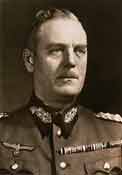
Unquestioning loyalty to the Kaiser had been the sacred
watchword in the Keitel family household for generations. The traditionally
conservative Prussian officer Wilhelm Keitel would practice the same
unquestioning obedience towards Adolf
Hitler - the supreme authority of Nazi Germany's fuehrer state.
Keitel rises rapidly through the ranks owing to his
"outstanding talent for organizational and tactical duties,"
but "lacks any inner sovereignty of character." (Gorlitz,
140). Like so many other officers, he falls under Hitler's hypnotic
spell. Because he is considered a perfect desk worker, Keitel finds
himself chained to the immense bureaucratic duties incumbent upon him
as Hitler's Chief of Staff at OKW.
For this reason, he could rest assured that he had no willing competitors
for his job.
Like many other officers, Keitel comes to believe in
Hitler's genius and infalliblity when time and again "the greatest
general of all time" [Keitel's words] proves the pessimists of
the General Staff wrong with his conquests of Austria, the Sudetenland,
the rest of Czechoslovakia, Poland, Denmark, Norway, the Low Countries,
and above all France.
Keitel is among the twelve generals who receive their
promotion to field marshal shortly after Germany's victory over France.
Hitler also grants him 100,000 Reichmarks which greatly embarrasses
Keitel causing him to transfer the money into a blocked account. Devoted
to his duties, he takes his leave only once during the war in the summer
of 1940.
The Wehrmacht's oath of Allegiance to the fuehrer compels
Keitel to comply with directives (like the Comissar
Order and Order for Guerrilla Warfare) that run against the grain
of his conscience. Keitel never waivers in his loyalty, despite his
belief that Hitler dishonored himself by committing suicide rather than
standing trial and answering for his actions.
Keitel's belief in the fuehrer oath manifests itself
above all on July 20, 1944. He is among the officers present in the
conference hut when Stauffenberg's time-bomb explodes. His first thought
is to rescue Hitler and on that pivotal afternoon he wages a ceaseless
teletype campaign against the conspirators to rally all the military
bases throughout the Reich. Despite the fact that Hitler is leading
Germany towards total destruction, Keitel can never bring himself to
understand Stauffenberg's July plot which he considers to be perfidy
of the worst kind.
Keitel is captured by the Allies and tried for crimes
against humanity at Nuremburg. Like the rest, he pleads not guilty to
such charges claiming that all German officers and soldiers were legally
bound to the sacred fuehrer oath which obligated them to execute orders.
He claims in his defense that he had been opposed to such directives
as the decision to attack Russia and the Commissar Order and that he
had repeatedly asked Hitler's permission to be relieved of command -
a request Hitler always refused given Keitel's indispensability as OKW
Chief of Staff. He therefore could not abdicate his duties willingly
as this constituted, in his mind, an act of disloyalty to the fuehrer,
the army, and Germany. Keitel is nevertheless found guilty of aiding
Hitler to commit a war agression, and of endorsing war crimes and crimes
against humanity. His request to be shot by firing squad as befits his
rank is denied. He is hanged in October 1946.