|
[By: Shira Shoenberg]
Greece is a small country by the Mediterranean Sea
where the first European civilization began more than 2,000 years ago.
About one-fifth of the country
is made up of islands and no part of Greece is more than 85 miles from
the sea. The achievements
of ancient Greece in government, science, philosophy and the arts are
considered foundations of western culture. Greece came under control
of invaders more than 2,000 years ago and did not gain independence
until 1829. Today, the Jewish population of Greece stands at approximately 4,500 people.
- Early Jewish Community
- Ottoman Rule
- Thessaloniki & Athens
- World War II
- Modern Greece
- The Greek Islands
- Jewish Tourist Sites
- Jewish Community Contacts
Early Jewish Community
Contact between Greeks
and Jews outside of Greece began after the Babylonian
exile of 586-539 B.C.E. When the Persian king Cyrus allowed Jews
to return to their homeland after the Babylonian exile, they met Greeks
for the first time. The prophet Ezekiel wrote of the Greek traders of "Javan," Ionia, who
traded in slaves and worked with bronze. The Greek historian Herodotus
knew of the Jews, whom he called Palestinian Syrians, and included
them in his list of those serving in the Persian king Xerxes’
navy when Xerxes invaded Greece in 480 B.C.E.
There may have been isolated Jews living in Greek
cities as far back as the Babylonian exile, but the first organized
Jewish communities in Greece were established in approximately 400
B.C.E. The communities flourished during the reign of Alexander the
Great and the subsequent Hellenistic period in around 300 B.C.E. Jewish
immigrants flooded Hellenist cities along the Aegean Coast and the
Greek mainland. The Greeks were polytheistic and maintained a glamorous
lifestyle. While most Jews retained their monotheism, many wealthy
Jews were attracted to Greek culture and created a class of assimilated,
pro-Greek Jews.

Throne of Moses
in the Synagogue of Delos from 1st Century |
Greek was the language of commerce, administration
and secular law in the Hellenistic kingdoms and, slowly, Jewish communities
began to forget Hebrew. In around 260 B.C.E., certain books of the
Bible began appearing in Alexandria in Greek translation. In approximately
250 B.C.E., the Macedonian-Egyptian king Ptolemy ordered the translation
of the entire bible into Greek by 70 scholars. This translation became
known as the Septuagint.
The most famous confrontation between Greeks and
Jews was the Maccabean Revolt of 167-164 B.C.E. The Seleucid king Antiochus IV imposed Greek religious
customs on the Jews and tried to convert the Jewish temple in Jerusalem into a temple
to the Greek god, Zeus. The Jewish revolt, led by the Hasmonean Judas Maccabee, defeated the Seleucid armies and recaptured the temple.
After the revolt, many Hellenized Jews left Judea and moved to Hellenistic
commercial centers such as Alexandria and Antioch.
According to Maccabees I 15:23 and also the Jewish
historian Philo (c. 30 B.C.E.–c. 45 C.E.), in the years following
the revolt the Jews built up communities in Sparta, Delos, Sicyon,
Samos, Rhodes, Kos, Gortynia, Crete, Cnidus, Aegina, Thessaly, Boeotia,
Macedonia, Aetonia, Attica, Argos, Corinth and Cyprus. When the Christian
Saint Paul visited Greece during the first century C.E., he found
well-established Jewish communities in Thessaloniki, Veroia, Athens,
Corinth and other towns.
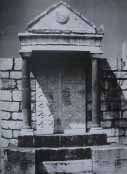
Synagogue of
Sardes,
c. 350 C.E. |
The Jews in these communities were called "Romaniot,"
a hellenized Latin term implying that they lived in the empire of
the "second Rome," meaning Greece. They developed customs
now known as "minhag Romania." They translated traditional
Jewish prayers into Greek and recited them in Greek, although the
prayers were written with Hebrew letters. The Jews’ political
existence was tenuous and "they absorbed from the Greeks before
the birth of Christ more than the Greeks absorbed from them"
(Levi, p. 203).
These communities of Romaniot developed throughout
the Byzantine period,
which lasted from approximately 476-1453 C.E. Life was not always
easy for the Jews and they were pressured to accept the Christian
Messiah, but they were also recognized as descendants of the Chosen
People and protected by the law. Many Jewish communities identified
themselves with certain industries. For example, the community of
Thebes, which consisted of 2,000 Jews, dominated the silk industry,
while Crete’s Jews were producers and exporters of agricultural
goods. Many Jews integrated into Greek culture. Some communities tried
to maintain Hebrew by writing out sections of the Tanach in Greek using Hebrew script. Many communities lost Hebrew entirely
and still more assimilated completely and lost all identity as Jews.
During the 9th-12th centuries, many Central
European Ashkenazi Jews who were scared by the Crusaders’
persecutions found refuge in Northern Greece, in Thessaloniki (a.k.a
Salonika).
Ottoman Rule
In 1453, the Ottoman
Turks captured Constantinople, the Byzantine capital, and began
to rule over all of Greece. Ottoman policy was based on Islamic law,
which recognized the Jews as a separate nation with religious and
often legal autonomy within their own communities. Greece became a
haven of religious tolerance for Jews fleeing the Spanish Inquisition
and other persecution in Europe. The Ottomans welcomed the Jews because
they improved the economy. Jews occupied administrative posts and
played an important role in intellectual and commercial life throughout
the empire. With the 1492
Edict of Expulsion against the Jews of Spain, more than 20,000
Sephardic Jews arrived in Thessaloniki in one year.
This signaled the beginning of Sephardic Jewry in
Greece. Many of the Sepharadim were "marranos," Jews who
had converted to Christianity in the 14th century and were
used to partaking in European culture. Many times their pride and
sense of cultural superiority led to friction in their dealings with
the Romaniot Jews. Eventually, however, the Romaniot communities of
Constantinople, Edirne, Thessaloniki, Rhodes and many others accepted
both the minhag (custom) and language of the Sepharadim. Romaniot
traditions remained in only a few communities such as Yoannina and
Chalkis. By the 16th century, the Sephardi language, Ladino,
had become the accepted language of Greek Jewry.
 Rojo Quarter of
Solonika, 17th Century
Rojo Quarter of
Solonika, 17th Century |
By supporting the Ottoman Empire, the Jews curried
disfavor with the Christian Orthodox Greeks. In 1821-1829, during
the Greek War of Independence, thousands of Jews were massacred alongside
the Ottoman Turks. The Jewish communities of Mistras, Tripolis, Kalamata
and Patras were completely destroyed. A few survivors moved north
to areas still under Ottoman rule.
In the late 19th century, Greece attempted
to regain the southern Balkan territories historically associated
with Greek history and language. Jews and other ethnic groups were
subject to "Hellenization," a movement to force them into
accepting Greek custom and language. The Romaniot Jews of southern
and northwestern Greece were already Hellenized to a large extent.
The Hellinization was mostly problematic for the Sepharadim who only
came under Greek rule after the Balkan Wars of 1912-1913.
In 1922-1923, there was a mass exodus of Greeks from
Asia Minor. The refugees settled on the Greek mainland and created
substantial economic competition between the Jews and the Greek refugees.
This created a tense climate in which the Jewish district of Kampel
in Salonika was burned in 1931. The suspects were thought to belong
to the fascist Ethniki Enosis Ellas (EEE, National Union of Greece),
although they were never found.
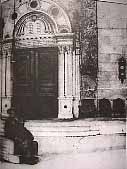
Kal Yashan Synagogue
in Salonika destroyed in 1917 |
Thessaloniki & Athens
Two of the most important Jewish communities in pre-World
War II Greece were Thessaloniki and Athens. In the 1600s, Thessaloniki,
a Sepharadi community, became one of the largest Jewish communities
in the world and was known as "ir v’em beyisral,"
metropolis and mother of Israel. By 1900, more than half of the town’s
population was Jewish, which was about 80,000 Jews. In 1900-1910 Thessaloniki
had more than 50 synagogues, 20 Jewish schools and numerous Jewish
institutions and associations. It was a center of Torah learning for all of Europe. Business was generally conducted in the
Sepharadi language of Ladino and, on Friday afternoons, almost all
commercial life stopped since most of the city’s workers were
Jewish. A sprawling Jewish cemetery lay in the center of the city
(the cemetery was destroyed during World War II to make room for a
new university). The Jewish population was varied and included both Karaites and Donmeh (followers
of the false messiah Shabbatai
Zevi). The city had a strong Judaeo-Spanish culture.
The downfall of the Jewish community started with
a fire in the Jewish quarter in 1917. Confiscations began in sections
of the ancient cemetery and continued through the late 1930s. In the
1920s a large number of Greek refugees from Asia Minor flooded the
city. Hellenization disrupted the Judaeo-Spanish culture by requiring
the imposition of the Greek language, the establishment of Sunday
instead of Saturday as a day of rest and the reorganization of traditional
religious Jewish life according to Greek laws. National and economic
life in Greece became increasingly centered around Athens and many
Jews moved there. As the Thessaloniki community weakened, some of
its Jews left Greece altogether. At the turn of the 20th century, the city boasted of 90,000 Jews. By 1939, there were approximately
56,000 left.
 Benveniste family,
Salonika (1904)
Benveniste family,
Salonika (1904) |
Athens retained a Jewish presence from the Middle
Ages until the 1800s. There was then a notable absence of Jews in
Athens following the Greek War of Independence, indicating that they
were either killed or forced to flee. The first "new" Jews
in the city came in 1834 when the Bavarian King Otto I of Greece settled
there, along with a Jew named Max Rothschild. Rothschild was soon
followed by other Bavarian, Ashkenazi Jews, and then by a group of
Jews from Turkey. By the mid-19th century there was a small
Jewish community in Athens, although it had no defining tradition,
as did the community in Thessaloniki.
The Jews in Athens were never completely secure politically.
During the 1840s, Easter celebrations in Athens included the ritual
burning of a symbolic "Judas." In 1847, Rothschild persuaded
the Greek Prime Minister to stop this practice. The public then focused
its attention on a Gibralter-born Jew of questionable business integrity
named Don Pacifico. Rioters sacked his house and burned his warehouse.
In 1854, the eccentric French-American aristocrat Sophie Berbe Marboise
left a considerable amount of property to the Athens Jewish community.
The Jews of Athens were in no position to claim the gift, however,
and never received any of the land.
Despite this insecurity in society, the Athens community
was well established by the late 1800s. It was legally organized in
1885 and its official charter was granted in 1889. A synagogue was
built in 1904 and dedicated as Etz Hayyim in 1906. By the 1940's,
the synagogue accomodated more than 3,000 people.
World War II
At the start of World War II, Greek Prime Minister
Ioannis Metaxas tried to maintain neutrality. On October 28, 1940,
Italy demanded that Greece give up its sovereignty. Metaxas refused
and, when Italy invaded, pushed the Italians back. On April 6, 1941,
the Germans invaded Greece and, on April 18, the Greek government
fled to Crete. On April 21, the Germans overran Athens and, on May
20, they took Crete.
 Nazi's Tour Athens
 |
The Germans divided Greece into three occupation
zones. The Germans held western Macedonia, Thessaloniki, a strip of
land in eastern Thrace, the major Aegean Islands and Crete. The Bulgarians
were given eastern Macedonia and Thrace. The Italians received the
Dodecanese Islands, the Ionian Islands, and a large section of mainland
Greece including Athens. At that time, approximately 76,000 Jews lived
in Greece: 55,000 in Salonika in the German zone, 6,000 in western
Thrace under Bulgaria and 13,000 under Italian control.
Several Greek resistance organizations were founded,
including the communist National Liberation Front in September 1941,
the republican National Republican Greek League in the summer of 1942
and National and Social Liberation in the summer of 1943.
The German Occupation Zone
As soon as the Germans entered Greek mainland, they
implemented anti-Jewish policies. The first Jewish community to be
affected by the Final Solution was Thessaloniki in the German zone. The Nazis occupied the city on
April 8, 1941. They aroused anti-Semitic sentiments in the Christian Greek populations and revived several
anti-Semitic publications that had been suppressed during Metaxas’
rule. On April 15, the council of the Jewish community was arrested
and replaced. In June 1941, the Nazi Jewish Affairs Commission, a.k.a.
the Rosenberg Commando, began confiscating Jewish libraries, manuscripts
and art and sending it to Germany.
In the winter of 1941-1942, refugees from Thrace,
eastern Macedonia and the Bulgarian territory ran to Thessaloniki
and Athens. The food supplies of Thessaloniki gave out and starvation
and typhus were rampant. The Nazis conducted summary arrests and executions.
Approximately 60 Jews died each day.
In July 1942, 9,000 Jews of Salonika were called
to forced labor. In October a ransom was set by the German civilian
administrator of Salonika, Max Merten, to redeem these men and the
1.9 billion drachmas that the Jews paid drained all of the community’s
wealth. He collected jewelry, antiques, cash and anything else of
value and supposedly loaded the treasure onto a fishing boat that
sank. On December 6, the Jewish cemeteries of Thessaloniki were confiscated
and pillaged.
The Rosenberg Commando demanded in early 1943 that
parts of the 1935 Nuremberg
Laws were to be put into effect. Jews had to wear a Star
of David and Jewish stores and residences were similarly marked.
The Nazis formed three ghettos and concentrated the Jews within them.
Jewish organizations were stopped and Jews were forced to register
their belongings. On March 15, deportations began. In the next three
months, 45,649 Jews were sent from Thessaloniki to Auschwitz.
Only a handful survived.
Merten brazenly returned to Greece after the war
to search for his lost loot. In 1958, a survivor spotted him and told
the police. He was arrested, tried and sentenced to 25 years in prison.
The Greek Prime Minister, however, sent him to Germany after just
eight months. He was retried there and acquitted for lack of evidence
that he had rounded up Jews and stolen their property. He died in
Germany. In 2000, a group of divers planned to search the Greek coast
for the estimated $2.4 billion worth of treasure (Jerusalem Report,
July 17, 2000).
The Bulgarian Occupation Zone
Many
members of the Bulgarian Orthodox Church and the Bulgarian public
helped the Jews, but the government supported the Nazis. On November
12, 1942, the Bulgarian government stated that it "readily accepts
the proposals of the German government to carry out the general evacuation
of the Jews from Bulgaria" (Stavrolakis).
That same month, the government instituted the provisions of the Nuremberg
Laws, forcing Jews to wear a Star
of David, submit a record of family wealth, live in proscribed
areas and abide by a 5:00 pm curfew. In January 1943, a commission
confiscated all Jewish valuables. On March 4, 1943 all Jews under
Bulgarian Occupation were arrested and imprisoned. About 200 escaped.
The other 4,100 were deported to Treblinka.
The extermination of Jews in the German and Bulgarian zones was completed
by the summer of 1943.
The Italian Occupation Zone
Those Jews living in the Italian zone were relatively
well off during the majority of the war. Jews in the Italian zone
were ignorant of Auschwitz and thought that the German racial laws had been applied only to remove
the Judaeo-Spanish bloc in Thessaloniki. The Italians helped hundreds
of Jews escape to Athens and issued more than 300 false identity papers.
The clergy hid more than 250 Jewish children. In Athens, the Jews
were integrated into the city’s life and were externally no different
from their Christian neighbors. They did not believe that the fate
of the Jews of Thessaloniki could affect them.
On September 8, 1943, the Italians surrendered to
Allied forces invading Italy. The Germans then arrested the Italians
in Greece and started the last phase of their "action" against
the Greek Jews. On September 20, the Rosenberg Commando arrived in
Athens. It demanded a list of the names and addresses of all Jews
residing in Athens and of all those who had helped Jews escape. It
created a council under Chief Rabbi Elias Barzilai to carry out Nazi
orders. The Jews, however, destroyed the community records so they
could not fall into Nazi hands. They helped Barzilai escape to the
partisans. On the eve of Yom
Kippur, October 8, 1943, the order was given to reorganize the
Jewish community under direct Nazi supervision. Jews were ordered
to register their names within five days. By the end of October, only
200 Jews registered. Many Jews left by boat, many joined partisan
camps in the mountains, and some converted. Most went into hiding.
By March 1944, however, about 1,500 Jews had registered either to
receive permission to work or out of fear of reprisals against Christian
neighbors who were hiding them. On March 24-25, 800 Athenian Jews
were sent to Auschwitz.
Throughout the summer, about 3,500 Jews from other cities in the Italian
zones joined these Athenian Jews in Auschwitz.
The End of the War
A total of at least 54,533 Greek Jews were sent to Auschwitz, despite the
protests of many Greek leaders. Most of these Jews were murdered,
though many were also involved in various acts of resistance. In September
1944, the Germans evacuated the Greek mainland. In May 1945, they
gave up the last of the Greek islands under their control. In total,
the Germans confiscated 280 million drachmas ($1.5 million) in cash
from Greek Jews, plus property. Between 60,000 and 65,000 Greek Jews
died in the Holocaust, though there
were a number of Jewish communities that at least partially survived
the war. In 1945, the total Jewish population in Greece was 10,000.
In December 2012, police in northern Greece recovered
668 fragments of marble headstones and other parts of Jewish graves
that were destroyed during the Nazi occupation of Greece in World
War II. After a 70-year search for the remains of graves smashed when
Thessaloniki's main Jewish cemetery was destroyed, the fragments were
found buried in a plot of land in the center of the city. According
to the head of Thessaloniki's Jewish community, David Saltiel, most
of the gravestones found dated from the mid-1800s up until World War
II.
In March 2013, Greek Jews gathered to commemorate thet 70th anniversary of the first roundup and deportation of Greek Jews to Nazi extermination camps during the Holocaust. A few hundred people came together at the city's Eleftherias (Freedom) Square, the very spot where the occupying Nazi forces rounded up the first group of Greek Jews on March 15, 1943.
Modern Greece
 Monument for
the 54,000 Thessaloniki Jews who perished in the Holocaust
Monument for
the 54,000 Thessaloniki Jews who perished in the Holocaust |
In 1944, the government of George Papandreou was
the first European government to return Jewish properties that had
been confiscated during the war. Property of the deceased was put
in a common fund to aid Jews impoverished by the war. A royal decree
in 1949 established the Foundation for the Welfare and Rehabilitation
of the Jewish Community in Greece. According to the decree, Jewish
survivors and their heirs could present claims in court for restitution
or compensation for property.
Since the Holocaust, there have been some anti-Semitic and Anti-Zionist incidents
in Greece. Under the rule of the socialist party PASOK in the 1980s,
pro-socialist papers compared Israel to the Nazis after Israel’s invasion of Lebanon, and
called for a boycott of Jewish shops. There are a few far-right, anti-Semitic
organizations and movements but their activity is generally minimal.
There are also some anti-Semitic or Anti-Zionist publications, with somewhat considerable circulation. The most common
manifestation of anti-Semitism is graffiti of swastikas and neo-Nazi
symbols.
The Greek far right political party "Golden Dawn" is described by scholars, the media, and the international community as antisemitic, fascist and antizionist. Golden Dawn began in 1980 as the brainchild of Nikolaos Michaloliakos, but was not registered as an official Greek political party until 1993. After 30 Golden Dawn members attacked a group of students outside of Athens University of Economics and Business in 1992 they began to become a household name in Greece and increased recruitment practices. The party was active from 1993-2005 and resumed political activity in 2007. The Golden Dawn gained a lot of political support during Greece's economic downturn by campaigning on concerns for unemployment, austerity and immigration. The 2012 election saw the Golden Dawn win more support from the Greek voters, and they recieved 7% of the popular vote. This was enough to land them seats in the Hellenic Parliament for the first time, with 21 seats won.
Golden Dawn members have been accused of carrying out acts of violence against Jewish individuals, immigrants, LGBT individuals, political opponents, and ethnic minorities. They have desecrated and vandalized synagogues, attacked innocent people on the street, and murdered political opponents such as Pavlos Fyssas. Their symbol is strikingly similar to the Swastika Nazi symbol, and they openly perform Nazi salutes and sell World War 2 era Nazi propaganda. The Golden Dawn party is a dangerous and antisemitic organization that appears to be edging ever closer to the Nazi idealogy. In response to the surge in popularity of the Golden Dawn party over the recent years, Greece's Parliament is cracking down on hate speech. The Parliament approved a law on September 10 2014 that bans Holocaust denial or trivialization and increases jail-time for instigating racist violence from 2 years to 3 years. The law provides a stipulation that groups who incite racial violence or participate in hate speech can be either fined by the government, or can be denied government funds and support. Just 6 days after this law was passed, a member of the Golden Dawn party was filmed stating that "We are ready to turn on the ovens... We will turn them into soap but we may get a rash... We will make lamps from their skins". In these statements he is referring to Jewish residents and immigrants in general. According to the accused he was "only joking" and those statements were made during a private conversation.
Following the October 2013 arrest of Golden Dawns leader Nikos Michaloliakos pending an investigation into their criminal activities after the stabbing death of Pavlos Fyssas, a court case was brought against the Golden Dawn party aimed at disbanding the organization. The prosecutor's 697 page case file was released on November 13 2014, and demonstrates that the Golden Dawn party was much more dangerous than originally believed. According to an ex-Golden Dawn member who testified against the organization, Golden Dawn members would be trained by butchers how to use knives more effectively for killing, and would participate in mass slaughters of sheep to practice their knife skills. The case file also includes photos of Golden Dawn members in military fatigues, and holding various weapons including a bazooka. Witnesses at the trial testified that the Golden Dawn party was planning and training to overthrow the Greek government, with leaders telling their members that they will break down the Parliament doors with tanks. In late 2014 and early 2015 dozens of members of the Golden Dawn party will be put on trial for offenses including extortion, murder, human trafficing, and assault. As of November 2014 more than 30 members of the party leadership are in police custody, and all of their members of Parliament along with 60 party supporters are being charged with criminal activities. Greek police seized harddrives, laptops, and cameras from the homes of Golden Dawn members, which included pictures of party leaders dressed in Nazi SS uniforms, giving the Nazi salute, and firing weapons while wearing jackets embroidered with swastikas.
In early 2000, Greece’s Supreme Court upheld
an award of 9.5 billion drachmas to relatives of 218 villagers massacred
by the Nazis at Distomo on June 10, 1944. Germany is refusing to pay.
Currently, only about 5,000 Jews are left in nine
Greek towns. The Jewish community announced in April 2000 that it
was launching a campaign to raise about $1 million to save its remaining
synagogues and cemeteries, some of which had been recently vandalized.
In June 2000, Greek Prime Minister Costas Simitis
said citizens would no longer have their religions stamped on their
identity cards (Jerusalem Report, June 19, 2000).
Greece opened its first kosher restaurant since World
War II in July 2004. The Kol Tuv restaurant, located in downtown Athens,
was started by Rabbi Mendel Hendel of Chabad Athens, to help Jewish
athletes coming to Greece for the 2004 Summer Olympics keep kosher.
Today, it is primarily a catering service, by the name of Glatt Kosher
Catering Service.
The Greek Islands
Khalkis
The Jewish community of Khalkis, on the island of
Euboea, is a two-hour train ride from Athens. It is the oldest Jewish
community in Europe, although there are now only 150 Jews there. It
contains a rebuilt Romaniot synagogue and a Jewish cemetery. Near
the main bridge linking Khalkis with the mainland is Heroes’
Square, which contains a commemorative bust of Colonel Mordechai Frizis,
a leading member of the Khalkis Jewish community and the first Greek
officer killed in World War II.
A short boat ride from Athens’ port of Piraeus
is the island of Aegina. Near the Temple of Apollo in Aegina is the
remaining mosaic floor of a Roman-era synagogue from the second or
third century. The floor was unearthed in 1811.
Rhodes
Rhodes, a city that once held about 4,500 Jews, is
less than an hour’s flight from Athens. Josephus mentions the Jews of Rhodes in the 1st century CE. Later, the Jews
are described as fierce defenders of the walled city against the Turks
in 1480. During the next four centuries, the community grew as new
synagogues and yeshivot were built and Jews became craftsmen and merchants.
The community prospered disproportionately to the size of the general
population. At its peak in the 1920's, the Jewish community was one-third
of the total population.
Benjamin of Tudela found 400 Jews in Rhodes when
he visited in the 1100s. By the thirteenth century, an Italian rabbi
noted the size of the community and the beautiful embroidery in the
Jewish homes. The community was then under the rule of the Knight
Hospitalers of St. John in Jerusalem. Their rulers let them build
a major synagogue on the island, but twenty years later the community
was expelled.
The Jewish community returned as slaves to the island
and when the Turks attacked the island again in 1522, the Jewish slaves
declared loyalty to them. The Turks welcomed Jews who had fled the Spanish and Portuguese
Inquisitions, and the community took many Spanish customs because
of the new immigrants.
After the Balkan Wars, the Italians ruled the island
and many in the Jewish community moved to Africa. A dramatic change
in the ratio between men and women caused many women to become engaged
by mail and join their husbands overseas. In 1928, the arch-Fascist
governor Mario de Vecchi closed a recently opeend seminary. Many new
Jewish immigrants were expelled, and the community faced discriminatory
laws. According to legend, the governor used Jewish tombstones to
build his own house.
When the Italians surrendered to the allies in 1943,
the Rhodeslis thought their persecution was over. But the Germans
occupied the island and ordered Jewish men to report to headquarters
in July of 1944. Many families reported also in the hopes that they
would be reunited with their husbands and fathers. Most of the community
was taken to Auschwitz and only 151 survived. Forty Jews were saved by the Turkish consul
general, Selahattin Ulkumen, because he demanded their release.
One of the synagogues left is the Kahal Shalom Synagogue
from the sixteenth century. Sanuel Modiano planned to have his bar
mitzvah inside the synagogue but he was destined to spend it in Auschwitz.
He is now a tour guide for the synagogue and La Juderia, the Jewish
neighborhood there before World
War II. The neighborhood once had Jewish couples flirting in its
central square, the Calle Ancha (Broad Street) and children parading
down the streets on Purim. The Calle Ancha has a fountain with iron
sea horses and is now known as Plateia Martyron Evreion, or the Square
of the Jewish Martyrs (of the Holocaust).
The road traveling west from the square was the Jewish commercial
zone and the site of the Salomon Alhadeff's Sons Bank. The Bank was
one of the best known in the Levant.
On June 23, 2002, Rhodesians from all over the world
gathered at the square to commemorate the unveiling of a six-sided
column Holocaust memorial translated into the six languages spoken
by the Rhodeslis. The inscription reads: "Never Forget. In memory
of the 1,604 Jews of Rhodes and Kos murdered in the Nazi
camps July 23, 1944."
Today thousands of Jewish and Israeli tourists frequent
the island which is under Greek rule. Shopkeepers have found it worthwhile
now to study Hebrew, and a kosher restaurant has now opened on the
island, run by an Israeli man of Yemenite descent. The native community
speaks Judeo-Spanish and there are less than 40 Jewish individuals
on the island. The governing body of the community is the Central
Board of Jewish Communities in Athens. The office of the Jewish community
is on 5 Polydorous. The telephone number is 30-24-22364 and e-mail
is: [email protected].
Kahal Shalom Synagogue: The synagogue was
built in 1577 and is one of the oldest in Europe with eight gigantic
columns supporting arches and black-and-white stone mosaic floor.
It desperately needs to be restored and was listed as one of the
100 Most Endangered Sitess by the World Monuments Fund, a New York-based
nonprofit organization that endeavers to preseving endangered art
works and architecture around the world.
Jewish Museum: Beyond the synagogue courtyard
a vaulted room leads to the Jewish Museum of Rhodes founded by Aron
Hasson. Photographs show the period before World War II, including
a picture of Selman Franco Jaffe entitled: "Standing on my
chair in front of my home in La Juderia, 1938, five years old, holding
a doll." Another picture shows a group of men after their release
from Auschwitz. Samuel Modiano is fourth from the left.
The original entrace is a right turn out of the
synagogue marked with a Star
of David on a pair of brown metal doors. The alley opposite
shows a Vizantious and a Hebrew inscription indicating that the
house was built in 1767. At number 9, a bakery prepared matzot.
Salomon Alhadeff Avenue: The Alhadeff family
funded a large park north of Dosiadou in 1933.
Alliance School, Notrica Foundation, Kahal Grand: The ground floor of this building housed a Talmud Torah and
on the upper floor of the Notrica Foundation building was a Jewish
center for young adults. A Greek flag flies outside the yellow structure
at 28 Kisthinious. . Near the building under an arched entraceway
is the donor's name, the Baron Edmond de Rothschild. Thiseos, behind
an artificial tree, is the last surviving piece of the first synagogue,
the Kahal Grande. La Puerta de la Mar is at the end of Kisthiniou.
Cemetery and Holocaust Memorial: Between
Christian and Muslim burial ground lies the Jewish cemetery. The
entrace is signaled by the pointed arch and a path that follows
the grounds. The sixteenth-century graves on the left are originally
from the old Jewish cemetery. Some unmarked graves can be found
on the right for the families who were deported to Auschwitz. Some
graves are marked by Hebrew poetry. Others have scissors carved
onto them, reminding guests that the residents were once textile
dealers and tailors.
In Faliraki a monument written in Greek, French
and Hebrew is a testimonial to victims of the Nazi deportations.
About 200 tombstones have been discovered in recent renovations.
Restaurants: Haim's Taverna is just west
of the city. The owner, Haim Kisra, has kosher Middle Eastern food
supervised by the rabbi of El Al Israel Airlines. It is closed for
Shabbat but will serve meals on holidays. It is located on 12-13
Ialysos; 25473.
For further information, the Jewish Historical
Foundation of Rhodes has a map of La Juderia and hotel recommendations.
The website is www.rhodesjewishmuseum.org.
Delos
A Jewish community in Delos was described by Josephus (38-100 B.C.) and in inscriptions found in a first century synagogue discovered on the island. The synagogue is part of a larger
residential quarter found on the northeastern corner of the Island.
Don Joseph Nassi, Duke of the Aegean Pelagus and
known as the "Great Jews," ruled the Cyclades Islands for
13 years. The capital of the Cyclades was Naxos, where one can find
a characteristic wall fountain from that period. Naxos's main street
boasts the name of Joseph Nassi.
Crete
Crete, the biblical Caphtor and the home of the Philistines,
contained a Jewish community for 2,500 years. The island was known
for its rabbis and scholars. At the end of the 15th century, the island
had four synagogues and welcomed Jewish refugees expelled
from Spain. The number of Jews had declined to 400 by the time
of the war. In June 1944, the Jews were put on the ship Penios,
which was sunk by the Germans as soon as she left port. Only seven
Cretan Jews survived the Holocaust.
All that remains now, however, is the shell of a synagogue in Hania,
in the former Jewish quarter bordering Kondilaki Street. The Archaeological
Museums of Heraklion and Rethymno have Jewish gravestones and a marble
stone with a Star of David.
Veria
A two-hour bus ride from Thessaloniki is Veria, where
a Jewish community existed for 2,000 years. Now there are only three
Jewish families there, but one can still see the old Jewish quarter
that lies off the main square. The area is a jumble of old wooden
houses, some of which can be recognized by Hebrew inscriptions under
the overhang of the roofs. The 300-year-old synagogue lies down a
stony path to the right of the quarter’s entrance.
Ionnina
The 65-person Jewish community of Ionnina is a bit
further from Thessaloniki. Some of the houses on its Koundourioti
Street bear ancient Hebrew inscriptions and Stars
of David. Today, most Jews there live in apartment buildings next
to the community headquarters at 18 Eliya Street. The Street is named
for Joseph Eliya, a Jewish poet from Ionnina. This is also the site
of the New Synagogue, which was destroyed during World War II. On
16 Ioustinianou Street is the existing Old Synagogue. Ionnina's municipal
museum contains two of the oldest surviving ketubot in the world.
Also of interest are the bust of Joseph Eliya in Alsos Park and a
municipal memorial to Holocaust victims
near the city walls.
Corfu
Jews have been living in the Ionian island of Corfu since at least 1160, coming first from the Balkan peninsula and from
Greek-speaking communities around the Mediterranean Sea. The Jews
of Corfu prospered under Venetian rule (1386-1797) and local attacks
on the community forced the Jews in 1622 to live in a ghetto "for
their protection."
Two synagogues were built on Corfu in the 16th century:
one Romaniote and one Italian. The Italian synagogue was destroyed
by bombs in World War II. The Romaniote synagogue, located on Velissarious
Street, survived the bombs of World War II and serves as the only
synagogue on the island today. In April 2011, arsonists broke into
the synagogue and was savagely destroyed almost all of its prayer
books, some being hundreds of years old. “We had books from the 15th, 16th and 17th century from Trieste,
Padova and Verona. Now they are gone," said Vino Shoshi, a former
president of the community in Corfu. The vandalism was strongly condemned
by both the Greek government and the international Jewish community.
When Napoleon conquered Corfu in 1797, he gave the
Jews equal rights and many more Jews from surrounding areas in Italy
and the Ottoman Empire moved to the island. By 1802, the Jewish community
had grown to 1,229 out of 45,000 total inhabitants.
In 1815, Corfu became a British protectorate and
though cultural life flourished under the new rulers, the Jews lost
their civil and political rights. In 1856, a blood libel led
to lethal attacks by Greeks. A second blood libel was spread in 1891
and a month-long pogrom ensued, which propelled nearly one quater
of Corfu's Jews to immigrate elsewhere. Two more blood libels
in 1915 and 1918 caused further emigration.
On the eve of World War II, approximately 2,000
Jews lived in Corfu. While they were relatively safe under Italian
occupation, once the Nazi's conquered the region, the vast majority
of Corfu's Jews were rounded up and shipped off to the European mainland.
In 1944, 1,759 Jews were deported to Auschwitz;
by wars end only 125 Jews survived on the island. The Metropolitan
Bishop of Zakynthos, Chrysostomos, along with the mayor, Lukas Carrer,
were responsible for saving this small number of Jews, according to
Marcia Haddad Ikonomopoulos, President of the Association of Friends
of Greek Jewry.
By 1958, only 85 Jews remained on Corfu.
Kos
A small, prosperous Jewish community lived on the
island of Kos, in the eastern Aegean. All 120 Jews were deported and
murdered in Auschwitz in 1944. Today, the community's synagogue is
a cultural center. A cemetery and old Jewish-owned villas also remain
on the island.
Zante
In Zante, another Ionian island, a Jewish community
was founded in 1522. By 1712, the community had two synagogues: the
Zakynthian and the Cretan. The former was severely damaged in an earthquake
in 1953, but its remains can still be seen and the latter was destructed.
During German occupation, the mayor of Zante refused to hand over
the list of the Jewish citizens, thereby saving all of them from deportation.
A monument was erected by the community thanking him for his efforts.
Jewish Tourist Sites
Roughly 3,000 of Greece’s 5,000 Jews reside
in Athens. Athens boasts a school for nursery through sixth grade,
a Jewish Youth Center and two synagogues — one Romaniot and one Sephardi. Athens also hosts the Central
Board of Jewish Communities in Greece, the governing body for the
Greek Jewish community.
One of the most popular Jewish tourist sites in Athens
is the Jewish
Museum of Greece, located at Nikis 39. The museum presents the
Jewish history of the area from Anatolia to Venice and also the general
history of the region. The museum includes Jewish clothing, artifacts
and photographs. Two highlights are a reconstructed synagogue from
Patras and a room representing the interior of a Jewish home in eastern
Greece from the time of Turkish
rule.
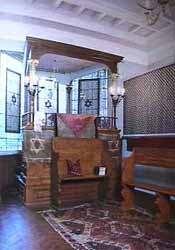 The restored
Synagogue of Patras in the Athens museum
The restored
Synagogue of Patras in the Athens museum |
In the marketplace under the Acropolis are the remains
of a fifth- century synagogue, identifiable by the menorah and lulav carvings. This can be seen by going to the far end
of the Temple of Efestou and positioning oneself with Lycabettus Hill
on the left and the Acropolis on the right.
In the Monastiraki area is a flea market with vendors
selling shoes, old books and other assorted odds and ends accompanied
by Oriental music playing in the background. This market is called
the Yusurum Market, named after a Jewish family from Istanbul of the
same name who owned a junk shop in the area in the turn of the century.
One can also find an ancient synagogue in Athens
and three Jewish cemeteries. One cemetery in the suburb of Nikea,
Pireaeus has a Holocaust monument.
The second largest Jewish community in Greece is
comprised of 1,300 Jews in Thessaloniki. The community of both Sepharadi
and Romaniot Jews is wealthy and maintains a daily minyan,
a rabbi, a kosher butcher, a school, a community center, various organizations
and an old age home. Community members periodically organize lectures,
art exhibitions and concerts.
The promenade along the Thessaloniki waterfront has
a walkway that follows the curve of the coast along the seaside that
edged the Jewish quarter. Not far from the White Tower on the waterfront
is Vassilisis Olgas Street that houses several turn-of-the-century
mansions and villas that were once owned by Jews. Nearby is Saadi
Levi Street, named for the publisher of one of Thessaloniki’s
earliest newspapers. North of there, at the intersection of Papanastassiou,
Karakassi and Priamou Streets, lies the Square of the Jewish Martyrs,
a park with flagstone layers, rosebush-trimmed slopes and a playground.
At 24 Irakliou in Thessaloniki is the Yad L’zichron
Synagogue, used for daily services. On its walls is a list of all
synagogues established in the city after 1378. Upstairs is the Center
for Historical Studies of the Jews of Salonika with photos and Jewish
artifacts.
At 35-37 Syngrou Street is a synagogue founded by
families from Monastir, Yugoslavia in 1937. It was the center of the
ghetto during the war. Another WWII site is a housing development
situated near the railroad station that was built by Baron
de Hirsch in the 1880s and was used as a holding pen during the
war.
Jewish Community Contacts
ATHENS
Israeli Embassy in Greece
1 Marathonodromon street
Tel: 210-6705500
Fax: 210-6705555
Email: [email protected]
Synagogue Beth Shalom (Sephardic)
5, Melidoni St.
Tel: (+30) 210 3252 875 - 210 3252 823
IMPORTANT: Due to security reasons, all visitors have to either show
identification or send in advance a copy of their passport along with
the dates of their visit to Fax: (+30) 210 322 0761
Romaniote Synagogue
8, Melidoni St. (open primarily on High Holidays)
THESSALONIKI
Yad Lazikaron Synagogue
24, Vassileos Herakliou St. (in the building of the community
offices)
Thessaloniki, Greece
Chabad of Greece
Rabbi Yoel and Ruth Kaplan -
Kouskoura Street 6 • Thessaloniki, 54622 • 30-698-245-0105
Website: www.jewishthessaloniki.com
E mail: [email protected]
Shabbat meals are available as well as other traveler's assistance.
Monastirioton Synagogue
35, Sygrou St. (open primarily on High Holidays)
Thessaloniki, Greece
Kosher butcher: Shmuel Ben Sasson - Nea agora in the center
Tel: 2310 222171
Rabbi Eliyahu Shitrit
work: 2310 221124
Home: 2310 223921
Mobile: 6936 896094
email: [email protected]
LARISSA
Synagogue Etz Haim: 29, Kentavron and Kyprou St.
Service times:
Friday evening & Kiddush: 21:00
Saturday morning: 8:00
Tel: (+30) 2410 532 965
Email of the community : [email protected]
Rabbi Itzhak Havi
Ifestou Street 4
Cell phone: (+30) 6987144317
Home Phone: (+30) 2410531882
Email: [email protected]
CHALKIS (Halkida)
Synagogue: 35 Kotsou St.
Service times: Friday evening: 20:00
Shabbat morning: occasionally
Open for visits
Tel: (+30) 22210 60111
CORFU (Kerkyra)
Synagogue: Velissariou St.
(in the old city)
Services only during Holidays
Open for visits (the key is available through Mr. Raphi Sousis in
the store behind the synagogue)
Tel: (+30) 26610 47777
CRETE - Hania
Synagogue Etz Hayyim: Parodos Kondylaki,
(includes a resource library with over 1700 books)
open daily (except Shabbat): 8:30 - 12:30 and 15:30 - 20:00
Tel: (+30) 28210 86286
Web site: www.etz-hayyim-hania.org
IOANNINA
Synagogue: 16, Ioustinianou St.
Services only during the High holidays
Open for visits
Tel: (+30) 26510 25195
RHODES
Synagogue: 8, Simiou Street and Dosiadou
Services: during the High Holidays.
Friday evening occasionally during the summer
Open for visits
Tel: (+30) 22410 22364
TRIKALA
Synagogue: 24, Athanassiou Diakou Str.
Services: only during the High Holidays.
Open for visits
Tel: (+30) 24310 2583
VOLOS
Synagogue: Xenophontos Platonos and Moisseos St.
Service times: Friday evening at sunset.
Open for visits
Tel: (+30) 24210 25302
Sources: Foreign Policy. Greeces Neo-Nazis were scarier than anyone imagined. November 13, 2014.
Haaretz. Neo-Nazi Greek party member convicted for threatening to throw migrants into oven. September 16, 2014
Encyclopedia
of the Holocaust. Macmillan Publishing Company, 1990.
Cited by Museum
of Tolerance Multimedia Learning Center.
Esther Hecht, "The Jewish Traveler: Corfu," Hadassah Magazine,
(February/March 2012).
Associated Press, "Lost tombstones recovered from destroyed Jewish
cemetery," Fox
News, December 20, 2012.
Henry, Marilyn. The Jerusalem Post Internet Edition. "More
Greek Claims against Germany". July 11, 2000.
House International Relations Committee. "Greece."
Institute
for Jewish Policy Research (JPR). 1997.
Jewish Heritage of Greece, Greek National Tourist Organization,
June 1992.
Levi, Peter. Atlas of the Greek World. Facts on File, New York:
1980. pgs. 203, 212-3.
Sacks, David. Encyclopedia of the Ancient Greek World. "Jews."
Facts on File, New York: 1995.
Stavrolakis, Nikos. A
Short History of the Jews of Greece.
Chabad of Greece, "Synagogues,"
2012.
Tigay, Alan. The
Jewish Traveler. Hadassah Magazine, 1994.
The World Book Encyclopedia. "Greece". 1988 Edition.
Yoel, Marcel. "The
Oldest Jewish Community in Europe." 1997.
Email from Marcia Haddad Ikonomopoulos,
President of the Association of Friends of Greek Jewry.
“Kosher in Greece,” JTA, (July 16, 2004)
Shefler, Gil. "Corfu Jews Mourn Loss of Prayer Books in Wake of
Attack",
Jerusalem Post, (April 20, 2011).
Pfeffer, Anshel. "Greece finally commemorates the destruction of Thessaloniki's Jewish community," Haaretz (March 20, 2013).
Photos Courtesy of Nikos Stavrolakis, A
Short History of the Jews of Greece. Synagogue and Acropolis photos
copyright Mitchell Bard. Delos, Thessaloniki memorial, Hania synagogue
and Jewish quarter of Rhodes, Jewish Heritage of Greece, Greek
National Tourist Organization. |