Meir Kahane
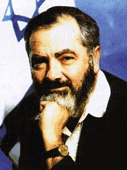
(1931 - 1990)
Meir David Kahane was a Jewish religious & Israeli nationalist activist who founded the Jewish Defense League (JDL). His controversial nature is a testament to the fact that he has been referred to as both a "visionary hero
of the Jewish people" and as a "criminal racist" or
"Kahanazi"
Kahane (born August 1, 1932; died November 5, 1990) was born in Brooklyn, New York. His father, Rabbi Charles Kahane, was involved in the Revisionist
Zionist movement, and was a close friend of Vladimir Jabotinsky. As a teenager, Meir became active in Betar, the militant revisionist
youth movement.
Kahane received a degree in International Law from
New York University, and ordination from the Mir Yeshiva in Brooklyn.
He edited the Jewish Press, and served as a pulpit rabbi and
teacher in New York until the mid-1960's. He also partnered with the
government in rallying Jewish support for the Vietnam War.
His life's work, however, really started in 1968, when he founded the Jewish
Defense League (JDL), whose activities were aimed at self-defense of the Jewish community in Brooklyn and harassment of Soviet activities in New York as a protest against the treatment of Jews in Russia. Kahane saw many of the poor and elderly Jews living
in the inner-city being targeted by criminals; as a result, he set out
to change the image of the Jew from "weak and vulnerable"
to one of a "mighty fighter, who strikes back fiercely against
tyrants." The JDL's controversial methods, which frequently included
the threat of, or actual violence, greatly exacerbated the Black-Jewish
tension already present in New York City. The JDL also focused on the
plight of Soviet Jewry, and coined the phrases "Never again,"
and "every Jew a .22" to emphasize that Jews would no longer
passively ignore the plight of their foreign brethren.
While some saw Kahane's goals as laudable, his actions were often criminal.
He spent time in jail after being convicted of conspiring to make bombs.
Kahane and his family moved to Israel in 1971, where he founded the
militantly anti-Arab Kach political party. The party's platform called for the
anexation of all conquered territories and the forcible removal of all
Palestinians. Under the auspices of Kach, Kahane continued to lobby
for his beliefs in violent ways, and was jailed on several occasions.
He was the first Jew in Israel to ever be accused of sedition.
Kahane ran for Knesset and lost in 1976 and 1980, but was finally elected in 1984. His movement
continued to grow until, prior to the 1988 Knesset elections, the Kach
party was banned from running by a Labor-Likud coalition. The ban was based on an amendment added to Israel's Basic
Law that disqualified any candidate whose platform included "incitment
to racism."
Two years later, in 1990, Kahane was assassinated in New York
City. An Egyptian-born Arab was acquitted of the murder on technicalities but in 1995 was sentenced to a long term of imprisonment for his involvement in Muslim fundamentalist terror in New York in relation to the 1993 World Trade Center bombing.
During his life, Kahane attempted to spread his message
through a variety of forums. He wrote numerous books espousing his opinions;
his most famous work, They Must Go, is alternately called a "magnum
opus" by Kahane's followers, and compared to Mein Kampf by his detractors. He also founded a seminary in Jerusalem,
called the "Yeshiva of the Jewish Idea." The school, which
still exists today, attempts to combine a traditional Jewish education
with right-wing political activism.
Even after his death, Kahane has had a tremendous
influence on the Israeli political scene. In March 1994, the Kach party
and its offshoot, Kahane Chai ("Kahane Lives"), founded by
Kahane's son Binyamin Zev, were officially designated as terrorist
organizations by both the Israeli government and the U.S. State
Department. The immediate cause of this designation was the February
1994 attack on the al-Ibrahimi Mosque in Hebron, in which Kach member
Baruch Goldstein shot 34 Muslims. Kach supported Goldstein's actions,
and referred to him as a "hero." More recently, Binyamin Zev
Kahane made waves by condoning Yigal Amir's 1995 assassination of Prime Minister Yitzhak Rabin.
Binyamin Zev Kahane was murdered by Arab extremists
in 2001, as he traveled with his family in the West
Bank. Several attacks on Palestinians in the West
Bank during the "al-Aksa intifada" have been attributed
to settlers affiliated with Kach or Kahane Chai.
Sources: The
Authentic Jewish Idea; The Jewish Defense League; Friedman, Robert I., The
False Prophet: Rabbi Meir Kahane: From FBI Informant to Knesset Member, London, 1990; Encyclopaedia
Judaica. © 2008 The Gale Group.
All Rights Reserved.
Photo: This file is licensed under the Creative Commons Attribution-Share Alike 3.0 Unported license. Author: Raayon-hayehudi |