Palestinian Refugees in Syria
(Updated January 2013)
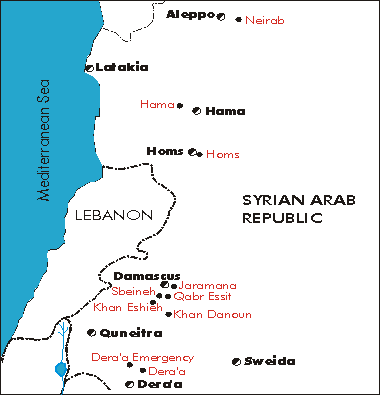
In Syria, UNRWA is mandated to provide health, education, and relief and social services to more than 486,000 Palestine refugees living in nine official and three unofficial camps. While Palestine refugees enjoy many of the rights of Syrian citizens, including access to social services provided by the Syrian government, development indicators reveal that they lag behind the host population in key areas, such as a higher infant mortality rate and lower school enrolment figures. Palestine refugees in Syria, like all Palestine refugees, remain a vulnerable population and live in uncertainty with regard to their long-term future.
Most of the Palestine refugees who fled to the Syrian Arab Republic in 1948 were from the northern part of Palestine, mainly from Safad and the cities of Haifa and Jaffa. A further 100,000 people, including Palestine refugees, fled from the Golan Heights to other parts of Syria when the area was occupied by Israel. A few thousand refugees fleeing war-torn Lebanon in 1982 also took refuge in Syria.
The ongoing political situation in Syria has affected the economy. The consequent decrease in value of the Syrian pound, increase in cost of basic commodities, and the shrinking job market have impacted the Palestine refugee community. As the UN agency responsible for their welfare, UNRWA is doing everything within its means to strengthen refugees’ ability to cope with the prevailing circumstances and eventually to achieve sustainable livelihoods.
Syria UNRWA Camps
Camp |
Approximate
Number of Refugees |
Khan Eshieh |
20,000 |
Khan Dunoun |
10,000 |
Sbeineh |
22,600 |
Qabr Essit |
23,700 |
Jaramana |
18,658 |
Dera'a |
10,000 |
Homs |
22,000 |
Hama |
8,000 |
Ein el-Tal |
6,000 |
Latakia |
10,000 |
Yamrouk |
148,500 |
Neirab |
20,500 |
TOTAL |
159,303 |
|
|
Facts and figures
- 499,189 registered refugees
- Nine camps
- 118 schools, with 66,586 pupils
- Damascus Training Centre
- 23 primary health centres
- Five community rehabilitation centres
- Five women's programme centres
Education
UNRWA operates 118 double-shift schools and offers basic elementary and preparatory education to 65,479 Palestine refugee children. Schools follow the national curriculum of the Syrian Ministry of Education. UNRWA also operates a vocational training centre in Damascus which prepares young refugees for employment by equipping them with marketable skills.
Health
UNRWA has a network of 23 primary healthcare centres which offer, among other services, pre-natal care for expectant mothers and their babies. UNRWA also provides environmental health services in the camps.
Relief and social services
UNRWA’s wide range of social services target the most vulnerable refugees including young people, women, the elderly, people with disabilities and the very poor. As well as serving Palestinians, the programme also runs specific projects to improve living conditions in the camps and has extended services to Palestinians who fled the war in Iraq.
Microfinance and microenterprise
Since its establishment in Syria in 2003, the microfinance programme has provided loans to micro-entrepreneurs and others who wish to start small businesses but do not qualify for bank loans. Due to its success, this programme has expanded quickly and a new office was opened in Aleppo. This brings to five the number of microfinance offices in Syria.
Sources: UNRWA |