Muslim Brotherhood
The Muslim Brotherhood - also called Muslim Brethren or The Society of the Muslim Brothers (Arabic: جمعية
الأخوان المسلمون Jamiat al-Ikhwan al-muslimun) - is an Islamic organization with a political approach
to Islam. It was founded in Egypt in 1928 by cleric Hassan al-Banna after the collapse of the Ottoman
Empire. Though many claim the organization decries violence, the Brotherhood is often viewed as the root source of Islamic terrorism.
- Ideology & Methodology
- Structure
- History
- Arab Spring Revolution
Ideology & Methodology
According to founder al-Banna, “It is the nature of Islam to dominate, not to be dominated, to impose its law on all nations and to extend its power to the entire planet.” Therefore, the Muslim Brotherhood opposes secular tendencies
of Islamic nations and wants a return to the precepts of the Qur'an. The Brotherhood firmly rejects all notions of Western influences in addition to rejecting extreme Sufism as well.
Brotherhood members organize events from prayer meetings to sport clubs for socializing.
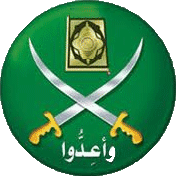 Muslim Brotherhood Logo
 |
The organization's motto: “Allah
is our objective. The Prophet is our leader. Qur'an is our law. Jihad is our way. Dying in the way of Allah is our highest hope.”
An important aspect of the Muslim Brotherhood ideology
is the sanctioning of jihad such as the 2004 fatwa issued by Sheikh Yusuf Al-Qaradawi making it
a religious obligation of Muslims to abduct and kill U.S. citizens in Iraq. al-Banna wrote that the Islamic flag must be raised again in the territories once ruled by Islam: "Thus, Andulasia (Spain), Sicily, the Balkans, the Italian coast, as well as the islands of the Mediterranean are all Muslim Meditarranean colonies, and they must return to the embrace of Islam."
The Brotherhood is also viewed by many in the Middle East and the West as the root source for Islamic terrorism. In 2005, a former Kuwaiti Minister of Education, Dr. Ahmad al-Rabi', wrote in the Saudi-owned Asharq al-awsat newspaper: "The beginings of all the religious terrrorism that we are witnessing today were int he Muslim Brotherhood's ideology .. all those who worked with bin-Laden and al-Qaida went out under the mandate of the Muslim Brotherhood."
Indeed, the Muslim Brotherhood not only condemned the US for killing bin-Laden in May 2011, they also facilitated the growth of al-Qaida. Abdullah Azzam, bin-Laden's mentor, came out of the Jordanian Muslim Brotherhood; Ayman al-Zawahiri, bin-Laden's deputy, came from the Egyptian Muslim Brotherhood; Khalid Sheikh Mohammed, mastermind of the 9/11 attacks, grew up in the Kuwaiti Muslim Brotherhood.
Muslim Brotherhood leaders also urge followers to restore Palestine and rescue Jerusalem. For example, in July 2012, Brotherhood General Guide Muhammad Badi' stated in a sermon: "Every Muslim must act to save Jerusalem from the usurpers and to [liberate] Palestine from the claws of occupation. This is a personal duty for all Muslims. They must participate in jihad by [donating] money or [sacrificing] their life." In another sermon, Badi' spoke in a similar vein: "How glad the Muslims will be if all Muslim rulers make the Palestinian cause a pivotal matter, and [if] the rulers and subjects rally around it with the single goal of restoring the Al-Aqsa Mosque, saving it from the filth of the Zionists, and enacting Islamic sovereignty over the beloved land of Palestine." In 2010, al-Badi' issued a similar statement: "Palestine will not be liberated by hopes and prayers, but rather by Jihad and sacrifice."
The Muslim Brotherhood is always working to spread its concepts throughout Egypt and the Middle East to
gain more followers. They work on almost all social levels including: schools,
universities, mosques, politics, and professional offices. One main strategy of the Brotherhood is to use a grassroots network of social and charitable organizations to expand their membership base, gain trust, and illustrate Islam's relevance in all aspects of life.
Structure
The Brotherhood has branches in 70 countries and territories, including its main contingents in Egypt, Syria, Gaza, Libya, Tunisia, and Jordan. It also maintains active branches in the United Kingdom, France, and in numerous other European countries as well as in the United States.
The Brotherhood
claims to have taken part in most pro-Islamic conflicts, from the Arab-Israeli
wars and the Algerian War of Independence to recent conflicts in
Afghanistan and Kashmir as well as the Arab Spring Revolutions that swept across North Africa.
The Egyptian Brotherhood existed as a mostly social organization with underground political and militaristic wings due to fierce oppostion by President Hosni Mubarak. Following the Egyptian Revolution of 2011, however, the Brotherhood emerged empowered, pulling in a plurarity 36% of votes for the new parliament and having their candidate, Mohamed Morsi, win in the presidential elections.
Elsewhere, the Brotherhood is also gaining prominence in the political sphere. For instance, in Tunisia, the Muslim Brotherhood affiliate Ennahda was founded in 1981, banned in 1992 but gained control of the Tunisian government in their recent elections, holding 89 out of 217 seats in the Constituent Assembly, the most of any party. In Morocco, the Brotherhoods' Justice and Development Party (PJD) won 107 of 395 seats and holds 12 of Morocco’s 31 cabinet positions including Prime Minister. In Jordan, the Muslim Brotherhood political party, Islamic Action Front, is posing a potential challenge to the government. In Syria, the Muslim Brotherhood is taking a leading role in the civil war and is believed to be in a position to take control if Bashar Assad is forced out of the government.
History
The Muslim Brotherhood began as a social and religious organization
in Egypt whose members regarded Islam as
a way of life. Many Syrian supporters founded their own branches in Syria, one of which was the
Aleppo branch, founded in 1935. The Aleppo branch eventually became
the Syrian headquarters of the Brotherhood. The Brotherhood expanded
its political involvement as the Party of the Muslim Brotherhood, Hizb
al-Ikhwan al-Muslimun.
The Brotherhood's founder, al-Banna, was a devout admirer of Adolf Hitler and the Nazi regime. During the 1930s, the Brotherhood became more political
in nature and an officially political group in 1939. Over the years, the organization developed an apparatus through which to provide military training to its followers and to engage in political terrorism against Egyptian Coptic Christians and government officials.
In 1942, during World
War II, Hassan al-Banna set up more Brotherhood branches in Transjordan
and Palestine. The headquarters of the Syrian branch moved to Damascus
in 1944. After World War II, Egyptian members took violent action against
King Farouk’s government. When the organization was banned in
Egypt, hundreds moved to Transjordan. Many also participated in the Arab-Israeli War of 1948-1949.
The Egyptian Muslim Brotherhood initially supported Gamal Abd an-Nasser's secular
government and cooperated with it, but resisted left-wing influences.
A Muslim Brother assassinated Egyptian Prime Minister Mahmud Fahmi Nokrashi
on December 28, 1948. The Brotherhood was banned, and al-Banna himself
was killed by government agents in Cairo in February 1949.
Muslim Brother Abdul Munim Abdul Rauf allegedly tried
to kill Nasser on October
26, 1954. The Brotherhood was outlawed again and more than 4,000 of
its members were imprisoned, including Sayyid Qutb, who later became
the most influential intellectual of the group. He wrote influential
books while in prison. More members moved to Jordan, Lebanon, Saudi
Arabia, and Syria.
The organization opposed the alliance Egypt had with
the USSR at the time, and opposed the communist influence in Egypt,
to the extent that it was reportedly supported by the CIA during the
1960s.
Nasser legalized the Brotherhood again in 1964, and
released all prisoners. After claiming more assassination attempts against
him, he had leaders executed in 1966 and imprisoned most others again.
Nasser's successor in Egypt, Anwar Sadat, promised reforms,
and that he would implement Shariah. However, Sadat's peace
treaty with Israel in 1979 angered the Brotherhood, which led to
his assassination in 1981.
In the 1950s, Jordanian members supported King
Hussein of Jordan against
political opposition and against Nasser's attempts to overthrow him.
When the King banned political parties in Jordan in 1957, the Brotherhood
was exempted.
The Syrian branch was the next to be banned when Syria joined Egypt in the United
Arab Republic (UAR) in 1958. The Brotherhood went underground. When
Syria left the UAR 1961, the Brotherhood won 10 seats in the next elections.
However, the Ba’th coup in 1963 forced them underground once more,
alongside all the other political groups.
The appointment of Hafez
al-Assad, an Alawite Muslim, as the Syrian president in 1971 angered
the Brotherhood even more because the majority of Muslims do not consider
Alawites true Muslims at all. Assad initially tried to placate them,
but made very little progress. Assad’s support of Maronites in
the Lebanese Civil War made the Brotherhood re-declare its jihad.
They began a campaign of strikes and terrorist actions. In 1979, they
killed 83 Alawite cadets in the Aleppo artillery school. Assad’s
attempts to calm them by changing officials and releasing political
prisoners did not help. Eventually the army was used to restore order
by force.
An assassination attempt against Assad on June 25, 1980, was the last straw. Assad made the Syrian parliament
declare Brotherhood membership a capital offense and sent the army against
them. In the operation, which lasted until February of 1982, the Syrian
army practically wiped out the Brotherhood, killing an unknown but large
number of people in the Hama Massacre. The Syrian branch disappeared,
and the survivors fled to join Islamic organizations in other countries.
The Saudi Arabian branch convinced king Ibn Saud to
let them start the Islamic University in Medina in 1961. After the Six-Day
War in 1967, the movement as a whole split into moderates and radicals.
The latter faction in Syria declared jihad against
the Ba'th party leaders. King
Hussein allowed the Jordanian branch to give military training to
Brotherhood rebels in Jordan.
In 1973, the Israeli government allowed local leader Ahmad Yassin to run social,
religious and welfare institutions among Palestinian Muslims. In 1983,
he was arrested for illegal possession of firearms and sentenced to
prison. When he was released 1985, he became more popular then ever.
When the first Intifada began in 1987, he became one of the founders of Hamas.
In 1984, the Muslim Brotherhood was partially reaccepted
in Egypt as a religious organization,
but was placed under heavy scrutiny by security forces. It remains a
source of friction.
In 1989, the Jordanian Brotherhood's political wing,
the Islamic Action Front, won 23 out of 80 seats in Jordan's parliament. King Hussein tried to
limit their influence by changing the election laws, but in the 1993
elections, they became the largest group in the parliament. They strongly
opposed the Jordanian-Israeli Peace
Treaty in 1994.
In the early days of the Soviet-Afghan war, the Muslim
Brotherhood was seen as a constituent part of the Afghan anti-communist
opposition.
The resistance movement in Afghanistan formed in opposition
to the leftist policies of King Zahir Shah. The movement had connections
to the Muslim Brotherhood.
The Russian government alleges that the Muslim Brotherhood
is a key force in the ongoing Chechen revolt. Russian officials accused
the Muslim Brotherhood of planning the December 27, 2002 suicide car
bombing of the headquarters of the Russian-backed government in Grozny,
Chechnya.
Though the Muslim Brotherhood is now viewed as a more
moderate group than other Islamist organizations operation in the Middle
East, such as al-Qaida,
and has participated in free elections in countries where they were
permitted to, messages delivered by the group's Supreme Guides have
made clear the Brotherhood remains committed to militancy. In September
2010, Muhammad Badi’ gave a sermon in which he said, "...
the improvement and change that the [Muslim] nation seeks can only be
attained through jihad and sacrifice and by raising a jihadi generation that pursues death, just as the enemies pursue life."
In an effort to possibly hide their militant Islamit
rules from the eyes of Western observers, the Brotherhood removed the
organizational by-laws from their main English language website in mid-February
2011. The bylaws, which were still available to Arabic readers, have
long been a source of discussion and debate because of the group's stated
goal of establishing an Islamic state while uniting Muslims around the
world. For example, section E of the bylaws states, "Need to work
on establishing the Islamic State, which seeks to effectively implement
the provisions of Islam and its teachings." Likewise, Section G
reads as follows: "The sincere support for a global cooperation
in accordance with the provisions of the Islamic Sharia ... and constructive
participation towards building a new basis of human civilization as
is ensured by the overall teachings of Islam."
Arab Spring Revolution
In January 2011, riots broke out on the streets of Cairo and soon the entire country was enveloped in revolution. Quickly termed the Arab Spring, the revolts in Egypt eventually led to the ouster of President Hosni Mubarak and the possibility for democracy to finally take hold in the country. Throughout the first few months of revolution, the Brotherhood kept a suprisingly low profile amongst those protesting in the streets and in Cairo's now famous Tahrir Square, though public opinion polls conducted in the wake of Mubarak stepping down showed that an increasing 75% of Egyptians voiced support in some form for the Brotherhood.
Before Mubarak officially removed himself from office, the Brotherhood initally supported Mohamed ElBaradei to lead the opposition forces against the government. Muslim Brotherhood demonstrator, though, referred to people like ElBaradei as "hamir al-thawra," donkeys of the revolution, suggesting they hoped to exploit ElBaradei in order to hijack the Egyptian revolution for their own agenda.
In June 2011, the Egyptian official news agency recognized the Muslim Brotherhood as a legitimate party for the first time since it was outlawed by the government in 1954. Recognized as the "Freedom and Justice Party (FJP)," the Brotherhood was given permission to run in parliamentary elections that were scheduled for late 2011. Abdel Moneim Abul Futuh, a senior member of the Brotherhood, announced that he would run for president as an independent in the election to be held after the parliamentary vote, though the Islamist group said they would not field a candidate.
In two rounds of parliamentary elections towards the end of 2011, the Brotherhood's FJP managed to beat many expectations of those in the West, and pulled in 36.3% of the general vote. Together with the ultra-conservative Salafi al-Nour Party, which won 28.8% of the votes, Egypt's two leading Islamist parties won about two-thirds of votes for party lists in the second round of polling for a parliament that will help draft a new constitution after decades of autocratic rule.
In January 2012, FJP's deputy leader and Brotherhood member Dr. Rashad Bayoumi told Arabic daily al-Hayat in an interview that Egypt’s Muslim Brotherhood will not recognize Israel “under any circumstance.” When asked whether it is a requirement for the government in Egypt to recognize Israel, Bayoumi responded by saying: “This is not an option, whatever the circumstances, we do not recognize Israel at all. It’s an occupying criminal enemy.” The deputy leader stressed during the interview that no Muslim Brotherhood members would ever meet with Israelis for negotiations.“I will not allow myself to sit down with criminals.”
Though the FJP had previously announced it would not field a candidate for the presidential elections, in March 2012, the Brotherhood's party announced that Khairat El-Shater, an engineer and businessman, would be their official representative. In April, however, the the Supreme Presidential Election Committee officially disqualified El-Shater from candidacy because of prior criminal convictions against him.
In response to El-Shater's suspension, the FJP placed Mohamed Morsi as their new candidate in April 2012. Morsi, a lifetime Brotherhood member, has served as media spokesman for the Brotherhood's Guidance Office before taking the position to lead their political party. In the first round of elections in May 2012, Morsi emerged as one of the top two vote-getters, amassing 24.8% of the vote, and qualified for the final election run-off set to take place the following month.
In late June 2012, almost a week after the run-off election between Morsi and secularist candidate Ahmed Shafik, official results confirmed that Morsi had garnered 51.7% of the votes and therefore won the presidency, making him the first ever candidate from an Islamist party to become head-of-state of an Arab country. He also becomes Egypt’s fifth president and the first from outside the militry.
Sources: Jerusalem Post (January 1, 2012; June 7, 2011); New York Times (June 25, 2012); Leadership Action Network (July 2012); MEMRI (July 23, 2012); The
Investigative Project on Terrorism (February 28, 2011); JCPA (February 2, 2011); Israel HaYom, (June 22, 2012); Wikipedia |