The images most people have of the Holocaust are those from the pictures taken after liberation:
the emaciated bodies of the living, half-burned corpses, ashes in crematoria
ovens, stacks of naked bodies, and mountains of hair, glasses, and shoes.
Photographs, however, cannot capture the sounds of suffering or the
smell of death.
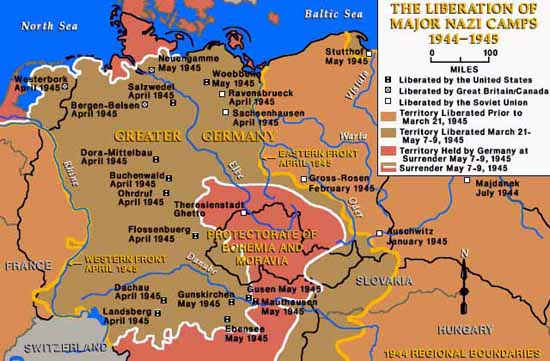
The death camp Majdanek in Poland was the first to be liberated. Soviet soldiers entered the camp
in the final stages of the war, on July 23, 1944.
Few prisoners were found alive, but they did find 800,000 pairs of shoes.
Shortly thereafter the Red Army overran several other killing centers.
On January 27, 1945,
they entered Auschwitz and
there found hundreds of sick and exhausted prisoners. The Germans had
been forced to leave these prisoners behind in their hasty retreat from
the camp. Also left behind were victims' belongings: 348,820 men's suits,
836,255 women's coats, and tens of thousands of pairs of shoes
The Allies did not liberate their first camps until
April 1945, when the British entered Bergen-Belsen and the Americans liberated Buchenwald and Dachau. Although the Germans had
attempted to empty the camps of surviving prisoners and hide all evidence
of their crimes, the Allied soldiers came upon thousands of dead bodies
"stacked up like cordwood," according to one American soldier.
The prisoners who were still alive were living skeletons. The headline
of one Army journalist’s story may have expressed the liberators’
feelings best, “Dachau Gives Answer To Why We Fought.”
Even after the Allies arrived, many prisoners were
beyond help. In Bergen-Belsen,
for example, 300 former prisoners died each day for a week. Half of
the prisoners discovered alive in Auschwitz died within a few days of being freed. Nearly 2,500 of the 33,000 survivors
of Dachau died within six weeks of liberation.
Disease, malnourishment, and mistreatment had worn them down too much.
After the camps were liberated, prisoners sometimes
took justice into their own hands and turned on their guards. In a few
instances, the liberators themselves were so horrified by what they
saw that they summarily executed the Nazis they captured
Survivors had mixed reactions to their newfound freedom.
While a few looked forward to being reunited with other family members,
some felt guilty for surviving when so many of their relatives and friends
had died. Some felt overwhelmed, as one survivor, Viktor Frankl, a psychiatrist,
expressed: "Timidly, we looked around and glanced at each other
questioningly. Then we ventured a few steps out of the camp. This time
no orders were shouted at us, nor was there any need to duck quickly
to avoid a blow or a kick. 'Freedom,' we repeated to ourselves, and
yet we could not grasp it."