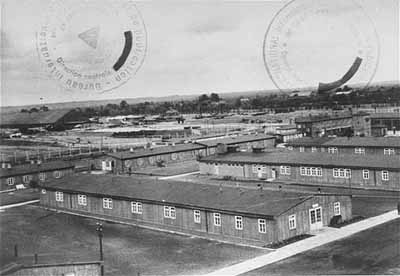
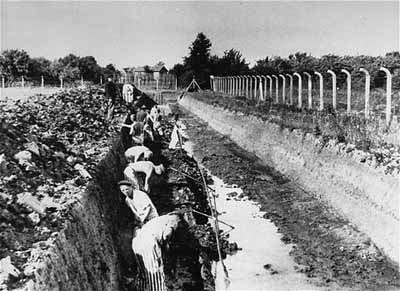
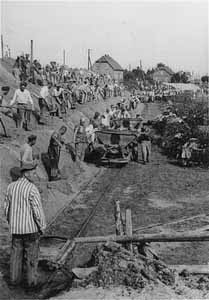
Built in December 1938 by one hundred inmates transferred from Sachsenhausen concentration camp, Neuengamme concentration camp was established around an empty brickworks in Hamburg-Neuengamme. The bricks produced there were to be used for the "Fuehrer buildings", part of the National Socialists' redevelopment plans for the river Elbe in Hamburg. Until June 4th, 1940, Neuengamme was a sub-camp of Sachsenhausen. At this date Neuengamme became an independent concentration camp, under the direct control of the overseer of concentration camps. The prisoners worked on the construction of the camp and the brickworks, regulating the flow of the Dove-Elbe river and the building of a branch canal, as well as on the mining of clay. The number of inmates increased dramatically in only a few months: in 1940, the population of the camp was 2,000 prisoners (with a proportion of 80% German inmates among them), Between 1940 and 1945, more than 95,000 prisoners were incarcerated in Neuengamme. On April 10th, 1945, the number of prisoners in the camp itself was 13,500. More than 2,000 men and 10,300 women were working in the different sub-camps depending on Neuengamme SS administration.
From the very first weeks of its existence to its liberation, Neuengamme was a deadly hell for the inmates. Despite the nearly nonexistent food rations, the inmates had to perform hard labor in all weather and under constant beatings of the SS guards. Very soon, the mortality rate reached an incredible level. Starvation, physical abuse, and total lack of hygiene and medical care very soon killed hundreds of inmates. During the war, tens of thousands of people were deported as concentration camp prisoners to Neuengamme from all over occupied Europe by the Nazis. In most cases they were incarcerated for having resisted German occupation, having refused to perform forced labor or simply as victims of racial persecution. From 80% in 1940, the proportion of Germans among the inmates decreased to approximately10%.
From 1942 on, the inmates were forced to work in the Nazi armament production. Initially the work was performed in the workshops of the camp but soon it was decided to transfer prisoners to the armaments factories located in the surroundings areas. At the end of the war, the external kommandos of Neuengamme spread all over northern Germany. Because of the Allied advance, hundreds of inmates were also forced to dig antitank ditches. In many large north German cities, concentration camp prisoners cleared rubble and removed corpses in the wake of bombing raids. All in all, there were 96 sub-camps, with 20 sub-camps for women. In early spring 1945, more than 45,000 inmates were working for the Nazi industry, with a third of women among them. At this time, the internal population of Neuengamme was 13,500 and the camp was completely overcrowded. The estimated number of victims in Neuengamme is approximately 56,000. Thousands of inmates were hanged, shot, gassed, killed by lethal injection or transferred to the death camps Auschwitz and Majdanek. In the last weeks of the war, the SS decided to evacuate Neuengamme. This was the start of one of the worst death marches of the war. During these death marches, approximately 10,000 inmates perished by shootings or simply starvation. The destination of one of these death marches was Neustadt, a German haven where the inmates had to be transported on a liner transformed into a military freighter: the "Cap Arcona". On April 27th, 1945, another freighter, the "Athen", arrived in Neustadt with 2,500 inmates from the Dora concentration camp. They were immediately transferred to the "Cap Arcona". Another ship, the "Thielbeck", arrived later with 2,500 inmates from other camps. On May 3rd, 1945, 3 PM, three "Typhoon" fighters from the RAF attacked the three ships. There were 7,500 inmates on board. Only 500 of them survived. Sources: The Forgotten Camps |