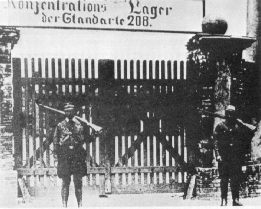
Officially, Esterwegen was not considered as a concentration camp but as a "Strafgefangenenlager" - "punishment camp for prisoners". Of course, the living conditions in this camp were the same as in the concentration camps: tortures, executions, forced work in the swamps until death, etc... In 1941, several prisoners of war coming from Belgium, France, Holland and Tchecoslovaquia as well as non-German political prisoners were transferred to Esterwegen. On this date, it became a sub-camp of the concentration camp of Neuengame. One of the most famous prisoner of Esterwegen was the German writer Karl Von Ossietzky. As pacifist and Nazi opponent, Karl von Ossietzky was jailed at Esterwegen since several months after he received the Nobel Prize of Peace in 1936. He was extremely weak and had been beaten and tortured several times. A emissary from the Helvetic Red Cross was sent to Esterwegen to inspect the condition of detention of Karl Von Ossietsky: "The SS officer came back with a shivering man, pale as death, a poor creature who seemed unable to feel anything. All his teeth were broken and he had a broken leg. I came to him for a handshake. He did not respond..." With the Nobel Prize, Karl von Ossietsky represented a problem for the Nazis: they could not kill him because he was at this time known worldwide. So he was transferred to a civil hospital where he died in 1938, under the close watching of the Gestapo. Very little is known about Esterwegen. The German local administration did all they could to deny the existence of a camp at Esterwegen. There were no crematory in the camp. Hundreds of victims are buried in a cemetery not far from the camp. In the years 1970's, the camp was occupied by the Bundeswehr (the German army). At this time, it was strictly forbidden to take any picture of the place. Sources: The Forgotten Camps |