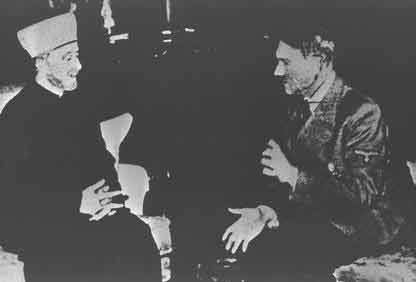
The Mufti and the Führer
(November 1941)
In 1941, Haj
Amin al-Husseini fled to Germany and met with Adolf
Hitler, Heinrich Himmler, Joachim Von Ribbentrop and other Nazi leaders. He wanted to persuade them to extend the Nazis’
anti-Jewish program to the Arab world.
The Mufti sent Hitler 15 drafts of declarations he
wanted Germany and Italy to make concerning the Middle East. One called on the two countries
to declare the illegality of the Jewish home in Palestine. Furthermore,
“they accord to Palestine and to other Arab countries the right
to solve the problem of the Jewish elements in Palestine and other Arab
countries, in accordance with the interest of the Arabs and, by the
same method, that the question is now being settled in the Axis countries.”1
In November 1941, the Mufti
met with Hitler, who told him the Jews were his foremost enemy. The
Nazi dictator rebuffed the Mufti's requests for a declaration in support
of the Arabs, however, telling him the time was not right. The Mufti
offered Hitler his “thanks for the sympathy which he had always shown
for the Arab and especially Palestinian cause, and to which he had given
clear expression in his public speeches....The Arabs were Germany's
natural friends because they had the same enemies as had Germany,
namely....the Jews....” Hitler replied:
Germany stood for uncompromising war against the
Jews. That naturally included active opposition to the Jewish national
home in Palestine....Germany would furnish positive and practical aid to
the Arabs involved in the same struggle....Germany's objective
[is]...solely the destruction of the Jewish element residing in the Arab
sphere....In that hour the Mufti would be the most authoritative
spokesman for the Arab world. The Mufti thanked Hitler profusely.2
In 1945, Yugoslavia sought to indict the Mufti as a war
criminal for his role in recruiting 20,000 Muslim volunteers for the SS, who participated in
the killing of Jews in Croatia and Hungary. He escaped from French detention
in 1946, however, and continued his fight against the Jews from Cairo
and later Beirut. He died in 1974.
Read more about the conversation between Hitler and the Mufti, CLICK HERE.
Sources:
1 “Grand Mufti Plotted To Do Away With All
Jews In Mideast,” Response, (Fall 1991), pp. 2-3.
2 Record of the Conversation Between the Fuhrer
and the Grand Mufti of Jerusalem on November 28, 1941, in the Presence of
Reich Foreign Minister and Minister Grobba in Berlin, Documents on
German Foreign Policy, 1918-1945, Series D, Vol. XIII, London, 1964,
p. 881ff in Walter Lacquer and Barry Rubin, The
Israel-Arab Reader, (NY: Facts on File, 1984), pp. 79-84.
|