History & Overview
Hebron, located in the Judean hills south of Jerusalem, is the site of the oldest Jewish community
in the world, dating back to Biblical times. Today, Hebron is home to some 250,000 Palestinians and approximately 700 Jews. An additional 6,000 Jews live in the adjacent community of Kiryat Arba.
- Introduction
- From Biblical Times to 1967
- Reestablishing the Jewish Community
- Distinction between "H1" & "H2"
- Shuhada Street & the Old City
- Cave of Machpelah/Ibrahimi Mosque
Introduction
Hebron (Al-Khalil in Arabic) is located
32 kilometers south of Jerusalem and is built on
several hills and wadis, most of which run north-
to-south. The Hebrew word "Hebron" is
explained as being derived from the Hebrew
word for "friend"
("haver"), a description for the Patriarch
Abraham.
The Arabic "Al- Khalil,"
literally "the friend," has
a nearly identical derivation and also refers to
Abraham (Ibrahim), whom Muslims similarly describe as the friend of God. Hebron is
one of the oldest continually occupied cities in the
world, and has been a major focus of religious worship
for over two millenia.
Hebron has a long and rich Jewish history and is the site of the oldest Jewish community
in the world. The Book
of Genesis relates that Abraham purchased the field where the Tomb
of the Patriarchs is located as a burial place for his wife Sarah.
According to Jewish tradition, the Patriarchs Abraham, Isaac and Jacob,
as well the Matriarchs Sarah, Rebecca, and Leah are all buried in the Tomb.
King David was anointed
King of Israel in Hebron, and he reigned in the city for seven years. One thousand years later,
during the first Jewish revolt against the Romans,
the city was the scene of extensive fighting. Jews lived in Hebron
continuously throughout the Byzantine, Arab, Mameluke
and Ottoman periods and it
was only in 1929 that the city became temporarily "free" of Jews as a result of a murderous Arab pogrom in which 67 Jews were murdered and the remainder forced to flee. After
the 1967 Six-Day War, the
Jewish community of Hebron was re-established.
Today, Hebron has a mostly Sunni Muslim population and its Jewish community is
comprised of roughly 700 people, including approximately 150 yeshiva students. An
additional 6,650 Jews live in the adjacent community
of Kiryat Arba.
Hebron's climate has, since Biblical times, encouraged extensive
agriculture and such areas surround
the city. Farmers in the Hebron region usually
cultivate fruits such as grapes and plums.
In addition to agriculture, local economy
relies on handicraft, small- and medium-scale
industry and construction. Hebron
is one of the most important marketplaces
in the Palestinian Territories.
From Biblical Times to 1967
Numbers 13:22 states that (Canaanite) Hebron was founded seven years before the Egyptian
town of Zoan, i.e. around 1720 BCE, and the ancient (Canaanite and Israelite)
city of Hebron was situated at Tel Rumeida. The city's history has been
inseparably linked with the Cave
of Machpelah, which the Patriarch Abraham purchased from Ephron the Hittite for 400 silver shekels (Genesis
23), as a family tomb. As recorded in Genesis, the Patriarchs Abraham, Isaac, and Jacob,
and the Matriarchs Sarah, Rebekah and Leah,
are buried there, and — according to a Jewish tradition — Adam and Eve are also buried there.
Hebron is mentioned 87 times in the Bible, and is
the world's oldest Jewish community. Joshua assigned Hebron to Caleb
from the tribe of Judah (Joshua
14:13-14), who subsequently led his tribe in conquering the city
and its environs (Judges 1:1-20).
As Joshua 14:15 notes, "the former name of Hebron was Kiryat Arba..."
Following the death of King Saul, God instructed David
to go to Hebron, where he was anointed King of Judah (II
Samuel 2:1-4). A little more than 7.5 years later, David was anointed
King over all Israel, in Hebron (II
Samuel 5:1-3).
The city was part of the united kingdom and —
later — the southern Kingdom of Judah,
until the latter fell to the Babylonians in 586 BCE. Despite the loss of Jewish independence, Jews continued
to live in Hebron (Nehemiah
11:25), and the city was later incorporated into the (Jewish) Hasmonean kingdom by John Hyrcanus.
King Herod (reigned 37-4
BCE) built the base of the present structure — the 12 meter high
wall — over the Tomb
the Patriarchs.
The city was the scene of extensive fighting during
the Jewish Revolt against
the Romans (65-70, see Josephus 4:529, 554), but Jews continued to live there after the Revolt, through
the later Bar Kochba Revolt (132-135 CE), and into the Byzantine period. The remains of a synagogue from the Byzantine period have been excavated in the city, and the Byzantines
built a large church over the Tomb of the Patriarchs, incorporating
the pre- existing Herodian structure.
Jews continued to live in Hebron after
the city's conquest by the Arabs (in 638), whose generally
tolerant rule was welcomed, especially after the often harsh
Byzantine rule — although the Byzantines never forbade
Jews from praying at the Tomb. The Arabs converted the Byzantine
church at the Tomb
the Patriarchs into a mosque.
Upon capturing the city in 1100, the Crusaders expelled
the Jewish community, and converted the mosque at the Tomb back into
a church. The Jewish community was re-established following the Mamelukes' conquest of the city in 1260, and the Mamelukes reconverted the church
at the Tomb of the Patriarchs back into a mosque. However, the restored
Islamic (Mameluke) ascendancy was less tolerant than the pre-Crusader
Islamic (Arab) regimes — a 1266 decree barred Jews (and Christians)
from entering the Tomb of the Patriarchs, allowing them only to ascend
to the fifth, later the seventh, step outside the eastern wall. The
Jewish cemetery -- on a hill west of the Tomb — was first mentioned
in a letter dated to 1290.
The Ottoman Turks' conquest of the city in 1517 was marked by a violent pogrom which
included many deaths, rapes, and the plundering of Jewish homes. The
surviving Jews fled to Beirut and did not return until 1533. In 1540,
Jewish exiles from Spain acquired
the site of the "Court of the Jews" and built the Avraham
Avinu ("Abraham Our Father") synagogue. (One year — according
to local legend — when the requisite quorum for prayer was lacking,
the Patriarch Abraham himself appeared to complete the quorum; hence, the name of the synagogue.)
Despite the events of 1517, its general poverty and
a devastating plague in 1619, the Hebron Jewish community grew. Throughout
the Turkish period (1517-1917), groups of Jews from other parts of the
Land of Israel, and the Diaspora,
moved to Hebron from time to time, joining the existing community, and
the city became a rabbinic center of note.
In 1775, the Hebron Jewish community was
rocked by a blood libel, in which Jews were falsely accused
of murdering the son of a local sheikh. The community --
which was largely sustained by donations from abroad -- was
made to pay a crushing fine, which further worsened its already
shaky economic situation. Despite its poverty, the community
managed, in 1807, to purchase a 5-dunam plot -- upon which
the city's wholesale market stands today -- and after several
years the sale was recognized by the Hebron Waqf. In 1811,
800 dunams of land were acquired to expand the cemetery.
In 1817, the Jewish community numbered approximately 500,
and by 1838, it had grown to 700, despite a pogrom which
took place in 1834, during Mohammed Ali's rebellion against
the Ottomans (1831-1840).
In 1870, a wealthy Turkish Jew, Haim Yisrael Romano,
moved to Hebron and purchased a plot of land upon which his family built
a large residence and guest house, which came to be called Beit Romano.
The building later housed a synagogue and served as a yeshiva, before
it was seized by the Turks. During the Mandatory
period, the building served the British administration as a police
station, remand center, and court house.
In 1893, the building later known as Beit
Hadassah was built by the Hebron Jewish community as
a clinic, and a second floor was added in 1909. The American
Zionist Hadassah organization contributed the salaries of
the clinic's medical staff, who served both the city's Jewish
and Arab populations.
During World War I, before the British
occupation, the Jewish community suffered greatly under the
wartime Turkish administration. Young men were forcibly conscripted
into the Turkish army, overseas financial assistance was
cut off, and the community was threatened by hunger and disease.
However, with the establishment of the British administration
in 1918, the community, reduced to 430 people, began to recover.
In 1925, Rabbi Mordechai Epstein established a new yeshiva,
and by 1929, the population had risen to 700 again.
On August 23, 1929, local Arabs devastated the Jewish
community by perpetrating a vicious, large-scale, organized, pogrom.
According to the Encyclopedia Judaica:
"The assault was well planned and
its aim was well defined: the elimination of the Jewish
settlement of Hebron. The rioters did not spare women,
children, or the aged; the British gave passive assent.
Sixty-seven were killed, 60 wounded, the community was
destroyed, synagogues razed, and Torah scrolls burned."
A total of 59 of the 67 victims were buried
in a common grave in the Jewish cemetery (including 23 who
had been murdered in one house alone, and then dismembered),
and the surviving Jews fled to Jerusalem. (During the violence,
Haj Issa el-Kourdieh -- a local Arab who lived in a house
in the Jewish Quarter -- sheltered 33 Jews in his basement
and protected them from the rioting mob.) However, in 1931,
31 Jewish families returned to Hebron and re-established
the community. This effort was short-lived, and in April
1936, fearing another massacre, the British authorities evacuated
the community.
Following the creation of the State of Israel in 1948, and the invasion by Arab armies, Hebron
was captured and occupied by the Jordanian Arab Legion. During the Jordanian
occupation, which lasted until 1967, Jews were not permitted to live
in the city, nor -- despite the Armistice
Agreement -- to visit or pray at the Jewish holy sites in the city.
Additionally, the Jordanian authorities and local residents undertook
a systematic campaign to eliminate any evidence of the Jewish presence
in the city. They razed the Jewish Quarter, desecrated the Jewish cemetery
and built an animal pen on the ruins of the Avraham Avinu synagogue.
Reestablishing the Jewish Community
Israel returned to Hebron in 1967.
The old Jewish Quarter had been destroyed and the
cemetery was devastated. Since 1968, the re-established
Jewish community in Hebron itself has been linked
to the nearby community of Kiryat
Arba. On April 4, 1968, a group of Jews registered
at the Park Hotel in the city. The next day they
announced that they had come to re- establish Hebron's
Jewish community. The actions sparked a nationwide
debate and drew support from across the political
spectrum. After an initial period of deliberation,
Prime Minister Levi
Eshkol's Labor-led government decided to temporarily
move the group into a near-by IDF compound, while a new community -- to be called Kiryat
Arba -- was built adjacent to Hebron. The first 105
housing units were ready in the autumn of 1972.
In the decade following the Six
Day War, when the euphoria of the victory had subsided, Judea and
Samaria were still largely unsettled by Jews. Rabbi Moshe Levinger and
a group of like-minded individuals determined that
the time had come to return home to the newly liberated
heartland of Eretz Yisrael.
“As their first goal, the group decided
to renew the Jewish presence in the the Jewish People’s
most ancient city, Hebron. Word of the decision spread
quickly and soon a nucleus of families was formed.
Their objective: to spend Pesach in Hebron's Park
Hotel. Hebron's Arab hotel owners had fallen on hard
times. For years they had served the Jordanian aristocracy
who would visit regularly to enjoy Hebron's cool dry
air. The Six Day War forced the vacationers to change
their travel plans. As a result, the Park Hotel's Arab
owners were delighted to accept the cash-filled envelope
which Rabbi Levinger placed on the front desk. In exchange,
they agreed to rent the hotel to an unlimited amount
of people for an unspecified period of time.
“The morning of Erev Pesach, April,
1968 saw the Levinger family along with families from
Israel's north, south and center packed their belongings
for Hebron. They quickly cleaned and kashered the half
of the hotel's kitchen allotted to them and began to
settle in. Women and children slept three to a bed
in the hotel rooms, while the men found sleeping space
on the lobby floor. At least Ya'akov Avinu had a rock
to place under his head, remembered one of the men
in dismay.
“Eighty-eight people celebrated Pesach
Seder that night in the heart of Hebron. ‘We
sensed that we had made an historical breakthrough",
recalls Miriam Levinger, and we all felt deeply moved
and excited.’”
Today, Kiryat
Arba has approximately 6,650 residents. Its
built-up area comprises some 6,000 dunams, and is
located about 750 meters from the Tomb at its nearest
point. Kiryat Arba has its own elected local council,
schools, religious and community institutions, clinics,
and industrial/commercial zone. It draws its water
from mains coming from the Etzion
Bloc and the Herodion area to the north. About
half of its residents work in Jerusalem and
its environs; 30% are employed in local education,
health, and administrative services, and the remaining
20% are employed in local tourism, industry, and
commerce. Hebron
is also home to around 160,000 Palestinians
The Jewish community in Hebron itself was
re-established permanently in April 1979, when a group of
Jews from Kiryat
Arba moved into Beit
Hadassah (see page 2 above). Following a deadly terrorist
attack in May 1980 in which six Jews returning from prayers
at the Tomb of
the Patriarchs were murdered, and 20 wounded (see Annex
I below), Prime Minister Menachem
Begin's Likud-led government agreed to refurbish Beit
Hadassah, and to permit Jews to move into the adjacent
Beit Chason and Beit Schneerson, in the old Jewish Quarter.
An additional floor was built on Beit
Hadassah, and 11 families moved in during 1986.
Since 1980, other Jewish properties and
buildings in Hebron have been refurbished and rebuilt. Today
the Hebron Jewish community comprises 19 families living
in buildings adjacent to the Avraham Avinu courtyard (see
page 2 above), the area also houses two kindergartens, the
municipal committee offices, and a guesthouse; seven families
living in mobile homes at Tel Rumeida; twelve families living
in Beit Hadassah;
six families living in Beit Schneerson; one family living
in Beit Kastel; six families live in Beit Chason; Beit Romano,
home to the Shavei Hevron yeshiva, is currently being refurbished.
Local administration and services for the
Hebron Jewish community are provided by the Hebron Municipal
Committee, which was established by the Defense and Interior
Ministries, and whose functions are similar to those of Israel's
regular local councils. The Ministry of Housing and Construction
has established the "Association for the Renewal of
the Jewish Community in Hebron," to carry out projects
in the city. The Association is funded both through the state
budget and by private contributions. It deals with general
development of, and for, the Jewish community.
In addition to the Tomb
of the Patriarchs, Tel Rumeida, the Jewish cemetery,
and the historical residences mentioned above, other Jewish
sites in Hebron include: 1) the Tomb of Ruth and Jesse (King
David's father) which is located on a hillside overlooking
the cemetery; 2) the site of the Terebinths of Mamre ("Alonei
Mamre") from Genesis 18:1, where God appeared to Abraham,
which is located about 400 meters from the Glass Junction
(Herodian, Roman, and Byzantine remains mark the site today);
3) King David's Pool (also known as the Sultan's Pool), which
is located about 200 meters south of the road to the entrance
of the Tomb of the Patriarchs, which Jews hold to be the
pool referred to in II Samuel 4:12, 4) the Tomb of Abner,
Saul and David's general, which is located near the Tomb,
and 5) the Tomb of Othniel Ben Kenaz, the first Judge of
Israel (Judges 3:9-11).
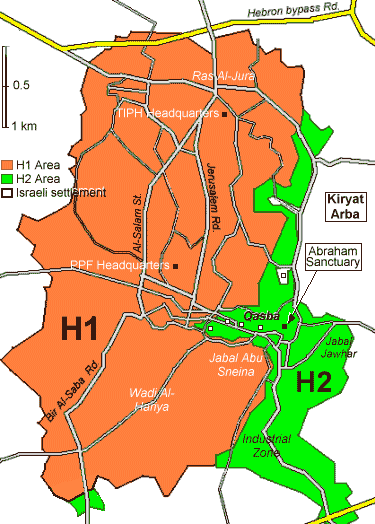
Distinction Between "H1" & "H2"
In January 1997, after nearly
thirty years of occupation, the Israel
Defense Forces (IDF) withdrew from some
80 percent of the Hebron municipal territory.
This redeployment, originally agreed upon
in the Interim
Agreement (Oslo II) of September 1995,
was postponed for several months, until a
new agreement - the "Protocol
Concerning the Redeployment in Hebron"
- was reached. In the meantime, most of the
biggest West Bank cities had already been
handed over to the Palestinian Authority.
In the Hebron Protocol, a
distinction is made between Hebron's "H1"
and "H2" areas. The status of the
largest part of the city, "H1",
is similar to the one pertaining to "Area
A". The Palestinian Police Forces (PPF)
exercise full control over "H1",
while the IDF are not allowed to enter, unless
escorted by Palestinian security forces. Yet,
the IDF maintain indirect control over this
part of the city, by occasionally establishing
checkpoints at entrances to the city, or by
closing these points of access. "H1"
covers residential sectors as well as the
commercial areas of Bab Al-Zawiya and Wadi
Al-Tuffah, situated west of the Old City.
In the remaining part of
the city, "H2", Israel maintains
military presence, as well as control over
various aspects of Palestinian daily life.
Palestinian civil institutions operate under
certain restrictions imposed by the Israeli
military administration. When it comes to
the PPF, they are only present when they participate
in joint patrols led by the IDF.
"H2" covers approximately
20 percent of the municipal territory. It
comprises the entire Qasba and areas adjacent
to the Jewish settlements. The population
in this area is composed of an estimated 30,000-35,000
Palestinians and approximately 400 Jewish
settlers.
This relatively small sector
is the geographic, economic, historic and
religious center of Hebron.
Shuhada Street & the Old City
One main road runs through
"H2" and connects the western to the eastern
part of the city: Al-Shuhada Street. The traffic
on this street, where three of the four Israeli
settlements of Hebron are located, is tightly
controlled by the IDF. Various restrictions
are imposed on Palestinian motorists who want
to use it. A bus station used to be located
along Al-Shuhada Street. This popular meeting
point was closed in 1986 and subsequently
turned into an Israeli military compound.
To this day, these successive measures have
led to the virtual extinction of the economic
activity along Al-Shuhada Street.
In spite of being located
inside the Israeli-controlled area of the
city, the Souq situated inside the Qasba and
behind Al-Shuhada Street remains one of the
busiest in the West Bank. However, the wholesale
vegetables market (Al-Hisbe), adjacent to
the Souq, has also been closed by Israel,
due to security considerations.
The Qasba itself is no longer among the most
densely populated areas of the city. Since
the first half of the twentieth century, its
population dropped from 8,000 to a few hundred.
To reverse this evolution, the Palestinian
local authorities have, since 1997, made a
continuous effort to renovate, rehabilitate
and develop the Old City. This led to an increase
in the number of families moving into the
Qasba. Similarly, efforts are being made to
highlight its cultural heritage.
Located northeast of the
Old City, the Ibrahimi Mosque/Cave
of Machpela is included in the area under
Israeli control, as are Islamic institutions,
and a number of old mosques.
Cave of Machpelah/Ibrahimi Mosque
The question of the Ibrahimi
Mosque/Cave of Machpela is among the most
sensitive issues in the Palestinian-Israeli
conflict. The sanctuary is dedicated to Abraham,
the patriarch of both Arabs and Jews. Deep-rooted
in Jewish tradition, the history of the Cave
of Machpela takes on a special importance,
as the site is believed to be the first piece
of land bought by Abraham in the Promised
Land.
Since the Islamic conquest
of the region, in the seventh century, the
site is predominantly revered by Muslims as
Al-Haram Al-Ibrahimi, the Abraham Sanctuary
or Ibrahimi Mosque. For seven centuries, its
access was restricted to Muslim worshippers
only. Jewish pilgrims were allowed to pray
at a special location, outside the building.
During the 1967
War, on the same day the Israeli troops
entered Hebron, the IDF chaplain placed a Torah scroll inside the Mosque. This initiative
made it possible for Jews to hold prayers
and religious services in various parts of
the sanctuary - sometimes at the same time
and place as the Muslims. This move raised
a wide indignation among the Arab public opinion
and Muslim clergymen. According to them, the
installation of a synagogue inside the sanctuary challenges the Muslim
character of the site.
The recent history of the
site was marked by the massacre of 29 Muslim
worshippers by a Kiryat
Arba settler, in February 1994. An Israeli
commission headed by Meir Shamgar examined
the circumstances of the bloodshed. Its recommendations
led to a number of new arrangements, such
as the establishment of a physical separation
between the worshippers of the two communities
and the tightening of the security checks
at the entrances. It was also decided that
on an equal number of days a year, the Ibrahimi
Mosque/Cave of Machpela would be reserved
for members of one community only.
Sources: Israeli Foreign Ministry; Temporary International Presence in Hebron |