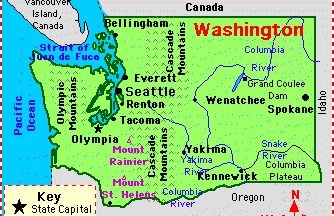
Washington and Israel
Trade and Population Statistics
| Exports to Israel (2015) |
$146,259,255 |
| Percentage Change (2014-2015) |
-30.84% |
| Total Exports to Israel (1996-Present) |
$3,160,808,137 |
| Israel's Trade Partner Rank (2015) |
47 |
| Military Contracts with Israel (2015) |
$3,783,725 |
| Jewish Population (2015) |
76,600 |
| Jewish Percentage of Population |
1.4% |
Binational
foundation grants shared by Washington and Israel
Grant recipients in
Washington from U.S.-Israel binational foundations:
Fred Hutchinson Cancer Research Center
John Fluke Mfg. Co. Inc.
Institute for Systems Biology
Medtronic Physio Control Inc.
Seattle Biomedical Research Institute
Sharplan Lasers Inc.
University of Washington
University of Washington Medical School
USDA-ARS Animal Diseases Research Unit
Washington State University
Bilateral
Institutions
Washington-Israel
Business Council -
WIBC's
mission s to support economic growth in Israel and Washington State
through stimulation and promotion of mutual commercial and educational
collaboration. The parallels between Israel and Washington State
plus the complimentary strengths of their business environments provides
many mutually-beneficial business opportunities in many different sectors.
WIBC primarily helps guide and assist Israeli companies who want to
expand into the US through Washington as well as US companies looking
to expand into Israel. Learn more about the Washington-Israel Businesss
Council, CLICK
HERE.
Cooperative
Agreements - "Memoranda of Understanding"
Help us build this
section of the Washington page. Email
AICE with any updates, additions, modifications or comments.
Washington Government Missions to Israel
August 2011 - Congresswoman Jaime
Herrera Buetler and Congressman Adam Smith accompanied the 81-member
Congressional delegation to Israel to learn more about regional politics
and the U.S.-Israel relationship.
July 1999 - Washington Attorney General
Christine O. Gregoire joined eight other attorneys general for a trip
to Israel. The participants in the mission went to explore U.S.-Israel
cooperation in legal affairs and discussed issues including youth violence,
the death penalty, and extradition laws.
Partners
For Change
The U.S.-Israel relationship is based on the twin
pillars of shared values and mutual interests. Given this commonality of
interests and beliefs, it should not be surprising that support for Israel
is one of the most pronounced and consistent foreign policy values of the
American people.
It is more difficult to devise programs that capitalize
on the two nations' shared values than their security interests;
nevertheless, such programs do exist. In fact, these SHARED VALUE
INITIATIVES cover a broad range of areas, including the environment,
science and technology, education and health.
As analyst David Pollock noted, Israel is an advanced country with a population that surpassed eight million people in 2013 and a robust, dynamic economy that allowed it to join the Organization for Economic Cooperation and Development (OECD). Between 2005 and 2013, Israel has represented a larger market for U.S. exports than Saudi Arabia. Although Israel's citizenry make up just 3 percent of the total region's population, Israel accounts for 25 percent of American exports in the Middle East.
"It has also been one of the top 20 foreign direct investors in the United States since 2009," Pollock confirms. He adds that "$2.25 billion of the $3 billion in annual U.S. aid to Israel comes back via Israeli purchases of U.S. military equipment - and that is just 5 percent of the total bilateral trade each year."
Today's interdependent global economy requires that
trade policy be developed at the national and state level.
Many states have recognized the opportunity for realizing
significant benefits by seeking to increase trade with Israel. Washington is one of 33 states that have cooperative
agreements with Israel.
In 2012, Washington exported over $73,721,151 worth
of manufacturing goods to Israel. Since 1996, Washington exports to
Israel have totaled more than $2,759,129,624 and Israel now ranks as Washington’s
25th leading trade partner.
Additionally in 2012, Washington received more than
$831,132.39 in foreign military financing (FMF) for US military aid
to Israel. Some of those companies that have received funding through FMF in 2012 or past years
include: Propulsion System Inc. in Seattle, B.E. Meyers & Co., Inc. in Redmond and United Western Technologies in Pasco.
Israel is certainly a place where potential business
and trade partners can be found. It can also be a source, however, for
innovative programs and ideas for addressing problems facing the citizens
of Washington.
Israel has developed a number of pioneering education programs. For example, AICE introduced an innovative Israeli
peer tutoring program to North Carolina that educators adapted for use
in the United States. Now known as Reading Together, the program is
used in 28 states. The program is designed to help students achieve
reading fluency and is mostly used for children in second grade. The
hope is that with its implementation, increasing numbers of students
will perform at grade level or above.
A range of other exciting approaches to social problems
like unemployment, environmental protection and drug abuse have been
successfully implemented in Israel and could be imported for the benefit
of Americans.
The potential for greater cooperation with Israel for
the benefit of Washington is limited only by the imagination.
Washington Firms
Profit From Business With Israel
As the only country with free trade agreements with both
the United States and the European community, Israel can act as a bridge
for international trade between the United States and Europe. Moreover,
because of the deep pool of talent, particularly in high-technology areas,
Israel provides excellent investment opportunities. Some of the nation's
largest companies, such as IBM, Coca-Cola, Motorola, Intel and McDonald's
have found that it is indeed profitable to do business in Israel.
More than 100 Washington companies
have discovered the benefits of doing business in Israel,
including Boeing, Microsoft, SEA-DMI, Advanced Hardware
Architecture, Mountain Safety Research and Advanced
Technology Lab.
In May 2000, SEA-DMI received a half-million dollar
order from the Israeli Navy for marine communications systems. This
equipment will become part of the Israeli navy's Global Marine Distress
Safety System (GMDSS). David Thompson, SEA-DMI’s President, states,
"We are pleased to receive this order because it represents growing
recognition of our GMDSS engineering efforts."
Nancy Shumann, Advanced Hardware Architecture’s
Product Marketing Manager, also enjoys working with Israelis. "They
are really nice, very smart business people...they have cutting edge
technologies," says Shumann. She views Israel as "forward looking
and technologically advanced." Advanced Hardware Architecture is a
semiconductor company that designs circuits for outside companies. They
produce most of their circuits in Israel and have many Israeli clients
including satellite and wireless communications companies.
Israel-based Schema Ltd. is an innovator of telecom
resource management (TRM) solutions that enable operators of wireless
networks worldwide to optimize and manage their resources. Washington-based
Watchmark Corp. is known worldwide for meeting the needs of modern telecommunication
networks. Both companies are jointly developing a leading product (killer
application) that will address the needs of wireless operators in today's
fiercely competitive CDMA market. It will be the first product in the
industry to provide true and powerful optimization to the process of
planning and maintenance of CDMA networks.
Mountain Safety Research Inc. (MSR) is a manufacturer
of outdoor sporting goods and sells these to an Israeli distributor,
Lapidot. Mike. Glavin, MSR’s sales and marketing manager states
that the distributor in Israel "has done an excellent job protecting
brand equity. They place products to the right people. They understand
the market well enough to place products where they belong — a
major strength of doing business with Israel."
Israel also plays a role in developing MSR’s sales
strategies. Israel understands what it takes to manufacture a product,
according to Gavin. "Their suggestions are useful and their input
is always welcome," he adds.
Another area of involvement in which U.S. firms compete
is the Israeli medical technology field. Advanced Technology Labs
Ultrasound (ATL) does business with an Israeli distributor, Medtechnics in
Tel Aviv. ATL has achieved a 70 percent overall market share in the
extremely competitive Israeli medical industry. Ties have grown strong
between these two companies. Kurt Kellin, Senior Area Manager for South
Europe, Middle East and Africa, states, "We have built a business with
our distributor, Medtechnica in Tel Aviv, it has been extremely rewarding,
personally and professionally. I have friends for life."
One good way to break into the Israeli market is through
a joint venture with an Israeli company. Funding for such projects is
available from the Binational
Industrial Research and Development Foundation (BIRD). BIRD funds projects throughout the states and hundreds of companies - including AOL, General Electric, BP Solar, Texas
Instruments and Johnson & Johnson - have benefitted from BIRD grants.
The United States and Israel established BIRD in 1977
to fund joint U.S.-Israeli teams in the development and subsequent commercialization
of innovative, nondefense technological products from which both the
Israeli and American company can expect to derive benefits commensurate
with the investments and risks. Most grant recipients are small businesses
involved with software, instrumentation, communications, medical devices
and semiconductors.
Since its inception, BIRD has funded more than 800
joint high-tech R&D projects through conditional grants totaling
more than $210 million. Products developed from these ventures have
generated more than $8 billion in direct and indirect revenues for both
countries and has helped to create an estimated 20,000 American jobs.
Dr. Eli Opper, the former Israeli chair of BIRD, has
said that BIRD is a strong pillar of US-Israel industrial
cooperation and that the extreme success of BIRD has
led Israel to adopt similar models of R&D with other countries.
Washington companies have benefited from more than
$700,000 in BIRD grants over the last three decades.
Scientific Innovations
Washington researchers are making scientific breakthroughs
and developing cutting-edge technologies in joint projects with Israeli
scientists thanks to support from the Binational
Science Foundation (BSF). BSF was established in 1972 to promote scientific relations
and cooperation between scientists from the United States and Israel.
The fund supports collaborative research projects in a wide area of
basic and applied scientific field for peaceful and non-profit purposes.
Since its inception, BSF has awarded some $480 million
through more than 4,000 grants in 45 states and the District of Columbia.
BSF-sponsored studies are highly successful
in achieving their two main goals: strengthening the US-Israel partnership
through science and promoting world-class scientific research for the
benefit of the two countries and all mankind. The BSF grants help extend research resources to achieve milestones that might
not otherwise be attainable; introduce novel approaches and techniques
to lead American researchers in new directions; confirm, clarify and
intensify research projects; and provide unmatched access to Israeli
equipment, facilities and research results that help speed American
scientific advances. BSF has documented no less than
75 new discoveries made possible by its research grants and counts 37
Nobel Prize and 19 Lasker Medical Award laureates among its joint partners.
The Fred Hutchinson Cancer Research Center and the
University of Washington are among the Washington institutions that
have shared with their counterparts in Israel more than $3.3 million
in BSF grants awarded since 1996 alone.
Fred Hutchinson's Gerald Smith and colleagues are
involved in the study of how DNA repair occurs. When DNA is broken it is
extremely dangerous to the cell. Dr. Smith researches how chromosomes break
leading to cancer and birth defects. The grant has given him new insight
into his own work and allows the labs to share antibodies. Smith considers
it "a good collaboration" and anticipates further cooperation in
the future.
University of Washington scientist Michael Schick is
studying polymers, which, among other things, are used to make plastic.
Polymers form layers at low temperatures; rarely do these layers fit
together evenly, usually they slam into one another, creating what is
called the grain boundary. The grain boundary affects the mechanical
properties of the polymer and overall energy of the system. Schick is
devising a theoretical model for the layered formation of polymers.
Schick enjoys working with the Israelis, "I'd
consider taking a sabbatical in Israel," he says. "Israel
has very good scientific talent. I've enjoyed working with them on a
scientific and personal level." He finds that Israel has done more
research in this field than the U.S. and he hopes to continue his relationship
with his Israeli counterparts and apply for new grants.
The University of Washington’s Lawrence Loeb and
his Israeli counterpart are studying the effects of the deterioration
of DNA replication, which leads to the fragile X syndrome, a genetic
disorder. Loeb says "the connection with Israel was vital and beneficial
to both sides." The research team has published more than 25 scientific
papers and co-authored a book.
In yet another BSF-sponsored project, Dr. Virginia
Berninger of the University of Washington is working with a team from
the University in Haifa led by Professor Zvia Breznitz that is researching
cognitive measurements of how children learn and how the brain reacts
to said learning. The group received a six-figure grant from the BSF
in late 2009 and have begun their initial stages of research using test
subjects from grades four and five. The work of the scientists is based
off of previous research done by both Berninger and Breznitz, which
can be viewed HERE.
Agriculture Benefits
In 1978 the United States and Israel jointly created
the Binational Agricultural
Research and Development Fund (BARD)
to help fund programs between US and Israeli scientists for mutually
beneficial, mission-oriented, strategic and applied research into agricultural
problems. Since its inception, BARD has funded more
than 1,000 projects in 45 states and the District of Columbia with a
total investment of more than $250 million. In 2000, an independent
and external economic review of 10 BARD projects conservatively
projected more than $700 million in revenue by the end of 2010, a number
which far outweighs the total investment in all BARD projects over its 33 year existence and helps to continually strengthen
the foundation.
Most BARD projects focus on either increasing agricultural
productivity, plant and animal health or food quality and safety and
have been influential in creating new technologies in drip irrigation,
pesticides, fish farming, livestock, poultry, disease control and farm
equipment. BARD funds projects in 45 states and the
District of Columbia and at present is beginning to administer collaborative
efforts between Australia, Canada and Israel as well. It is difficult
to break down the impact on a state-by-state basis, but overall, BARD-sponsored
research has generated sales of more than $500 million, tax revenues
of more than $100 million and created more than 5,000 American jobs.
Washington institutions have shared grants worth more
than $3.5 million since 1979.
Washington State University, College of Veterinary
Medicine professors Guy Palmer and Kelly Brayton have used BARD grants to collaborate with scientists at Israel's Veterinary Institute
in studying how to control Anaplasma marginale, the most prevalent
tick-borne pathogen of cattle worldwide. Professor Palmer originally
began this research in the 1980's and has received four BARD grants since that time when there were molecular tools to research anaplasmosis.
While blood-based vaccines for anaplasmosis are widely used
in many tropical countries, these vaccines cannot be licensed by the
US or the EU due to the unknown risk that these vaccines have in transmitting
both known and unknown pathogens. The BARD-supported
analysis between these Israeli and American scientists helped to isolate
different strains of the disease and reveal the nature of the problem.
Guy and his colleagues have developed a test that is
used by the USDA and others worldwide to test for certain types of proteins
that cause anaplasmosis. Their findings also include two antigens in
diseased cattle that may eventually be used as a vaccine. Since the
start of their research project, the American and Israeli scientists
have produced more than 70 primary reference manuscripts in high quality
journals, such as Science and the Journal of Immunology,
have co-authored 15 publications and have published more than 262 papers
on the subject since 1988. To read more about this genome sequencing
project, its history, importance and most recent research and findings, CLICK
HERE.
In another BARD project, William Catterall,
a professor in the School of Medicine at the University of Washington,
collaborated with a group of scientists from California, Pennsylvania
and Israel on a BARD sponsored project that examined
the production of non-hazardous insecticides. The group's work is not
yet completed, though they have made great strides toward developing
a new class of insecticides that are highly effective, not harmful to
animals and humans, and environmentally friendly; research that has
generated much interest in the scientific community worldwide. This
research has been on-going for nearly two decades and, as this is very
important to the farming industry in both the US and Israel, BARD continues to support the project today. With the increase in insecticides
used by farmers across both countries, they are raising pollutant levels
and, by sheer irony, also increasing incest resistance to these agents.
The insecticide the scientists are making will nullify these ill effects.
Read more about this important project, CLICK
HERE.
BARD research done outside the state
also benefits Washington. Research on an RNA virus, which kills young
seedlings, would be helpful for Washington's wheat industry. Washington
dairy farmers will benefit from research on boosting milk fat and protein
quality in cows. Washington state accounts for most of the $1 billion
apple crop in the U.S. and BARD research on preserving
crisp apples will significantly boost profits.
Other Cooperative
Programs
Help us build this section. Email AICE with any additions,
modifications, updates or comments. Thank you for your support.
Sister Cities:
WASHINGTON. . . . . .. . .. . . .. . . .. . . ..
.. . . . . . . . . . . . . . . . . . ISRAEL |
Seattle |
|
|
|
UJA Partnership 2000
Communities:
NEVADA. . . . . .. . .. . . .. . . .. . . ..
.. . . . . . . . . . . . . . . . . . ISRAEL |
Seattle |
|
State
Contacts:
Jewish Federation of Greater Seattle
2031 Third Ave.
Seattle, WA 98121
Tel. 206-443-5400
|