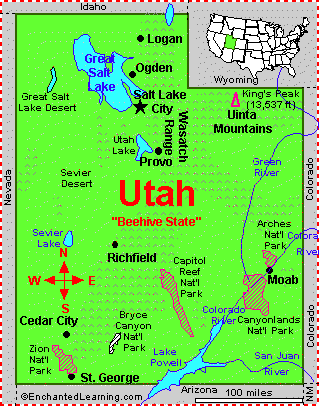
Utah and Israel
Trade and Population Statistics
| Exports to Israel (2015) |
$40,492,426 |
| Percentage Change (2014-2015) |
-31.71% |
| Total Exports to Israel (1996-Present) |
$711,111,380 |
| Israel's Trade Partner Rank (2015) |
29 |
| Military Contracts with Israel (2015) |
$1,820,319 |
| Jewish Population (2015) |
11,600 |
| Jewish Percentage of Population |
0.57% |
Binational
foundation grants shared by Utah and Israel
Grant recipients in
Utah from U.S.-Israel binational foundations:
Aerotrans Corp.
Brigham Young University
Evans & Sutherland
Fairchild Semiconductors Corp.
Logan State University
Myriad genetics, Inc.
Novell Inc.
University of Utah
University of Utah Medical School
Utah State University
Wicat Systems Inc.
Bilateral
Institutions
None. Help us build this section. Email AICE with updates,
additions, corrections or comments.
Cooperative
Agreements - "Memoranda of Understanding"
In February 2012, the Utah State Senate unanimously passed resolution S.J.R.18, sponsored by Senator Curt Bramble [R-Orem], that recognized Utah's cultural, economic, military and security bonds to Israel. Rep. Patrice Arent [D-Salt Lake City], co-sponsored the measure in the Utah House of Representatives.
Utah Government Missions to Israel
April 2013 - Governor Gary Herbert is planning a state-wide trade mission to Israel to help develop connections in the Middle East for companies based in Utah. The delegation will be participating in key meetings with government and industry experts and officials in Tel Aviv and Jerusalem. Networking opportunities with Israeli companies, local chambers of commerce and other U.S. companies already doing business in Israel will be also available. Apply for the trip, CLICK HERE.
January 2012 - State Senate President Michael Waddoups [R-Taylorsville] ook part in a trade mission to Israel with the National Conference of State Legislatures. "Not only am I glad I did it, I'd love to do it again," Waddoups said. Learn more, CLICK HERE.
November 2011 - Provo mayor John Curtis
traveled to Israel with the American Jewish Comittee (AJC) and four
other major U.S. city mayors as part of Project Interchange, and AJC-run
educational institute.
May 2009 - Governor Jon Huntsman led
a delegation of Utah business and government leaders in a trade mission
to Israel. The governor used this mission in an attempt to expand strategic
relationships between Utah and Israel. The governor sees much potential
in Utah partnerships with Israel on alternative energy development and
water conservation, both issues very important to Utah's economy. Read
more about the mission, CLICK
HERE.
Partners
For Change
The U.S.-Israel relationship is based on the twin
pillars of shared values and mutual interests. Given this commonality of
interests and beliefs, it should not be surprising that support for Israel
is one of the most pronounced and consistent foreign policy values of the
American people.
It is more difficult to devise programs that capitalize
on the two nations' shared values than their security interests;
nevertheless, such programs do exist. In fact, these SHARED VALUE
INITIATIVES cover a broad range of areas, including the environment,
science and technology, education and health.
As analyst David Pollock noted, Israel is an advanced country with a population that surpassed eight million people in 2013 and a robust, dynamic economy that allowed it to join the Organization for Economic Cooperation and Development (OECD). Between 2005 and 2013, Israel has represented a larger market for U.S. exports than Saudi Arabia. Although Israel's citizenry make up just 3 percent of the total region's population, Israel accounts for 25 percent of American exports in the Middle East.
"It has also been one of the top 20 foreign direct investors in the United States since 2009," Pollock confirms. He adds that "$2.25 billion of the $3 billion in annual U.S. aid to Israel comes back via Israeli purchases of U.S. military equipment - and that is just 5 percent of the total bilateral trade each year."
Today's interdependent global economy requires that
trade policy be developed at the national and state level.
Many states have recognized the opportunity for realizing
significant benefits by seeking to increase trade with Israel. Utah is one of 33 states that have cooperative
agreements with Israel.
In 2012, Utah exported over $50 million worth
of manufacturing goods to Israel. Since 1996, Utah exports to
Israel have totaled nearly $600 million and Israel now ranks as Utah’s 33rd leading trade partner.
Additionally in 2012, Utah received more than
$103,000 in foreign military financing (FMF) for US military aid
to Israel. Some of those companies that have received funding through FMF in 2012 or past years
are Hydro Engineering Inc. in Salt Lake City and Camnetics Manufacturing Corp. in Clinton.
Israel is certainly a place where potential business
and trade partners can be found. It can also be a source, however, for
innovative programs and ideas for addressing problems facing the citizens
of Utah.
Israel has developed a number of pioneering education programs. For example, AICE introduced an innovative Israeli
peer tutoring program to North Carolina that educators adapted for use
in the United States. Now known as Reading Together, the program is
used in 28 states. The program is designed to help students achieve
reading fluency and is mostly used for children in second grade. The
hope is that with its implementation, increasing numbers of students
will perform at grade level or above.
A range of other exciting approaches to social problems
like unemployment, environmental protection and drug abuse have been
successfully implemented in Israel and could be imported for the benefit
of Americans.
The potential for greater cooperation with Israel for
the benefit of Utah is limited only by the imagination.
Utah Firms Profit
From Business With Israel
As the only country with free trade
agreements with both the United States and the European
community, Israel can act as a bridge for international
trade between the United States and Europe. Moreover,
because of the deep pool of talent, particularly
in high-technology areas, Israel provides excellent
investment opportunities. Some of the nation's largest
companies, such as IBM, Microsoft, Motorola, Intel
and McDonald's have found that it is indeed profitable
to do business in Israel.
Roughly 50 Utah companies have discovered
the benefits of doing business in Israel, including
Hexcel Corporation and Wicat.
Michael Backall, Communications
and Investor Relations Manager of Hexcel Corporation
stated that Hexcel has had a "long standing
relationship with the Israeli aircraft and airline
industry, since the 1960's or 70's." Over this
period of time, Hexcel has sold spare parts and replacement
materials to El Al for their Boeing aircrafts and
has supplied private companies that supply Israeli
Aircraft Industries (IAI). Backall says, "Israel
has been a long-standing, valued customer. It has
been a productive and helpful relationship. Our dealing
with them have been mutually satisfactory." Backall
considers the Israelis to be good customers and looks
forward to working with them in the future.
Another airline supplier, Wicat,
provided El Al computer-based training solutions
to learn how to fly and to use devices. Tod Peterson,
Director of Marketing, says, "We would like
to continue doing business with El Al and we are
actively pursuing business with them." El Al
bought a $250,000 purchase from them in the past,
and Wicat is currently pursing another purchase for
one-half to one and half million dollars
Wicat enjoys a special relationship
with El Al and considers it one of their closest
relationships compared with other airlines. "We
value their relationship deeply and they even help
us get other clients," says Peterson.
One good way to break into the Israeli market is through
a joint venture with an Israeli company. Funding for such projects is
available from the Binational
Industrial Research and Development Foundation (BIRD). BIRD funds projects in 36 states and the District of
Columbia and hundreds of companies including AOL, GE, BP Solar, Texas
Instruments and Johnson & Johnson have benefitted from BIRD grants.
The United States and Israel established BIRD in 1977
to fund joint U.S.-Israeli teams in the development and subsequent commercialization
of innovative, nondefense technological products from which both the
Israeli and American company can expect to derive benefits commensurate
with the investments and risks. Most grant recipients are small businesses
involved with software, instrumentation, communications, medical devices
and semiconductors.
Since its inception, BIRD has funded more than 800
joint high-tech R&D projects through conditional grants totaling
more than $210 million. Products developed from these ventures have
generated more than $8 billion in direct and indirect revenues for both
countries and has helped to create an estimated 20,000 American jobs.
Dr. Eli Opper, the former Israeli chair of BIRD, has
said that BIRD is a strong pillar of US-Israel industrial
cooperation and that the extreme success of BIRD has
led Israel to adopt similar models of R&D with other countries.
Utah companies have benefited from more than $800,000
in BIRD grants over the last three decades.
Scientific
Innovations
Utah researchers are making scientific breakthroughs
and developing cutting-edge technologies in joint projects with Israeli
scientists thanks to support from the Binational
Science Foundation (BSF). BSF was established in 1972 to promote scientific relations
and cooperation between scientists from the United States and Israel.
The fund supports collaborative research projects in a wide area of
basic and applied scientific field for peaceful and non-profit purposes.
Since its inception, BSF has awarded some $480 million
through more than 4,000 grants in 45 states and the District of Columbia.
BSF-sponsored studies are highly successful
in achieving their two main goals: strengthening the US-Israel partnership
through science and promoting world-class scientific research for the
benefit of the two countries and all mankind. The BSF grants help extend research resources to achieve milestones that might
not otherwise be attainable; introduce novel approaches and techniques
to lead American researchers in new directions; confirm, clarify and
intensify research projects; and provide unmatched access to Israeli
equipment, facilities and research results that help speed American
scientific advances. BSF has documented no less than
75 new discoveries made possible by its research grants and counts 37
Nobel Prize and 19 Lasker Medical Award laureates among its joint partners.
The University of Utah (UT) and Brigham Young University
are among the Utah institutions that have shared with their counterparts
in Israel nearly $2 million in BSF grants awarded since
1996 alone.
UT physicist Alexei Efros and his
colleagues have been exploring the electron system
in atoms. They are working on a computer simulation
that will provide a theoretical model for electron
transfer between various energy states. Efros says
that he is in "permanent contact" with
his Israeli counterparts. Together they have produced
a number of papers and they share the workload between
their two labs. He works on the physical aspects
of the experiments, while they compute the results.
Efros adds that he is "delighted to work with
Israelis, they are good scientists and very good
physicists."
BYU scientist Thomas Fletcher is doing concurrent research
with the Israelis on increasing the efficiency of power plants, which
make electricity from coal. His approach is to use a dual system of
a gas turban and a steam turban to create energy in the power plant.
His dual system will increase the energy efficiency from its current
level of 35 percent to 60 percent. "The grant has been beneficial
to my work and to progress in general," states Fletcher. Their
research is ongoing and he hopes to publish some joint papers in the
near future.
Agriculture
Benefits
In 1978 the United States and Israel jointly created
the Binational Agricultural
Research and Development Fund (BARD)
to help fund programs between US and Israeli scientists for mutually
beneficial, mission-oriented, strategic and applied research into agricultural
problems. Since its inception, BARD has funded more
than 1,000 projects in 45 states and the District of Columbia with a
total investment of more than $250 million. In 2000, an independent
and external economic review of 10 BARD projects conservatively
projected more than $700 million in revenue by the end of 2010, a number
which far outweighs the total investment in all BARD projects over its 33 year existence and helps to continually strengthen
the foundation.
Most BARD projects focus on either increasing agricultural
productivity, plant and animal health or food quality and safety and
have been influential in creating new technologies in drip irrigation,
pesticides, fish farming, livestock, poultry, disease control and farm
equipment. BARD funds projects in 45 states and the
District of Columbia and at present is beginning to administer collaborative
efforts between Australia, Canada and Israel as well. It is difficult
to break down the impact on a state-by-state basis, but overall, BARD-sponsored
research has generated sales of more than $500 million, tax revenues
of more than $100 million and created more than 5,000 American jobs.
Utah institutions have shared grants worth more than
$1.3 million since 1979. .
The University of Utah's Orly's Ardon is studying iron
metabolism in yeast. She is using yeast as a model organism for plants
and animals. She is learning where iron is stored in cells and about
the genes responsible for its uptake into cells. Dr. Ardon is currently
visiting the University of Utah from Israel through the BARD grant. She enjoys working with Americans and was excited to be working
at one of the most advanced institutes in the state. Working in the
U.S. has allowed her to study things she was not able to study in Israel.
There have been a number of publications of her research and more are
on the way.
Utah State University's Fredrick
Provenza is working with U.S. and Israeli scientists
to understand the compound polyethylene glycol (peg),
which allows animals (such as cattle and sheep) to
eat toxic foods called tannins. Many plants are high
in tannins, which reduce the digestibility of food
or cause toxic affects in animals. Peg compound binds
to tannins which 1) allows animals to utilize plants
that otherwise they could not have eaten (because
if only one type of plant is eaten on a field, its
supply is exhausted and other plants overrun the
field), 2) increase biodiversity in fields used for
grazing and 3) increases the use of animals as tools
to manipulate vegetation (in some areas animals are
used instead of machines to clear away woody plants
(high in tannins), thus saving fuel and energy and
using a more natural approach).
Dr. Provenza praised his Israeli colleagues and said
that they do "tremendous work to understand nutrition and toxicological
factors of tannins and peg and are world leaders in this field of research."
The BARD grant has allowed him to explore areas that
he was unable to before.
A second scientist at Utah State University, R.J Hanks,
has studied for more than ten years the problems of saline irrigation
for various plants, such as wheat and alfalfa, and has designed a management
process to solve them. His research highlights the importance of maximizing
irrigation rates for each crop. Too much salt accumulated near the roots
of plants decrease crop yields over time.
Other
Cooperative Programs
Help us build this section of the Utah state page. Email AICE with any updates,
additions, comments or corrections.
Sister Cities:
UJA Partnership 2000
Communities:
UTAH. . . . . .. . .. . . .. . . .. . . ..
.. . . . . . . . . . . . . . . . . . ISRAEL |
Salt
Lake City |
|
State
Contacts:
Dov Raviv
Anat Vered
Representative-Israel
State of Utah
International Business Development Office
P.O. Box 65065
Tel Aviv
61650, Israel
Tel. 972-3-642-5051
Fax. 972-3-641-5363
Email. [email protected]
Web. http://www.utahtrade.com
United Jewish Federation of Utah
2416 E. 1700 South
Salt Lake City, UT 84108
Tel. 801-581-0102
|