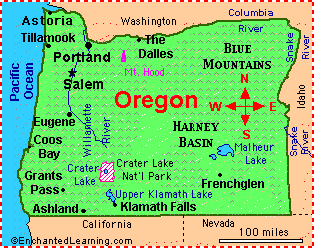
Oregon and Israel
Trade and Population Statistics
| Exports to Israel (2015) |
$218,978,302 |
| Percentage Change (2014-2015) |
+11.46% |
| Total Exports to Israel (1996-Present) |
$1883,489,263 |
| Israel's Trade Partner Rank (2015) |
19 |
| Military Contracts with Israel (2015) |
$1,207,220 |
| Jewish Population (2015) |
38,100 |
| Jewish Percentage of Population |
1.24% |
Binational
foundation grants shared by Oregon and Israel
Grant recipients in
Oregon from U.S.-Israel binational foundations:
Decision Research
Electro Scientific Industries Inc.
nCUBE Corp.
Oregon Grad. Inst. Science & Tech.
Oregon Health Sciences University
Oregon State University
Tektronix Inc.
University of Oregon
VA Medical Center
Bilateral
Institutions
Oregon-Israel Business
Alliance -
Formed in 2010
under the leadership of Governor Ted Kulongoski and various Israeli
government officials, the OIBA held its inaugural event on the campus
of the University of Oregon in Portland and was attended by officials
from the State of Oregon, the City of Portland and businesspeople from
the biotech, high-tech and cleantech industries. During his speech at
the event, Gov Kulongoski described "the secret" to cooperation
between the two sides as relating to Israel's advancement in water technologies
and Oregon's expertise in forestry. Learn more about this newly established
bilateral organization, CLICK
HERE.
Cooperative
Agreements - "Memoranda of Understanding"
In October 2010, Governor Ted
Kulongoski signed a memorandum of understanding with the Israeli
government "to develop and strengthen economic, industrial, technological
and commercial cooperation." According to the Governor's press
release, the agreement "is in the best interest of the people of
Oregon. Israel is a strong and democratic friend of Oregon and the United
States. This agreement will build on our existing trade relationship
with Israel, open up new opportunities to share information and foster
commercial ties in areas that are vital to Oregon's economic future."
Read about the debate this MOU sparked, CLICK
HERE.
Oregon Government Missions to Israel
November 2010 - Governor Ted Kulongoski
led another business development mission to Israel, his second such
trip since taking office in Oregon. The Governor's delegation included
business leaders who helped Gov Kulongoski with the goal of promoting
Oregon as the ideal partner for green energy, security, and manufacturing
projects, while also opening new markets for Oregon products. Read more
about the mission, CLICK
HERE.
April 2008 - Governor Ted Kulongoski
led a business development mission in Israel where he met with representatives
from Intel’s Israeli research and development (R&D) facility
among a number of other such companies operating in Israel. “Oregon
is home to Intel’s largest production facility in the world, which
is the back bone of Oregon’s renowned ‘silicon forest’
semiconductor industry,” Governor Kulongoski said. “I want
the state to do everything it can to keep Oregon on the cutting edge
of silicon technology, which is such a driving force of Oregon’s
economy.” Read more about the Governor's trip, CLICK
HERE.
Partners
For Change
The U.S.-Israel relationship is based on the twin
pillars of shared values and mutual interests. Given this commonality of
interests and beliefs, it should not be surprising that support for Israel
is one of the most pronounced and consistent foreign policy values of the
American people.
It is more difficult to devise programs that capitalize
on the two nations' shared values than their security interests;
nevertheless, such programs do exist. In fact, these SHARED VALUE
INITIATIVES cover a broad range of areas, including the environment,
science and technology, education and health.
As analyst David Pollock noted, Israel is an advanced country with a population that surpassed eight million people in 2013 and a robust, dynamic economy that allowed it to join the Organization for Economic Cooperation and Development (OECD). Between 2005 and 2013, Israel has represented a larger market for U.S. exports than Saudi Arabia. Although Israel's citizenry make up just 3 percent of the total region's population, Israel accounts for 25 percent of American exports in the Middle East.
"It has also been one of the top 20 foreign direct investors in the United States since 2009," Pollock confirms. He adds that "$2.25 billion of the $3 billion in annual U.S. aid to Israel comes back via Israeli purchases of U.S. military equipment - and that is just 5 percent of the total bilateral trade each year."
Today's interdependent global economy requires that
trade policy be developed at the national and state level.
Many states have recognized the opportunity for realizing
significant benefits by seeking to increase trade with Israel. Oregon is one of 33 states that have cooperative
agreements with Israel.
In 2012, Oregon exported over $172,351,044 worth
of manufacturing goods to Israel. Since 1996, Oregon exports to
Israel have totaled more than $1,558,202,931 and Israel now ranks as Oregon’s
14th leading trade partner.
Additionally in 2012, Oregon received more than
$3,364,666 in foreign military financing (FMF) for US military aid
to Israel. Some of those companies that have received funding through FMF in 2012 or past years
include: Freeman Marine Equipment, Inc. in Gold Beach, Engineering Design Team Inc. in Beaverton and Service Steel, Inc. in Portland.
Israel is certainly a place where potential business
and trade partners can be found. It can also be a source, however, for
innovative programs and ideas for addressing problems facing the citizens
of Oregon.
Israel has developed a number of pioneering education programs. For example, AICE introduced an innovative Israeli
peer tutoring program to North Carolina that educators adapted for use
in the United States. Now known as Reading Together, the program is
used in 28 states. The program is designed to help students achieve
reading fluency and is mostly used for children in second grade. The
hope is that with its implementation, increasing numbers of students
will perform at grade level or above.
A range of other exciting approaches to social problems
like unemployment, environmental protection and drug abuse have been
successfully implemented in Israel and could be imported for the benefit
of Americans.
The potential for greater cooperation with Israel for
the benefit of Oregon is limited only by the imagination.
Oregon Firms Profit
From Business With Israel
As the only country with free trade agreements with both
the United States and the European community, Israel can act as a bridge
for international trade between the United States and Europe. Moreover,
because of the deep pool of talent, particularly in high-technology areas,
Israel provides excellent investment opportunities. Some of the nation's
largest companies, such as IBM, Microsoft, Motorola, Intel and McDonald's
have found that it is indeed profitable to do business in Israel.
Many Oregon companies have discovered the benefits
of doing business in Israel, including EDX Engineering Inc., Mentor
Graphics and Electro Scientific Industries.
Jennifer Dunkin, customer relations manager at EDX
Engineering Inc., has been selling engineering software to Israelis for at
least five years. "They are always very kind and interested in
training and using software correctly. They are high-level users,"
says Dunkins. She also enjoys the contacts she has made working with
Israelis and trusts their references. Dunkin finds Israelis easy to work
with and looks forward to working with them in the future.
Another Oregon-based company, Mentor Graphics, has been
doing business in Israel since 1986 selling graphic software tools and
applications to the Israeli government. These tools are used for
telecommunications, consumer electronics, semiconductors and aerospace.
Most of the purchases are made through the New York Office of the Israeli
Ministry of Defense. According to Judy Erdmann, European Liason for Mentor
Graphics, "it is very worthwhile to do business in Israel" and
she "highly recommends that other companies do business in
Israel."
Joe Reinhart, Vice President of Business Development at
Electro Scientific Industries, also feels that "Israel is a good place
to do business." Electra Scientific supplies equipment to Israel for
the production of semiconductors and makes close to $5-10 million dollars a
year. Electra Scientific has a good deal of business in Israel and has
cooperative projects with many Israeli companies, including Vishay Israel.
One good way to break into the Israeli market is through
a joint venture with an Israeli company. Funding for such projects is
available from the Binational
Industrial Research and Development Foundation (BIRD). BIRD funds projects in 36 states and the District of
Columbia and hundreds of companies including AOL, GE, BP Solar, Texas
Instruments and Johnson & Johnson have benefitted from BIRD grants.
The United States and Israel established BIRD in 1977
to fund joint U.S.-Israeli teams in the development and subsequent commercialization
of innovative, nondefense technological products from which both the
Israeli and American company can expect to derive benefits commensurate
with the investments and risks. Most grant recipients are small businesses
involved with software, instrumentation, communications, medical devices
and semiconductors.
Since its inception, BIRD has funded more than 800
joint high-tech R&D projects through conditional grants totaling
more than $210 million. Products developed from these ventures have
generated more than $8 billion in direct and indirect revenues for both
countries and has helped to create an estimated 20,000 American jobs.
Dr. Eli Opper, the former Israeli chair of BIRD, has
said that BIRD is a strong pillar of US-Israel industrial
cooperation and that the extreme success of BIRD has
led Israel to adopt similar models of R&D with other countries.
nCUBE and Electro Scientific are two of a number of
Oregon-based companies that have profited from more than $1 million
dollars in BIRD grants since 1980.
Scientific Innovations
Oregon researchers are making scientific breakthroughs
and developing cutting-edge technologies in joint projects with Israeli
scientists thanks to support from the Binational
Science Foundation (BSF). BSF was established in 1972 to promote scientific relations
and cooperation between scientists from the United States and Israel.
The fund supports collaborative research projects in a wide area of
basic and applied scientific field for peaceful and non-profit purposes.
Since its inception, BSF has awarded some $480 million
through more than 4,000 grants in 45 states and the District of Columbia.
BSF-sponsored studies are highly successful
in achieving their two main goals: strengthening the US-Israel partnership
through science and promoting world-class scientific research for the
benefit of the two countries and all mankind. The BSF grants help extend research resources to achieve milestones that might
not otherwise be attainable; introduce novel approaches and techniques
to lead American researchers in new directions; confirm, clarify and
intensify research projects; and provide unmatched access to Israeli
equipment, facilities and research results that help speed American
scientific advances. BSF has documented no less than
75 new discoveries made possible by its research grants and counts 37
Nobel Prize and 19 Lasker Medical Award laureates among its joint partners.
Institutions such as Oregon State University, Oregon
Health Science University and the University of Oregon are among the
Oregon institutions that have shared with their counterparts in Israel
nearly $2.42 million in BSF grants awarded since 1996
alone.
In 2009, Professor Hiro Nonogaki of Oregon State University
was awarded a four year BSF grant to collaborate with
Dr. Aaron Fait of Ben Gurion University of the Negev in Sde Boker, Israel.
The BSF project, called “Spatial Diversification
of Metabolism at Germination”, is in the midst of its on-going
research. The project focuses on the mechanisms of seed germination,
which is an important initial step in agricultural production. Successful
germination is the key to the establishment of vigorous plants that
will lead to high crop yields. Germination is realized through many
biochemical and molecular changes in seeds, which have not been fully
understood. This project aims to elucidate the mechanisms underlying
seed germination. The principal investigator in Israel is currently
working on profiling small chemical substances in seeds while the U.S.
researcher visited Sede Boqer, Israel to train Israeli researchers and
students for tissue specific gene expression analysis. The integration
of the different expertise will draw a complete picture of seed germination.
The knowledge obtained from this project will contribute to technology
development for seed enhancement and will contribute to global seed
business.
Professor Nonogaki is extremely excited about the possibilites
that this BSF project could open for the agricultural
community in the future. As Prof Nonogaki himself attests, "The
support from the U.S.-Israel Binational Science Foundation provides
excellent opportunities for U.S. scientists and their counterpart in
Israel." Without the support of BSF, it is wholly
possible to realize that this project would never have gotten off the
ground.
Oregon State University Zoologist Virginia Weiss has
been collaborating with her Israeli counterpart for four years. She is
researching soft coral, a symbiosis of animal and micro algae, which is
commonly found in the Red Sea. Israel has one of the best coral reefs in
the world, which is accessible year-round and Weiss hopes to understand how
the animal and plant parts interact in coral. In this collaboration, Weiss’s
counterpart in Israel has access to the coral and special microscopes,
while she researches the molecular biology aspects of the issue. "This
research could not have happened without my partner," states Weiss.
Another BSF recipient, C. T. Roberts,
a scientist from Oregon Health Sciences University, has been collaborating
with an Israeli counterpart since 1989. They are researching how tumor
suppressor genes regulate and prevent growth factor action in cancer
cells. "The BSF grant has allowed us to continue
our international collaborations" states Roberts. The team has
written more than 40 publications, with more in progress. Their research
is especially relevant to the study of breast and prostate cancer.
Michael Kavanaugh, another Oregon Health Sciences University
scientist, is studying how molecules found on the surface of brain cells
transport glutamate. These molecules are involved in certain neuro-degenerative
diseases, such as strokes and ALS (Lou Gehrig’s disease). Through
this collaborative work, Kavanaugh hopes to learn the role of these
molecules in the diseases. According to Kavanaugh, "the BSF grant has facilitated the collaboration and pushed our understanding
further." Over a three-four year period, Kavanaugh and his Israeli
counterpart have written six or seven papers together.
The University of Oregon’s William Trevarrow has
been collaborating with Israeli scientist Clay Davis on research dealing
with Zebra fish. The research has provided a novel approach to identify
genes that detect proteins in the early development of Zebra fish. He
believes that it is a "technologically innovative and creative
project." Trevarrow hopes to collaborate with more Israelis in
the future.
Agriculture Benefits
In 1978 the United States and Israel jointly created the Binational
Agricultural Research and Development Fund (BARD)
to help fund programs between US and Israeli scientists for mutually
beneficial, mission-oriented, strategic and applied research into agricultural
problems. Since its inception, BARD has funded more
than 1,000 projects in 45 states and the District of Columbia with a
total investment of more than $250 million. In 2000, an independent
and external economic review of 10 BARD projects conservatively
projected more than $700 million in revenue by the end of 2010, a number
which far outweighs the total investment in all BARD projects over its 33 year existence and helps to continually strengthen
the foundation.
Most BARD projects focus on either increasing agricultural
productivity, plant and animal health or food quality and safety and
have been influential in creating new technologies in drip irrigation,
pesticides, fish farming, livestock, poultry, disease control and farm
equipment. BARD funds projects in 45 states and the
District of Columbia and at present is beginning to administer collaborative
efforts between Australia, Canada and Israel as well. It is difficult
to break down the impact on a state-by-state basis, but overall, BARD-sponsored
research has generated sales of more than $500 million, tax revenues
of more than $100 million and created more than 5,000 American jobs.
Oregon institutions have shared grants worth more than $1.2 million
since 1979.
Valerim Dolja of the Botany Department of Oregon State
University received a BARD grant in 1998 to study how
viruses cause plant diseases. Dolja and his Israeli counterpart have
produced trans-genetic plants that are resistant to the Poty virus,
a disease prevalent in crops throughout the world. Half of the experiments
are performed in the United States, while the other half are conducted
at Israel’s Volcani Center. Access to cutting edge technology,
Israeli expertise on the Poty virus and trans-genetic plants are just
some of the benefits Dolja has gained by working with Israelis. "Everyone
benefits from the interaction; without BARD support,
the research would have been impossible," said Dolja.
BARD research done outside the state
has also been beneficial to Oregon. Studies to improve water quality,
water availability and the efficiency of water use is valuable because
Oregon has 35% irrigated farming. Oregon’s $100 million potato
crop may benefit from BARD research on the potato leaf-roll
virus. Finally, Oregon’s flower bulbs can be protected thanks to
solarization techniques designed by Israeli scientists.
Other
Cooperative Programs
Help us build this section of the Oregon state
page. Email AICE with any
additions, modifications, updates or comments. Thank you for your support.
Sister Cities:
OREGON.
. . . . .. . . . .. . .. . . .. . . .. . . .. .. . . . . . . .
. . . . . . . . . . ISRAEL |
Portland |
|
UJA Partnership 2000
Communities:
OREGON . . . . . .. . . . . .. . .. . . ..
. . .. . . .. .. . . . . . . . . . . . . . . . . . ISRAEL |
Portland |
Kiryat Malachi -
Hof Ashkelon |
State
Contacts:
Jewish Federation Of Lane County
Box #-5924
Eugene, OR 97405-0911
Tel. 541-484-2541
Jewish Federation Of Portland
6651 SW Capitol Hwy
Portland, OR 97219-1914
Tel. 503-245-6219
|