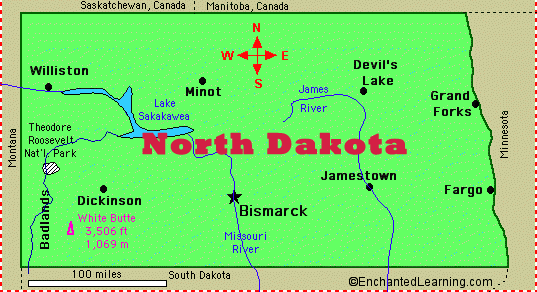
North Dakota and Israel
Trade and Population Statistics
| Exports to Israel (2015) |
$5,419,686 |
| Percentage Change (2014-2015) |
-9.19% |
| Total Exports to Israel (1996-Present) |
$56,087,587 |
| Israel's Trade Partner Rank (2015) |
39 |
| Military Contracts with Israel (2015) |
$0 |
| Jewish Population (2015) |
800 |
| Jewish Percentage of Population |
0.1% |
Binational
foundation grants shared by North Dakota and Israel
Grant recipients in
North Dakota from U.S.-Israel binational foundations:
University of North Dakota Medical School
Bilateral
Institutions
None. Help us build this section. Email AICE with
any updates, additions, corrections or comments. We appreciate your
support!
Cooperative
Agreements - "Memoranda of Understanding"
In May 2008, Dr. Gerald Groenewold,
Director of the Energy & Environmental Research Center (EERC) at
the University of North Dakota, announced the development of a long-term
partnership between the EERC and Israel to address critical energy security
issues facing both Israel and the United States. The partnership comes
on the heels of the signing of a Memorandum of Understanding between
the US Department of Energy and the Interdisciplinary Center at Herziloyah
in Israel for cooperation on various energy topics. The MOU enables
cooperation in carbon management technologies, water resource stewardship
in power production, alternative fuels development, development of hydrogen
and fuel cells, power grid efficiency and reliability, hybrid energy
systems, and advanced materials for energy systems, all of which the
EERC has expertise in. Read more about the collaboration between EERC
and Israel, CLICK
HERE.
North Dakota Government Missions to Israel
None. Help us build this section. Email AICE with
any updates, additions, corrections or comments. We appreciate your
support!
Partners
For Change
The U.S.-Israel relationship is based on the twin
pillars of shared values and mutual interests. Given this commonality of
interests and beliefs, it should not be surprising that support for Israel
is one of the most pronounced and consistent foreign policy values of the
American people.
It is more difficult to devise programs that capitalize
on the two nations' shared values than their security interests;
nevertheless, such programs do exist. In fact, these SHARED VALUE
INITIATIVES cover a broad range of areas, including the environment,
science and technology, education and health.
As analyst David Pollock noted, Israel is an advanced country with a population that surpassed eight million people in 2013 and a robust, dynamic economy that allowed it to join the Organization for Economic Cooperation and Development (OECD). Between 2005 and 2013, Israel has represented a larger market for U.S. exports than Saudi Arabia. Although Israel's citizenry make up just 3 percent of the total region's population, Israel accounts for 25 percent of American exports in the Middle East.
"It has also been one of the top 20 foreign direct investors in the United States since 2009," Pollock confirms. He adds that "$2.25 billion of the $3 billion in annual U.S. aid to Israel comes back via Israeli purchases of U.S. military equipment - and that is just 5 percent of the total bilateral trade each year."
Today's interdependent global economy requires that
trade policy be developed at the national and state level.
Many states have recognized the opportunity for realizing
significant benefits by seeking to increase trade with Israel. North Dakota is one of 33 states that have cooperative
agreements with Israel.
In 2012, North Dakota exported over $1,777,002 worth
of manufacturing goods to Israel. Since 1996, North Dakota exports to
Israel have totaled more than $47,120,750 and Israel now ranks as North Dakota’s 48th leading trade partner.
To date, North Dakota has not received foreign military financing (FMF) for US military aid
to Israel.
Israel is certainly a place where potential business
and trade partners can be found. It can also be a source, however, for
innovative programs and ideas for addressing problems facing the citizens
of North Dakota.
Israel has developed a number of pioneering education programs. For example, AICE introduced an innovative Israeli
peer tutoring program to North Carolina that educators adapted for use
in the United States. Now known as Reading Together, the program is
used in 28 states. The program is designed to help students achieve
reading fluency and is mostly used for children in second grade. The
hope is that with its implementation, increasing numbers of students
will perform at grade level or above.
A range of other exciting approaches to social problems
like unemployment, environmental protection and drug abuse have been
successfully implemented in Israel and could be imported for the benefit
of Americans.
The potential for greater cooperation with Israel for
the benefit of North Dakota is limited only by the imagination.
North Dakota Firms
Profit From Business With Israel
One good way to break into the Israeli market is through a joint venture
with an Israeli company. Funding for such projects is available from
the Binational Industrial
Research and Development Foundation (BIRD). BIRD funds projects in 36 states and the District of
Columbia and hundreds of companies including AOL, GE, BP Solar, Texas
Instruments and Johnson & Johnson have benefitted from BIRD grants.
The United States and Israel established BIRD in 1977
to fund joint U.S.-Israeli teams in the development and subsequent commercialization
of innovative, nondefense technological products from which both the
Israeli and American company can expect to derive benefits commensurate
with the investments and risks. Most grant recipients are small businesses
involved with software, instrumentation, communications, medical devices
and semiconductors.
Since its inception, BIRD has funded more than 800
joint high-tech R&D projects through conditional grants totaling
more than $210 million. Products developed from these ventures have
generated more than $8 billion in direct and indirect revenues for both
countries and has helped to create an estimated 20,000 American jobs.
Dr. Eli Opper, the former Israeli chair of BIRD, has
said that BIRD is a strong pillar of US-Israel industrial
cooperation and that the extreme success of BIRD has
led Israel to adopt similar models of R&D with other countries.
As of yet, no North Dakota companies have taken advantage of the opportunity
to reduce the risk of new ventures and tap into the deep pool of Israeli
talent through the BIRD program.
Scientific Innovations
Researchers across the United States are making scientific
breakthroughs and developing cutting-edge technologies in joint projects
with Israeli scientists thanks to support from the Binational
Science Foundation (BSF). BSF was established in 1972 to promote scientific relations
and cooperation between scientists from the United States and Israel.
The fund supports collaborative research projects in a wide area of
basic and applied scientific field for peaceful and non-profit purposes.
Since its inception, BSF has awarded some $480 million
through more than 4,000 grants in 45 states and the District of Columbia.
BSF-sponsored studies are highly successful
in achieving their two main goals: strengthening the US-Israel partnership
through science and promoting world-class scientific research for the
benefit of the two countries and all mankind. The BSF grants help extend research resources to achieve milestones that might
not otherwise be attainable; introduce novel approaches and techniques
to lead American researchers in new directions; confirm, clarify and
intensify research projects; and provide unmatched access to Israeli
equipment, facilities and research results that help speed American
scientific advances. BSF has documented no less than
75 new discoveries made possible by its research grants and counts 37
Nobel Prize and 19 Lasker Medical Award laureates among its joint partners.
Currently no North Dakota institutions have taken advantage
of the BSF grants.
Agriculture Benefits
In 1978 the United States and Israel jointly created the Binational
Agricultural Research and Development Fund (BARD)
to help fund programs between US and Israeli scientists for mutually
beneficial, mission-oriented, strategic and applied research into agricultural
problems. Since its inception, BARD has funded more
than 1,000 projects in 45 states and the District of Columbia with a
total investment of more than $250 million. In 2000, an independent
and external economic review of 10 BARD projects conservatively
projected more than $700 million in revenue by the end of 2010, a number
which far outweighs the total investment in all BARD projects over its 33 year existence and helps to continually strengthen
the foundation.
Most BARD projects focus on either increasing agricultural
productivity, plant and animal health or food quality and safety and
have been influential in creating new technologies in drip irrigation,
pesticides, fish farming, livestock, poultry, disease control and farm
equipment. BARD funds projects in 45 states and the
District of Columbia and at present is beginning to administer collaborative
efforts between Australia, Canada and Israel as well. It is difficult
to break down the impact on a state-by-state basis, but overall, BARD-sponsored
research has generated sales of more than $500 million, tax revenues
of more than $100 million and created more than 5,000 American jobs.
Here too, there are no North Dakota institutions that have taken advantage
of the opportunities presented by BARD to create and
extend agricultural research projects.
Other Cooperative
Programs
None. Help us build this section. Email AICE with
any updates, additions, corrections or comments. We appreciate your
support!
Sister Cities:
None.
State
Contacts:
American-Israel Chamber of Commerce {also covers North Dakota)
6311 Wayzata Blvd., #240
Minneapolis, MN 55416-1224
Tel. 612-593-8666
Fax. 612-593-8668
Email. [email protected]
Web. http://www.aiccmn.org
|