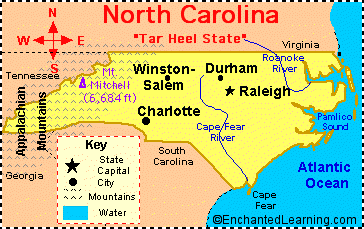
North Carolina and Israel
Trade and Population Statistics
| Exports to Israel (2015) |
$139,052,082 |
| Percentage Change (2014-2015) |
+13.96% |
| Total Exports to Israel (1996-Present) |
$1,846,509,323 |
| Israel's Trade Partner Rank (2015) |
35 |
| Military Contracts with Israel (2015) |
$17,322,802 |
| Jewish Population (2015) |
120,000 |
| Jewish Percentage of Population |
1.6% |
Binational
foundation grants shared by North Carolina and Israel
Grant recipients in
North Carolina from U.S.-Israel binational foundations:
Duke University
Duke Medical School
East Carolina University
Gaston County Dyeing Machine Co.
North Carolina State University
University of North Carolina
University of North Carolina Medical School
Wake Forest University
Bilateral
Institutions
American-Israel Chamber
of Commerce Southeast Division -
Though
based in Atlanta, the Southeast Division of the AICC was established
in 1992 to help Israeli businesses explore new markets and develop business
relationships with companies in Georgia as well as North Carolina, Alabama,
Mississippi, South Carolina and Tennessee. AICC-SD boasts over 450 members
today amd has earned the reputation as one of the most successful and
effective bi-national business organizations in the United States. Since
its founding, AICC-SD has been involved in completed transactions valued
at over $700 million, thereby contributing to the economies of both
Israel and the Southeastern United States. To learn more about the AICC
Southeast Division, CLICK
HERE.
Cooperative
Agreements - "Memoranda of Understanding"
In 1994, Gov. Jim Hunt established
an International Commission that includes task forces to stimulate trade
and exchanges with Israel in business, academia, arts and culture, education
and social services. The Israel-North Carolina International Commission
(INCIC) was created in 1996 to manage the cooperative projects. Gov
Hunt originally chose Israel ecause of the country’s potential
as a regional center for trade in the Middle East. Read more about the
commission, CLICK
HERE (page 12).
In 1993, the governments of North
Carolina and Israel signed a far reaching and broad agreement that led
to the establishment in 1996 of North Carolina-Israel Development Centers
in both places as well as an Israeli center for people with autism based
on a North Carolina model.
North Carolina Government Missions to Israel
None. Help us build this section. Email AICE with
any updates, additions, corrections or comments.
North Carolina Honors Israel’s 60th Birthday
In 2008, the North Carolina General Assembly expressed
the state’s strong friendship with the State of Israel.
The House and Senate resolutions highlighted the state’s historical
ties to the Jewish people, the state’s vibrant trading relationship
with Israel, and called for North Carolinians to honor Israel’s
60th anniversary as a modern state.
North Carolina and Israel share
a robust friendship built on economic cooperation and common values.
As the resolution states, “the people of Israel have established
a vibrant, pluralistic, democratic political system, including freedom
of speech, press, assembly, and religion.” Israel is also one
of North Carolina’s top trading partners. Since 1996, Israel has
purchased over $1.3 billion in goods and services from the Tarheel State.
The two have also shared millions of dollars in bi-national grants,
supporting their respective universities as they strive to make new
technological and medical advances.
The joint resolution was the fifth
piece of legislation honoring Israel passed in the Southeast. Similar
resolutions were also passed in Georgia, South Carolina, Tennessee,
and Mississippi. Read the joint declaration, CLICK
HERE.
Partners
For Change
The U.S.-Israel relationship is based on the twin
pillars of shared values and mutual interests. Given this commonality of
interests and beliefs, it should not be surprising that support for Israel
is one of the most pronounced and consistent foreign policy values of the
American people.
It is more difficult to devise programs that capitalize
on the two nations' shared values than their security interests;
nevertheless, such programs do exist. In fact, these SHARED VALUE
INITIATIVES cover a broad range of areas, including the environment,
science and technology, education and health.
As analyst David Pollock noted, Israel is an advanced country with a population that surpassed eight million people in 2013 and a robust, dynamic economy that allowed it to join the Organization for Economic Cooperation and Development (OECD). Between 2005 and 2013, Israel has represented a larger market for U.S. exports than Saudi Arabia. Although Israel's citizenry make up just 3 percent of the total region's population, Israel accounts for 25 percent of American exports in the Middle East.
"It has also been one of the top 20 foreign direct investors in the United States since 2009," Pollock confirms. He adds that "$2.25 billion of the $3 billion in annual U.S. aid to Israel comes back via Israeli purchases of U.S. military equipment - and that is just 5 percent of the total bilateral trade each year."
Today's interdependent global economy requires that
trade policy be developed at the national and state level.
Many states have recognized the opportunity for realizing
significant benefits by seeking to increase trade with Israel. North Carolina is one of 33 states that have cooperative
agreements with Israel.
In 2012, North Carolina exported over $121,290,810 worth
of manufacturing goods to Israel. Since 1996, North Carolina exports to
Israel have totaled more than $1,597,899,570 and Israel now ranks as North Carolina’s
18th leading trade partner.
Additionally in 2012, North Carolina received more than
$26,179,330.55 in foreign military financing (FMF) for US military aid
to Israel. Some of those companies that have received funding through FMF in 2012 or past years
include: Honeywell International in Rocky, Piedmont Propulsion Systems, Inc in Winston-Salem and Shakespeare Company in Charlotte.
Israel is certainly a place where potential business
and trade partners can be found. It can also be a source, however, for
innovative programs and ideas for addressing problems facing the citizens
of North Carolina.
Israel has developed a number of pioneering education programs. For example, AICE introduced an innovative Israeli
peer tutoring program to North Carolina that educators adapted for use
in the United States. Now known as Reading Together, the program is
used in 28 states. The program is designed to help students achieve
reading fluency and is mostly used for children in second grade. The
hope is that with its implementation, increasing numbers of students
will perform at grade level or above.
A range of other exciting approaches to social problems
like unemployment, environmental protection and drug abuse have been
successfully implemented in Israel and could be imported for the benefit
of Americans.
The potential for greater cooperation with Israel for
the benefit of North Carolina is limited only by the imagination.
North
Carolina Firms Profit From Business With Israel
Because of Israel’s unique status
as the only country with free trade agreements with
both the United States and the European Community,
it can act as a bridge for international trade between
the United States and Europe. Moreover, because of
the deep pool of talent, particularly in high-technology
areas, Israel provides excellent investment opportunities.
Some of the nation’s largest companies, such as IBM,
Microsoft, Motorola and Intel, as well as more than
80 North Carolina firms, have found that it is indeed
profitable to do business in Israel.
Sara Lee of Winston-Salem has discovered the
benefits of exporting to Israel as well as importing products. The
company has a minority interest in Delta Galil Industries, an
underwear and sock manufacturer in Tel Aviv, and now distributes its
clothing around the United States. Terry Gill, Director of Global
Sourcing for Sara Lee described the relationship as a good one with a
company that makes a good product.
Another textile giant, Fieldcrest Cannon, recently
signed a $26 million distribution agreement with Kitan to sell its
bedding in the United States.
Gambit Computer Communications has a marketing
agreement with the Raleigh-based networks group of Memorex Telex Corp.
Gambit develops, manufactures and sells computer communications
equipment for local and wide area networks. The strategic alliance is
focusing on sales, support and marketing in the short-term, but
Gambit’s North America Operations Manager, Ehud Katzir, says that a
second phase might involve establishing a manufacturing facility in
the U.S. that would create new jobs in North Carolina.
Mike White, Executive Manager for Protec, went on a
trade mission to Israel and met with some of the leading Israeli
telecommunications companies to discuss possible service agreements.
Today, the Burlington-based company services ISDN equipment
manufactured by Telrad. While in Israel, White discovered untapped
business opportunities. “You could put the marketing genius
available in North Carolina to work with Israeli companies to sell a
variety of products in the United States,” he said.
North Carolina companies could also take advantage
of the new Russian talent in Israel. Southern Optical, for example, is
in the process of concluding a deal with a kibbutz factory to support
an incubator in Jerusalem whose Russian engineers are producing a new
product that could be beneficial to the optical industry. Southern
Optical’s Tom Sloan praises the Israelis for their “low-cost,
highly capable technological development.”
One good way to break into the Israeli market is through
a joint venture with an Israeli company. Funding for such projects is
available from the Binational
Industrial Research and Development Foundation (BIRD). BIRD funds projects in 36 states and the District of
Columbia and hundreds of companies including AOL, GE, BP Solar, Texas
Instruments and Johnson & Johnson have benefitted from BIRD grants.
The United States and Israel established BIRD in 1977
to fund joint U.S.-Israeli teams in the development and subsequent commercialization
of innovative, nondefense technological products from which both the
Israeli and American company can expect to derive benefits commensurate
with the investments and risks. Most grant recipients are small businesses
involved with software, instrumentation, communications, medical devices
and semiconductors.
Since its inception, BIRD has funded more than 800
joint high-tech R&D projects through conditional grants totaling
more than $210 million. Products developed from these ventures have
generated more than $8 billion in direct and indirect revenues for both
countries and has helped to create an estimated 20,000 American jobs.
Dr. Eli Opper, the former Israeli chair of BIRD, has
said that BIRD is a strong pillar of US-Israel industrial
cooperation and that the extreme success of BIRD has
led Israel to adopt similar models of R&D with other countries.
North Carolina companies have benefited from close to $1.2 million in BIRD grants over the 16 years.
In 1995, Gaston County Dyeing Machine Co. became the
first North Carolina firm to receive a BIRD grant (to
develop a monitoring sensor for the industry). Subsequently, two more
Carolina firms received grants.
Scientific
Innovations
North Carolina researchers are making scientific breakthroughs
and developing cutting-edge technologies in joint projects with Israeli
scientists thanks to support from the Binational
Science Foundation (BSF). BSF was established in 1972 to promote scientific relations
and cooperation between scientists from the United States and Israel.
The fund supports collaborative research projects in a wide area of
basic and applied scientific field for peaceful and non-profit purposes.
Since its inception, BSF has awarded some $480 million
through more than 4,000 grants in 45 states and the District of Columbia.
BSF-sponsored studies are highly successful
in achieving their two main goals: strengthening the US-Israel partnership
through science and promoting world-class scientific research for the
benefit of the two countries and all mankind. The BSF grants help extend research resources to achieve milestones that might
not otherwise be attainable; introduce novel approaches and techniques
to lead American researchers in new directions; confirm, clarify and
intensify research projects; and provide unmatched access to Israeli
equipment, facilities and research results that help speed American
scientific advances. BSF has documented no less than
75 new discoveries made possible by its research grants and counts 37
Nobel Prize and 19 Lasker Medical Award laureates among its joint partners.
Institutions in North Carolina have shared with their
counterparts in Israel more than $4.7 million in BSF grants awarded since 1996 alone. The University of North Carolina, North
Carolina State and Duke are among the grant recipients.
BSF-supported collaborative research
between Prof. Joseph Yanai of the Hebrew University in Jerusalem and
Prof. Theodore Sorkin from Duke University has succeeded in reversing
brain birth defects in animal models, using stem cells to replace defective
brain cells. Neural and behavioral birth defects, such as learning disabilities,
are particularly difficult to treat because the prenatal teratogen substances
that cause the abnormalities act diffusely in the fetal brain, resulting
in multiple defects. Profs. Yanai and Sorkin’s BSF sponsored teams were able to overcome this obstacle in laboratory tests
with mice by using mouse embryonic neural stem cells. These cells migrate
in the brain, search for the deficiency that caused the defect, and
then differentiate into becoming the cells needed to repair the damage.
The scientists are now developing procedures for the least invasive
method for administering the neural stem cells, which is probably via
blood vessels, thus making the therapy practical and clinically feasible.
Tom Petes, a geneticist at UNC, is doing basic research
to discern the rules of recombination. “By looking at the way
a cell breaks down in a primitive organism like yeast,” he explained,
“we hope to gain an understanding of what goes haywire in higher
organisms and is thought to cause tumors.” Petes is working with
a colleague who knows a lot about damage to DNA and DNA repair and finds
the collaboration gives him ideas and new ways of thinking. “Without
this type of collaboration,” says Petes, “you get inbred
ideas. The BSF grant allows me to meet and work with
other scientists.” This is especially important, he added, because
money has become tight and it is difficult to go to as many conferences
as he used to for such exchanges.
One of the keys to health care reform will be
figuring out how to provide services to a population that lives longer
than past generations. UNC sociologist Elizabeth Mutran is working on
a study that could provide some answers by determining how the elderly
feel about different aspects of health care and what they want at the
end of their lives. Mutran is working with an Israeli colleague from
Beersheva on a project that involves interviews with 1,000 Israelis
who are over 70. The respondents will be requestioned over the next
three years to see how life events affect their attitudes toward
treatment.
Mutran said the population in North Carolina is too
homogenous to examine many important variables. By doing the study in
Israel it will be possible to look at the influence of such things as
health care funding, family structures, the role of religion and
attitudes toward death. The results could help determine the care
older Americans will need and expect.
Richard Smith is a statistician at UNC conducting research
on extreme values, which has the practical application of making possible
predictions about extremes in sea level and climate. Smith cited the
example of trying to determine the frequency and magnitude of floods
to assist people in a place like Holland determine how high dikes should
be built. The BSF grant allowed Smith to work closely
with a colleague at the Technion in Haifa who also works in his specialized
area of research. “Any collaboration is beneficial in research,”
Smith said, “and BSF gave me an opportunity to
work on an international basis.”
BSF documented 75 new discoveries
that probably would not have been possible without foundation-supported
collaboration. These advances included the development of new methods
and techniques, the discovery of new phenomena and major theoretical
breakthroughs.
Agriculture
Benefits
In 1978 the United States and Israel jointly created
the Binational Agricultural
Research and Development Fund (BARD)
to help fund programs between US and Israeli scientists for mutually
beneficial, mission-oriented, strategic and applied research into agricultural
problems. Since its inception, BARD has funded more
than 1,000 projects in 45 states and the District of Columbia with a
total investment of more than $250 million. In 2000, an independent
and external economic review of 10 BARD projects conservatively
projected more than $700 million in revenue by the end of 2010, a number
which far outweighs the total investment in all BARD projects over its 33 year existence and helps to continually strengthen
the foundation.
Most BARD projects focus on either increasing agricultural
productivity, plant and animal health or food quality and safety and
have been influential in creating new technologies in drip irrigation,
pesticides, fish farming, livestock, poultry, disease control and farm
equipment. BARD funds projects in 45 states and the
District of Columbia and at present is beginning to administer collaborative
efforts between Australia, Canada and Israel as well. It is difficult
to break down the impact on a state-by-state basis, but overall, BARD-sponsored
research has generated sales of more than $500 million, tax revenues
of more than $100 million and created more than 5,000 American jobs.
North Carolina institutions have shared grants worth
nearly $3.5 million since 1979. North Carolina State and the University
of North Carolina are among the grant recipients with NC State receiving
the lions share.
John Brake, a professor in the department of poultry
science at North Carolina State, teamed with two professors in Israel
in 2009 to develop a method for improving the survival rates of broiler
chickens. Supported by BARD, their research uncovered
a method that may help farmers increase the efficiency, cost-effectiveness,
and profitability of growing broiler chickens. The research revolved
around changing incubator conditions that would help decrease the chickens
body temperatures, leading to a lowering of their metabolic rate, stress
levels, and heat loss.
Overall, Prof. Brake and his Israeli counterparts found
that reducing heat stress related mortality will contribute $25 million
to the USA and global broiler industry, which has been rapidly growing
in years past though was searching for answering in dealing with the
incubation problem. Additionally, Prof Brake found that slight changes
in incubation temperatures could improve meat yeild by 1%, an addition
that will contribute over $20 million annually to the USA broiler industry.
Professor Brake was extremely happy with the support
and leeway given to his research team by BARD. With
the help of BARD facilitating the collaboration with
Israel, Prof Brake is confident that his research team is "going
to change the manner in which incubation of eggs take place all over
the world." For more information on this project, CLICK
HERE.
In another project together with scientists at the
Israel Ministry of Agriculture, Dr. Gabriel Katul, a professor of Hydrology
and Micrometeorolgy at Duke University, completed a BARD-sponsored
project in 2010 that may have significant impact on the way water is
used and preserved during irrigation process in closed areas such as
screenhouses or greenhouses. While irrigation requirements of crops
in open fields are relatively well established, Dr. Katul and his colleagues
were aware of a significant knowledge gap related to irrigation practices
and requirements for protected or closed crops. Since the number of
of argicultural crops grown in protected enviornments is constantly
increasing, gaining a better understanding for proper irrigation techniques
for these crops will help to better maximize water use efficiency.
Thanks to the support of BARD, cooperation
between Dr. Katul's research team in North Carolin and the Israeli team
was very close and "significantly promoted all the research objectives."
Both principle investigators were able to travel between the two countries
and personally collaborate numerous times together. To read more about
this project, CLICK
HERE.
Spanning more than two decades, another BARD-sponsored
project put a group of scientists from North Carolina University that
included Professors D. Mason Pharr (deceased in 2009), Steven Huber
and John Williamson together with a large group from the Volcani Center
in Israel to research ways in making melon taste sweeter. Through help
from the BARD foundation, the group researched and found the complete
characterization of the metabolic pathway responsible for the melon's
sweet taste. The scientists then showed that almost twenty enzymatic
reactions are involved in this process, and have further identified
the key enzymes that determine the level of sucrose in the fruit. The
group published a number of articles in various academic and scientific
journals, including Physiologia Plantarum. Learn more about this study, CLICK
HERE.
Most species of fish in warm, brackish seawater found
in the Mediterranean, Red Sea, Gulf of Mexico and areas of North Carolina
are susceptible to a deadly parasite. Ed Noga, an immunologist at North
Carolina State, has a BARD grant to study the immune
response of fish. He and his Israeli collaborators are interested in
understanding this response so they can develop ways to immunize them.
Noga finds the project beneficial because he has
the opportunity to see how other scientists do research, some
technology is transferred and he interacts with people who have
different expertise and experiences. “It is a very productive,
positive interaction.”
Jack Britt, an animal physiologist at North
Carolina State, is interested in improving the fertility of dairy
cattle. His colleagues in Israel have similar interests and work in a
similar climate. The system they are developing appears to increase
fertility in a cattle population with low fertility.
A geneticist at North Carolina State, Ben McDaniel,
is also interested in cattle, but he is looking at how traits are
passed on from one generation to the next. He went back to 1883 to
trace the development of one breed.
The research indicates that it is important to look
at the maternal lines of bulls, supporting the observations of Israeli
breeders who said that certain traits were passed on better to
daughters than sons.
The project also involves researchers at Iowa State
and, McDaniel says, BARD helped combine the unique
expertise of scientists in Israel, Iowa and North Carolina. In addition,
Israel had a molecular genetics lab that State lacked. The collaboration
has established strong links between McDaniel and his Israeli counterparts.
Some of the benefits to North Carolina from BARD research are more indirect. For example, BARD grantees
have developed techniques to help preserve the color, taste and texture
of apples, one of the State’s important crops. Other projects
have developed strategies for breeding leaner poultry with no loss of
other valuable characteristics, which can reduce costs for the state’s
poultry industry.
Other
Cooperative Programs
The North Carolina-Israel
Autism Project is intended to expand existing
relationships and establish new ones through
the systematic training of professionals and
parents in Israel based on 1) the knowledge
and technology of the North Carolina TEACCH
program (Treatment and Education of Autistic
and related Communication-handicapped Children),
2) the importance of diagnostic, assessment,
treatment and education programs in Israel,
and 3) the exchange of information and ideas
between the Israeli and North Carolina parent
organizations (ALUT-The National Association
for Autistic Children in Israel and the Autism
Society of North Carolina).
“Reading Together” is a peer tutoring
program adopted from Hebrew University’s YACHAD program. The program
involves fifth graders tutoring second graders who are slow readers.
The pilot project is being run in Guilford County. The University of
North Carolina at Greensboro is being established as a national center
for the training, development and dissemination of the program.
The Israel/North Carolina Cultural Exchange began
in the fall of 1996 and included 11 exhibitions, film festivals,
artist residencies and public programs designed to explore Israeli art
and make it available throughout the State and Southeast.
The North Carolina School of Science and
Mathematics and the Israel Arts and Science Academy signed an
agreement to establish joint curricula and activities in the area of
world leadership.
Duke University has developed the Duke Information
System for Cardiovascular Care (DISCC), which allows analysis of
epidemiological information, national health care profiles, clinical
trials data, resource utilization, etc. The university is sharing its
databank with the Israeli Ministry of Health.
The Guilford County School System has entered into
an agreement with the Alexander Muss High School in Israel (AMHSI)
whereby students from Guilford schools can receive credit for
participating in an eight-week program at AMHSI.
NCIP coordinated and presented a live
teleconference linking cardiac care centers at Duke University Medical
Center, The Rabin Medical Center, Baylor Children’s Hospital and the
University of Milan to demonstrate the advances and uses of
video-conferencing in diagnostic medicine in December 1996.
A teaching curriculum for dealing with stress in
children who live in regions of war and terrorism is being jointly
developed by Israeli and North Carolina researchers and will involve
teachers and students at the Jordan Institute for Families at the
University of North Carolina and Tel Hai College in the Upper Galilee.
North Carolina State and the Volcani Center of
Agricultural Research signed a cooperation agreement for joint
research.
The Jewish Community Day School Durham/Chapel Hill
is electronically linked with elementary school students at the Beit
H’Tfozut school for a program related to Jewish identity in the
Diaspora.
Israel and North Carolina signed a technology cooperation agreement
in which the Israel Center for Industrial R&D and the North Carolina
Technology and Science Authority will set up a joint framework for fast
Internet data transmission, GLOBES reported (4/9/98). This will include
databases of high-tech companies in the two states and technological
business cooperation opportunities. Seminars and meetings on cooperation
will be held in North Carolina and Israel during the next two years,
the first of which will occur during the Telecom ’98 Exhibition
in Tel Aviv this November.
Sister
Cities:
NORTH
CAROLINA . . . . . . . . . .. .
.. . . .. . . .. . . .. .. . . . . . . . . . . . . . . . . . ISRAEL |
Charlotte |
|
State
Contacts:
Durham-Chapel Hill Jewish Federation
3700 Lyckan Pkwy., Suite B
Durham, NC 27707
Tel. 919-489-5335
Fax. 919-489-5788
Email: [email protected]
website: shalomdch.org |
Jewish Federation Of Wake County
8210 Creedmoor Rd., #104
Raleigh, NC 27613
Tel. 919-676-2200 |
North Carolina-Israel Partnership
Yaakov Weiss 4/34, Tel Aviv 69124
Tel. 03-642-8001, 643-1567
Tel. 08-939-2447
Email: [email protected] |
Greensboro Jewish Federation
5509-C West Friendly Avenue
Greensboro, NC 27410
Tel: 336-852-5433
Fax: 336-852-4346
website: www.shalomgreensboro.org |
North Carolina-Israel Partnership
5509-C West Friendly Avenue
Greensboro, NC 27410
Tel. 336-218-0200
Fax. 336-218-1016
Email. [email protected] |
North Carolina Partnership for Economic Development
Dept. of Commerce, 430 N. Salisbury St.
Raleigh, NC 27611
Tel. (919) 733-4962
Fax. 919-733-8356 (f) |
Jewish Federation Of Greater Charlotte
5007 Providence Rd.
Charlotte, NC 27401
Tel. 910-272-3189 |
North Carolina-Israel Partnership
11 Achimeier St., #3
Tel Aviv, Israel 69126
Tel. 3-643-1567
Fax. 3-643-0180
Email. [email protected] |
Western North Carolina Jewish Federation
236 Charlotte St.
Asheville, NC 28801
Tel. 704-253-0701 |
|