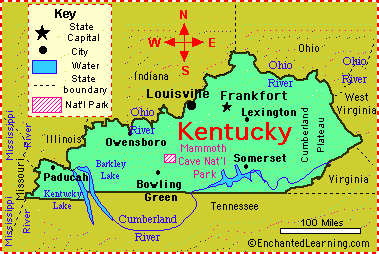
Kentucky and Israel
Trade and Population Statistics
| Exports to Israel (2015) |
$70,792,256 |
| Percentage Change (2014-2015) |
-1.56% |
| Total Exports to Israel (1996-Present) |
$745,406,720 |
| Israel's Trade Partner Rank (2015) |
31 |
| Military Contracts with Israel (2015) |
$16,953,641 |
| Jewish Population (2015) |
19,000 |
| Jewish Percentage of Population |
0.58% |
Binational
foundation grants shared by Kentucky and Israel
Grant recipients in
Kentucky from U.S.-Israel binational foundations:
University of Kentucky
University of Louisville
University of Louisville Medical
Bilateral
Institutions
None. Help us build this section of the Arizona
page. Email AICE with
any updates, additions, corrections or comments.
Cooperative
Agreements - "Memoranda of Understanding"
None. Help us build this section of the Arizona
page. Email AICE with
any updates, additions, corrections or comments.
Kentucky Government Missions to Israel
January 2013 - Senator Rand Paul (KY-R) traveled to Israel in early January 2013. While there, he voiced his strong opposition to US foreign aide, saying that "It will be harded to defend Israel if we destroy our country in the process ... I think there will be significant repercussions to running massive deficits." The trip marks Rand Paul's first time to Israel, which many spectators view as a sign of his potential run for the U.S. presidency come 2016. Paul met with Israeli leaders including PM Netanyahu and President Peres, as well as Naftali Bennet who leads the Bayit Yehudi party. To read more about the trip, CLICK HERE.
Partners
For Change
The U.S.-Israel relationship is based on the twin
pillars of shared values and mutual interests. Given this commonality of
interests and beliefs, it should not be surprising that support for Israel
is one of the most pronounced and consistent foreign policy values of the
American people.
It is more difficult to devise programs that capitalize
on the two nations' shared values than their security interests;
nevertheless, such programs do exist. In fact, these SHARED VALUE
INITIATIVES cover a broad range of areas, including the environment,
science and technology, education and health.
As analyst David Pollock noted, Israel is an advanced country with a population that surpassed eight million people in 2013 and a robust, dynamic economy that allowed it to join the Organization for Economic Cooperation and Development (OECD). Between 2005 and 2013, Israel has represented a larger market for U.S. exports than Saudi Arabia. Although Israel's citizenry make up just 3 percent of the total region's population, Israel accounts for 25 percent of American exports in the Middle East.
"It has also been one of the top 20 foreign direct investors in the United States since 2009," Pollock confirms. He adds that "$2.25 billion of the $3 billion in annual U.S. aid to Israel comes back via Israeli purchases of U.S. military equipment - and that is just 5 percent of the total bilateral trade each year."
Today's interdependent global economy requires that
trade policy be developed at the national and state level.
Many states have recognized the opportunity for realizing
significant benefits by seeking to increase trade with Israel. Kentucky is one of 33 states that have cooperative
agreements with Israel.
In 2012, Kentucky exported over$55,394,042.00 worth
of manufacturing goods to Israel. Since 1996, Kentucky exports to
Israel have totaled more than $614,554,113.00 and Israel now ranks as Kentucky’s
30th leading trade partner.
Additionally in 2012, Kentucky received more than
$15,960,733.05 in foreign military financing (FMF) for US military aid
to Israel. Some of those companies that have received funding through FMF in 2012 or past years
include: LSY Defense, LLC and Lys International, Inc., both in Louisville, and Lexel Imaging Systems, Inc in Lexington.
Israel is certainly a place where potential business
and trade partners can be found. It can also be a source, however, for
innovative programs and ideas for addressing problems facing the citizens
of Kentucky.
Israel has developed a number of pioneering education programs. For example, AICE introduced an innovative Israeli
peer tutoring program to North Carolina that educators adapted for use
in the United States. Now known as Reading Together, the program is
used in 28 states. The program is designed to help students achieve
reading fluency and is mostly used for children in second grade. The
hope is that with its implementation, increasing numbers of students
will perform at grade level or above.
A range of other exciting approaches to social problems
like unemployment, environmental protection and drug abuse have been
successfully implemented in Israel and could be imported for the benefit
of Americans.
The potential for greater cooperation with Israel for
the benefit of Kentucky is limited only by the imagination.
Kentucky Firms
Profit From Business With Israel
As the only country with free trade
agreements with both the United States and the European
community, Israel can act as a bridge for international
trade between the United States and Europe. Moreover,
because of the deep pool of talent, particularly in
high-technology areas, Israel provides excellent investment
opportunities. Some of the nation's largest companies,
such as IBM, Microsoft, Motorola, Intel and McDonald’s
have found that it is indeed profitable to do business
in Israel.
More than 100 Kentucky companies have
discovered the benefits of doing business in Israel,
including IBM, Jim Beam, Oshkosh B’Gosh, and Westinghouse.
Coroly Tartar, a contract administration
specialist, for Conco Inc. said that they have been
selling ammunition containers to Israel for four years.
The Israeli military put in a request for a quotation
and Conco bids on them. Tartar said that Israel has
been a good customer and Conco’s experience dealing
with Israel has been good compared to other countries.
Off and on for about 20 years Keco
Industries Inc. has been selling air-conditioning units
to the Israeli Air Force. Keco actually manufactures
the units, which then go to a freight forwarder (exporter)
and then end up in Israel. Jeff Andrews, contract administrator
for Keco, said that they had a pretty good relationship
with Israel and that the Israeli Air Force comes to
Keco whenever they need a product.
National Band and Tag Company has been
exporting chicken bands to Israel for more than 25 years.
When the company advertised in an international publication,
a few Israeli customers were attracted. National Band
and Tag Co. has one or two buyers in Israel who buy
large quantities and then distribute to individuals
who want tags. National Band and Tag Co. also sells
animal tags to research universities.
HY-Q International's, B-D Crystal Subsidiary
does business with Israel through its offices in Australia
or England and also through a consortium in California,
said Vice President of sales Pam Deschler. A California
company orders frequency control crystal products used
in anything wireless, such as timing devices for electric
components, and then ships the products worldwide, including
Israel. HY-Q has been doing business this way for the
past couple of years.
The Information Products Division of
IBM has been exporting printers to Israel for the past
several years. Rather than going directly to Israel,
however, the Kentucky branch ships them to New Jersey
where the actual marketing and selling take place. In
addition, IBM has headquarters in Europe that deals
mainly with Israel. If the European warehouse does not
have a certain item, they may come to the U.S. in which
case the Kentucky manufacturer supplies the New Jersey
warehouse.
Several other companies in Kentucky
also export to Israel through other locations, including
Atochem North America which sells synthetic resin, Ingersoll-Rand
Company Centrifugal Compressor Division, and Jim Beam
Brands Company which sells whiskey.
One good way to break into the Israeli market is through
a joint venture with an Israeli company. Funding for such projects is
available from the Binational
Industrial Research and Development Foundation (BIRD). BIRD funds projects in 36 states and the District of
Columbia and hundreds of companies including AOL, GE, BP Solar, Texas
Instruments and Johnson & Johnson have benefitted from BIRD grants.
The United States and Israel established BIRD in 1977
to fund joint U.S.-Israeli teams in the development and subsequent commercialization
of innovative, nondefense technological products from which both the
Israeli and American company can expect to derive benefits commensurate
with the investments and risks. Most grant recipients are small businesses
involved with software, instrumentation, communications, medical devices
and semiconductors.
Since its inception, BIRD has funded more than 800
joint high-tech R&D projects through conditional grants totaling
more than $210 million. Products developed from these ventures have
generated more than $8 billion in direct and indirect revenues for both
countries and has helped to create an estimated 20,000 American jobs.
Dr. Eli Opper, the former Israeli chair of BIRD, has
said that BIRD is a strong pillar of US-Israel industrial
cooperation and that the extreme success of BIRD has
led Israel to adopt similar models of R&D with other countries.
Kentucky companies have benefited from more than $1
million in BIRD grants over the last three decades.
Scientific
Innovations
Kentucky researchers are making scientific breakthroughs
and developing cutting-edge technologies in joint projects with Israeli
scientists thanks to support from the Binational
Science Foundation (BSF). BSF was established in 1972 to promote scientific relations
and cooperation between scientists from the United States and Israel.
The fund supports collaborative research projects in a wide area of
basic and applied scientific field for peaceful and non-profit purposes.
Since its inception, BSF has awarded some $480 million
through more than 4,000 grants in 45 states and the District of Columbia.
BSF-sponsored studies are highly successful
in achieving their two main goals: strengthening the US-Israel partnership
through science and promoting world-class scientific research for the
benefit of the two countries and all mankind. The BSF grants help extend research resources to achieve milestones that might
not otherwise be attainable; introduce novel approaches and techniques
to lead American researchers in new directions; confirm, clarify and
intensify research projects; and provide unmatched access to Israeli
equipment, facilities and research results that help speed American
scientific advances. BSF has documented no less than
75 new discoveries made possible by its research grants and counts 37
Nobel Prize and 19 Lasker Medical Award laureates among its joint partners.
Institutions in Kentucky, including the University
of Kentucky and the University of Louisville, have shared more than
$200,000 in BSF grants awarded since 1996 alone.
In 2009, Dr. Michael Pennington of Peptides International,
Inc., based in Louisville, received a 2-year BSF grant
to collaborate with Dr. Jordan Chill of Bar Ilan University in Tel Aviv,
Israel on research into peptide drug ShK-186. The drug, which as of
Janurary 2011, was about to enter clinical trials, is hoped to be used
to treat multiple scleroris. BSF facilitated the cooperation
between the two sides and Dr. Pennington is thankful to the BSF because the two scientists strenghts play hand-in-hand with each other
on the project. According to Dr. Pennington, "Our aim is to have
a better model of the peptide and how it binds to its target receptor
so that we might improve on its selectivity characteristics."
Microbiology Professor Ron Doyle of
the University of Louisville Medical College has been
collaborating with Mel Rosenberg of Tel Aviv University
to study the hydrophobic properties of bacterial cell
surfaces. An example of this may be when one has a sore
throat; the bacteria adhere to the mucosal cells causing
discomfort. Together, Doyle and Rosenberg edited a book
for the American Society for Microbiology, which is
considered a prestigious honor. Out of this research
came a tangible product. Rosenberg started a company
in Israel that markets mouthwash that disrupts the hydrophobic
interactions between bacteria and tissue. This product
has become the most popular mouthwash in Israel. According
to Doyle, it actually removes bacteria while others
only prevent the bacteria metabolism for a while. So
far, Rosenberg has one patent in the U.S. and is trying
to get another approved by the FDA.
Professor Doyle has also worked with
the Garbers, a husband and wife research team based
out of Bar-Ilan University. The collaborators studied
certain bacterial organisms that kill cystic fibrosis,
burn and aged patients. They discovered that if they
made a vaccine out of lectins, carbohydrate proteins,
it would prevent the adhesion of bacteria on the tissue
of these patients. By preventing this adhesion, they
would prevent colonization that turns into toxic bacteria,
which ultimately becomes lethal and will kill the patient.
In addition to working with Israelis through BSF grants, Doyle has worked with Professor Itzchak Ofek of Tel Aviv University
on his own. They studied adhesion and wrote a widely acclaimed book
on the topic. Professor Doyle had extremely positive experiences dealing
with Israel and collaborating with their scientists. Regarding the Binational
Science Foundation, he thinks it is a great program that needs to be
expanded because there are many good proposals that are not funded.
Doyle was attracted to the program because he has been “able to
maintain a friendship with Israelis and see a sense of ability in them.
Money is very wisely spent in Israel and they don’t waste it the
way Americans do; $2000 for Israelis goes a long way.” Doyle, also
a reviewer of BSF grant applications, said that the
program is “very good for the USA by virtue of cooperation with
the talented Israelis. We both come out ahead and [the cooperation]
is good for both the U.S. and Israel.”
BSF was established in 1972 to promote
research cooperation between scientists from the United States and Israel. BSF-sponsored studies benefit the United States by
extending research resources to achieve milestones that might not otherwise
be attainable; introducing novel approaches and techniques that can
lead American researchers to move in new directions; confirming, clarifying
and intensifying research projects; providing access to Israeli equipment
and facilities and early access to Israeli research results that speed
American scientific advances. BSF documented no less
than 75 new discoveries that probably would not have been possible without
foundation-supported collaboration.
Agriculture
Benefits
In 1978 the United States and Israel jointly created the Binational
Agricultural Research and Development Fund (BARD)
to help fund programs between US and Israeli scientists for mutually
beneficial, mission-oriented, strategic and applied research into agricultural
problems. Since its inception, BARD has funded more
than 1,000 projects in 45 states and the District of Columbia with a
total investment of more than $250 million. In 2000, an independent
and external economic review of 10 BARD projects conservatively
projected more than $700 million in revenue by the end of 2010, a number
which far outweighs the total investment in all BARD projects over its 33 year existence and helps to continually strengthen
the foundation.
Most BARD projects focus on either increasing agricultural
productivity, plant and animal health or food quality and safety and
have been influential in creating new technologies in drip irrigation,
pesticides, fish farming, livestock, poultry, disease control and farm
equipment. BARD funds projects in 45 states and the
District of Columbia and at present is beginning to administer collaborative
efforts between Australia, Canada and Israel as well. It is difficult
to break down the impact on a state-by-state basis, but overall, BARD-sponsored
research has generated sales of more than $500 million, tax revenues
of more than $100 million and created more than 5,000 American jobs.
Kentucky institutions have shared, with their counterparts in Israel, BARD grants worth just over $1 million since 1979.
The prevention of transmitting plant viruses via both
fungus and insects and improving the nutrition of cattle are just three
examples of joint research projects conducted under the auspices of BARD in Kentucky.
Professor Lisa Vaillancourt of the University of Kentucky
collaborated with professors at the Weizmann Institute of Science and
the Volcani Center, both in Israel, to research the effect of fungi
pathogens on their ability to transmit diseases into harvested crops.
With funding help from BARD, the group of scientists
revealed that fungi alter pH levels in plants as part of their invasion
strategy. This knowledge has been translated into effective postharvest
treatments for preventing fungi infection, which have been successfully
applied commercially since 2004, and are currently used as the main
treatment for all exported mango fruit in Israeli packing houses.
Professor Vaillancourt was especially grateful for
all the help that BARD gave in realizing this research
project. "I am very grateful for the support my program has received
from BARD," Prof. Vaillancourt said, "it
has been an excellent experience for me to collaborate with my Israeli
colleagues on an exciting program of mutual interest to the US and Israel."
Read more about Professor Vaillancourt's research, CLICK
HERE.
Professor David Harman of the University
of Kentucky has been studying the nutritional effects
of starch on animals. His overall goal is to improve
how animals digest starch by giving them different nutritional
treatments that will hopefully enable farmers to improve
the growth of their cattle using less feed. Harman is
collaborating with Dr. Bruckental of the Hebrew University
in Jerusalem. In Kentucky, the research team studies
the effects on beef cattle while in Israel they examine
dairy cattle. Although distance has been a challenge,
according to Professor Harman, he has had a very positive
experience sharing data, plans and comments back and
forth with his counterpart in Israel.
Professor of Plant Pathology Thomas Perone, also of
the University of Kentucky, has received several BARD grants dating back to the 1980's. He is now studying the transmission
of plant viruses by insects with scientists at the Volcani Center, a
plant research institute, in Israel. By studying this process, the collaborators
hope to ultimately understand virus transmission and find a way to stop
it, thus saving many important and useful species of plants. This study
is important because it pertains to most plants. The research focuses
on the tobacco plant and zucchini. Perone feels that his Israeli counterparts
have been “good collaborators.” His last BARD grant recently expired and he is currently in the process of writing
a new proposal.
A team of agricultural economists from the University
of Maryland and the University of California found that the economic
benefits of just five projects—related to cotton, pecans and solarization—exceeded
all U.S. investment in BARD. New projects promote increased
quantity and improved quality of agricultural produce.
Other Cooperative
Programs
None. Help us build this section of the Arizona
page. Email AICE with
any updates, additions, corrections or comments.
Sister Cities
None. Help us build this section of the Arizona
page. Email AICE with
any updates, additions, corrections or comments.
UJA Partnership
2000 Communities
State
Contacts:
Hillel
Campus Profiles
Jewish Federation of Central Kentucky
340 Romany Rd.
Lexington, KY 40502
Tel. 606-268-0672
Jewish Federation of Louisville
3630 Dutchmans Lane
Louisville, KY 40205
Tel. 502-451-8840
|