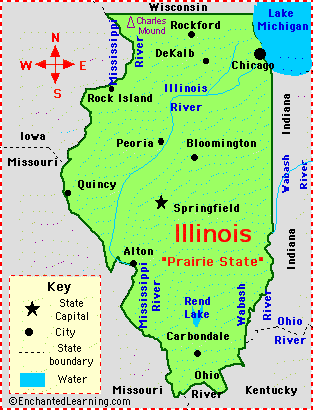
Illinois and Israel
Trade and Population Statistics
| Exports to Israel (2015) |
$206,142,145 |
| Percentage Change (2014-2015) |
+3.25% |
| Total Exports to Israel (1996-Present) |
$4,290,094,265 |
| Israel's Trade Partner Rank (2015) |
38 |
| Military Contracts with Israel (2015) |
$120,530,835 |
| Jewish Population (2015) |
401,400 |
| Jewish Percentage of Population |
4.2% |
Binational
foundation grants shared by Illinois and Israel
Grant recipients in
Illinois from U.S.-Israel binational foundations:
Amcol International, Inc.
Argonne National Lab
Bio-Logic Systems Corp.
DePaul
Display Technologies Inc.
Encyclopedia Britannica Educational Corp.
Eye Research Institute
Fermi National Accelerator Lab
Illinois Institute of Technology
Interactive Systems Corp.
Loyola University of Chicago
Loyola University of Chicago Medical
Molex, Inc.
Motorola Inc.
Northern Illinois
|
Northwestern
Northwestern Medical School
Siemens Medical Systems Inc.
Rush University, St. Luke's Medical Ctr.
Toyota Technological Institute
University of Chicago
University of Chicago Medical School
University of Illinois
University of Illinois Medical School
University of Illinois Urbana-Champaign
USDA-ARS Plant Biology Lab
Wheelabrator Technologies Inc.
Wheelabrator Water Tech
Zenith Electronics Inc. |
Bilateral
Institutions
America-Israel Chamber of Commerce
Chicago:
Founded in 1958,
the AICC-C is tasked with developing business relationships between
Illinois and Israeli companies. The not-for-profit trade association
connects its members into a global network that provides vital information
and facilitates business contacts. Members of the AICC-C include manufacturers,
distributors, wholesalers, retailers, professional and business service
providers, venture capitalists, investment bankers and R&D scientists.
Over the years, hundreds of companies have found ways to grow their
international trade. Read more about America-Israel Chamber of Commerce
Chicago, CLICK
HERE.
Chigago-Israel Business Initiative:
CIBI is a project of the
America-Israel Chamber of Commerce (AICC) that seeks to leverage cooperation
between the city of Chicago and the State of Illinois with the Israel
Trade and Investment Center to encourage Israel-based businesses, looking
to expand internationally, to locate their North American headquarters
in the immediate Chicago area. CIBI works in numerous fields including
Health and Life Sciences, Homeland Security and Telecommunications.
Learn more about the Chicago-Israel Business Initiative, CLICK
HERE.
Cooperative
Agreements - "Memoranda of Understanding"
In March 2013, the University of Chicago and Israel's Ben-Gurion University of the Negev signed a Memorandum of Understanding to explore a research partnership that would create new water production and purification technologies for deployment in regions of the globe where fresh water resources are scarce. The ambitious research collaborations will apply the latest discoveries in nanotechnology to create new materials and processes for making clean, fresh drinking water more plentiful and less expensive by 2020. University of Chicago President Robert J. Zimmer and Ben-Gurion President Rivka Carmi both signed the MOU. Joint activities may include the exchange of visiting faculty members, researchers and students; the development of funding proposals for collaborative work; and the creation of innovative commercial technologies and new business ventures. Learn more about the partnership, CLICK HERE.
In June 2006 Illinois and Israel signed
a Memorandum of Understanding committing both sides to enhancing homeland
security cooperation. The MOU builds upon the already strong economic
relationship between Illinois and Israel by creating a framework for
the two sides to advance dialogue, trade, investment, and joint technology
research and development in the homeland security sector. The initiative
was launched by the Illinois Homeland Security Market Development Bureau,
a government organization charged with attracting homeland security
companies to the state, and the Israeli Ministry of Industry, Trade
and Labor. Read more abou the MOU, CLICK
HERE.
In 1988, Gov. James Thompson signed
a Memorandum of Intent that created the Illinois-Israel Initiative,
which calls for projects of mutual economic benefit through improved
trade, technology development, science, agriculture and tourism.
Illinois Government Missions to Israel
July 2011 - In a trip of goodwill
and trade cooperation, Assistant Majority Leader Jeff Schoenberg, state
Senator Ira Silverstein and Congressmen Jesse Jackson Jr. and Peter
Roskam accompanied Governor Pat Quinn's delegation to Israel where they
visited a Motorola Solutions facility and Better Place - an Israel-based
organization developing charging stations for electric cars across Israel
- and signed a "sister lakes" agreement between Lake Michigan
and Lake Kinneret. The two officials also attended a ceremony at Ben
Gurion University of the Negev for an agreement promoting exchange of
faculty, research and other partnership between Ben Gurion and the University
of Illinois-Chicago. Finally, the delegation met with high-ranking government
officials in Jerusalem and Tel Aviv. Read more, CLICK
HERE.
July 2008 - In a buildup to the 2008
presidential elections, Senator Barack Obama made an official visit
to Israel as part of a whirlwind tour in which the oval office-hopeful
visited seven different countries. In Israel, Sen. Obama stressed how
much he wants to work towards solving the Israeli-Palestinian conflict
and used his short time in country to visit the southern Israeli city
of Sderot which has been under constant rocket attack from Hamas in
Gaza since the Israeli withdrawal in 2005. Read more, CLICK
HERE.
June 2006 - A delegation led by members
of the Illinois Department of Commerce and Economic Opportunity ran
a trade mission as part of "Opportunity Returns", Gov. Blagojevich's
comprehensive economic development strategy to create jobs and expand
economic growth throughout Illinois. "This trade mission to Israel
strengthened our already solid relationship with this key trading partner,
providing an opportunity for Illinois companies to establish new trading
partnerships in the robust homeland security sector with Israel’s
leading science and technology providers. We are also pleased to have
launched a business-focused fellowship program between Illinois and
Israel that will help attract the best and the brightest from both countries
in order to commercialize research, develop products and create jobs,”
Gov. Blagojevich said. Read the Governor's Press Release on the trip, CLICK
HERE
Partners
For Change
The U.S.-Israel relationship is based on the twin
pillars of shared values and mutual interests. Given this commonality of
interests and beliefs, it should not be surprising that support for Israel
is one of the most pronounced and consistent foreign policy values of the
American people.
It is more difficult to devise programs that capitalize
on the two nations' shared values than their security interests;
nevertheless, such programs do exist. In fact, these SHARED VALUE
INITIATIVES cover a broad range of areas, including the environment,
science and technology, education and health.
As analyst David Pollock noted, Israel is an advanced country with a population that surpassed eight million people in 2013 and a robust, dynamic economy that allowed it to join the Organization for Economic Cooperation and Development (OECD). Between 2005 and 2013, Israel has represented a larger market for U.S. exports than Saudi Arabia. Although Israel's citizenry make up just 3 percent of the total region's population, Israel accounts for 25 percent of American exports in the Middle East.
"It has also been one of the top 20 foreign direct investors in the United States since 2009," Pollock confirms. He adds that "$2.25 billion of the $3 billion in annual U.S. aid to Israel comes back via Israeli purchases of U.S. military equipment - and that is just 5 percent of the total bilateral trade each year."
Today's interdependent global economy requires that
trade policy be developed at the national and state level.
Many states have recognized the opportunity for realizing
significant benefits by seeking to increase trade with Israel. Illinois is one of 33 states that have cooperative
agreements with Israel.
In 2012, Illinois exported over $267,654,091.00 worth
of manufacturing goods to Israel. Since 1996, Illinois exports to
Israel have totaled more than $3,834,918,432.00 and Israel now ranks as Illinois’s
8th leading trade partner.
Additionally in 2012, Illinois received more than $76,976,036.54 in foreign military financing (FMF) for US military aid
to Israel. Some of those companies that have received funding through FMF in 2012 or past years
include: Caterpillar Inc. in Chicago, Honeywell in Chicago, and Siemens PLM Software Inc. in Carol Stream.
Israel is certainly a place where potential business
and trade partners can be found. It can also be a source, however, for
innovative programs and ideas for addressing problems facing the citizens
of Illinois.
Israel has developed a number of pioneering education programs. For example, AICE introduced an innovative Israeli
peer tutoring program to North Carolina that educators adapted for use
in the United States. Now known as Reading Together, the program is
used in 28 states. The program is designed to help students achieve
reading fluency and is mostly used for children in second grade. The
hope is that with its implementation, increasing numbers of students
will perform at grade level or above.
A range of other exciting approaches to social problems
like unemployment, environmental protection and drug abuse have been
successfully implemented in Israel and could be imported for the benefit
of Americans.
The potential for greater cooperation with Israel for
the benefit of Illinois is limited only by the imagination.
Illinois Firms
Profit From Business With Israel
As the only country with free trade agreements with both
the United States and the European community, Israel can act as a bridge
for international trade between the United States and Europe. Moreover,
because of the deep pool of talent, particularly in high-technology areas,
Israel provides excellent investment opportunities. Some of the nation's
largest companies, such as IBM, Microsoft, Intel and Digital Equipment have
found that it is indeed profitable to do business in Israel.
Roughly 200 Illinois companies have also discovered
the benefits of trade with Israel. Several own interests in Israeli
companies or have subsidiaries there, including American National Can
Co., A Epstein & Sons International, Motorola,
Bio-Logic Systems and Sara Lee.
Sara Lee, for example, has a minority interest in Delta
Galil Industries, an underwear and sock manufacturer in Israel, and now
distributes its clothing around the United States.
American National Can has for many years owned an
interest in a company at a kibbutz near Haifa. Lageen Box Can Factory, Ltd.
makes three-piece metal cans for fruits and vegetables.
High-tech giant Motorola has been in Israel for more
than forty years. Some of the technologies developed by the company and now
used worldwide, such as its fast, low-voltage 24-bit Digital Signal
Multimedia Engine and Chipset for Fiber Optics Distribution Data Interface,
originated in Israel.
The American-Israel Chamber
of Commerce and Industry of Metropolitan Chicago
provides information about
trade opportunities and helps match Israeli
and Illinois companies that are interested
in cooperative ventures. One source of funds
for such projects is the Binational Industrial
Research and Development Foundation (BIRD).
One good way to break into the Israeli market is through
a joint venture with an Israeli company. Funding for such projects is
available from the Binational
Industrial Research and Development Foundation (BIRD). BIRD funds projects in 36 states and the District of
Columbia and hundreds of companies including AOL, GE, BP Solar, Texas
Instruments and Johnson & Johnson have benefitted from BIRD grants.
The United States and Israel established BIRD in 1977
to fund joint U.S.-Israeli teams in the development and subsequent commercialization
of innovative, nondefense technological products from which both the
Israeli and American company can expect to derive benefits commensurate
with the investments and risks. Most grant recipients are small businesses
involved with software, instrumentation, communications, medical devices
and semiconductors.
Since its inception, BIRD has funded more than 800
joint high-tech R&D projects through conditional grants totaling
more than $210 million. Products developed from these ventures have
generated more than $8 billion in direct and indirect revenues for both
countries and has helped to create an estimated 20,000 American jobs.
Dr. Eli Opper, the former Israeli chair of BIRD, has
said that BIRD is a strong pillar of US-Israel industrial
cooperation and that the extreme success of BIRD has
led Israel to adopt similar models of R&D with other countries.
Several Illinois companies including Amcol International,
Molex, Inc., Motorola, Bio-Logic Systems, Display Technologies, Interactive
Systems, Encyclopedia Britannica, Wheelabrator Technologies, Siemens
Medical Systems and Zenith Electronics have benefited from nearly $4.2 million in BIRD grants over the last three decades..
Gabriel Raviv of Bio-Logic said that his company has
had two BIRD grants for joint ventures with its Israeli
subsidiary to develop medical equipment. The most recent one resulted
in the production of a new EEG product that has been doing so well the
company will easily be able to repay the grant.
“BIRD helps lower the risk for
projects,” Raviv noted, making it easier for companies like his
to take chances on developing new products.
Scientific
Innovations
Illinois researchers are making scientific breakthroughs
and developing cutting-edge technologies in joint projects with Israeli
scientists thanks to support from the Binational
Science Foundation (BSF). BSF was established in 1972 to promote scientific relations
and cooperation between scientists from the United States and Israel.
The fund supports collaborative research projects in a wide area of
basic and applied scientific field for peaceful and non-profit purposes.
Since its inception, BSF has awarded some $480 million
through more than 4,000 grants in 45 states and the District of Columbia.
BSF-sponsored studies are highly successful
in achieving their two main goals: strengthening the US-Israel partnership
through science and promoting world-class scientific research for the
benefit of the two countries and all mankind. The BSF grants help extend research resources to achieve milestones that might
not otherwise be attainable; introduce novel approaches and techniques
to lead American researchers in new directions; confirm, clarify and
intensify research projects; and provide unmatched access to Israeli
equipment, facilities and research results that help speed American
scientific advances. BSF has documented no less than
75 new discoveries made possible by its research grants and counts 37
Nobel Prize and 19 Lasker Medical Award laureates among its joint partners.
Institutions in Illinois have shared with their counterparts
in Israel nearly $10 million in BSF grants awarded since
1996. The Universities of Chicago and Illinois, Northwestern and
Northern Illinois are among the grant recipients.
In March of 2009 a study led by Dr. Mark Brand from
the University of Illinois and Professor Aaron Avivi from the Institute
of Evolution at the University of Haifa found that genetic mechanisms
in subterranean mole rats can be targeted for development of anti-cancer
drugs. Funded by BSF, the landmark discovery revealed
that a mechanism mole rats have developed in order to survive the low
oxygen levels in their underground habitats are similar to the mechanisms
used by tumors to survive and progress in humans, and, if the gene is
targeted correctly, could help in the discovery of specific anti-cancer
drugs.1
The University of Chicago's Ronald Harvey is
collaborating with a “first-rate chemist” at Hebrew University to
investigate a molecule suspected of being a carcinogen, and its
relationship to hydrocarbons. The research may add to the understanding of
the connection between sources of hydrocarbons like cigarette smoke and car
exhaust and causes of cancer.
Gene Robinson, a professor of biology at the University
of Illinois Urbana-Champaign, believes strongly in the character and
importance of research sponsored by BSF in the states.
He notes, "The BSF has been extremely successful
in fostering significant scientific discovery... this program promotes
scientifici excellence at the highest levels and I hope it continues
to enjoy a high level of support from both Israel and the United States."
Another project with important implications for health
is being conducted by Jim Grotberg at Northwestern. He and his collaborator
are leading authorities on the fundamental mechanics of gas exchange in the
lungs and the causes of wheezing and crackling sounds. Their research has
laid the groundwork for understanding shortness of breath in people with
asthma and emphysema. Grotberg does math modeling while his colleague at
the Technion is an “outstanding” experimentalist in physiology. Their
work has been especially useful in the development of treatments for
infants with pulmonary problems.
James Norris of the Argonne National Lab and a Hebrew
University colleague are using magnetic resonance to develop an understanding
of the chemistry of photosynthesis. The significance of this work is
clear, Norris explained, when you consider that food, coal, and petroleum
are products of photosynthesis. The BSF grant has provided
Norris with extra manpower for his lab and the opportunity to work with
one of the world's experts in the use of liquid crystals.
Minerals & Refractories Ltd. (M&R) is an Israeli
importer of refractories and ferro alloys to the heavy industry, as
well as a consultant on the selection and application of these materials
to the cement, fertilizers, oil refining, electric, and glass industries.
M&R has been involved in engineering and installation of refractories
in large scale projects in many of the heavy industries in Israel in
which refractories are used. U.S.-based Vesuvius Corp. is one of the
largest refractory manufacturers and suppliers in the world, as well
as the largest monolithics producer in North America. The two companies
jointly developed a complete integrative redesign of the refractory
and insulating lining structure of various electrolysis cells and other
vessels in the chemical industry. The project dealt simultaneously with
the testing, development, selection and sometimes upgrade of highly
durable refractory materials, as well as with structural and installation
design of the lining. The project concept will be applied and tested
first at the Dead Sea Magnesium (DSM) plant. The joint venture intends
to offer its customers the on-going supply of relatively large, ready
to install, pre-fabricated refractory lining building units of a cell,
which will be engineered, cast, heat treated and delivered ready-to-install
to the customer.
CMT Medical Technologies is an Israeli company specializing
in digital radiography and digital fluoroscopy products. Illinois-based
Richardson Electronics Ltd., (RELL) is a publicly held U.S. manufacturer
of electronic components and subsystems for diagnostic medical imaging.
The companies are collaborating to develop and market a product for
upgrading medical X-ray radiography systems from film to state-of-the-art
digital systems, based on flat panel detectors (FPDs). The upgraded
system offers will offer all the advantages and performance of digital
radiography, at a much lower price than completely new digital X-ray
radiography systems.
Researchers at the University of Chicago teamed up with researchers from Ben-Gurion University in 2014 to begin work on a water scarcity project, aiming to make clean drinking water accessable to everyone in the world. In 2012 University of Chicago based researcher Matthew Tirrell approached an old friend at Ben-Gurion University about working together on water scarcity research. The Israeli team of scientists was sought out by Chicago University because of their hands-on experience dealing with water scarcity issues through technology. Scientist from the University of Chicago Steve Sibener stated in an interview with the Chicago Tribune that water scarcity "Is the issue of the day. Hundreds of millions of people are at risk of not having water". Researchers from the two Universities are working on projects such as using a standard inkjet printer to apply contaminant-repelling chemicals to a water filter. They are also using radioactive isotopes to track water movement in hopes of finding more hidden underground aquifers.
The general benefits to the United States from BSF-sponsored
studies include the extension and elaboration of research to achieve
milestones that might not have been reached otherwise; the introduction
of novel thinking and techniques that led American researchers to move
in new directions; confirmation, clarification and intensification of
research projects; access to Israeli equipment and facilities unavailable
elsewhere and early access to Israeli research results that sped American
scientific advances.
BSF documented 75 new discoveries
that probably would not have been possible without foundation-supported
collaboration. These advances included the development of new methods
and techniques, the discovery of new phenomena and major theoretical
breakthroughs.
Agriculture
Benefits
In 1978 the United States and Israel jointly created the Binational
Agricultural Research and Development Fund (BARD)
to help fund programs between US and Israeli scientists for mutually
beneficial, mission-oriented, strategic and applied research into agricultural
problems. Since its inception, BARD has funded more
than 1,000 projects in 45 states and the District of Columbia with a
total investment of more than $250 million. In 2000, an independent
and external economic review of 10 BARD projects conservatively
projected more than $700 million in revenue by the end of 2010, a number
which far outweighs the total investment in all BARD projects over its 33 year existence and helps to continually strengthen
the foundation.
Most BARD projects focus on either increasing agricultural
productivity, plant and animal health or food quality and safety and
have been influential in creating new technologies in drip irrigation,
pesticides, fish farming, livestock, poultry, disease control and farm
equipment. BARD funds projects in 45 states and the
District of Columbia and at present is beginning to administer collaborative
efforts between Australia, Canada and Israel as well. It is difficult
to break down the impact on a state-by-state basis, but overall, BARD-sponsored
research has generated sales of more than $500 million, tax revenues
of more than $100 million and created more than 5,000 American jobs.
Illinois institutions have shared grants totalling more than $3 million
since 1979, with the University of Illinois receiving the majority of
these funds.
At Illinois, Harris Lewin is working on a project to
identify genes in dairy cattle that control important traits like milk
production. He calls the collaboration a "good marriage of
expertise" between his work as an experimental geneticist and his
colleague's quantitative research.
Another Illinois scientist interested in dairy cattle
is starting his third BARD project. Sidney Spahr works
in the only major U.S. program concerned with dairy automation. His
first BARD grant involved the use of automation for
data acquisition about cows, such as the measurement of milk yield.
The second grant focused on integrating the data into a software management
system. His current research focuses on the use of ultrasonics to develop
a way of measuring a cow's body fat.
Spahr's work focuses on the biology of the problem,
while the Israelis develop the technology. The collaboration is important
because the United States has de-emphasized livestock engineering.
At the University of Chicago, Donald Steiner is studying growth
hormones to see if they can be genetically engineered to grow fish faster
for food. His collaborator is able to do things in her lab that Steiner
can't, such as making the protein for use in the fish and analyzing
the biological activity. “She works at the protein level,”
he said, “and we're at the DNA/RNA level.”
The University of Illinois is also a member of the International
Arid Lands Consortium, an independent nonprofit organization composed
of four other universities, the U.S. Forest Service and the Jewish National
Fund, which explores the problems and solutions of arid and semiarid
regions. According to the director of the consortium, Israel is "by
far the leading country" in the application of various technologies
studied by the group.
Other Cooperative
Programs
The University of Illinois is a member of the International
Arid Lands Consortium, a Congress-funded independent, nonprofit
organization established in 1989 that conducts research, develops applications
in arid and semiarid land technologies, and applies its projects in
countries around the world including the U.S. and Israel.
Sister Cities
ILLINOIS |
ISRAEL |
Chicago |
|
Highland Park |
Qiryat Gat |
UJA Partnership
2000 Communities
State
Contacts:
Hillel
Campus Profiles
AIPAC
4801 W. Peterson Ave., #315
Chicago, IL 60646
Tel. 312-685-5595
Fax. 312-685-2130 |
America-Israel Chambers of Commerce
180 North Michigan Avenue, Suite 911
Chicago, IL 60601
Tel. 800-645-3433 or 312-641-2944
Fax. 312-641-2941
Email: [email protected] |
America-Israel Chamber of Commerce & Industry-Metropolitan Chicago
180 North Michigan Ave., #911
Chicago, IL 60601
Tel. 312-641-2937
Fax. 312-641-2941
Email. [email protected] |
Sherwin Pomerantz, Director
American-Israel Chamber of Commerce/Chicago
c/o Atid EDI Ltd
Bldg. 2, Har Hotzvim, P.O. Box 45005
Jerusalem
Israel 91450
Tel. 25710199
|
Elgin Area Jewish Welfare Chest
330 Division St.
Elgin, IL 60120
Tel. 708-741-5656 |
Illinois Department of Commerce and Community Affairs
c/o Atid EDI Ltd
Building 2, Har Hotzvim
P O B 45005, 91450 Jerusalem
Tel. 02-571-0199
Web: http://www.atid-edi.com/illinois.htm |
Israeli Consulate
111 E. Wacker Dr.
Chicago, IL 60611
Tel. 312-565-3300
Fax. 312-565-3871 |
Jewish Community Center of Chicago
5050 West Church St.
Skokie, IL 60077
Tel. 708-675-2200 x152 |
Jewish Federation
520 S 2nd St.
Springfield, IL 62701-1735
Tel. 217-753-1010 |
Jewish Federation of Champaign-Urbana
503 East John St.
Champaign, IL 61820
Tel. 217-367-9872 |
Jewish Federation Greater Rockford
1500 Parkview Ave.
Rockford, IL 61107-1821
Tel. 815-399-5497 |
Jewish Federation of Metro Chicago
1 S. Franklin
Chicago, IL 60606
Tel. 312-761-1000 |
Jewish Federation Of Peoria
5901 N Prospect Rd.
Peoria, IL 61614
Tel. 309-689-0063 |
Jewish Federation Quad Cities
209 18th St
Rock Island, IL 61201-8706
Tel. 309-793-1300 |
Jewish Federation Of South Illinois
6464 W Main St #-7A
Belleville, IL 62223-3811
Tel. 618-398-6100 |
Jewish Federation of Springfield
730 East Vine St.
Springfield, IL 62703
Tel. 217-528-3446 |
|