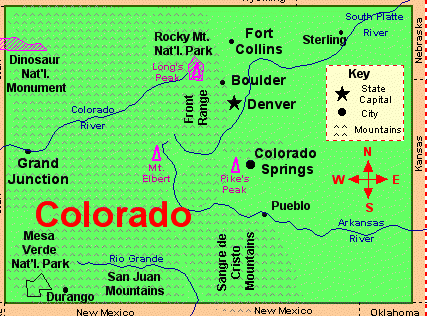
Colorado and Israel
Trade and Population Statistics
| Exports to Israel (2013) |
$36,557,630 |
| Percentage Change (2012-2013) |
-1.27% |
| Total Exports to Israel (1996-Present) |
$639,033,364 |
| Israel's Trade Partner Rank (2013) |
27 |
| Military Contracts with Israel (2015) |
$18,208,651 |
| Jewish Population (2015) |
100,100 |
| Jewish Percentage of Population |
2.5% |
Binational
foundation grants shared by Colorado and Israel
Grant recipients in
Colorado from U.S.-Israel binational foundations:
Barbara Davis Center for Childhood Diabetes
Clonetics Corporation
Colorado State University
Daisy/Cadnetix Inc.
International Software
National Center for Atmospheric Research
National Jewish Center for Immunology & Respiratory Medicine
National Renewable Energy Lab
NOAA
Solar Energy Research Institute
University of Colorado
University of Colorado Medical School
U.S. WestInteractive Services
Bilateral
Institutions
Colorado-Israel Chamber
of Commerce:
The CICC was
formed by a group of Colorado business and civic leaders to help foster
economic and business development opportunities between Colorado and
Israel. Among the objectives of the Chamber is to help Colorado businesses
identify development and investment opportunities in Israel; to provide
Colorado businesses a point for facilitating import of technology, intellectual
capability, and goods and services from Israel; and to assist Israel
in formulating public policy and incentives that will attract investment
by Colorado firms. Learn more about the Chamber of Commerce and business
opportunities, CLICK
HERE.
Cooperative
Agreements - "Memoranda of Understanding"
In July 2010, Governor Bill Ritter
and Professor Pedro Berliner of Jacob Blaustein Institutes for Desert
Research (BIDR) in Israel's Negev desert signed a Memorandum of Understanding
with the stated goal being to "encourage voluntary interaction
and cooperation and to promote friendship between the two parties for
their mutual benefit." After signing the MOU, together with President
of Colorado State University Anthony Frank, Governor Ritter spoke about
the important of Colorado and Israeli collaboration. "This agreement
builds upon our mutual interests and common fields of research in fields
such as water, biotechnology and solar energy," Gov. Ritter said.
"These are quality of life issues for the people of Colorado."
Read more about the signing of the MOU, including pictures from the
event - CLICK
HERE.
During a government mission to Israel in the summer
of 2010, Colorado's Department of Natural Resources and Agriculture
signed an MOU with the Desert Agro Research Center in Israel that is
focused on water and agriculture research and development in arid and
semi-arid climates. “Water will be one of the most important economic
drivers for Colorado as we continue to grow,” Gov. Ritter said.
“Colorado and Israel can learn from each other on water technologies
such as desalination, treatment and conservation.”
Also in July 2010, the Colorado School
of Mines agreed to establish workforce-development ties with Noble Energy
and the Israel Institute of Technology (Technion) to help develop the
discovery of a vast natural gas reserve off Israel's coast. Israel lacks
the workforce to develop such a project and CSM will jointly help in
the overall development.
Colorado Government Missions to Israel
August 2012 - Senator Michael Bennet travelled to Israel where he participated in an educational seminar on foreign policy and national security issues related to the U.S.-Israeli relationship; visited various cultural, historic and political sites; and met with government officials, business leaders, military leaders and experts. On his trip, Sen. Bennet visited Sderot, Tel Aviv, the Golan Heights and the West Bank.
August 2011 - Congressmen Ed Perlmutter
and Scott Tipton accompanied the 81-member Congressional delegation
to Israel to learn more about regional politics and the U.S.-Israel
relationship.
July 2010 - Colorado Governor Bill
Ritter led an economic-development mission to Israel in summer 2010
together with a delegation of administration officials and more than
a dozen Colorado businesspeople and community personalities. The mission
focused on job creation, exchanging knowledge and building bilateral
partnerships in such innovative fields as energy, clean-tech and water.
Looking back at the mission, in which the delegation signed a number
of MOU's and met with top Israeli officials such as President Shimon
Peres, Gov. Ritter said it was "a success on all fronts- business,
academic and research." Read Gov. Ritter's press release on the
mission, CLICK
HERE.
September 2009 - Colorado Congresswoman
Betsy Markey made her first ever trip to Israel and got a first-hand
look at the realities of living in the Middle East. During the trip,
Markey met with Israeli Prime Minister Benjamin Netanyahu, President
Shimon Peres and a number of other high ranking government officials.
After returing from the mission, Markey commented on her understanding
of Israel's role in international relations, especially due to the fact
that it is a "beacon of democracy" in the region. She also
mentioned that Israel has every right to exist and defend itself from
hostile neighbors. Read more about Congresswoman Markey's trip, CLICK
HERE.
Colorado Formalizes Support for Israel
On March 18, 2011, Colorado's legislative leaders-
both Republicans and Democrats- came together to honor Israel by passing
Senate Joint Resolution 11-027 that proclaims, “continued support
by the Colorado General Assembly for a strong relationship between the
United States and Israel.” Israel’s Ambassador to the United
States, Dr. Michael Oren, stopped in both chambers of the Legislature
to witness the reading and passage of the resolution. Senate President
Brandon Shaffer (D-Longmont) spoke about the connection between the
state of Coloardo and Israel. "“We share with Israel not
only a mutual friendship, but mutual economic and trade interests. Today,
Colorado boasts more than $36 million in annual exports to Israel. Tomorrow,
and in the years ahead we hope to grow this trade relationship many
times over. It was wonderful to hear Democrats and Republicans share
their fond stories and feelings about Israel, and we look forward to
growing our friendship." Read more about the resolution, CLICK
HERE.
Partners
For Change
The U.S.-Israel relationship is based on the twin
pillars of shared values and mutual interests. Given this commonality of
interests and beliefs, it should not be surprising that support for Israel
is one of the most pronounced and consistent foreign policy values of the
American people.
It is more difficult to devise programs that capitalize
on the two nations' shared values than their security interests;
nevertheless, such programs do exist. In fact, these SHARED VALUE
INITIATIVES cover a broad range of areas, including the environment,
science and technology, education and health.
As analyst David Pollock noted, Israel is an advanced country with a population that surpassed eight million people in 2013 and a robust, dynamic economy that allowed it to join the Organization for Economic Cooperation and Development (OECD). Between 2005 and 2013, Israel has represented a larger market for U.S. exports than Saudi Arabia. Although Israel's citizenry make up just 3 percent of the total region's population, Israel accounts for 25 percent of American exports in the Middle East.
"It has also been one of the top 20 foreign direct investors in the United States since 2009," Pollock confirms. He adds that "$2.25 billion of the $3 billion in annual U.S. aid to Israel comes back via Israeli purchases of U.S. military equipment - and that is just 5 percent of the total bilateral trade each year."
Today's interdependent global economy requires that
trade policy be developed at the national and state level.
Many states have recognized the opportunity for realizing
significant benefits by seeking to increase trade with Israel. Colorado is one of 33 states that have cooperative
agreements with Israel.
In 2012, Colorado exported over $44,191,335.00 worth
of manufacturing goods to Israel. Since 1996, Colorado exports to
Israel have totaled more than $560,937,891.00 and Israel now ranks as Colorado’s
XX leading trade partner.
Additionally in 2012, Colorado received more than
$6,666,893.00 in foreign military financing (FMF) for US military aid
to Israel. Some of those companies that have received funding through FMF in 2012 or past years
include: Aerospace Technologies in Boulder, Conduant Corporation in Longmont, LITEYE SYSTEMS, Inc. in Centennial, and InfoTrust Inc. in Colorado Springs.
Israel is certainly a place where potential business
and trade partners can be found. It can also be a source, however, for
innovative programs and ideas for addressing problems facing the citizens
of Colorado.
Israel has developed a number of pioneering education programs. For example, AICE introduced an innovative Israeli
peer tutoring program to North Carolina that educators adapted for use
in the United States. Now known as Reading Together, the program is
used in 28 states. The program is designed to help students achieve
reading fluency and is mostly used for children in second grade. The
hope is that with its implementation, increasing numbers of students
will perform at grade level or above.
A range of other exciting approaches to social problems
like unemployment, environmental protection and drug abuse have been
successfully implemented in Israel and could be imported for the benefit
of Americans.
The potential for greater cooperation with Israel for
the benefit of Colorado is limited only by the imagination.
Colorado Firms
Profit From Business With Israel
As the only country with free trade agreements with both
the United States and the European community, Israel can act as a bridge
for international trade between the United States and Europe. Moreover,
because of the deep pool of talent, particularly in high-technology areas,
Israel provides excellent investment opportunities. Some of the nation’s
largest companies, such as IBM, Microsoft, Motorola, Intel and McDonald’s
have found that it is indeed profitable to do business in Israel.
More than 80 Colorado companies have
discovered the benefits of doing business in Israel,
including Cryenco, Translogic Corp. and Golden Software.
Lisa Sanchez, spares coordinator of Cryenco
Incorporated, said that her company deals with Israel through government
contracts. Just last year they began exporting tanks used for liquid oxygen
and nitrogen but have already found Israel to be a good business market and
have had an easy time doing business there.
Translogic is a light material handling company. The
company sells computerized pneumatic tube systems that move materials under
10 pounds to hospitals in Israel, according to international business
development specialist Steve Leazengood. These may be used for transporting
lab samples that are used within a pharmacy or around the hospital.
Translogic has been selling these items to both big and small hospitals in
Israel for more than 20 years. “Israel is a mature market in many senses
of the word,” said Leazengood. “They have a high degree of
technological know-how and their appreciation of technology is evident.”
Golden Software is a computer graphics retailer. They
have been selling their products—mainly two and three dimensional
scientific software used for graphing and contouring—to Israel for at
least five to eight years. Patti Dierking, Director of Operations, said
Israel is one of 120 countries where its products are sold. Dierking added
that Golden Software has never had a problem dealing with their Israeli
buyers and has had a fine working relationship.
In the medical field, Rocky Mountain Instrument
Corporation has been exporting laser optics that are used in eye surgery to
Israel for several years, according to one sales representative. Valleylab
exports hospital supplies Israel, such as electrical, surgical and
ultrasonic equipment.
One good way to break into the Israeli market is through
a joint venture with an Israeli company. Funding for such projects is
available from the Binational
Industrial Research and Development Foundation (BIRD). BIRD funds projects in 36 states and the District of
Columbia and hundreds of companies including AOL, GE, BP Solar, Texas
Instruments and Johnson & Johnson have benefitted from BIRD grants.
The United States and Israel established BIRD in 1977
to fund joint U.S.-Israeli teams in the development and subsequent commercialization
of innovative, nondefense technological products from which both the
Israeli and American company can expect to derive benefits commensurate
with the investments and risks. Most grant recipients are small businesses
involved with software, instrumentation, communications, medical devices
and semiconductors.
Since its inception, BIRD has funded more than 800
joint high-tech R&D projects through conditional grants totaling
more than $210 million. Products developed from these ventures have
generated more than $8 billion in direct and indirect revenues for both
countries and has helped to create an estimated 20,000 American jobs.
Dr. Eli Opper, the former Israeli chair of BIRD, has
said that BIRD is a strong pillar of US-Israel industrial
cooperation and that the extreme success of BIRD has
led Israel to adopt similar models of R&D with other countries.
Several companies in Colorado have taken advantage
of the BIRD grants, which have totaled nearly $1.2
million since 1980. These include Clonetics Corporation, Daisy/Cadnetix
Inc. and U.S. WEST Media Group.
US WEST Media Group is a domestic and international
cable and telephony, wireless communication and directory and information
systems company. The company teamed up with VDOnet Corporation, the
leading Israeli provider of real-time video for the Internet. They received
a BIRD grant to develop public/private parallel networks
for the Internet that will allow cable operators to provide a higher
quality, lower cost service than is now available through standard telephone
modems or ISDN. The new technology will make it possible to offer video
applications, such as video telephones and video email, which require
the higher bandwidth provided by cable modems.
Scientific
Innovations
Colorado researchers are making scientific breakthroughs
and developing cutting-edge technologies in joint projects with Israeli
scientists thanks to support from the Binational
Science Foundation (BSF). BSF was established in 1972 to promote scientific relations
and cooperation between scientists from the United States and Israel.
The fund supports collaborative research projects in a wide area of
basic and applied scientific field for peaceful and non-profit purposes.
Since its inception, BSF has awarded some $480 million
through more than 4,000 grants in 45 states and the District of Columbia.
BSF-sponsored studies are highly successful
in achieving their two main goals: strengthening the US-Israel partnership
through science and promoting world-class scientific research for the
benefit of the two countries and all mankind. The BSF grants help extend research resources to achieve milestones that might
not otherwise be attainable; introduce novel approaches and techniques
to lead American researchers in new directions; confirm, clarify and
intensify research projects; and provide unmatched access to Israeli
equipment, facilities and research results that help speed American
scientific advances. BSF has documented no less than
75 new discoveries made possible by its research grants and counts 37
Nobel Prize and 19 Lasker Medical Award laureates among its joint partners.
Colorado State, the University of Colorado and NOAA
are among the many Colorado institutions that have shared more than
$3.9 million with counterparts in Israel through grants awarded by BSF since 1996 alone.
Dr. William Cotton, a professor of atmospheric science
at Colorado State University, is collaborating with Professor Zev Levin at
Tel Aviv University to determine the process responsible for creating haze
in the Dead Sea area. “If we can understand the processes in the Dead
Sea, then maybe we can help the situation in the Salt Lake City area,”
said Professor Cotton. Their collaboration basically consists of exchanging
modeling codes. Cotton shows his Israeli counterparts how to use the
Regional Modeling Atmospheric Systems (RAMS) and Israel gives Colorado
access to their codes. The two scientists had been working together for
five years previously, “so this project was a natural continuation,”
said Cotton. They have also worked together on research sponsored by the
Department of Energy and other organizations.
University of Colorado Professor James Jankowski is
studying the “ethnic relations in 20th century Egypt.” Together with
his collaborator, Israel Gershoni of Tel Aviv University, they are
exploring the relationship and social and political tensions between
different communities in Egypt, such as the Muslims, Jews and Egyptians.
Their objective is to produce a manuscript that offers new insights into
the relationship between various ethnic communities in modern Egypt. In
Israel, Gershoni has students doing field work, conducting interviews and
making site observations. Both professors will also visit Egypt as part of
their research. Jankowski and Gershoni have worked together on three
previous projects and Jankowski says, “we work well together.”
Chemist David Nesbitt of the University of Colorado is
working with Benny Gerber of Hebrew University to study gas surface state
to state inelastic scattering. This relates to the way molecules strike a
surface and either stick or don’t stick. “This is of considerable
importance in semiconductor manufacturing and in ozone depletion,” said
Nesbitt. “The dynamics at the interface are important in understanding
cell membranes, manufacturing batteries, corrosion and friction.”
Gerber is doing the theoretical aspect of the research
while Nesbitt is conducting experiments on thin films of molecules as they
sublime into a vacuum. Sublimation is the process in chemical physics when
a solid goes into a gas phase. By doing reverse physics, he can see the
molecules transform from gas to the condensed state, and this allows him to
understand the condensation phenomenon.
“In my personal experience, the most powerful
thing to do is to encourage scientists to get away from their own lab
and get into other labs because that’s where the real connections
are made,” says Nesbitt. “The amount of funds may be small,
but they can steer a significant amount of research and catalyze new
ideas. A small amount of money can be extremely cost effective. The
people I’ve dealt with resulting from this grant have been extremely
good collaborators and the [BSF] program should absolutely
be continued and supported.”
Roger Pielke, a professor of atmospheric science at
Colorado State, is studying with his Israeli collaborator how winds develop
over Lake Kinneret in Israel. Practical applications of this experiment
include the knowledge and insight of what may happen if, for example, there
is a pollution spill in the Kinneret. Since Lake Kinneret has a breeze over
it, their models may help provide information on where the pollution will
move and how to eradicate it. The collaborators used a Regional Atmospheric
Modeling System that was developed at Colorado State. Because Lake Kinneret
is a relatively small area to model, it is easy to develop a technique,
said Pielke.
The two scientists, along with a third colleague at
Rutgers, have had long professional and personal relationships. “Our
research cooperation has continued over a long time and will undoubtedly
continue into the future. One good thing about the BSF grant was that it allowed me to travel to Israel and interact with the
students,” said Pielke. He added that the research collaboration
has continued even though their BSF project was completed.
This is not the first time that Professor Albert Myers
of Colorado State University and Alfred Hassner of Bar-Ilan University
have worked together. They have known each other since they both worked
at Harvard 30 years ago. In 1997, they received a BSF grant for a chemistry project relating to generating optically active
compounds that are important in the synthesis of new pharmaceuticals.
This research could have important applications for companies developing
new drugs. According to Meyers, most of the chemical experimentation
will take place in Israel. Myers will visit Israel and his lab will
provide support services and instruments. He added, “this will
be a fruitful cooperation because Hassner is an excellent scientist
and we have excellent equipment. Between his ability and our ability
to support his work, we will be able to come up with some meaningful
products that will be helpful to the pharmaceutical industry both in
the U.S. and Israel.”
Twentieth century physics has been able to understand
different forces of gravity, elector-magnetic force, and strong and
weak nuclear forces. But what forces bring the molecules together and
how exactly do these particles change into other particles? Scientists
Ram Brustein from Ben-Gurion University in Be'er Sheva and Senarath
P. de Alwis of the University of Colorado in Boulder are collaborating
on a deeper understanding of string theory. String theory postulates
that particles are string-like, or one-dimensional, and possibly have
many dimensions.
BSF sponsored studies benefit the
United States by extending research resources to achieve milestones
that might not otherwise be attainable; introducing novel approaches
and techniques that can lead American researchers to move in new directions;
confirming, clarifying and intensifying research projects; providing
access to Israeli equipment and facilities and early access to Israeli
research results that speed American scientific advances. BSF documented no less than 75 new discoveries that probably would not have
been possible without foundation-supported collaboration.
Agriculture
Benefits
In 1978 the United States and Israel jointly created
the Binational Agricultural
Research and Development Fund (BARD)
to help fund programs between US and Israeli scientists for mutually
beneficial, mission-oriented, strategic and applied research into agricultural
problems. Since its inception, BARD has funded more
than 1,000 projects in 45 states and the District of Columbia with a
total investment of more than $250 million. In 2000, an independent
and external economic review of 10 BARD projects conservatively
projected more than $700 million in revenue by the end of 2010, a number
which far outweighs the total investment in all BARD projects over its 33 year existence and helps to continually strengthen
the foundation.
Most BARD projects focus on either increasing agricultural
productivity, plant and animal health or food quality and safety and
have been influential in creating new technologies in drip irrigation,
pesticides, fish farming, livestock, poultry, disease control and farm
equipment. BARD funds projects in 45 states and the
District of Columbia and at present is beginning to administer collaborative
efforts between Australia, Canada and Israel as well. It is difficult
to break down the impact on a state-by-state basis, but overall, BARD-sponsored
research has generated sales of more than $500 million, tax revenues
of more than $100 million and created more than 5,000 American jobs.
Colorado State and the Solar Energy Research Institute
are just two Colorado institutions that have been doing joint research
projects with Israel conducted under the auspices of BARD.
Colorado institutions have shared grants worth almost $800,000 since
1979.
James DeMartini of Colorado State and his Israeli collaborators’
main goal was to prepare a DNA vaccine for sheep viral infection. “Overall,”
he said, “the project was quite satisfactory. Our approach to the
new vaccine didn’t work out but we gained new insight into virus
host interaction.” DeMartini said the BARD program
allowed him to work with capable Israeli scientists who had mutual interests.
Colorado State researchers have also collaborated with
Hebrew University to study Trichoderma fungus species that can prevent
fungus related diseases in emerging seeds and young plants. The researchers
have developed new methods for growing these fungi, which they’ve
patented. Conventionally produced Trichodermas already have been approved
for commercial use by the Food and Drug Administration.
While pesticides are needed in modern agriculture,
they have also become a contamination problem of rural water resources.
For example, sorghum, a major crop in Colorado, is sensitive to bromacil
and terbacil, common agricultural herbicides. BARD researchers developed a new, economical procedure for diminishing water-born
pesticides using the sun. In the laboratory, scientists tested 69 dye
sensitizers that can oxidize pesticides when activated by visible light.
After testing the pesticide breakdown products, they found that these
treatments were harmless and permitted normal germination and seed growth.
After these lab tests, a prototype Solar Wastewater Disinfection Plant
was built that achieved the goal of removing injected pesticides. In
addition, the BARD solar process destroyed 99.9% of
most bacterial pathogens in the sewage within two hours.
Colorado produces more than $100 million worth of potatoes
a year. New potato plants are started from the “eyes” of seed
potatoes. This method of reproduction allows for the transmission of
debilitating viral diseases, such as potato leaf-roll virus (PLRV),
from generation to generation, with substantial economic loss. For example,
downgrading U.S. Grade #1 potatoes to U.S. Grade #2 means a loss of
$400-600 per ton to the farmer. Thus, assuring virus-free seed potatoes
is extremely profitable to the industry. BARD grantees
improved techniques for extracting useable virus samples from diseased
plants and the samples were then injected into rabbits and sheep to
stimulate the production of antiviral antibodies. The grantees then
used their antibodies to develop a test which could detect many different
strains. The same method used in this process is also used in pregnancy
test kits. The new test, both cheaper and more general than its predecessors,
is now produced and distributed free of charge to certain agencies.
A diagnostic kit is also sold commercially to farmers through a U.S.
agricultural firm. The rate of PLRV infections has dropped drastically
since the invention of this new test.
Colorado also benefits from BARD research
done elsewhere in the country. BARD grantees in Georgia,
for example, have been studying CO2, a normal component of
the air we breathe, and demonstrated that it is a viable nontoxic alternative
to other gases that leave toxic residues in stored grains and are believed
to cause damage to the ozone layer, to the fumigation of stored grains.
These methods are already being applied by several commercial firms
in the U.S. and Israel, and wheat producing states, such as Colorado,
are likely to benefit.
A team of agricultural economists from the University
of Maryland and the University of California found that the economic
benefits of just five projects — related to cotton, pecans and
solarization — exceeded all U.S. investment in BARD.
New projects promote increased quantity and improved quality of agricultural
produce.
Other Cooperative
Programs
Biking for Kids Under Fire - Program created by a
number of Jewish youth organizations in Denver that raises money that
will be put towards purchasing bikes, helmets, and bicycle repairs for
children in the Israeli town Kibbutz Nahal Oz. This Denver-based group
of children recognized the daily struggles that kids their age at Kibbutz
Nahal Oz endure in the form of Hamas rocket attacks, and are sending
their support one bike at a time.
Sister Cities
UJA Partnership
2000 Communities
STATE CITIES |
ISRAELI CITIES |
Denver |
Kiryat Milacha -
Hof Ashkelon |
Allied Jewish Federation
of Colorado |
Ramat Negev
("Ramah of the South") |
State
Contacts:
Hillel
Campus Profiles
Jewish Federation of Colorado
300 South Dahlia St.
Denver, CO 80222
Tel. 3033213399
Website: http://www.jewishcolorado.org/
Branches of Colorado Jewish Federations:
Aspen Network
25 Broadway, Suite 1700
New York, NY 10004-1010
Phone: 212-284-6595
Fax: 212-284-6853
E-mail: [email protected]
|
 |
Colorado/Denver
300 South Dahlia Street, Suite 300
Denver, CO 80246-8118
Phone: 303-321-3399
Fax: 303-322-8328
E-mail: [email protected]
Website: http://www.AJFColorado.org
|
|
Fort Collins Network
25 Broadway, Suite 1700
New York, NY 10004-1010
Phone: 212-284-6595
Fax: 212-284-6853
E-mail: [email protected]
|
|
Greeley Network
25 Broadway, Suite 1700
New York, NY 10004-1010
Phone: 212-284-6595
Fax: 212-284-6853
E-mail: [email protected]
|
|
Pueblo Network
25 Broadway, Suite 1700
New York, NY 10004-1010
Phone: 212-284-6595
Fax: 212-284-6853
E-mail: [email protected]
|
|
|
|
|