Yigael Yadin
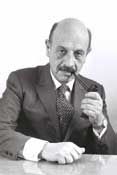
(1917 - 1984)
Yigael Yadin was born in Jerusalem and joined the Haganah in
1933. He became a key figure in the Haganah leadership, was its operations officer, and helped devise and implement
many of the strategies used in the War
of Independence. Following the establishment
of the State, he was named the second Chief
of Staff of the Israel
Defense Forces (IDF), and served in that capacity from 1949-1952.
During his tenure, Yadin reorganized the standing army, the system of
compulsory military service, and the reserves.
Yadin left the army in 1952 and, himself the son of
archaeologist Eliezer Sukenik,
studied archeology at the Hebrew
University of Jerusalem. He earned his Ph.D. in 1955 on research
into one of the Dead Sea Scrolls,
and for this he was awarded the Israel
Prize in Jewish Studies in 1956. In the following years, Yadin continued
his research in archeology and antiquities, teaching and publishing
prolifically. Among his best-known works are Masada (1968) and Tefillin from Qumran (1969). In 1970 he became head of the Institute
of Archeology at the Hebrew University.
Yadin’s fieldwork, conducted in the 1950’s
and 1960’s, encompassed many important excavations at a range of
sites, including Hazor, caves of the Judean Desert, Masada,
and Meggido. Employing thousands
of volunteers from Israel and abroad, his vast archeological digs expanded
the field tremendously. Yadin’s findings have shed light on various
periods of ancient Israel, such as the Canaanite, First Temple, and Herodian periods, as well as the Bar
Kokhba revolt. Perhaps his most famous contribution was his decoding
and interpreting of several scrolls from the Dead
Sea and the Judean Desert.
Yadin also did much to make archaeology a more accessible and less exclusively esoteric field. His writing is
both scholarly and of interest to more widespread audiences. He strove
not only to document his archaeological findings but to place them in
a cultural context and understand them as an avenue to cultural history.
Yadin was also instrumental in acquiring the Dead Sea Scrolls for Israel
and highlighting them in the Israel
Museum’s Shrine of the Book, thus bringing these archeological
treasures closer to the public.
In his later life, Yadin’s career in archeology
was complemented by several public posts. In 1967,
he served as military advisor to Prime Minister Levi
Eshkol, and following the Yom
Kippur War he served on the Agranat Commission that investigated
the lapses which led to the surprise attack. In 1976, Yadin formed “Dash”
(Democratic Movement for Change), a new political party dedicated to
electoral reform. In the elections of 1977, the party won 15 Knesset seats and joined the first Likud government. Although the party itself broke up two years later with
little achievement in restructuring electoral politics, Yadin served
as deputy prime minister from 1977 to 1981, following which he retired
from political life, returning to his research until his death in 1984.
Sources: The Pedagogic
Center, The Department for Jewish Zionist Education, The Jewish Agency
for Israel, (c) 1997, 1998, 1999, 2000, Director: Dr. Motti Friedman,
Webmaster: Esther Carciente. Photo: National Photo collection. |