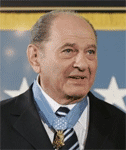
Tibor Rubin is a Holocaust survivor and an American soldier awarded with the highest military honor, the Congressional Medal of Honor, for his service in the Korean War.
On September 23, 2005, 76-year
old Rubin was finally awarded
the nation's highest military accolade for
gallantry in combat - the Congressional Medal of Honor. The Medal of Honor is awarded
to those who displayed “conspicuous
gallantry and intrepidity at the risk
of his life, above and beyond the call
of duty, in actual combat against an enemy
armed force.”
Rubin was the 18th Jewish recipient of
the Medal of Honor since it was created
during the Civil
War by President
Lincoln.
It took 55 years for Rubin's heroic actions to be honored by the country after
finally breaking through the wall of government
bureaucracy and prejudice towards minorites
who fought in World
War II and the Korean
War. Rubin's story is none the less amazing for the wait.
Rubin, known as "Tibi" or
"Ted," was born in a Hungarian shtetl called Paszto. At age 13, his family was rounded
up by the Nazis,
and he was sent to the Mauthausen concentration camp in Austria.
Rubin survived, but his parents and his two sisters
perished in the camp.
When Mauthausen was liberated by Allied
troops, Rubin, then 15, swore that he would repay his
liberators by going to the United States and fighting
against the Germans. "I was going to go to the
U.S. and join the U.S. army to show my appreciation ... It
was my wish to fight alongside them," Rubin said.
In 1948, Rubin made it to the United
States and tried
to enlist in the U.S. Army only to be turned
away because he failed the English test. He finally
passed the exam in 1950 and was sent to fight on the
frontlines of the Korean War.
At one point in the war, his company
needed to find a route to retreat from their positions, so Rubin single-handedly
defended a hill for 24 hours and held off scores of
North Korean troops. This feat alone was enough to earn
him four recommendations for the Medal of Honor and
numerous other military awards. However,
Rubin's commander - First Sgt. Artice Watson - who was described
by many of Rubin's fellow soldiers as a "vicious anti-Semite"
and often volunteered Rubin to go on the most dangerous
patrol missions, ignored the orders to put through the paperwork to allow Rubin to receive the coveted Medal of Honor.
Some of the men in Rubin’s company were
present when Watson refused to put through the order
and they believe he did this because
Rubin was Jewish. “I believe in my heart that First
Sgt. Watson would have jeopardized his own safety rather
than assist in any way whatsoever in the awarding of
the medal to a person of Jewish descent,” wrote
Cpl. Harold Speakman in a notarized affidavit.
In October 1950, Rubin and
the survivors of his company were captured
by the Koreans and placed into a POW camp.
At the risk of being executed if caught,
nearly every night Rubin would sneak out
of the camp to get food for the desperate
GIs. His acts of bravery and compassion
kept between 35-40 soldiers alive until
they were finally set free.
“He (Rubin) did many good deeds,
which he told us were ‘mitzvahs’
in the Jewish tradition . . . He was a very religious
Jew, and helping his fellow men was the most important
thing to him,” said Sgt. Leo Cormier Jr., a fellow
prisoner.
In the 1980s, nearly 30 years after
he had been discharged, Rubin's army friends began protesting
the Army's inaction and unfilled promises to recognize
Rubin's bravery. The issue quickly reached members of
Congress. Sen. John McCain (R-Ariz.) introduced a special
bill on Rubin’s behalf in 1988. Former Rep. Robert
Dornan (R-Calif.) pleaded for recognition of his constituent.
Rep. Robert Wexler (D-Fla.) and former Rep. Benjamin
Gilman (R-N.Y.) harassed the Pentagon and government
agencies to act. The U.S. Army was forced to reexamine
their discrimination policies towards awarding minorities
during World War II and the Korean War.
The “Leonard Kravitz Jewish War
Veterans Act” was passed in 2001 by Congress to
aid in the recognition of minority fighters. Kravitz,
the uncle and namesake of rock musician Lenny Kravitz,
was killed manning his lone machine gun against attacking Chinese troops
during the Korean War, allowing the rest of his platoon
to retreat in safety. Kravitz was recommended for the
Medal of Honor, but was downgraded to a lower decoration
because of military prejudices.
Rubin jokes, “It would have been
nice if they had given me the medal when I was a young
handsome man,” mused Rubin. “It would have
opened a lot of doors.” Now, top military officers
will have to call him "Sir" and "Mister,"
and even five-star generals have to give him a customary
salute. Tradition requires that the President will stand
when Rubin enters a room. Rubin wanted to receive official
recognition for his "Jewish brothers and sisters,"
and to prove to Americans that there was a "a little
shmuck from Hungary, who fought for their beloved country.
Now, it’s Mister Shmuck, the hero.”