When American forces
occupied the small German town of Hadamar,
they heard rumors about the murder of the
mentally ill at a local psychiatric hospital.
Hadamar had been one of six major “euthanasia” facilities
in Nazi
Germany that claimed the lives of
some 200,000 Germans. These were crimes committed
by German citizens against their fellow citizens
within the borders of their own country.
As such, the murders at Hadamar were not
classified as war crimes and therefore offered
no legal basis for trial by American forces.
However, hospital records revealed that 476
forced laborers from Poland and
the Soviet
Union — Allied countries — had also
perished at Hadamar, and these crimes did
fall under international jurisdiction.
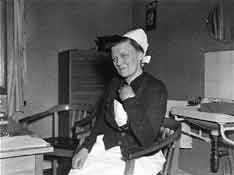
Irmgard Huber, head nurse of the hospital,
was among the staff arrested by the Americans.
Her claims that she never killed patients
were corroborated by co-workers and witnesses
and she was released. Later, the court ruled
that Huber had indeed played a role in selecting
patients for murder and in falsifying death
certificates. She also controlled the supply
of drugs used to overdose patients. Huber
was rearrested, tried with six others, and
received 25 years in prison for serving as
an accomplice to murder.
Huber was also among the 25 persons tried
at a later German-convened Hadamar
trial in 1947, which was able to try German nationals
who had participated in the murder of thousands
of their fellow citizens. As accomplice to
murder in at least 120 cases, Huber was sentenced
to eight additional years in prison.
In the early 1950s, however, American authorities
bowed to Cold War political pressure and
issued amnesties and clemencies for many
convicted Nazi perpetrators. Despite her
proven role in numerous murders, Irmgard
Huber was released from prison in 1952.