Hans Hube
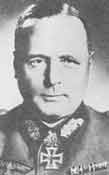
(1880 - 1944)
Hans Hube was born in Naumburg, Germany,
on October 29, 1880. He joined the German Army and in 1910 was promoted
to the rank of lieutenant. He served throughout the First World War
and was seriously wounded and as a result lost his left arm.
Despite his disability, Hube remained in the army and
in 1939 was promoted to colonel. Hube took part in the invasion of Poland where he was again seriously wounded. He returned to duty the following
year and as commander of the 16th Motorized Division participated in
the Western Offensive.
Promoted to major general he participated in Operation
Barbarossa. A brave officer, Hube won the Knight's Cross (August
1941), Oakleaves (January 1942) and Swords (December 1942). Hube was
at Stalingrad and was one
of the senior officers evacuated from the front on January 28, 1943,
when it was clear the German Army would be defeated.
In March 1943, Hube was given command of 14th Panzer
Corps and soon afterward was sent to Italy. In July, General Erwin
Rommel sent Hube to Sicily.
Hube, Germany's only one-armed general in the Second
World War, was placed in command of the 1st Panzer Army in October 1943.
He was badly defeated by General Ivan Konev and the Red Army at Dniester
in March 1944. Soon afterward, he clashed with General Erich
von Manstein when he ordered him to stay north of the Carpathians.
When Manstein was replaced by General Walther Model, Hube got his way
and was able to retreat across the Dniester.
On April 20, 1944 Hube returned to Germany where Adolf
Hitler personally awarded him the Diamonds. Hans Hube was killed
when his plane crashed while returning to the Eastern Front on April
21, 1944.
Sources: Spartacus
Schoolnet |