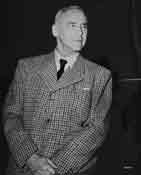
Wilhelm Frick served as Reich Minister of the Interior
and Reichsprotektor of Bohemia and Moravia.
Frick was born in Alsenz,
the son of a Protestant schoolteacher. He studied law at several German
universities and received his doctorate in 1901. From 1904 to 1924 he
worked as a government official in the Munich police department. An
early adherent of National Socialism, Frick participated in the failed Beer Hall Putsch in November
1923, for which he was jailed for several months.
In 1924, he was elected
as one of the first Nazi deputies to the Reichstag. Six years later he became Minister of the
Interior in Thuringia, the first Nazi minister in a provincial government.
During his tenure he purged the police force of Weimar sympathizers
and promoted Nazi candidates for office over all others. After the Nazi
seizure of power, Frick was appointed Reich Minister of the Interior,
a position he held until August 1943. His training as a jurist was put
to use in the drafting of legislation that removed Jews from public
life, abolished political parties, and sent dissidents to concentration
camps. After helping Hitler to consolidate power, Frick steadily lost influence.
In 1943, he was
appointed Reichsprotektor of Bohemia and Moravia, but real authority
in the Protectorate lay in the hands of his subordinate, Karl Hermann
Frank. After the war, Frick was tried before the International
Military Tribunal at Nuremberg. Following his conviction, he was
hanged on October 16, 1946, in Nuremberg.